Frase
AI-assisted SEO content tool that turns SERP research into briefs, outlines, and optimized drafts inside one editor.
Gallery
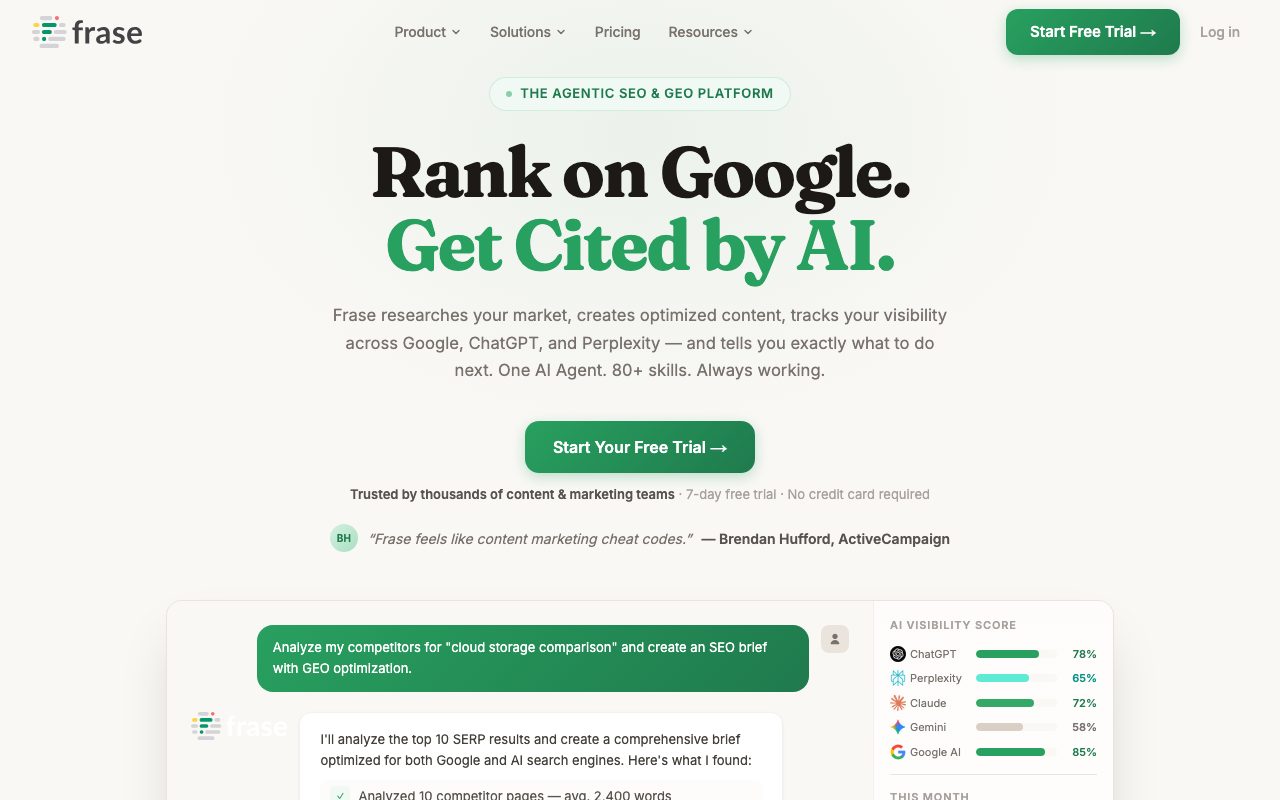
About Frase
Frase is the SEO content tool that does the boring research before you write. It scrapes the top-ranking pages, extracts the questions and topics they cover, and turns that into a brief. Then it helps you outline and draft against that brief. It's an SEO writer's research assistant, not a magic robot.
The product launched in 2018 and found its niche helping content teams ship long-form SEO faster. Where Surfer SEO leans hard on score-the-text optimization, Frase leans on briefs and outlines. Different philosophy, similar end goal.
If you've ever opened ten browser tabs to "research" a blog post and ended up with a notes mess, Frase replaces that workflow. The briefs aren't perfect, but they save real hours.
What Frase actually does
You give Frase a target keyword. Frase pulls the top 20 Google results, parses them, and produces a brief: headers, questions answered, statistics cited, and topics covered. You can then outline, draft, and optimize against that brief.
The AI writer is built in. You can generate a full draft from a brief, or rewrite sections, or expand outlines. The text isn't going to win awards, but it's a starting draft. Most teams treat it as a research-and-outline tool first, AI writer second.
SERP-driven briefs
This is Frase's core feature. The brief shows you what topics, questions, and entities the top-ranking pages cover. You use that to make sure your draft covers the same ground (and then some). It's the difference between guessing and knowing.
Content optimization scoring
Frase scores your draft against the topics it expects to see. The score isn't gospel, but it's a useful signal. If you're missing key entities, the score drops. The optimization tab feels like Surfer's cousin.
Who Frase is for
Content marketers, SEO agencies, and bloggers who write long-form content for search. If you publish 4+ SEO articles a month and currently do research manually, Frase pays for itself in time saved.
It's not for short-form content, social posts, or product copy. It's also not great for technical content where the SERP doesn't reflect what experts know. Use Frase for the bread-and-butter "best X for Y" and "how to Z" articles.
Frase pricing
Solo at $15 a month covers 4 article credits and 1 user. Basic at $45 a month gets 30 article credits. Team at $115 a month gets unlimited credits and 3 users. Pro Add-On for unlimited AI writing is $35 a month on top.
The pricing is fair for the category. Surfer SEO and Marketmuse cost more. The credit system is a tradeoff: cheaper entry, but you can hit limits if you crank out content.
Features worth knowing
SERP analyzer
Pulls top results and breaks down their structure, length, headings, and topics. You can see at a glance what kind of article ranks for the keyword and structure yours accordingly.
Brief builder
Generates briefs from SERP analysis. You can edit, add notes, and pass them to writers. The brief format is clean and exports to Google Docs cleanly.
AI outliner and writer
Generate outlines from briefs. Generate drafts from outlines. The AI writer is fine for drafts, weaker for finished copy. Most teams use it as scaffolding.
Content optimization
Score your draft against expected topics. Get suggestions for missing entities. The interface is similar to Surfer but feels more research-focused than score-chasing.
The tradeoffs
Frase isn't a writing tool. It's an SEO research tool with a writer attached. If you want a great writing experience, Frase isn't it. The editor is functional, not delightful.
The AI writer is also behind the cutting edge. GPT-4 and Claude in their own apps produce better drafts. Frase's value is the workflow, not the model. Pair Frase with a real editor and you're set.
Frase vs alternatives
The usual comparisons are Frase vs Surfer SEO, Frase vs Marketmuse, and Frase vs Clearscope. Surfer is heavier on optimization scoring. Marketmuse is more enterprise. Clearscope is the premium pick.
Frase is the best entry point for solo SEOs and small teams. See Frase alternatives or browse the best SEO content tools.
Bottom line on Frase
Frase is the practical SEO content tool for teams that publish weekly. The briefs save hours. The optimization scoring keeps you honest. The AI writer is a nice-to-have, not the reason you buy.
If you write SEO content for a living, Frase earns its place in the stack. It's not the prettiest tool. It's one of the most pragmatic.
Common Frase questions
Does Frase replace a writer? No. The AI writer is good enough for first drafts but not finished copy. Frase is best as a research and outlining tool, with the AI as a starting-point generator. The teams getting the most out of it have writers in the loop.
Is Frase better than Surfer SEO? Different tools for similar goals. Surfer is heavier on optimization scoring and keyword density. Frase is heavier on briefs and research. If you want score-the-text, Surfer. If you want help organizing what to write, Frase.
Does Frase work for non-English content? It handles major European languages, Spanish, French, German, Portuguese. Quality varies. For non-Latin scripts the support is more limited. Plan to test with your target language before committing.
Can I customize the AI writer?
Yes, with prompt templates and brand voice settings. You can set tone, audience, and voice guidelines. The output gets closer to your style with tuning. It's not as flexible as Jasper or Copy.ai for marketing copy, but it's enough for SEO blog posts.
What about plagiarism and AI detection?
Frase doesn't ship plagiarism detection. Run drafts through Copyscape if it matters. AI-generated content from any tool risks AI detection flags. Edit drafts substantially to bring them in line with your voice and reduce detection risk.
Workflow tips for Frase
Always start with the SERP analysis. Skipping it is leaving the best feature on the table. The brief is only as good as the SERP it's built from.
Use the optimization score as a guide, not a target. Hitting a 90 doesn't guarantee rankings. Missing key entities does hurt. Aim for "covers the topic well" not "maxed the score."
Combine Frase briefs with manual research. Frase tells you what's on the SERP. Your subject matter expertise tells you what's missing. The combo beats either alone.
Treat the AI writer as scaffolding. Generate an outline, get a rough first draft, then rewrite for voice and depth. Posts that ship straight from Frase usually feel thin. Browse tools for SEO teams for related picks.
Real-world Frase scenarios
A content marketing agency uses Frase for client SEO articles. Each article starts with a Frase brief. Writers fill in the outline. The optimization score keeps coverage thorough. Time to publish dropped from 2 days per article to about 6 hours. Quality stayed equivalent.
A solo blogger uses Frase to compete with bigger sites in a niche. The SERP analysis tells them what's already ranking. The brief tells them what to cover. They beat half the competition in 3 months by being more thorough than the existing top results.
A SaaS company uses Frase for their content team's process. Briefs become tickets. Writers draft. Editors review against the optimization score. The handoff is clean. Less debate about what to include because the brief makes it explicit.
How to actually use Frase well
Start every article with a SERP analysis. Skipping it means you're guessing about what readers expect. The 5 minutes saves hours later.
Don't chase 100 on the optimization score. The marginal returns past 80 are tiny and the writing gets weird. Aim for thorough coverage over score-maxing.
Customize the brief template. The default brief is generic. Modify it to match your team's process. Better briefs produce better articles.
Pair Frase with subject matter expertise. Frase tells you the SERP. SMEs tell you the truth. The combo wins. Articles that rely only on what's already on the SERP tend to ship shallow content. Browse the Frase page for community reviews.
Why Frase wins on workflow
The SEO tools market is crowded. Surfer competes on optimization scoring. Marketmuse competes on enterprise features. Clearscope competes on premium polish. Frase competes on the actual research-to-publish workflow.
The brief-first approach matters because it changes what writers do. Without a brief, writers work from gut and Google searches. With a brief, they work from data. The articles get better not because the writers got smarter but because the inputs got more structured.
For small content teams without dedicated SEO specialists, Frase democratizes a workflow that bigger teams take for granted. The brief tells the writer what to cover. The optimization score keeps coverage thorough. The team ships better content without hiring a strategist.
Frase isn't going to replace human judgment about what's worth writing. That's still the strategist's job. But the execution of any given article gets faster and more thorough with Frase in the loop. That's a meaningful productivity win for content teams that publish regularly.
Tutorial / Demo
Key Features
- Automated SERP research and brief building
- AI-assisted draft generation in the editor
- Topic coverage and optimization scoring
- Question and FAQ extraction from SERPs
- Search Console integration and content analytics
- Outline templates and shared briefs
Pros & Cons
What we like
- Compresses research, briefing, and drafting
- Strong outline and FAQ extraction
- Useful for agencies briefing many writers
Room for improvement
- AI drafts still need careful human editing
- Some advanced features sit behind add-on pricing
Frequently Asked Questions
Does Frase have a free trial?
Frase vs Surfer SEO, which one should I pick?
Can Frase actually replace a human writer?
Does Frase integrate with WordPress or Google Docs?
Is the AI Write feature included or extra?
Best For
Featured in
Tags
Alternatives to Frase
View all
Encited
Technical and Content optimization platform for SEO and AI search. Alternative to Prerender.io, Rankability, Profound

Surfer SEO
Content optimization tool that scores drafts in real time against the top-ranking pages for any target keyword.

Writesonic
AI writing and SEO content platform that now doubles as an AI search visibility engine for brands

AEO Engine
Managed answer engine optimization that wins brands citations inside AI answers
Our take
Tool Index Editorial · May 2026· 4.6/5
Frase is the kind of tool you adopt when you want ai-assisted seo content tool that turns serp research into briefs, outlines, and optimized drafts inside one editor.
On the strengths side: Compresses research, briefing, and drafting, Strong outline and FAQ extraction, and Useful for agencies briefing many writers. Honest gripes: AI drafts still need careful human editing and Some advanced features sit behind add-on pricing.
Verdict: Frase comfortably earns its spot in the category — a smart default when you need briefing freelance writers at scale.
Editorial opinion from the Tool Index team, written from the public product pages. Not a user review.
Reviews (6)
Honest take after six months
Started using Frase casually, now it's pinned in my dock. Real selling point: strong outline and FAQ extraction. Worth calling out the topic coverage and optimization scoring too. Would buy again without thinking twice.
Easy 5 from me
Adopted Frase for one project, ended up using it for more. Where it really wins is useful for agencies briefing many writers. It fits well for content team workflows from idea to publish.
Bought it for one feature, stayed for ten
Two quarters of using Frase, here's what holds up. The thing I keep coming back to: compresses research, briefing, and drafting. Worth calling out the automated SERP research and brief building too. It fits well for researching and drafting SEO content.
Honest take after about half a year
Took a few weeks for Frase to click, then it stuck. Honestly impressed by how strong outline and FAQ extraction. Worth calling out the topic coverage and optimization scoring too. Found it works best for briefing freelance writers at scale. Easy yes for anyone weighing the same trade-offs.
Pros
- Strong outline and FAQ extraction
Good for most of what we need
Have been using Frase for a while, here's where I land. The thing I keep coming back to: useful for agencies briefing many writers. Worth calling out the search Console integration and content analytics too. That said, AI drafts still need careful human editing is a real gripe. Decent value once you accept the rough edges.
Pros
- Strong outline and FAQ extraction
Honest take after a few weeks
Skeptical at first because Frase looked too simple. It's not. Honestly impressed by how compresses research, briefing, and drafting. Their take on search Console integration and content analytics is solid. Mostly using it for content team workflows from idea to publish. Easy yes for anyone weighing the same trade-offs.
Pros
- Compresses research, briefing, and drafting
- Strong outline and FAQ extraction
- Useful for agencies briefing many writers
Badge builder
Add Frase to your website
Choose a badge style and size, preview it here, then copy the generated HTML. Badge images are self-contained SVGs and do not require an external script.

<a href="https://toolindex.net/tools/frase?ref=badge" target="_blank" rel="noopener">
  <img src="https://toolindex.net/badge/frase/medium.svg" alt="Frase - Listed on Tool Index" width="180" height="50" />
</a>How to use the badge
- 1. Pick the style, size, and theme that fit your layout.
- 2. Copy the generated HTML from the code block.
- 3. Paste it into your footer, homepage, or press page.
Score badge available
Frase qualifies for the score and circle badges based on its current top-10 positionin SEO Tools.
Badge clicks return visitors to this profile with a referral tag so the source remains identifiable.
Related Tools

Confluence
Atlassian's long-running team wiki that anchors many enterprise knowledge stacks

Apatero AI
The creator studio for AI image, video, audio, 3D, and avatars, now at apatero.ai.

SEOdata.dev
Simple API for keyword search volume, CPC, and competition data

SEObot
Autonomous AI SEO agent that runs your blog and link building on autopilot
Work on Frase? Request listing access or correction