
Ship
An operating system that runs AI coding agents as a managed team with cost tracking and verified delivery
Gallery
About Ship
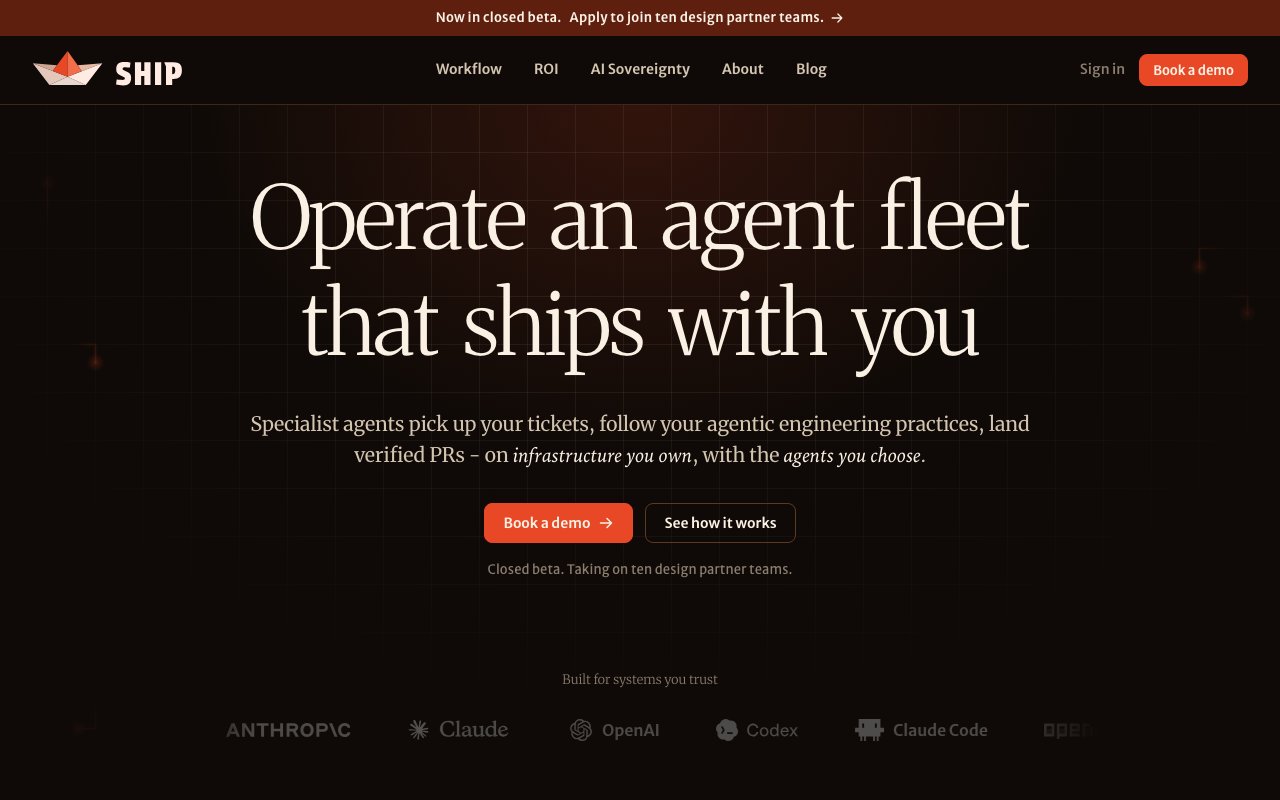
Ship operates as a fleet management system for AI coding agents, coordinating specialized roles that handle different stages of software delivery. Instead of relying on a single AI assistant that attempts everything at once, Ship deploys six distinct agents with focused responsibilities. The Researcher gathers requirements and context before any code gets written. The Planner creates detailed implementation specifications based on that research. The Builder writes and tests code in isolated sandbox environments where experiments won't affect production systems. The Reviewer evaluates output against original plans and team guidelines. The Operator pushes approved code to pull requests and runs deployment pipelines. The Tester validates functionality with documented proof. Each agent focuses on what it does best while the system orchestrates their collaboration toward completed deliveries.
This architecture addresses problems that emerge when teams scale up AI-assisted development without proper oversight. Studies suggest that reviewing AI-generated code actually requires more effort than reviewing human code, yet delivery outcomes barely improve despite this additional burden. Cost variability presents another challenge that compounds as usage grows, with identical tasks sometimes differing by over 100x in expense depending on which models and tools execute them. Teams often lack visibility into what autonomous coding tools actually do, creating accountability gaps where unreviewed code ships, spending becomes unpredictable, and outcomes can't be attributed to specific decisions. Ship tackles these issues through systematic orchestration and transparency.
Real-time mission tracking shows exactly what each agent is doing, how much each stage costs, and what decisions agents make along the way. Teams gain visibility into outcomes that autonomous coding tools typically obscure behind simple success or failure reports. When something goes wrong, the audit trail reveals where the process broke down. When costs spike unexpectedly, the breakdown shows which models consumed the budget. This instrumentation transforms AI coding from a black box into a manageable system with measurable properties that teams can optimize over time.
The workflow progresses through five stages from planning through testing. During the planning phase, agents research requirements and produce implementation specifications before any code gets written, reducing the wasted effort of building solutions that miss the actual need. Building happens in isolated sandbox environments where agents can write, test, and iterate without affecting production systems or contaminating working branches. Review evaluates code against the original plans and team guidelines, catching issues before they reach human reviewers who would otherwise spend time identifying problems that automated checks could have surfaced. Deployment pushes approved changes through the team's existing CI/CD pipelines, integrating with established workflows rather than replacing them. Testing validates that delivered features actually work, with agents producing evidence documenting their verification steps rather than simply claiming success.
Engineering organizations that already use AI for code generation represent the primary audience for Ship. The platform assumes teams operate their own infrastructure, maintain existing GitHub and Linear integrations, and hold contracts with AI providers. This positions Ship differently from hosted AI coding services that lock users into specific providers or infrastructure arrangements. Teams keep full ownership of their tooling decisions, bringing their own API keys, choosing their own models, and controlling where processing happens. The sovereignty emphasis means teams benefit directly from optimizations and cost reductions rather than paying markup to an intermediary that controls the stack.
Cost transparency runs throughout the system at every level. Per-stage cost tracking shows exactly where money goes during each mission, making it possible to identify which steps consume disproportionate resources. Model comparison helps teams understand which AI configurations deliver the best results for their specific workloads, turning model selection from guesswork into data-driven decisions. Attribution connects outcomes to specific agent configurations, measuring whether changes to prompts, models, or workflows actually improve delivery quality and efficiency. Over time, teams accumulate institutional knowledge about what works for their particular codebase and team dynamics.
Ship currently operates in closed beta, accepting applications from engineering teams willing to participate as design partners shaping product direction. Ten spots are available for teams that want early access and direct influence over roadmap priorities. Interested organizations book demos through the website to discuss their workflows and evaluate fit. For teams struggling with unpredictable AI coding costs, unreliable output quality, or limited visibility into what autonomous tools actually do, Ship offers a structured approach that treats AI agents more like managed team members with defined roles than black-box assistants that sometimes help and sometimes create messes.
Key Features
- Six specialist AI agents with defined roles
- Mission Control dashboard with cost tracking
- Gated pull request delivery with verification
- Model routing across OpenAI, Claude, OpenRouter
- Zero-trust security with isolated sandboxes
- GitHub and Linear integrations
Pros & Cons
What we like
- Treats AI agents as a coordinated team rather than isolated tools
- Real-time cost visibility per mission and model
- Pull requests gated on reviews and test results
- Can run on your own infrastructure for compliance
Room for improvement
- No published pricing, requires demo to understand costs
- Newer product with a smaller user base
- Requires buy-in to the multi-agent workflow model
- Setup complexity for teams used to simpler copilots
Frequently Asked Questions
What is Ship?
How does Ship differ from a regular AI coding assistant?
Is Ship free?
Can Ship run on my own infrastructure?
Best For
Featured in
Alternatives to Ship
Cursor
VS Code fork built around an AI pair-programmer

Replit
Browser IDE plus Replit Agent that builds and deploys apps from a prompt
Windsurf
Codeium's AI editor with Cascade agent and deep IDE integration
Vibe Built
Building real apps with agentic AI. What worked, what broke, what shipped.
Reviews (0)
Badge builder
Add Ship to your website
Choose a badge style and size, preview it here, then copy the generated HTML. Badge images are self-contained SVGs and do not require an external script.

<a href="https://toolindex.net/tools/ship?ref=badge" target="_blank" rel="noopener">
  <img src="https://toolindex.net/badge/ship/medium.svg" alt="Ship - Listed on Tool Index" width="180" height="50" />
</a>How to use the badge
- 1. Pick the style, size, and theme that fit your layout.
- 2. Copy the generated HTML from the code block.
- 3. Paste it into your footer, homepage, or press page.
Standard badge available
The standard listing badge is available now. Score and circle badges are limited to tools currently ranked in the top 10 of a category.
Badge clicks return visitors to this profile with a referral tag so the source remains identifiable.
Related Tools

Bolt.new
Prompt-to-deployed full-stack app inside the browser

Tabnine
Privacy-first enterprise AI code assistant you control, with SaaS, VPC, on-prem, or fully air-gapped deployment
Cursor
VS Code fork built around an AI pair-programmer

Skeezo
Agent-native macOS IDE for coordinating Claude Code and AI agents
Work on Ship? Request listing access or correction