
Snagr
Recover abandoned Polar checkouts, failed renewals, and cancelled subscriptions
Gallery
About Snagr
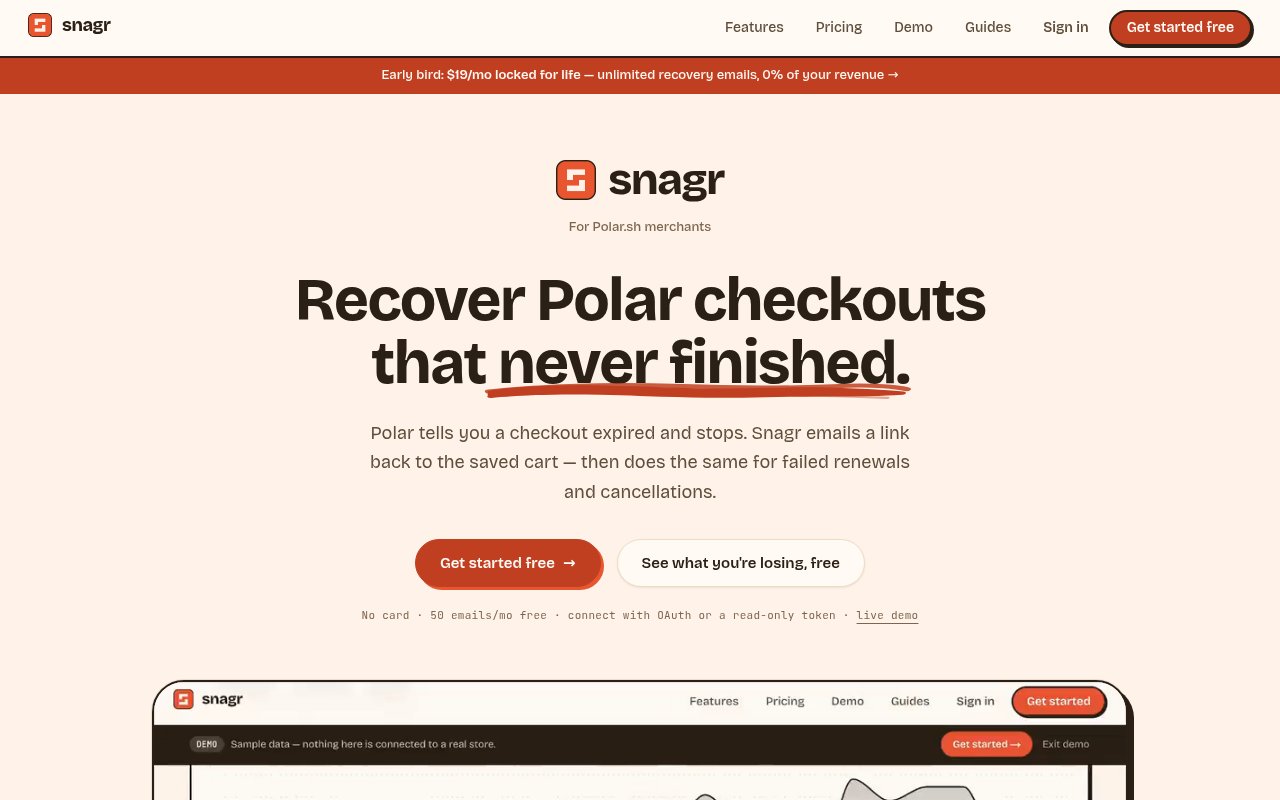
Snagr is a recovery email service made specifically for merchants who sell through Polar. It watches for three points where otherwise interested customers can disappear, an unfinished checkout, a failed subscription renewal, and a cancellation. Polar already retries failed renewal charges, but it doesn't follow up on expired checkouts or cancelled subscriptions in the same way. Snagr fills those gaps with timed email sequences and gives the merchant a dashboard for seeing which customers returned. It is a deliberately narrow product. This isn't a general email marketing suite that happens to connect to Polar. The event model, recovery links, attribution, and reporting are all shaped around a Polar store.
Setup starts by connecting a Polar organization. The site offers OAuth and a read-only token route, and says a merchant can get started without entering a card. Once connected, Snagr listens for recoverable events rather than asking someone to import contacts or build an audience by hand. For an abandoned checkout, the default sequence begins about 30 minutes after the checkout expires, then sends two more messages around 24 and 48 hours later. Each message links the customer back to the saved checkout. For a failed renewal, its reminders are staggered around Polar's own retry cadence so the customer doesn't receive duplicate notices. A cancellation can trigger a win-back message after 30 days, with a later resubscription shown as a recovery.
The default emails are visible on the public site, so a merchant can inspect the tone and timing before connecting a store. Pro customers can edit the templates and step delays, while either sequence type can be switched off when it doesn't fit the business. Snagr also checks for the conditions that should prevent another message. Unsubscribes, hard bounces, and complaints go onto a per-team suppression list, and that list is checked when a sequence starts and again before a later step is sent. This matters for a tool that acts on customer email addresses because recovery stops being useful the moment it turns into repeated unwanted mail.
Reporting goes beyond a raw count of emails sent. A conversion is attributed when the customer completes a checkout or the subscription returns to active within 14 days of the most recent recovery email. The record keeps the sequence, email, timestamp, and amount behind that result, which makes the recovered revenue number easier to inspect. Snagr also describes a 5 percent holdback method that leaves a small random control group unemailed and compares its recovery rate with the contacted group. That is meant to separate incremental lift from customers who would have returned on their own. The pricing comparison assigns detailed holdback lift reporting to Pro, while both plans include 14-day attribution and the analytics dashboard.
Sending infrastructure changes with the plan. The free tier uses a shared Snagr sending domain, while Pro supports a merchant's own domain with DKIM, SPF, and DMARC. Pro also removes the recovery email cap and allows unlimited Polar organizations, which is useful for a studio or operator managing more than one storefront. The free plan connects one organization and includes all three recovery sequence types, analytics, forecasts, and shareable reporting. When the 50-email monthly allowance runs out, extra sends are held instead of immediately discarded. The site says those held messages are retried for about 10 days and are released if the account upgrades, with the allowance resetting at the start of the next UTC month.
The product is best suited to indie software businesses, creator stores, and small SaaS teams that already rely on Polar and want recovery without maintaining webhooks, schedules, email delivery, attribution, and suppression logic themselves. Its focus makes the workflow unusually direct, but it also defines the main limitation. A Stripe, Paddle, or Lemon Squeezy merchant won't get value from it, and a team that wants newsletters, broadcasts, or broad lifecycle automation will still need another product. The public site is candid about that boundary and about the places where Polar already handles part of the job, especially failed payment retries.
Snagr publishes unusually detailed privacy and operating information for a young service. It says it stores the customer, checkout, order, subscription, and email event data needed to run recovery, but it never receives card numbers or banking credentials from Polar. Store records and OAuth tokens are removed from the live database when an organization is disconnected, and a merchant can delete the whole account from the dashboard. The service is run by an individual in India rather than an incorporated company, with one published contact address. Pricing is freemium. The free plan includes 50 recovery emails each month, and Pro is advertised at $19 per month or $199 per year with no percentage taken from recovered revenue. That gives small Polar stores a practical way to prove the workflow before paying for unlimited volume and the deliverability controls.
Key Features
- Abandoned checkout email sequences
- Failed renewal recovery
- Cancellation win-back campaigns
- Fourteen-day revenue attribution
- Randomized holdback lift reporting
- Custom authenticated sending domains
Pros & Cons
What we like
- Purpose-built around Polar events and recovery links
- Free plan includes all three recovery flows
- Flat Pro price takes no recovered revenue
- Published privacy and suppression controls are detailed
Room for improvement
- Only useful for merchants already selling through Polar
- Free recovery sends are capped at 50 monthly
- Editable templates and custom domains require Pro
- Service is operated by one individual
Frequently Asked Questions
What is Snagr?
Does Snagr replace Polar's failed payment retries?
Is Snagr free?
What customer data does Snagr handle?
Best For
Featured in
Alternatives to Snagr
Apatero AI
The creator studio for AI image, video, audio, 3D, and avatars, now at apatero.ai.

Prompted Income
Make money with AI, documented with the receipts instead of the screenshots.

Sellsmithy
The workshop side of selling digital products. Built first, fees counted, duds included.

Postdex
An exclusive marketplace for finished, human-made articles. Every piece sells once.
Reviews (0)
Badge builder
Add Snagr to your website
Choose a badge style and size, preview it here, then copy the generated HTML. Badge images are self-contained SVGs and do not require an external script.

<a href="https://toolindex.net/tools/snagr?ref=badge" target="_blank" rel="noopener">
  <img src="https://toolindex.net/badge/snagr/medium.svg" alt="Snagr - Listed on Tool Index" width="180" height="50" />
</a>How to use the badge
- 1. Pick the style, size, and theme that fit your layout.
- 2. Copy the generated HTML from the code block.
- 3. Paste it into your footer, homepage, or press page.
Standard badge available
The standard listing badge is available now. Score and circle badges are limited to tools currently ranked in the top 10 of a category.
Badge clicks return visitors to this profile with a referral tag so the source remains identifiable.
Related Tools
Apatero AI
The creator studio for AI image, video, audio, 3D, and avatars, now at apatero.ai.

SEObot
Autonomous AI SEO agent that runs your blog and link building on autopilot

Substack
Hosted newsletter and publication platform with built-in payments, recommendations, and an audience network for writers.

MailerLite
Friendly, affordable email marketing tool with newsletters, automations, landing pages, and a growing creator toolkit.
Work on Snagr? Request listing access or correction