
Upstash
Serverless Redis, Kafka, and QStash for modern applications
Gallery
About Upstash
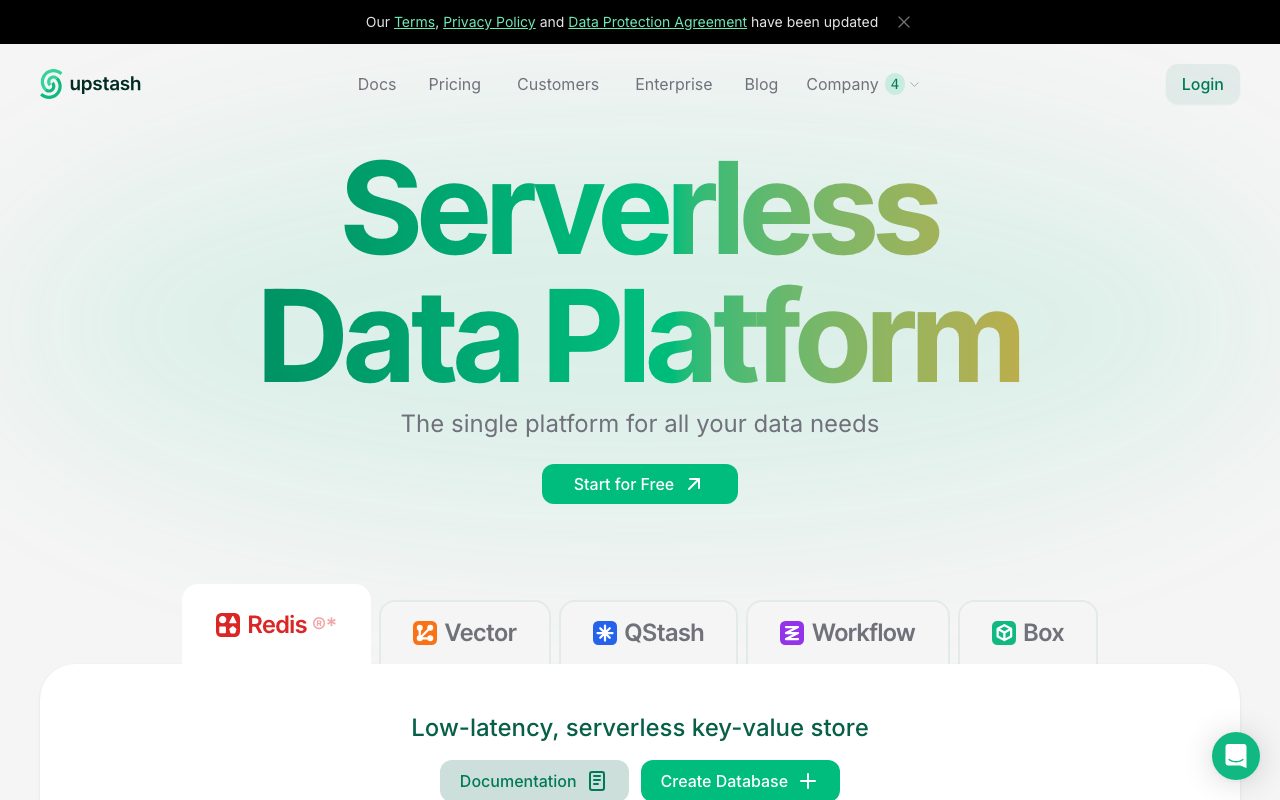
Upstash is a serverless data platform that offers Redis, Kafka, QStash messaging, and a vector database with per-request pricing. The pitch is that you don't pay for idle servers. You pay per command, per request, or per workflow run.
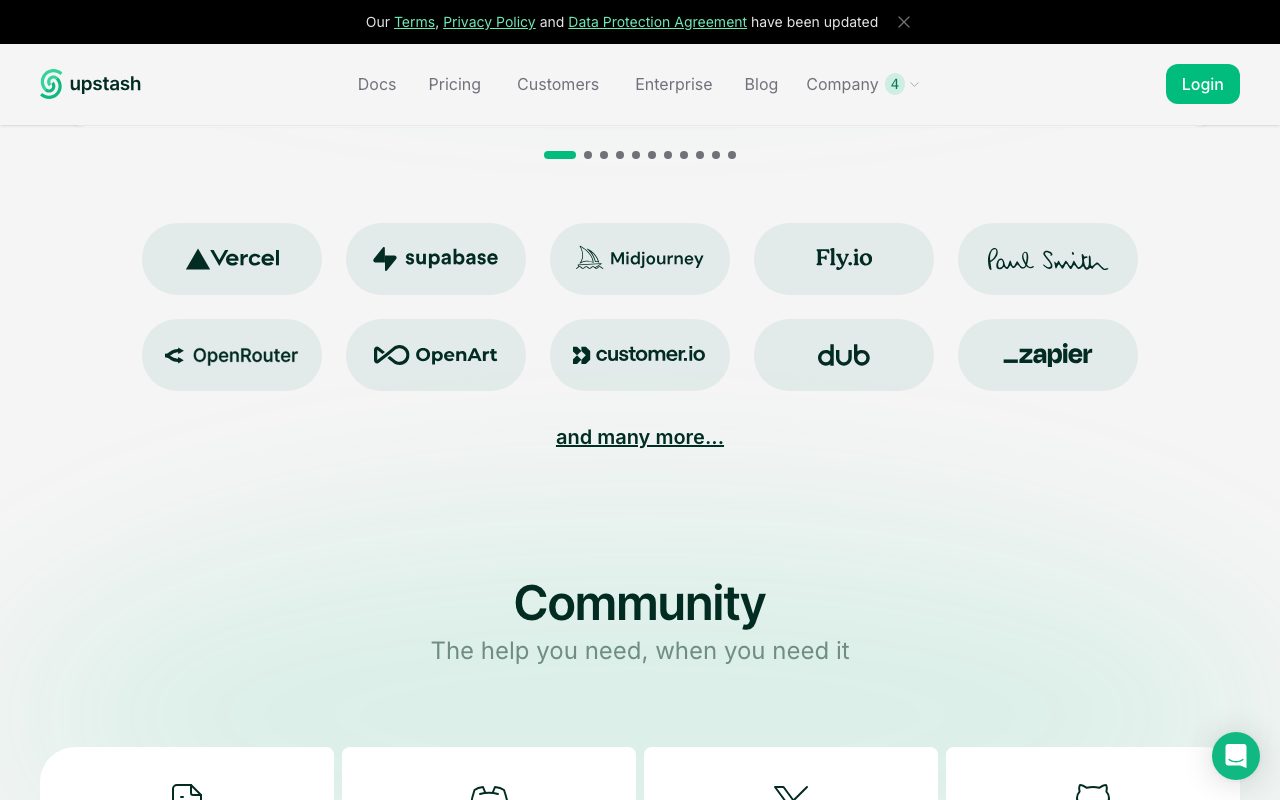
The product is aimed at modern developers building on serverless platforms like Vercel, Netlify, AWS Lambda, and Cloudflare Workers. Traditional Redis or Kafka services don't fit those workloads cleanly. Upstash rebuilt the data layer for that world.
What Upstash actually does
Upstash Redis gives you a globally available Redis database with HTTP and TCP access. The HTTP API is the unique part. Cloudflare Workers, Vercel Edge, and similar runtimes can use Redis without persistent connections.
QStash is a serverless message queue and scheduler. You send a message via HTTP, and Upstash delivers it to your endpoint at the right time, with retries and exponential backoff. The vector database powers AI search and recommendation use cases.
Who Upstash is built for
Upstash is built for developers shipping on serverless or edge platforms. Vercel and Cloudflare devs are the heaviest users. Indie hackers love the free tier and per-request billing.
It's less ideal for traditional always-on Redis workloads where you'd saturate a managed Redis cluster all day. Upstash's pricing favors bursty workloads.
Upstash pricing
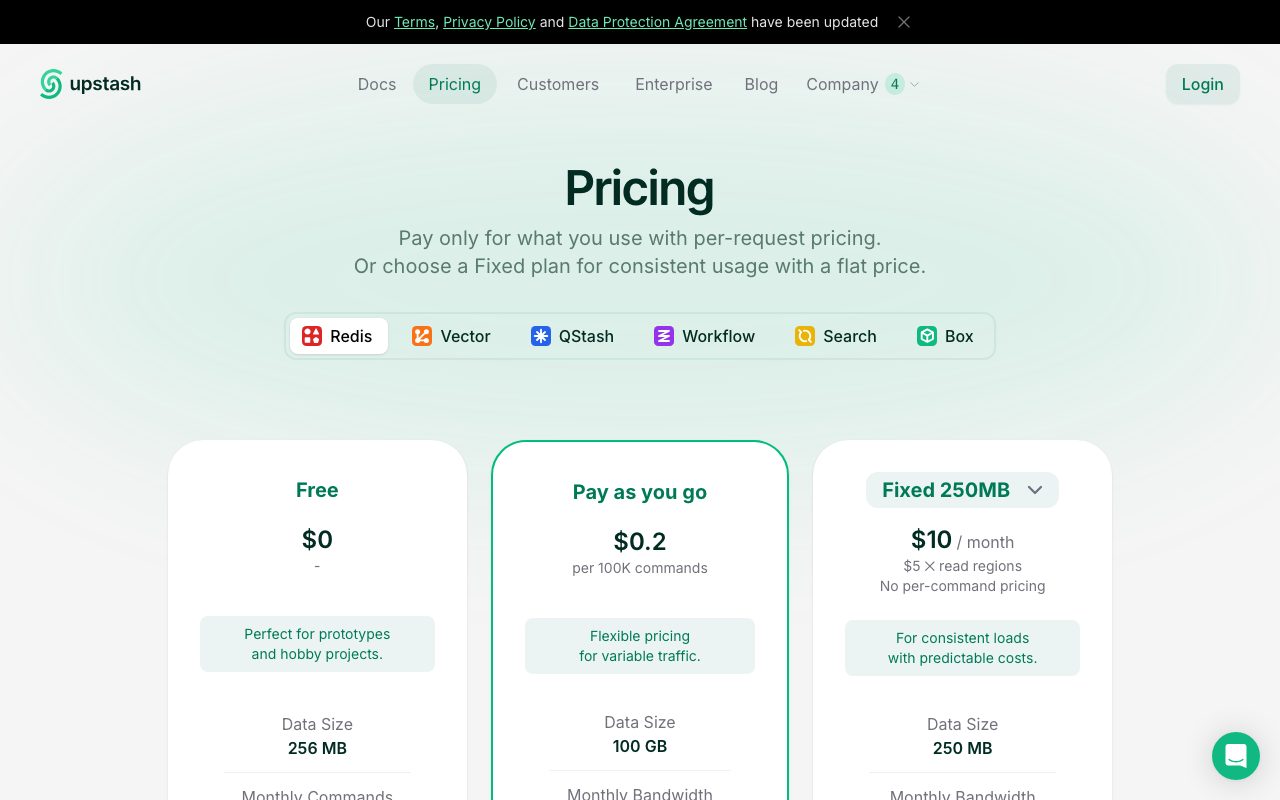
The free tier is generous and covers a real product launch. Paid plans charge per command for Redis, per message for QStash, and per request for the vector database. There's a fixed-price option for predictable workloads at higher volume.
Compare with Upstash alternatives if you want a benchmark. For serverless workloads, the math usually favors Upstash.
Features that define Upstash
The Redis HTTP API is the unique feature. You connect over HTTPS instead of TCP, which works in any runtime including Cloudflare Workers and the Vercel Edge runtime. That alone is why many teams choose Upstash.
Global replication is built in. You pick regions, and Upstash replicates the database with low-latency reads across regions. Strong consistency or eventual consistency are configurable.
QStash is a great fit for scheduled jobs in serverless environments. Cron without managing a worker. The vector DB plugs into AI app patterns for search, RAG, and similarity.
Upstash is what Redis would look like if it was rebuilt for serverless. The HTTP-first design unlocks runtimes Redis can't normally serve.
Tradeoffs and rough edges
HTTP overhead is higher than direct TCP for very high-throughput workloads. If you're running millions of commands per second from a single backend, a traditional Redis cluster may be cheaper.
Some advanced Redis features are limited or differ from upstream Redis. Always check the docs for command compatibility before betting a workflow.
Upstash vs alternatives
The closest competitors are Redis Cloud, DragonflyDB, and managed Redis on AWS or Google Cloud. Redis Cloud is the official option. DragonflyDB is a faster Redis-compatible alternative. Cloud-managed Redis is the default if you're already deep in AWS.
Upstash's edge is the serverless model and HTTP API. See Upstash vs Redis Cloud and the best serverless databases.
Common questions about Upstash
Is Upstash compatible with Redis clients? Mostly, yes, via TCP. The HTTP API uses Upstash's own SDK.
Can Upstash work with Cloudflare Workers? Yes, that's a primary use case.
Does Upstash offer a Kafka product? Yes, serverless Kafka is part of the product line.
Bottom line on Upstash
Upstash is the serverless data platform that fits modern frontend and edge stacks. It's a strong default for any serverless app that needs Redis or queues. Browse tools for developers for the rest of the stack.
If you build on Vercel or Cloudflare Workers, Upstash is on the short list.
Upstash patterns
Common patterns include session storage, rate limiting, caching, leaderboards, and pub/sub. The HTTP API works for all of them in serverless environments. Connection pooling concerns disappear because there's no persistent connection.
QStash powers scheduled jobs and webhook delivery. You replace cron and a worker with a single HTTP call to QStash. The fan-out and retry semantics are built in.
When not to pick Upstash
If your workload is steady, high throughput, and runs on long-lived servers, traditional managed Redis may be cheaper. Upstash's pricing favors bursty serverless traffic. The break-even depends on commands per second.
If you need the very latest Redis features the day they ship, upstream Redis or Redis Cloud may suit better. Upstash supports a wide subset, but bleeding edge releases sometimes lag.
Tutorial / Demo
Key Features
- Serverless Redis with per-request pricing
- Serverless Kafka for event streaming
- QStash for serverless message queues
- Global replication for low latency
- REST API for edge compatibility
- Built-in rate limiting
- Integrations with Vercel, Cloudflare, and AWS
Pros & Cons
What we like
- True serverless with pay-per-request pricing
- Works perfectly with edge and serverless platforms
- Free tier is generous for small projects
- Redis protocol compatible
- Simple setup with no infrastructure to manage
Room for improvement
- Per-request pricing can be unpredictable at high volume
- Maximum database size limits on lower plans
- Not suitable for large persistent datasets
- Latency is higher than self-hosted Redis for co-located services
Frequently Asked Questions
Does Upstash have a free tier?
Upstash Redis vs Redis Cloud, what's the difference?
Does Upstash work with edge runtimes?
What is QStash?
Is Upstash data really durable?
Best For
Featured in
Alternatives to Upstash
MongoDB Atlas
The fully-managed cloud version of MongoDB with built-in search, vector search, time series, and serverless tiers.

Neon
Serverless Postgres with database branching, scale-to-zero compute, and a generous free tier.

Turso
Distributed SQLite at the edge. Replicate a libSQL database to dozens of regions for sub-10ms reads.
PlanetScale
Serverless MySQL platform with branching and zero-downtime migrations
Our take
Tool Index Editorial · May 2026· 4.3/5
Upstash is the kind of tool you adopt when you want serverless redis, kafka, and qstash for modern applications.
On the strengths side: True serverless with pay-per-request pricing, Works perfectly with edge and serverless platforms, and Free tier is generous for small projects. What to watch for: Per-request pricing can be unpredictable at high volume and Maximum database size limits on lower plans.
Bottom line: pick Upstash when you need rate limiting for APIs and serverless functions; look elsewhere if per-request pricing can be unpredictable at high volume would be a dealbreaker.
Editorial opinion from the Tool Index team, written from the public product pages. Not a user review.
Reviews (3)
Hit the Upstash sweet spot
Upstash is one of those tools you stop noticing because it just works. The biggest win has been true serverless with pay-per-request pricing. Their take on QStash for serverless message queues is solid. Mostly using it for background job queues with QStash. Hard to imagine going back to my previous setup.
Pros
- Works perfectly with edge and serverless platforms
Maybe in a year when they fix the basics
Came to Upstash after frustration with what I had before. The thing I keep coming back to: simple setup with no infrastructure to manage. Built-in rate limiting works the way you'd hope. Mostly using it for event streaming with serverless Kafka. It would be a 5 if not for latency is higher than self-hosted Redis for co-located services. Might revisit when they iterate further.
Quietly excellent
Upstash isn't perfect but it's the best I've used in this category. Real selling point: redis protocol compatible. Sticking with Upstash.
Pros
- Simple setup with no infrastructure to manage
- Works perfectly with edge and serverless platforms
- True serverless with pay-per-request pricing
Badge builder
Add Upstash to your website
Choose a badge style and size, preview it here, then copy the generated HTML. Badge images are self-contained SVGs and do not require an external script.

<a href="https://toolindex.net/tools/upstash?ref=badge" target="_blank" rel="noopener">
  <img src="https://toolindex.net/badge/upstash/medium.svg" alt="Upstash - Listed on Tool Index" width="180" height="50" />
</a>How to use the badge
- 1. Pick the style, size, and theme that fit your layout.
- 2. Copy the generated HTML from the code block.
- 3. Paste it into your footer, homepage, or press page.
Standard badge available
The standard listing badge is available now. Score and circle badges are limited to tools currently ranked in the top 10 of a category.
Badge clicks return visitors to this profile with a referral tag so the source remains identifiable.
Related Tools



Work on Upstash? Request listing access or correction