
Supabase
The open source Firebase alternative
Gallery
About Supabase
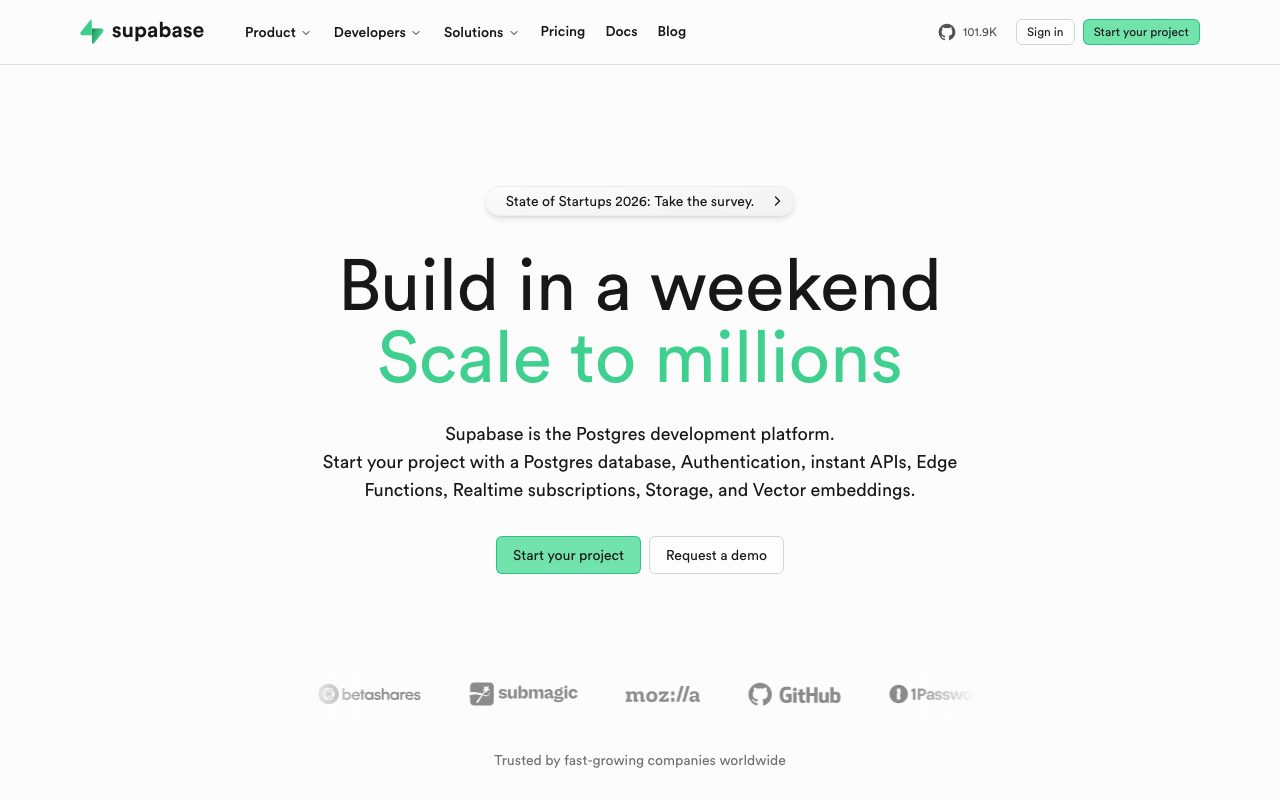
Supabase is the open-source Firebase alternative built on Postgres. You get auth, database, storage, real-time, and edge functions in one product. Unlike Firebase, the underlying database is a real, full-power Postgres you actually own.
It's the default backend for indie hackers, AI app builders, and side projects shipping fast. The free tier is generous and the developer experience is genuinely excellent.
What Supabase actually does
The base layer is a hosted Postgres database. Auto-generated REST and GraphQL APIs sit on top. Row Level Security policies enforce permissions at the database level.
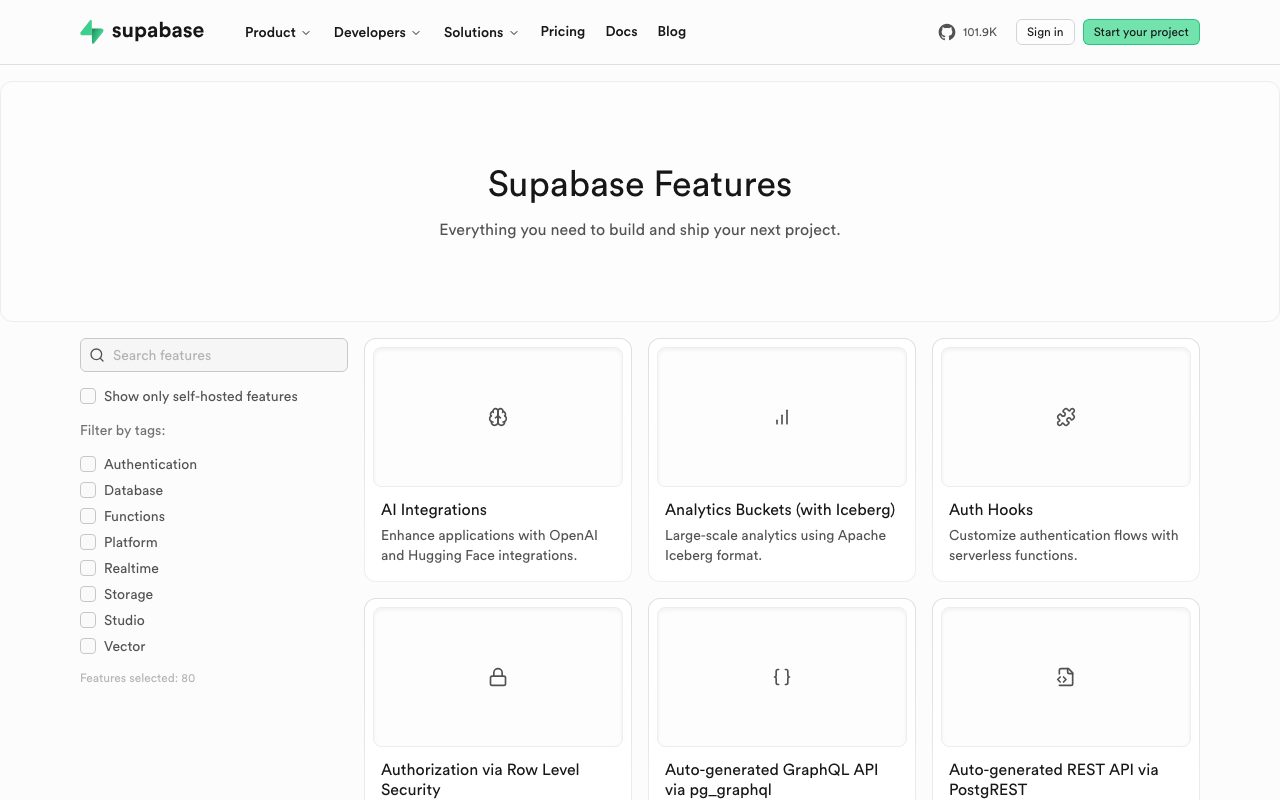
Around the database sit auth (email, OAuth, magic links, SAML, MFA), storage with image transformations, real-time subscriptions, edge functions written in TypeScript, and vector embeddings for AI applications.
The whole stack is open source. You can self-host every piece. The hosted version is the convenient option, not the only option.
Who Supabase is for
Web app developers who want a real database without managing servers. Mobile app backends needing auth and real-time. AI and ML applications with vector storage. Startups shipping MVPs fast.
It's also great for teams who outgrew Firebase and want SQL back. Postgres handles complex queries that Firestore makes painful.
Supabase pricing breakdown
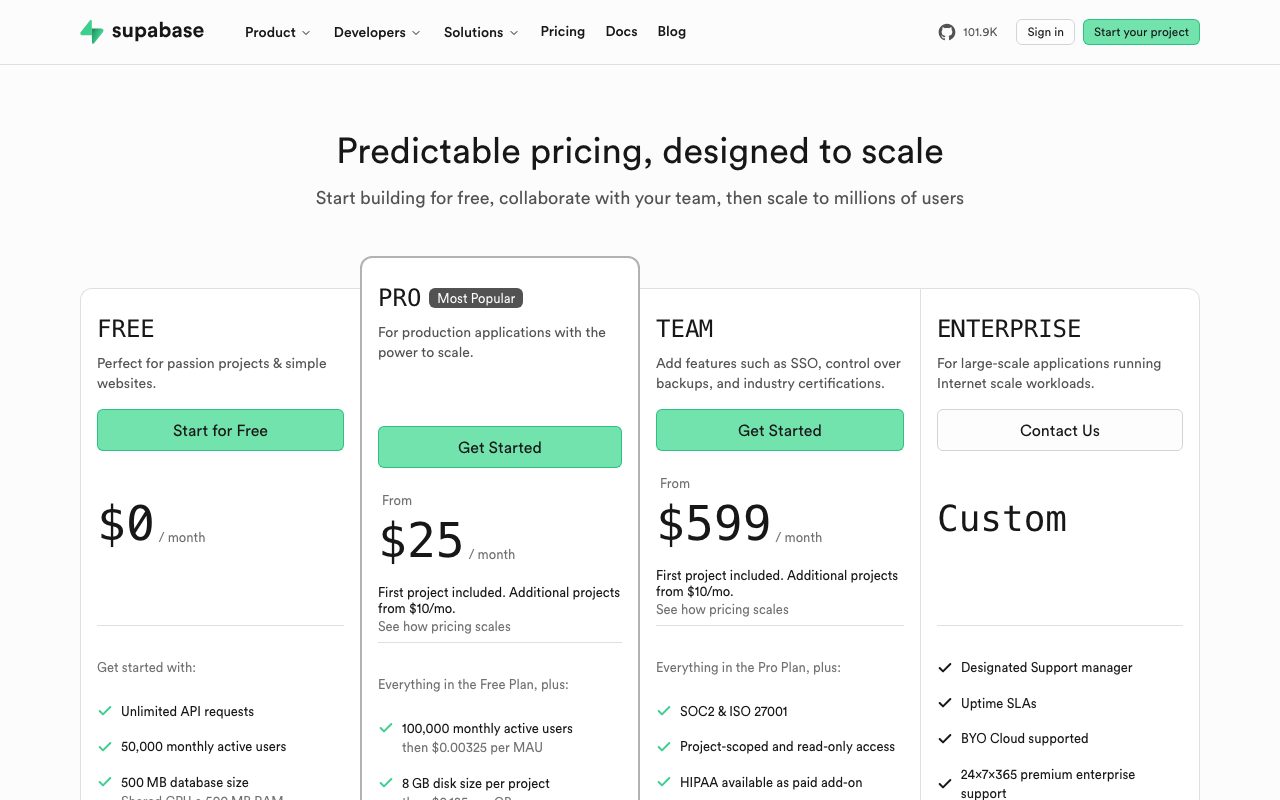
The free tier covers two projects, 500 MB database, 1 GB storage, and 50,000 monthly active users on auth. It's enough to run a real side project comfortably.
Pro runs $25 per month per project. Database storage, auth users, and bandwidth go up. Daily backups, log retention, and email support kick in.
Team adds $599 per month for advanced compliance and SOC 2. Enterprise is custom-quoted.
Compute and storage scale beyond the included quotas with predictable per-unit pricing. The bills don't surprise you.
Standout Supabase features
Full Postgres power. Real SQL, real joins, real transactions, real foreign keys. Firebase couldn't do that. Supabase makes it the default.
Open source and self-hostable. If Supabase shuts down tomorrow, you spin up the same stack on your own infrastructure. Few BaaS products offer that exit ramp.
Auto-generated APIs let you skip the CRUD plumbing. Define a table, get REST endpoints. Add Row Level Security and your auth model just works.
Real-time subscriptions broadcast database changes to connected clients. Building a collaborative or live-updating UI is roughly twenty lines of client code.
Vector embeddings via pgvector make Supabase a real player for AI apps. Store, query, and rank by similarity in the same database that holds your business data.
Honest tradeoffs
Younger than Firebase. Fewer tutorials, smaller community, fewer Stack Overflow answers. The gap is closing fast but it's still real.
Some features still maturing. Edge functions, the auth dashboard, and some quotas have rough edges. The team ships fixes weekly.
Postgres can be complex for beginners. Indexes, query plans, vacuum, replication, all real concepts you eventually meet. Worth learning anyway.
Edge function cold starts are real. For latency-critical paths, plan around them or pre-warm.
Supabase makes Postgres approachable. That sentence used to be impossible. The DX really is that good.
Supabase vs the alternatives
The headline rival is Firebase. Firebase is older, more mobile-focused, and uses NoSQL Firestore. Supabase is SQL-first, open source, and growing faster.
Neon and PlanetScale compete on the database layer. They focus on Postgres or MySQL hosting without the auth and storage layer Supabase bundles.
For pure backend-as-a-service alternatives, Appwrite is the closest. Open source, similar feature set, smaller community.
Convex takes a different approach with reactive functions. Worth comparing if real-time is your primary concern.
See best backend-as-a-service platforms, Supabase alternatives, and Supabase vs Firebase.
Bottom line on Supabase
Supabase is the default backend for new apps in 2026. Real Postgres, real auth, real storage, real-time included, all open source. The free tier ships your MVP without a credit card.
If you're starting a new app and you don't have an opinionated infrastructure already, start here. You'll spend the first week shipping features instead of plumbing.
Supabase auth in practice
Supabase Auth handles email/password, magic links, OAuth providers (Google, GitHub, Apple, Facebook, dozens more), SAML SSO for enterprise, and MFA. The breadth covers basically every real-world auth need.
Row Level Security policies enforce permissions at the database level. Even if your application code has a bug, the database refuses to return rows the user shouldn't see. That's a stronger security posture than typical app-level auth.
JWTs sign on the auth server and verify in the database. Custom claims let you embed roles or tenant IDs into tokens. The whole pattern is well-documented and battle-tested.
Supabase real-time in practice
Real-time subscriptions broadcast Postgres changes to connected clients. Insert a row, every subscribed client receives the change. The pattern fits collaborative apps, live dashboards, and chat features naturally.
Channels handle ephemeral state like presence and broadcasting. Show "who's online" or "who's typing" without storing it permanently. Lighter than full database persistence.
The connection pooling is solid. Thousands of concurrent connections work fine on Pro plans. Larger workloads need careful planning around the connection limits.
Supabase common questions
"Is Supabase production-ready?" Yes. Many real businesses run on Supabase. Some at scale.
"How does Supabase compare to Firebase?" SQL versus NoSQL is the headline. Open source versus closed is the second. Supabase wins on flexibility; Firebase wins on mobile maturity.
"Can I migrate off Supabase?" Yes. The data is in Postgres. Export, import to any other Postgres host, done.
"What about edge functions?" TypeScript edge functions deploy to Supabase's network. Cold starts exist; pre-warm or accept the latency.
Final word on Supabase
Supabase is the default backend for new apps right now. Real Postgres, real auth, real storage, real-time included, all open source. The free tier ships your MVP without a credit card.
If you're starting a new app and you don't have an opinionated infrastructure already, start here. You'll spend the first week shipping features instead of plumbing infrastructure.
The community is growing fast. Tutorials, courses, and Stack Overflow answers all multiply quarter over quarter. By the time you hit a question, somebody else probably already answered it.
Supabase common patterns
The standard pattern: Postgres for data, Supabase Auth for users, Supabase Storage for files, Edge Functions for backend logic, real-time for live updates. The whole app fits inside Supabase.
Row Level Security enforces multi-tenancy at the database level. Policies like "users can only see their own rows" run automatically. Application bugs can't leak data the database refuses to return.
Database webhooks fire on row changes. Use them to trigger edge functions, send emails via Resend, or sync data to external services. The serverless event model works well.
Auth hooks let you customize the auth flow without leaving Supabase. Pre-signup validation, post-signup welcome flows, custom claims on tokens.
Supabase for AI applications
pgvector turns Postgres into a vector database. Store embeddings alongside your business data. Query by similarity using SQL.
The combined storage is the differentiator. Application data and embeddings live in the same database. No separate vector store, no eventual consistency between systems.
Edge Functions handle the model calls. OpenAI, Anthropic, Cohere, or local models accessed from edge functions. Results cached or stored back in Postgres.
Real-time subscriptions push AI responses to clients as they generate. Streaming completions become straightforward.
Supabase deployment patterns
Most apps deploy frontend to Vercel, Netlify, or Cloudflare Pages, with Supabase handling the backend. The split works cleanly.
Some apps deploy fully on Cloudflare with Supabase as the database layer. Workers call Supabase via the Postgres connection or PostgREST.
Mobile apps (React Native, Flutter, native iOS/Android) talk directly to Supabase. Auth, database, and storage SDKs cover all major platforms.
Background jobs run via Edge Functions on cron schedules, or via external workers reading from Postgres queue tables.
Supabase scaling considerations
Free tier is plenty for MVPs. Pro at $25 per project handles real production traffic.
Connection pooling matters at scale. Supabase ships PgBouncer by default. Configure your app to use the pooler for serverless workloads.
Read replicas and dedicated compute become available on higher tiers. Most apps don't need them. Some do.
Self-hosting kicks in for very large workloads or compliance requirements. The open-source release matches the hosted product closely.
Supabase long-term outlook
Supabase's growth trajectory has been steep. Adoption among new app developers has reached genuine scale. The community, the documentation, and the integrations all reinforce each other.
Open source remains the moat. If Supabase gets acquired or pivots, users have an exit ramp. Self-hosting works. That insurance policy reduces the risk of adopting it.
The product keeps expanding. Vector embeddings, edge functions, and real-time all matured significantly. Each year adds new capabilities without breaking existing ones.
Firebase remains the dominant alternative. Different shape, different audience. Mobile-first apps still favor Firebase. Web-first apps increasingly favor Supabase.
For new apps in 2026, Supabase is the default backend recommendation. The DX, the open-source story, and the generous free tier all compound.
Tutorial / Demo
Key Features
- Full Postgres database
- Built-in authentication
- Real-time subscriptions
- Edge Functions (TypeScript)
- File storage with transformations
- Vector embeddings for AI
- Row Level Security
- Auto-generated APIs
Pros & Cons
What we like
- Full Postgres power, not just NoSQL
- Open source and self-hostable
- Excellent developer experience
- Real-time built in
- Generous free tier
Room for improvement
- Younger than Firebase, fewer tutorials
- Some features still maturing
- Postgres can be complex for beginners
- Edge Function cold starts
Frequently Asked Questions
What is Supabase used for?
Is Supabase free to use?
What are the pros and cons of Supabase?
Who should use Supabase?
Best For
Featured in
Tags
Alternatives to Supabase



Our take
Tool Index Editorial · May 2026· 4.8/5
Supabase positions itself as the open source firebase alternative, and on the whole it earns the framing.
Where it wins: Full Postgres power, not just NoSQL, Open source and self-hostable, and Excellent developer experience. Less impressive: Younger than Firebase, fewer tutorials and Some features still maturing.
In short: Supabase is a strong pick when you need web applications, and a harder sell if younger than Firebase, fewer tutorials would be a dealbreaker.
Editorial opinion from the Tool Index team, written from the public product pages. Not a user review.
Reviews (5)
Finally something that fits
Tried Supabase on a side project first. Honestly impressed by how generous free tier. Their take on full Postgres database is solid. Mostly using it for startups.
Pros
- Excellent developer experience
- Real-time built in
- Full Postgres power, not just NoSQL
Switched away after a month
Adopted Supabase for one project, ended up using it for more. Genuine strength: real-time built in. Their take on auto-generated APIs is solid.
Cons
- Some features still maturing
- Younger than Firebase, fewer tutorials
Surprised how much we use this
Took a few weeks for Supabase to click, then it stuck. The biggest win has been real-time built in. Hard to imagine going back to my previous setup.
Pros
- Full Postgres power, not just NoSQL
Pulled its weight from week one
Picked Supabase for the lower price, stayed for the actual quality. Real selling point: open source and self-hostable. Worth calling out the vector embeddings for AI too. It fits well for mobile app backends. That said, younger than Firebase, fewer tutorials is a real gripe. Easy yes for anyone weighing the same trade-offs.
Pros
- Full Postgres power, not just NoSQL
- Generous free tier
- Open source and self-hostable
Cons
- Younger than Firebase, fewer tutorials
- Edge Function cold starts
Supabase is fine, here's the real take
Got Supabase on the recommendation of someone I trust. Honestly impressed by how full Postgres power, not just NoSQL. Honest gripe: some features still maturing. Decent value once you accept the rough edges.
Pros
- Real-time built in
Badge builder
Add Supabase to your website
Choose a badge style and size, preview it here, then copy the generated HTML. Badge images are self-contained SVGs and do not require an external script.

<a href="https://toolindex.net/tools/supabase?ref=badge" target="_blank" rel="noopener">
  <img src="https://toolindex.net/badge/supabase/medium.svg" alt="Supabase - Listed on Tool Index" width="180" height="50" />
</a>How to use the badge
- 1. Pick the style, size, and theme that fit your layout.
- 2. Copy the generated HTML from the code block.
- 3. Paste it into your footer, homepage, or press page.
Score badge available
Supabase qualifies for the score and circle badges based on its current top-10 positionin Database.
Badge clicks return visitors to this profile with a referral tag so the source remains identifiable.
Related Tools

Kevin Gabeci
Solo developer building web apps, cozy browser games, and AI creator toolkits.

Coolify
Self-hostable, open source alternative to Heroku and Netlify

Warp
The modern terminal reimagined with AI and collaboration

Bolt.new
Prompt-to-deployed full-stack app inside the browser
Work on Supabase? Request listing access or correction