PlanetScale
Serverless MySQL platform with branching and zero-downtime migrations
Gallery
About PlanetScale
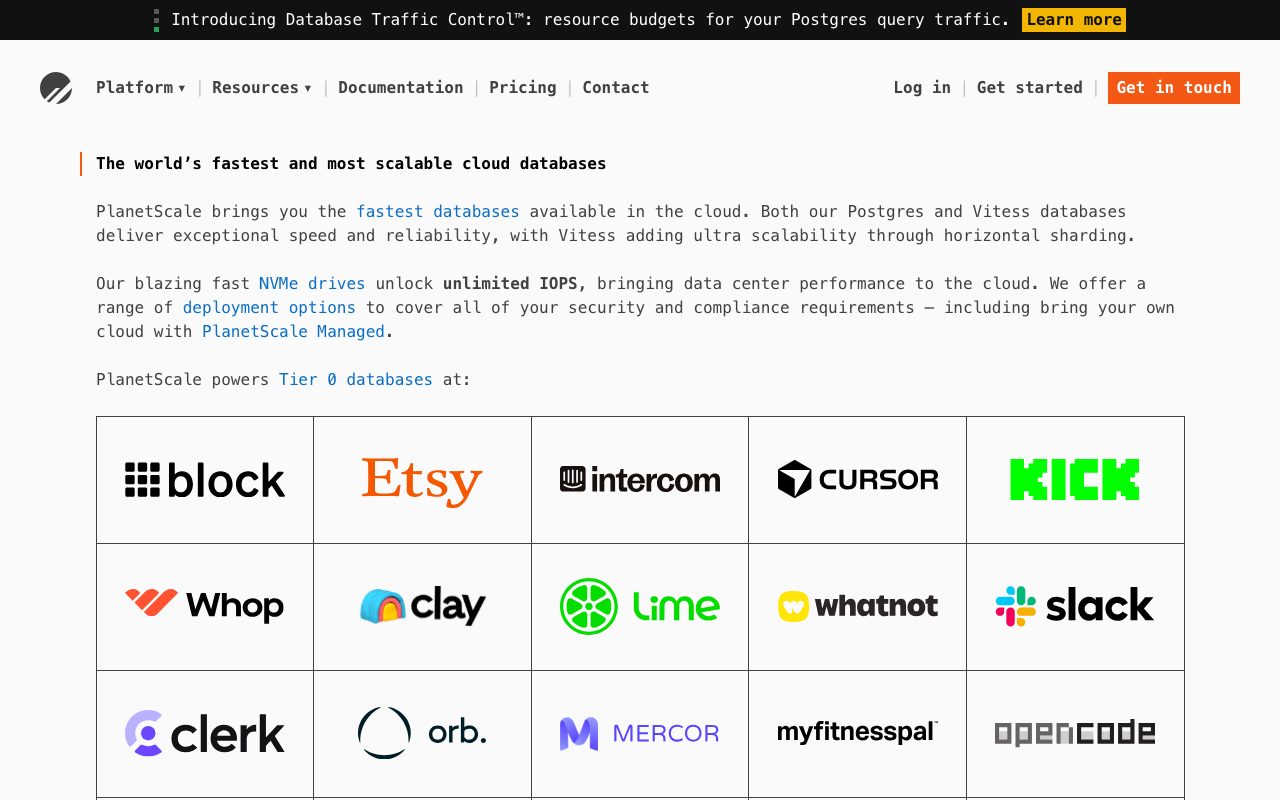
PlanetScale is the serverless MySQL platform that brought database branching to the masses. It's MySQL underneath, but the developer experience feels closer to git than to phpMyAdmin.
The company was founded by Sam Lambert and Jiten Vaidya in 2018, with Vitess (the open-source database tech behind YouTube's MySQL) at the core. PlanetScale raised from Andreessen Horowitz, Insight Partners, and Kleiner Perkins.
If you're shopping for managed databases today, you're probably comparing PlanetScale, Neon (Postgres), and Supabase. Here's the honest breakdown.
What PlanetScale actually does
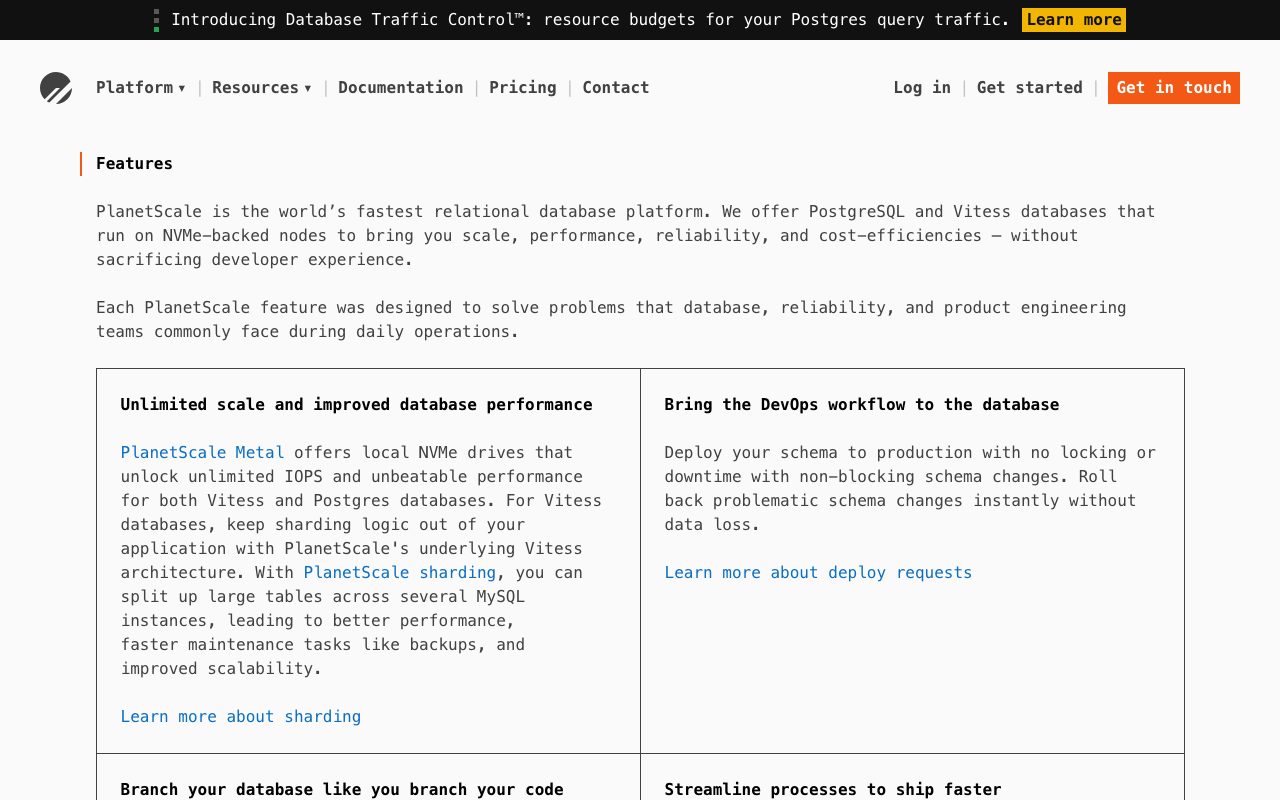
PlanetScale runs MySQL on top of Vitess, the sharding layer Google built for YouTube. You get a MySQL-compatible database that scales horizontally, with branching, deploy requests, and zero-downtime migrations as first-class features.
The killer feature is branching. Just like git, you create a branch off main, run schema changes there, test them, then merge back via a deploy request. PlanetScale validates the migration is safe before applying it to production.
Beyond branching, PlanetScale offers connection pooling, read replicas across regions, point-in-time backups, query insights, and a built-in console. The PR-style migration workflow is the differentiator.
Who PlanetScale is for
Engineering teams running MySQL who hate doing schema migrations at 3 AM. The branching workflow turns "scary production migration" into "deploy request like any code change."
SaaS startups and growth-stage companies are the heavy users. The pricing scales with usage, not server hours, which fits irregular load patterns. Railway and Render don't offer this kind of database-native workflow.
Where PlanetScale doesn't fit: applications using MySQL features Vitess doesn't support (foreign keys until recently, certain advanced features), Postgres-first stacks, or workloads where you'd rather run your own infrastructure for cost reasons.
Pricing breakdown
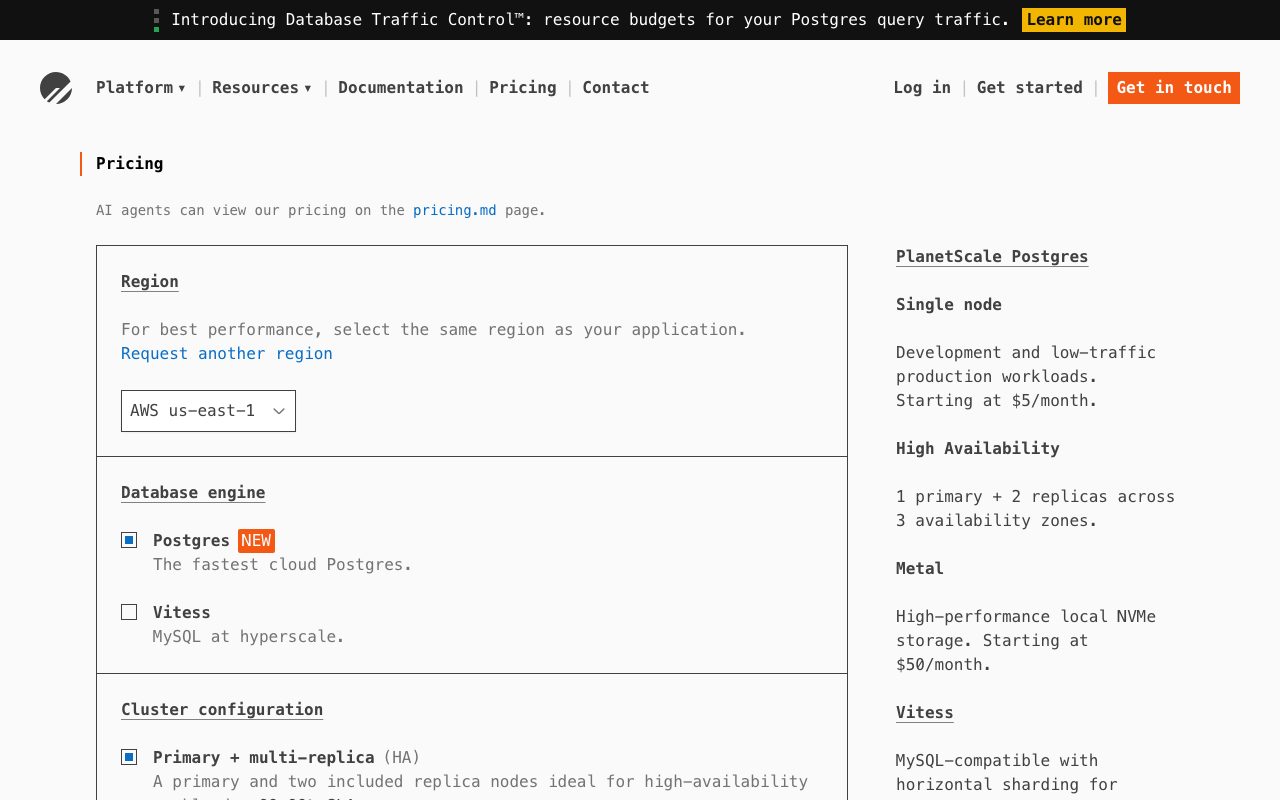
PlanetScale removed its free tier in 2024, which was controversial. The cheapest paid plan is now Scaler at $39/month with 10GB storage and 100M reads/month.
Scaler Pro is $99/month with more capacity. Enterprise plans are custom-quoted with dedicated infrastructure, advanced security, and migration support.
The pricing model includes storage, reads, writes, and rows scanned. Costs can surprise teams that don't optimize queries. The dashboard shows hot queries, which helps.
Standout features
Database branching
Branching is the headline feature. Create a branch from production, make schema changes, test queries, merge with a deploy request. Migrations apply via Vitess's online schema change, which means zero downtime even on big tables.
This workflow eliminates entire categories of database incidents. No more "alter table locked production for 20 minutes." The deploy request validates row counts and runs the migration safely.
Insights and query analysis
PlanetScale's Insights dashboard surfaces slow queries, hot rows, and performance regressions. You can see the exact query, its plan, and impact without standing up a separate APM tool.
Connection pooling built-in
PlanetScale's connection pooling is native. No PgBouncer to configure. Serverless functions and edge runtimes connect without exhausting MySQL's connection limits, which is a classic pain.
PlanetScale's branching feature changed how I think about database migrations. The "test before merge" model belongs in databases too.
Honest tradeoffs
The free-tier removal hurt PlanetScale's hobbyist appeal. Lots of indie developers moved to Neon or Supabase as a result. PlanetScale's bet is on profitable companies that gladly pay; the trade-off is fewer organic discovery loops.
Vitess imposes some MySQL limitations. Foreign keys only became fully supported in 2023. Certain MySQL features (XA transactions, some triggers) don't work the same way. Most apps don't hit these, but check before migrating.
It's MySQL. If your stack is Postgres-first, PlanetScale isn't your tool. Neon, Supabase, and Crunchy Bridge are the Postgres equivalents.
PlanetScale vs alternatives
Versus Neon: Neon is the Postgres branching equivalent. Similar workflow, different database. Pick based on whether you're MySQL or Postgres. If both are options for greenfield, Postgres has more features and Neon has a generous free tier.
Versus Supabase: Supabase is Postgres plus auth, storage, and realtime. Different value prop. Supabase is a backend, PlanetScale is a database. Different scopes.
Versus AWS RDS / Aurora MySQL: RDS is the established managed MySQL. Cheaper at scale, more knobs, but no branching workflow and no connection pooling out of the box. PlanetScale wins on developer experience; RDS wins on cost at large scale.
Versus running your own Vitess: Possible but operationally heavy. PlanetScale handles the Vitess complexity. Self-hosted only makes sense at huge scale or for very specific compliance reasons.
For more options, see best managed databases or compare via PlanetScale vs Neon.
Bottom line
PlanetScale is the right choice for MySQL teams that take schema migrations seriously and don't want to babysit their database. The branching workflow alone is worth the price.
It's not the cheapest option. It's not the right tool for hobbyists since the free tier disappeared. But for paying-customer SaaS companies running MySQL, PlanetScale's experience is best-in-class.
If you're starting fresh, evaluate Postgres alternatives (Neon, Supabase) too. The database choice influences other decisions for years.
PlanetScale's branching workflow in practice
The branching feature changes how teams ship database changes. Create a branch off main, run schema changes there, validate the migration, open a deploy request, and merge.
The deploy request shows what changes will apply, estimates the migration time, and lets you approve before execution. Vitess's online schema change handles big tables without downtime.
This workflow pairs cleanly with code-level pull requests. A code PR that includes schema changes can reference the deploy request. Reviewers see both code and DB changes in one place.
Connection from edge runtimes
PlanetScale's HTTP-based connection driver works from edge runtimes (Cloudflare Workers, Vercel Edge, Deno Deploy). Traditional MySQL drivers require persistent connections that edge functions can't maintain.
The performance is competitive. HTTP connections add a few ms of latency vs persistent MySQL connections, but you save the connection pool management headaches. Most apps don't notice the difference.
The serverless connection model also handles bursty traffic better. Lambda or Vercel functions don't exhaust connection pools under load.
Real-world PlanetScale patterns
The most successful PlanetScale teams treat schema migrations as deployment events, not maintenance windows. Branch, test, deploy, all in regular working hours.
Common patterns: feature branches with their own schema (test alpha features in isolation), staging branch for QA, main branch for production. The git mental model maps cleanly.
For very large teams, multiple branches off main can run in parallel. Vitess handles the merge complexity better than you'd expect.
Performance tuning
The Insights dashboard surfaces slow queries automatically. You can see the exact SQL, execution count, and impact. This replaces traditional EXPLAIN-based tuning with continuous monitoring.
Index recommendations come pre-computed. PlanetScale suggests indexes based on observed query patterns. Most teams ship 80% of their index optimizations from these suggestions.
Common PlanetScale questions
Why MySQL and not Postgres?
The Vitess foundation requires MySQL. Vitess was built for YouTube's MySQL needs. Adding Postgres support would mean a different sharding layer entirely.
Neon is the Postgres equivalent of PlanetScale's spirit. If you prefer Postgres, evaluate Neon alongside PlanetScale.
What about the foreign key situation?
PlanetScale supported foreign keys after a long period of not supporting them. The historical absence is now a feature, not a bug, for most teams.
If you're starting fresh, foreign keys work. If you're migrating from a system that relied heavily on cascading deletes, evaluate carefully.
Can I run PlanetScale on my own infrastructure?
PlanetScale Enterprise has self-hosted options for compliance reasons. The complexity is significant; only large organizations with dedicated DBAs should consider it.
Most companies should use PlanetScale's managed service. The cost of self-hosting Vitess outweighs the savings unless you're at huge scale.
For more database options, see best databases or PlanetScale vs Supabase.
PlanetScale's positioning
The free tier removal in 2024 was a deliberate market positioning move. PlanetScale chose to focus on paying customers rather than developer mindshare.
The trade-off: less organic word-of-mouth from indie developers, more focus on enterprise sales motion. Time will tell if this pays back.
For startups with budget for $39/month database, PlanetScale's value proposition remains strong. For pre-revenue projects, Neon or Supabase are now the friendlier starting points.
For more options, see best managed databases.
PlanetScale for serverless stacks
The serverless connection model is what makes PlanetScale fit edge runtimes. Traditional MySQL drivers exhaust connection pools under serverless workloads. PlanetScale's HTTP driver sidesteps the problem entirely.
Combined with Vercel Edge, Cloudflare Workers, or Deno Deploy, PlanetScale enables truly serverless full-stack apps. No connection management, no pool tuning, no surprises under traffic spikes.
For traditional stacks (long-running Node or Rails servers), the standard MySQL driver works fine. The HTTP driver is optional but useful when you need it.
For more serverless tooling, see best serverless platforms.
Tutorial / Demo
Key Features
- Database branching for safe schema changes
- Non-blocking schema migrations with zero downtime
- Built on Vitess for horizontal scaling
- Automatic read replicas and connection pooling
- Insights dashboard for query performance
- CLI and API for database management
- Integration with popular frameworks and ORMs
Pros & Cons
What we like
- Database branching is a game changer for teams
- Zero-downtime schema migrations
- Scales automatically without manual sharding
- Great developer experience with CLI and dashboard
- Built on battle-tested Vitess technology
Room for improvement
- MySQL only, no PostgreSQL support
- Free tier was removed, now starts at paid plans
- Foreign key constraints have limitations
- Vendor lock-in due to Vitess-specific behavior
Frequently Asked Questions
What is PlanetScale used for?
Is PlanetScale free to use?
What are the pros and cons of PlanetScale?
Who should use PlanetScale?
Best For
Featured in
Tags
Alternatives to PlanetScale
MongoDB Atlas
The fully-managed cloud version of MongoDB with built-in search, vector search, time series, and serverless tiers.

Neon
Serverless Postgres with database branching, scale-to-zero compute, and a generous free tier.

Turso
Distributed SQLite at the edge. Replicate a libSQL database to dozens of regions for sub-10ms reads.

Upstash
Serverless Redis, Kafka, and QStash for modern applications
Our take
Tool Index Editorial · May 2026· 4.3/5
If you're evaluating PlanetScale, the headline is simple: serverless mysql platform with branching and zero-downtime migrations, and most teams will get value out of the box.
Where it wins: Database branching is a game changer for teams, Zero-downtime schema migrations, and Scales automatically without manual sharding. Honest gripes: MySQL only, no PostgreSQL support and Free tier was removed, now starts at paid plans.
Bottom line: pick PlanetScale when you need scaling MySQL databases for growing SaaS applications; look elsewhere if mySQL only, no PostgreSQL support would be a dealbreaker.
Editorial opinion from the Tool Index team, written from the public product pages. Not a user review.
Reviews (3)
Recommended without reservation
Got PlanetScale on the recommendation of someone I trust. The thing I keep coming back to: database branching is a game changer for teams. Got real value out of integration with popular frameworks and ORMs. Sticking with PlanetScale.
Pros
- Scales automatically without manual sharding
Useful but pricey
Started using PlanetScale casually, now it's pinned in my dock. Real selling point: built on battle-tested Vitess technology. One thing that bugs me: vendor lock-in due to Vitess-specific behavior.
Pros
- Scales automatically without manual sharding
- Great developer experience with CLI and dashboard
- Built on battle-tested Vitess technology
Solid product, even better support
PlanetScale is one of those tools you stop noticing because it just works. Honestly impressed by how database branching is a game changer for teams. Worth calling out the insights dashboard for query performance too. Main use case: teams that want Git-like workflows for database changes.
Pros
- Built on battle-tested Vitess technology
- Zero-downtime schema migrations
Badge builder
Add PlanetScale to your website
Choose a badge style and size, preview it here, then copy the generated HTML. Badge images are self-contained SVGs and do not require an external script.

<a href="https://toolindex.net/tools/planetscale?ref=badge" target="_blank" rel="noopener">
  <img src="https://toolindex.net/badge/planetscale/medium.svg" alt="PlanetScale - Listed on Tool Index" width="180" height="50" />
</a>How to use the badge
- 1. Pick the style, size, and theme that fit your layout.
- 2. Copy the generated HTML from the code block.
- 3. Paste it into your footer, homepage, or press page.
Score badge available
PlanetScale qualifies for the score and circle badges based on its current top-10 positionin Database.
Badge clicks return visitors to this profile with a referral tag so the source remains identifiable.
Related Tools



Work on PlanetScale? Request listing access or correction