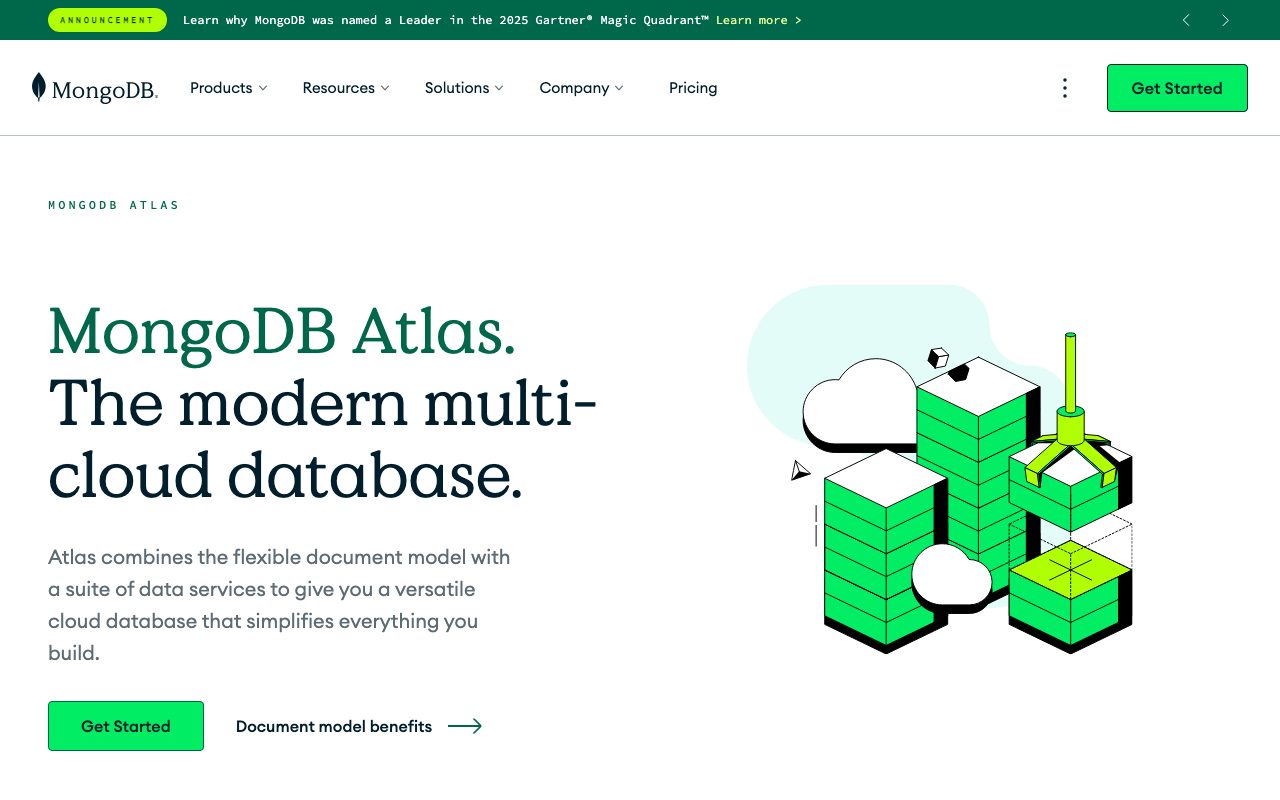
MongoDB Atlas
The fully-managed cloud version of MongoDB with built-in search, vector search, time series, and serverless tiers.
Gallery
About MongoDB Atlas
MongoDB Atlas is the managed database service that runs MongoDB across AWS, Azure, and GCP without you touching a server. You pick a region. You pick a tier. Atlas spins up a replica set, handles backups, scales storage, and monitors the cluster while you focus on your app.
It's the easiest way to run MongoDB in production. The free tier is genuinely useful. The pricing is honest if not always cheap. Most teams running serious Mongo workloads end up here.
It's not the right fit for every workload. Sometimes Postgres is the better answer. But for document oriented data, real time analytics, and fast iteration, MongoDB Atlas remains a strong pick.
What MongoDB Atlas does
You provision a cluster. Atlas spins up replica sets across availability zones. You connect via a connection string. The data lives in a managed Mongo instance with automatic failover, backups, and scaling.
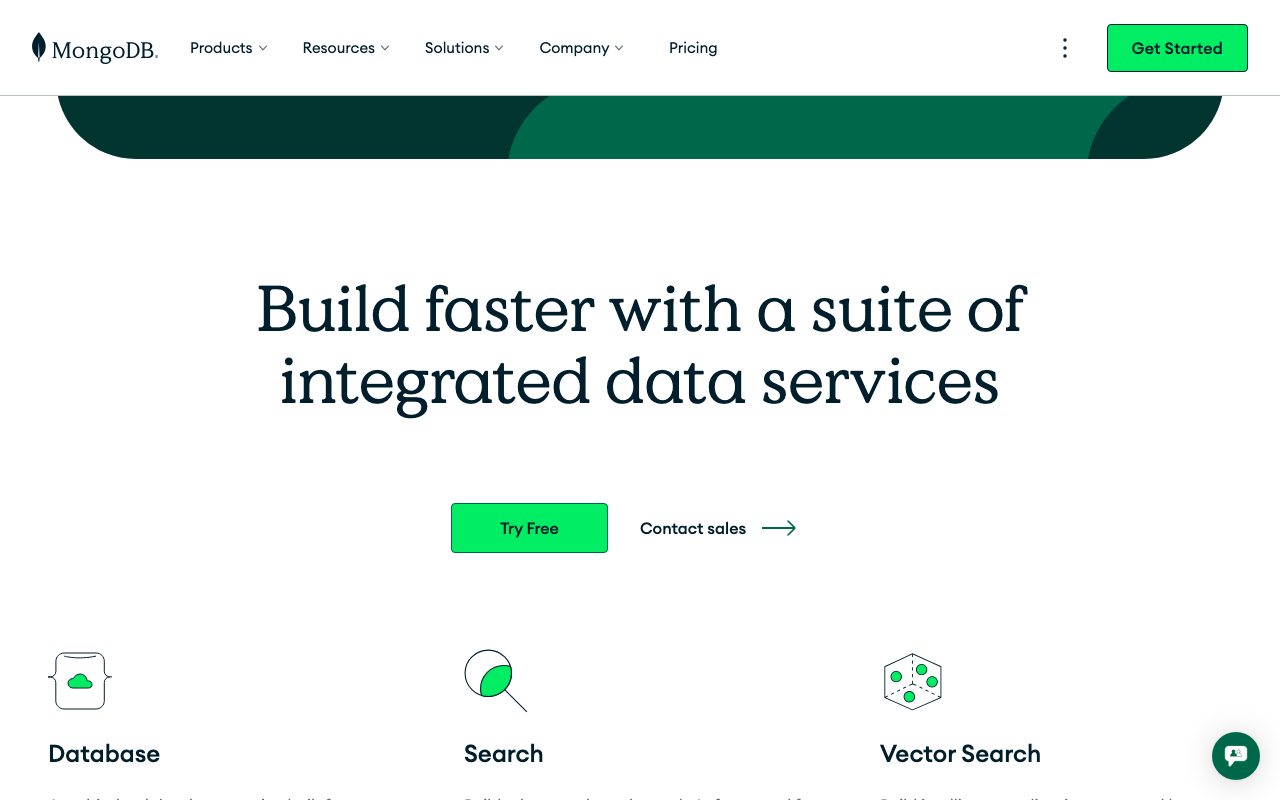
Beyond the core database, Atlas bundles Atlas Search (full text search powered by Lucene), Atlas Vector Search (vector embeddings for RAG and AI workloads), Charts (BI on top of Mongo), Triggers (serverless functions on data changes), and Data API.
The whole platform is meant to be the data backbone for an app. Operational data plus search plus analytics plus event streams. One vendor, one bill, less plumbing.
Who MongoDB Atlas is for
Application developers who like the document model. JSON heavy APIs, content platforms, e commerce catalogs, IoT telemetry, real time apps. Mongo's flexibility shines when your data shape evolves weekly.
Startups use the free tier to ship MVPs. Mid market teams scale up to dedicated clusters. Enterprises run multi region globally distributed deployments.
The AI workload crowd has been adopting Atlas Vector Search to avoid running a separate vector database. One tool for both your operational data and your RAG embeddings is a real simplification.
Pricing
The free shared tier (M0) gives 512MB of storage. Forever free. Enough for a side project, a personal dashboard, or a prototype.
Shared paid tiers (M2, M5) start around $9 per month for small workloads. Dedicated tiers (M10 and up) start at $57 per month and scale with cluster size, region, and disk.
Serverless instances are an alternative billing model based on read and write operations plus storage. Useful for spiky workloads. Atlas Search and Vector Search add separate costs based on indexed data and query volume.
Features that pull the weight
Auto scaling for storage is genuinely hands off. The cluster grows the disk as your data grows. You don't get paged for "disk full" at 3am.
Backup and point in time restore is included. You can restore to any moment in the last few days. Useful when someone runs the wrong update query in production.
Atlas Search means you don't run a separate Elasticsearch cluster for full text. Atlas Vector Search means you don't run Pinecone or Weaviate alongside. The bundled story is real value at scale.
Where Atlas hurts
Egress costs can sting. If your app servers run on a different cloud or region than your cluster, you'll pay AWS or GCP for the cross network traffic. Place your cluster in the same region as your compute.
The dedicated tier pricing climbs fast. A production worthy multi region setup with backups and Atlas Search runs into thousands of dollars per month. The free tier impression is misleading at scale.
MongoDB the company has had some licensing drama (the SSPL move pushed open source distros away). Atlas itself is unaffected as a managed service. Just know the underlying license isn't pure open source.
MongoDB Atlas vs the alternatives
Postgres on Neon, Supabase, or PlanetScale is the most common alternative. Different data model. Often the right answer when your data is relational. We compare in MongoDB Atlas vs Supabase.
FerretDB and DocumentDB clones run the Mongo wire protocol on Postgres. Useful for cost or licensing reasons. See best database as a service.
Firestore is Google's document database. Different ergonomics. Browse MongoDB Atlas alternatives for more.
If you're building an AI app with both operational data and RAG embeddings, Atlas Vector Search collapses two systems into one. The simpler architecture pays for itself even at the dedicated tier price point.
Common MongoDB Atlas questions
Is Atlas the same as MongoDB? Atlas is the managed cloud version. Same database engine, hosted by MongoDB Inc.
Can I move from Atlas to self hosted Mongo? Yes, via dump and restore or the Atlas Live Migration tool. Browse database tools for related picks.
Does Atlas run on AWS only? No. AWS, GCP, and Azure all supported. You pick the region and cloud per cluster.
The bottom line on MongoDB Atlas
MongoDB Atlas is the easy answer for managed Mongo in 2026. The free tier is real. The dedicated tiers scale to enterprise. The bundled search and vector capabilities are pragmatic.
If your app is JSON heavy and your data shape evolves, MongoDB Atlas earns its place. If you're starting from scratch with strict relational needs, Postgres on Supabase or Neon might fit better.
The category has matured and Atlas competes mostly on operational polish. For teams who want managed Mongo without the ops, this is the destination. Browse the toolindex catalog for adjacent infra.
Atlas cluster sizing
Start small and scale up. M0 is free. M2 and M5 are shared instances good for small dev workloads. M10 is the smallest dedicated tier and where most production workloads land.
Track the storage utilization and IOPS in the Atlas dashboard. Hit 70 percent on either consistently and it's time to scale up. Scaling is online and fast.
Avoid premature scaling. M30 versus M10 is a 4x cost difference. Make sure your queries are tuned and your indexes are right before throwing hardware at the problem.
Atlas Search practical use
Atlas Search uses Lucene under the hood. Define a search index per collection. Each index defines which fields are searchable, with what analyzers.
The search aggregation stage runs queries via the Atlas Search compound operator. You combine text matches, filters, and boosts.
For most apps, replacing your homegrown text search with Atlas Search lifts relevance significantly. Compare relevance before and after with real user queries.
Atlas Vector Search for AI apps
Define a vector field. Index it as a vector search index. Query it with the cosine similarity operator. RAG over your operational data without a separate database.
Embeddings come from your model of choice. OpenAI's text embedding ada, Cohere's embed, or open source like sentence transformers. Atlas stores the vectors and indexes them.
The cost model is reasonable. You pay for the index plus the query volume. Compare to running Pinecone or Weaviate alongside Mongo and the consolidation usually wins.
Atlas backup and DR
Continuous backup with point in time restore is included on dedicated tiers. You can restore to any second in the last few days.
For longer retention, configure Atlas backups to retain weekly snapshots for months. The cost ramp is small.
For multi region disaster recovery, enable a read replica in a different region. Promote it manually if the primary region goes down. Failover is in your hands.
MongoDB Atlas Triggers
Triggers are serverless functions that fire on database events. Insert, update, delete, schedule, or auth events. The function runs on Atlas without you managing infrastructure.
Useful for keeping derived data in sync. A trigger fires when a document changes. The function updates an aggregated collection. The pattern saves a separate worker.
For heavy compute, push work to a real service. Triggers are best for light orchestration, not heavy processing.
Atlas connection management
Connection limits per cluster size matter. M10 supports a few hundred concurrent connections. Going over causes new connections to wait.
Use connection pooling on your application side. The driver pools by default but tune the pool size for your workload.
For serverless functions that scale rapidly, use the Data API or set up a connection proxy. Lambda hammering Atlas with thousands of cold connections will exhaust limits.
Atlas Charts for in app dashboards
Charts is the BI layer on Atlas. Build dashboards that read from your operational data. Embed them in your app or share with stakeholders.
The visualization options cover the common chart types. Not as deep as Looker or Tableau but adequate for many internal use cases.
Useful for SaaS teams who want customer facing analytics. Embed Charts dashboards in your product with auth tokens. Customers see their own data.
Atlas global clusters and sharding
Sharding distributes data across multiple replica sets. Required for very large datasets or extremely high write throughput.
Atlas handles sharding configuration through the UI. The choice of shard key matters and is hard to change later. Plan it early.
Most apps don't need sharding. Vertical scaling on M30 to M80 covers a huge range. Reach for sharding when you've actually outgrown a single replica set.
MongoDB Atlas Data API
The Data API exposes your collections as HTTP endpoints. Useful for serverless functions and edge runtimes that don't want connection management.
The performance is reasonable for moderate throughput. For high QPS, the native driver still wins.
The convenience is real. No connection pool to manage. No driver to bundle. Just HTTP requests.
Atlas FAQ from production teams
How does scaling work? Vertical scale up to M80. Sharding past that. The Atlas dashboard handles both.
What's the SLA? 99.99 percent on dedicated tiers. Read the contract for specifics on covered scenarios.
Can I bring my own encryption keys? Yes, on Enterprise. BYOK with AWS KMS, Azure Key Vault, or GCP KMS.
Tutorial / Demo
Key Features
- Managed clusters across AWS, GCP, and Azure
- Atlas Search and Vector Search built in
- Serverless tier with per-operation billing
- Continuous backups with point-in-time restore
- Time series collections and change streams
Pros & Cons
What we like
- Free M0 tier is generous for prototypes
- Vector Search avoids running a separate database
- Multi-cloud and global cluster options
Room for improvement
- Dedicated cluster pricing climbs fast above the free tier
Frequently Asked Questions
Does MongoDB Atlas have a free tier?
Atlas vs self-hosted MongoDB, which?
Does Atlas support vector search?
Can Atlas run on AWS, GCP, and Azure?
Is MongoDB the right database for me?
Best For
Featured in
Tags
Alternatives to MongoDB Atlas
View all
Neon
Serverless Postgres with database branching, scale-to-zero compute, and a generous free tier.

Turso
Distributed SQLite at the edge. Replicate a libSQL database to dozens of regions for sub-10ms reads.
PlanetScale
Serverless MySQL platform with branching and zero-downtime migrations

Upstash
Serverless Redis, Kafka, and QStash for modern applications
Our take
Tool Index Editorial · May 2026· 4.6/5
If you're evaluating MongoDB Atlas, the headline is simple: the fully-managed cloud version of mongodb with built-in search, vector search, time series, and serverless tiers, and most teams will get value out of the box.
Worth highlighting: Free M0 tier is generous for prototypes, Vector Search avoids running a separate database, and Multi-cloud and global cluster options. The friction points: Dedicated cluster pricing climbs fast above the free tier.
In short: MongoDB Atlas is a strong pick when you need apps with deeply nested or schemaless documents, and a harder sell if dedicated cluster pricing climbs fast above the free tier would be a dealbreaker.
Editorial opinion from the Tool Index team, written from the public product pages. Not a user review.
Reviews (8)
MongoDB Atlas, better than expected
Honest take: MongoDB Atlas delivers most of what the marketing promises. What stands out is how vector Search avoids running a separate database. Got real value out of continuous backups with point-in-time restore. Main use case: RAG pipelines using Vector Search alongside metadata. Easy yes for anyone weighing the same trade-offs.
Pros
- Vector Search avoids running a separate database
- Multi-cloud and global cluster options
- Free M0 tier is generous for prototypes
Finally something that fits
Found MongoDB Atlas on a Reddit thread, glad I clicked. The thing I keep coming back to: multi-cloud and global cluster options. Their take on managed clusters across AWS, GCP, and Azure is solid. Still recommending it to people in similar setups.
Pros
- Multi-cloud and global cluster options
- Vector Search avoids running a separate database
- Free M0 tier is generous for prototypes
Pulled its weight from week one
MongoDB Atlas is one of those tools you stop noticing because it just works. Real selling point: vector Search avoids running a separate database. Would buy again without thinking twice.
Pros
- Vector Search avoids running a separate database
Worth the price of admission
Tried half a dozen options before landing on MongoDB Atlas. Honestly impressed by how free M0 tier is generous for prototypes. Got real value out of managed clusters across AWS, GCP, and Azure. Still recommending it to people in similar setups.
Pros
- Vector Search avoids running a separate database
- Free M0 tier is generous for prototypes
- Multi-cloud and global cluster options
Underrated honestly
MongoDB Atlas isn't perfect but it's the best I've used in this category. What stands out is how free M0 tier is generous for prototypes. Got real value out of serverless tier with per-operation billing. Still recommending it to people in similar setups.
Pros
- Free M0 tier is generous for prototypes
- Vector Search avoids running a separate database
- Multi-cloud and global cluster options
Recommended without reservation
Adopted MongoDB Atlas for one project, ended up using it for more. Real selling point: multi-cloud and global cluster options. It fits well for existing MongoDB shops moving off self-hosted.
Quietly excellent
Skeptical at first because MongoDB Atlas looked too simple. It's not. What stands out is how multi-cloud and global cluster options. Hard to imagine going back to my previous setup.
Pros
- Free M0 tier is generous for prototypes
- Vector Search avoids running a separate database
Solid daily driver
Hadn't planned on switching, but MongoDB Atlas was hard to ignore. Genuine strength: vector Search avoids running a separate database. Got real value out of continuous backups with point-in-time restore. Still recommending it to people in similar setups.
Pros
- Free M0 tier is generous for prototypes
- Multi-cloud and global cluster options
- Vector Search avoids running a separate database
Badge builder
Add MongoDB Atlas to your website
Choose a badge style and size, preview it here, then copy the generated HTML. Badge images are self-contained SVGs and do not require an external script.

<a href="https://toolindex.net/tools/mongodb-atlas?ref=badge" target="_blank" rel="noopener">
  <img src="https://toolindex.net/badge/mongodb-atlas/medium.svg" alt="MongoDB Atlas - Listed on Tool Index" width="180" height="50" />
</a>How to use the badge
- 1. Pick the style, size, and theme that fit your layout.
- 2. Copy the generated HTML from the code block.
- 3. Paste it into your footer, homepage, or press page.
Score badge available
MongoDB Atlas qualifies for the score and circle badges based on its current top-10 positionin Database.
Badge clicks return visitors to this profile with a referral tag so the source remains identifiable.
Related Tools



Work on MongoDB Atlas? Request listing access or correction