
Vercel
Develop, preview, and ship delightful user experiences
Gallery
About Vercel
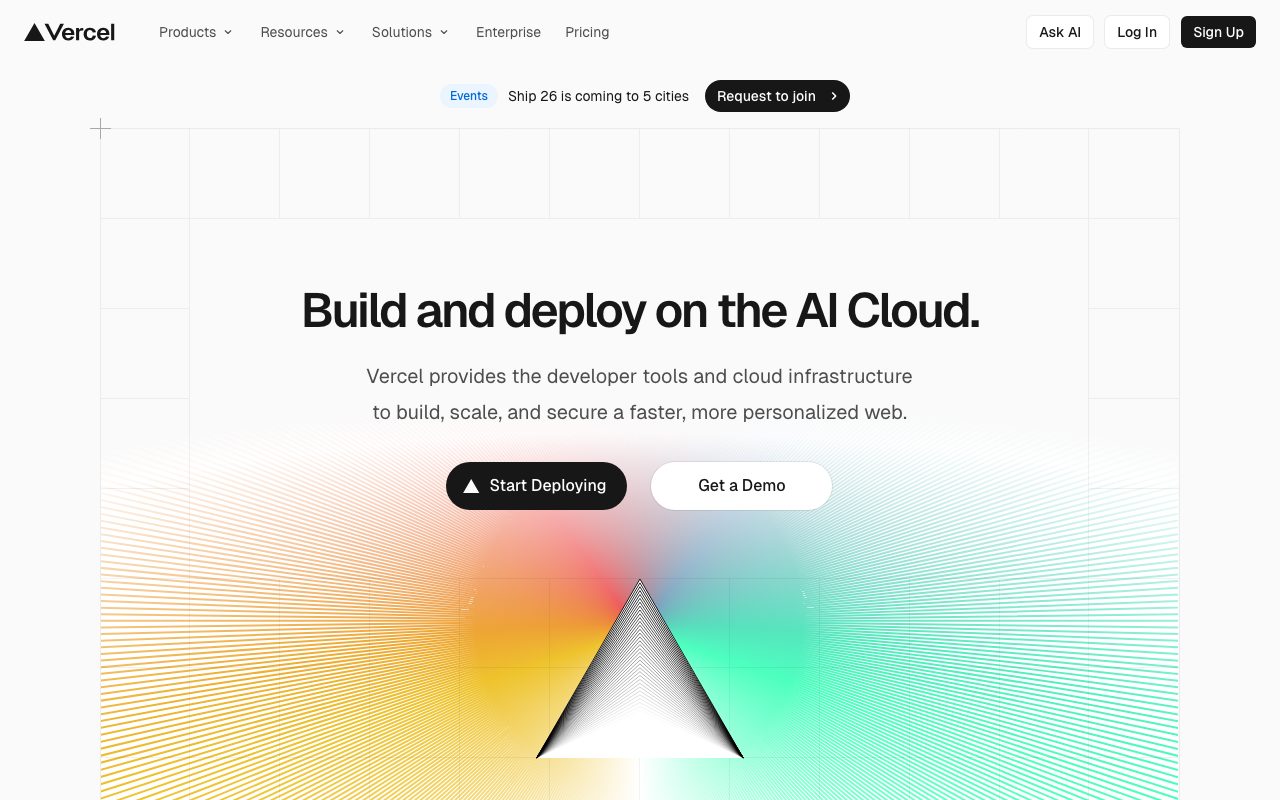
Vercel is the deployment platform built around Next.js, edge networks, and a developer experience that prioritizes "git push and walk away." It's the spiritual heir to Heroku for the modern frontend era.
The company makes Next.js, hosts it best, and has built a deep platform around frontend deployment. The lines between framework and platform have blurred on purpose.
If you've used Netlify or Cloudflare Pages, Vercel is the closest peer. The Next.js gravity is what tilts most teams toward it.
What Vercel actually does
Vercel builds and deploys your frontend (and increasingly, your backend functions) onto a global edge network. You connect a git repo, and every push gets a unique preview URL. Production deploys happen on merge.
The platform handles CDN, image optimization, serverless functions, edge functions, analytics, and observability. It's not just hosting. It's a full deploy pipeline plus runtime.
Preview deployments
Every PR gets its own URL with the full app running. Stakeholders can review. QA can test. Designers can comment. This single feature reshapes how teams ship.
Who Vercel is for
Frontend teams using Next.js, React, Vue, Svelte, or any modern framework. Marketing sites that need a CDN. Product apps that mix static rendering with serverless backends.
It's overkill for static brochure sites that could live on a $5 VPS. The platform's strengths show when you need previews, edge functions, or serious frontend tooling.
The Next.js team
If you're shipping Next.js, Vercel is the path of least resistance. Image optimization, server components, ISR, and middleware all work without configuration. Self-hosting Next.js is possible but Vercel handles the rough edges.
Pricing breakdown
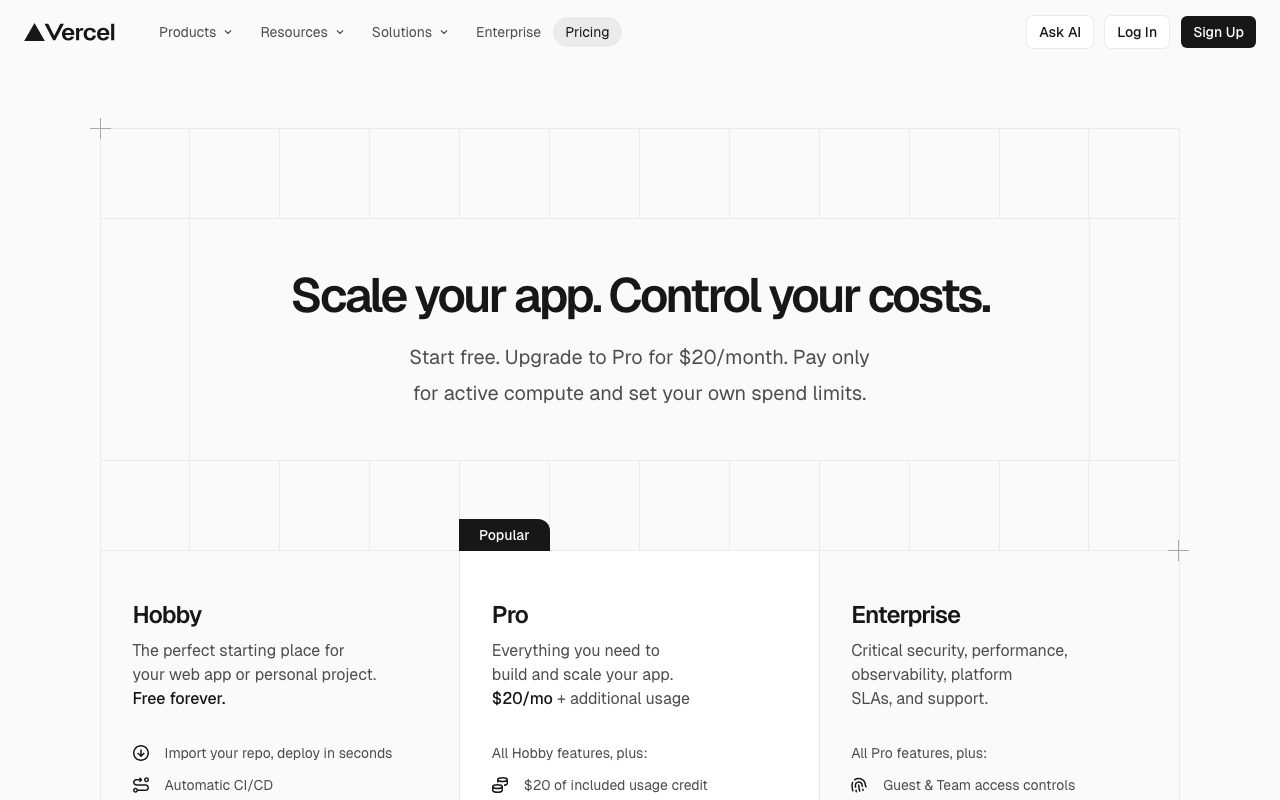
Hobby tier is free for personal projects. Pro is per-seat with included usage. Enterprise for SLA and security needs.
Pro is reasonable for small teams. Watch the bandwidth and function execution charges as you scale. Vercel can get expensive fast if you have heavy traffic and aren't watching the meters.
The bandwidth gotcha
Bandwidth and function invocations are the two costs that bite. If you have viral traffic spikes, your bill can scale unpleasantly. Many teams add a CDN like Cloudflare in front to control costs.
Standout features of Vercel
The git-to-prod loop is industry-leading. Push, get a URL, merge, get a deploy. Nothing else feels quite this smooth out of the box.
Edge functions and middleware. You can run logic at the edge in milliseconds, close to your users. Authentication, A/B testing, geolocation routing all live there.
Vercel Analytics and Speed Insights
Real-user metrics for Web Vitals, plus traffic analytics that don't require a third-party script. They're paid features but useful and well-integrated.
Honest tradeoffs with Vercel
Vendor lock-in is real. Next.js features lean on Vercel's runtime. Self-hosting is possible but parts of the experience don't translate. Plan accordingly if portability matters.
The pricing model can surprise. Bandwidth caps, function execution times, and team seats all add up. Read the meters before assuming Pro covers your scale.
Vercel is what Heroku felt like in 2010, except for the frontend era. The DX bar they set keeps the rest of the industry honest.
Vercel vs alternatives
Vercel vs Netlify: Netlify was first to this category. Vercel ate market share by going deeper on Next.js. Both are solid; Next.js bias decides for many teams.
Vercel vs Cloudflare Pages: Cloudflare is cheaper at scale and has a different runtime. Vercel has better Next.js support and tooling.
Vercel vs Render: Render is broader, covers backends and databases. Vercel is frontend-focused with backend functions on top.
For broader views, see the best hosting platforms or check Netlify alternatives and Vercel vs Netlify.
When Vercel wins
You're shipping Next.js. You want preview URLs by default. You want edge functions without hand-rolling them.
Bottom line on Vercel
Vercel is the modern frontend deployment platform that earned its position by sweating developer experience harder than anyone else. The DX is real. So is the bill at scale.
If you're not a Next.js team and you're cost-sensitive, Cloudflare Pages or Netlify deserve a look. For the rest, Vercel is hard to beat. See tools for frontend developers for adjacent picks.
Why Vercel feels different from older PaaS
Heroku was revolutionary in 2010. Vercel is revolutionary in the 2020s. The difference is generational. Heroku optimized for backend Rails and Django apps. Vercel optimized for modern frontend frameworks where the line between client and server is blurred.
Edge functions, server components, ISR, and middleware all assume a different architectural model than traditional PaaS. Vercel built for that model from the start. Older platforms are bolting it on.
The Next.js advantage
Vercel maintains Next.js. That gravitational pull means Next.js features show up on Vercel before anywhere else. Self-hosting Next.js is possible but you'll always be a step behind on platform-specific optimizations.
Vercel beyond Next.js
The platform supports any modern framework: SvelteKit, Nuxt, Astro, Remix, Vue, Solid. Each has framework presets that handle build configuration. The DX isn't quite as smooth as Next.js but it's still better than rolling your own deployment.
The serverless function runtime supports Node and edge runtimes. You can build APIs alongside your frontend without separate hosting for backend code. For full-stack JS apps, this consolidation is meaningful.
Preview deployments deep dive
Every PR gets a unique URL. Comments from stakeholders go directly on the preview. Designers can review without spinning up local environments. QA can test before merge. This is the feature most teams cite as why they stay on Vercel.
Common Vercel questions
Is Vercel free for personal use? Yes, the Hobby tier is generous. Does Vercel work with Cloudflare? Yes, you can put Cloudflare in front for additional caching. Can you self-host Next.js outside Vercel? Yes, with some feature limitations.
For more, see tools for frontend teams and Vercel vs Netlify.
Final take on Vercel
Vercel is the modern frontend deployment platform that earned its position by sweating developer experience harder than the rest. The bill at scale can sting, but the time saved usually pays for itself. For frontend-heavy teams, it's hard to beat.
Vercel's edge network architecture
Vercel runs on a global CDN with over a hundred edge regions. Static assets cache at the edge. Edge functions execute at the edge. Server-rendered pages can stream from regional compute. The architecture is designed to put your content close to users.
This matters for performance. Time-to-first-byte from cold caches is competitive globally. For apps with international audiences, the latency improvement compared to single-region hosting is real and measurable.
Image optimization
Vercel handles image transformation: resizing, format conversion to WebP or AVIF, responsive images for different viewports. Next.js's Image component leverages this automatically. For sites with lots of images, this saves real bandwidth and improves Core Web Vitals.
Vercel functions and runtimes
Serverless functions run on Node, Python, or other supported runtimes. Edge functions run on a lighter, V8-based runtime that's faster to cold-start but more limited in what it can do. You pick the runtime based on your needs.
For simple API endpoints and middleware, edge functions win on speed. For complex backend logic with heavy dependencies, Node serverless wins on capability. Most apps use both, with the platform routing requests appropriately.
Vercel observability
Vercel Analytics, Speed Insights, and Logs give you visibility into how your app performs in production. Real-user metrics show actual loading speeds across user devices and geographies. Logs surface errors and slow requests. The observability stack is paid but useful.
For teams that don't want to integrate Datadog or New Relic, Vercel's built-in observability is enough. For teams with existing observability commitments, Vercel exports metrics that integrate with external tools.
Preview deployments at scale
For larger teams, preview deployments are a workflow superpower. Designers comment directly on previews. Product managers test before merging. Stakeholders review without spinning up environments. Preview deployments compress the review cycle from days to hours.
Vercel pricing reality
The Hobby tier is genuinely free for personal projects. Pro is reasonable for small teams. The bill bites at scale, particularly on bandwidth-heavy sites. Function execution time, image optimization volume, and team seats all factor into total cost.
For unexpected viral traffic, Vercel's pricing can produce surprise bills. Many teams put Cloudflare in front of Vercel for additional caching. Some teams self-host Next.js to avoid the meter entirely. Both are legitimate strategies for cost-conscious operators.
Self-hosting Next.js
Next.js can run anywhere Node runs. You can self-host on AWS, on a VPS, or in your own Kubernetes cluster. Some Vercel-specific features (like image optimization) require additional configuration. Most apps work fine.
The self-host route makes sense for teams with strong DevOps capabilities and predictable scale. For teams that want zero infrastructure overhead, Vercel pays for itself. The choice is yours.
Vercel's framework relationships
Vercel sponsors and contributes to multiple frameworks beyond Next.js. SvelteKit, Nuxt, Astro, and others get attention. The platform's framework presets show this multi-framework commitment. You're not locked to Next.js if you start on Vercel.
For teams evaluating frameworks, Vercel is framework-friendly. The Next.js bias exists but other frameworks are first-class citizens, not afterthoughts. This is healthier than tools that lock you to one stack.
The DX leadership story
Vercel set the bar for modern frontend deployment DX. Other platforms have copied features, but Vercel keeps shipping new ones. The platform innovates faster than competitors, which makes choosing it a defensive bet on continued momentum.
Tutorial / Demo
Key Features
- Git-based deployments
- Global edge network (100+ cities)
- Preview deployments for every commit
- Edge Functions and Middleware
- Built-in analytics
- Framework auto-detection
- Image optimization
- Environment variable management
Pros & Cons
What we like
- Incredibly easy to deploy
- Best-in-class Next.js support
- Fast global edge network
- Great developer experience
- Generous free tier
Room for improvement
- Can get expensive at scale
- Best features tied to Next.js
- Limited compute for complex backends
- Vendor lock-in concerns
Frequently Asked Questions
What is Vercel used for?
Is Vercel free to use?
What are the pros and cons of Vercel?
Who should use Vercel?
Best For
Featured in
Tags
Alternatives to Vercel

Our take
Tool Index Editorial · May 2026· 4.6/5
Vercel positions itself as develop, preview, and ship delightful user experiences, and on the whole it earns the framing.
The standout points: Incredibly easy to deploy, Best-in-class Next.js support, and Fast global edge network. Where it stumbles: Can get expensive at scale and Best features tied to Next.js.
Recommendation: this is a strong default when you need frontend developers. If can get expensive at scale would be a dealbreaker, the alternatives section below is worth a scroll.
Editorial opinion from the Tool Index team, written from the public product pages. Not a user review.
Reviews (6)
Quietly excellent
Found Vercel on a Reddit thread, glad I clicked. The biggest win has been generous free tier. Git-based deployments works the way you'd hope. Found it works best for next.js applications. That said, limited compute for complex backends is a real gripe.
Pros
- Incredibly easy to deploy
Cons
- Vendor lock-in concerns
Surprised how much we use this
Skeptical at first because Vercel looked too simple. It's not. The biggest win has been generous free tier. Edge functions and middleware works the way you'd hope.
Pros
- Generous free tier
- Great developer experience
Hit the Vercel sweet spot
Found Vercel on a Reddit thread, glad I clicked. Honestly impressed by how great developer experience.
Vercel is fine, here's the real take
Picked Vercel for the lower price, stayed for the actual quality. Where it really wins is incredibly easy to deploy. Worth calling out the framework auto-detection too. Found it works best for e-commerce storefronts. Wish they'd address how can get expensive at scale. Solid pick for my use case, your mileage may vary.
Cons
- Best features tied to Next.js
- Can get expensive at scale
Easy 5 from me
Came to Vercel after frustration with what I had before. Real selling point: incredibly easy to deploy. The environment variable management is more useful than I expected. Wish they'd address how vendor lock-in concerns. Would buy again without thinking twice.
Cons
- Best features tied to Next.js
- Can get expensive at scale
Useful but pricey
Vercel is one of those tools you stop noticing because it just works. What stands out is how great developer experience. Their take on git-based deployments is solid. Honest gripe: limited compute for complex backends.
Pros
- Best-in-class Next.js support
Cons
- Limited compute for complex backends
Badge builder
Add Vercel to your website
Choose a badge style and size, preview it here, then copy the generated HTML. Badge images are self-contained SVGs and do not require an external script.

<a href="https://toolindex.net/tools/vercel?ref=badge" target="_blank" rel="noopener">
  <img src="https://toolindex.net/badge/vercel/medium.svg" alt="Vercel - Listed on Tool Index" width="180" height="50" />
</a>How to use the badge
- 1. Pick the style, size, and theme that fit your layout.
- 2. Copy the generated HTML from the code block.
- 3. Paste it into your footer, homepage, or press page.
Score badge available
Vercel qualifies for the score and circle badges based on its current top-10 positionin Cloud.
Badge clicks return visitors to this profile with a referral tag so the source remains identifiable.
Related Tools

Kevin Gabeci
Solo developer building web apps, cozy browser games, and AI creator toolkits.

Coolify
Self-hostable, open source alternative to Heroku and Netlify
Hetzner
High-performance European cloud hosting at unbeatable prices

Warp
The modern terminal reimagined with AI and collaboration
Work on Vercel? Request listing access or correction