Hetzner
High-performance European cloud hosting at unbeatable prices
Gallery
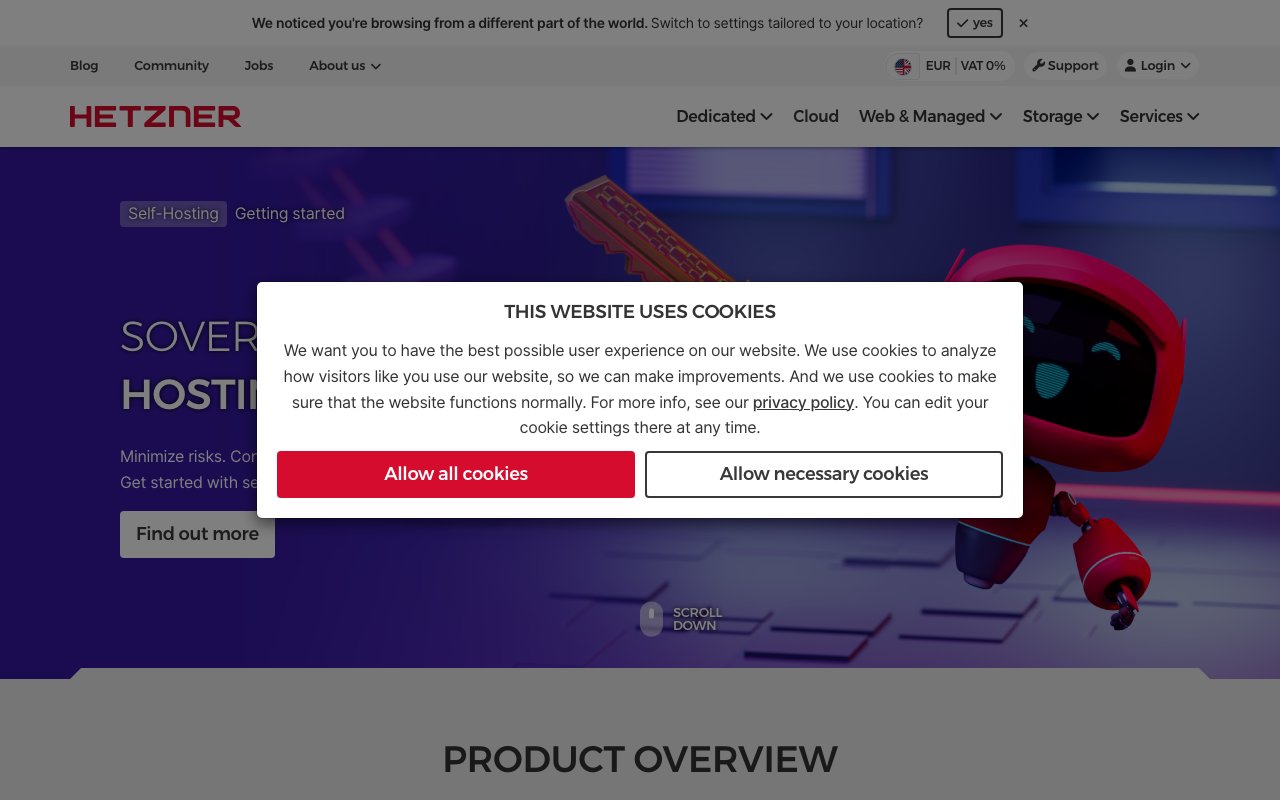
About Hetzner
Hetzner is the German cloud provider that runs the same workloads AWS runs, for a quarter of the price. The catch is that you have to know what you're doing. Hetzner doesn't hold your hand. The reward is bills you can read without flinching.
For developers tired of AWS pricing surprises, Hetzner is the standard switch. Cloud servers, dedicated hardware, object storage, and managed Kubernetes all live there. The data centers are in Germany, Finland, and the US, with Singapore expanding. The hardware is some of the most cost-efficient compute on the market.
What Hetzner offers
Hetzner has three product lines. Hetzner Cloud is the AWS EC2 equivalent: virtual machines, networking, load balancers, volumes, all hourly billed. Hetzner Dedicated is bare metal servers you rent monthly, often AMD Ryzen or EPYC class. Hetzner Robot is the management layer for bare metal.
The Cloud product is what most people start with. You pick a server size, region, and OS image, and you have a VM in 30 seconds. Snapshots, backups, and floating IPs work as expected. The networking model is simple and not particularly clever, which is a feature.
Storage Box and Object Storage
Hetzner's Storage Box is dirt cheap NFS storage for backups and large files. Object Storage is S3-compatible and priced aggressively, often cheaper than Cloudflare R2 at scale. For backup workloads, the math beats AWS by an order of magnitude.
Who Hetzner is for
Hetzner fits engineers who can read documentation and run Linux. Indie hackers, small startups, agencies, and cost-conscious enterprises use Hetzner heavily. Anyone running a side project that has bills attached should at least price-check Hetzner against DigitalOcean and AWS.
Hetzner isn't for teams that need a managed everything experience or compliance frameworks like FedRAMP. The support is good but slow by AWS Enterprise standards. If you can't troubleshoot a Linux box, you'll struggle.
Hetzner pricing
A 4 vCPU shared-CPU Cloud server with 8 GB RAM costs around 5 euros a month. The same general-purpose tier on AWS would run you over 30 dollars before bandwidth. Hetzner includes 20 TB of egress per month with most servers, which is the part that actually matters for high-traffic apps.
Dedicated servers start around 35 euros a month for entry tier and scale to AMD EPYC machines with 64 cores and 256 GB RAM for a few hundred euros. The pricing pages list every option clearly, with no quote-required tiers.
Hetzner features in practice
The Cloud Console is plain and functional. The CLI is solid. Terraform support is mature. The API is well-documented and complete. There's no Lambda equivalent, no managed databases beyond what you self-host, and the ML accelerator story is thin.
Hetzner Cloud's load balancers, firewalls, and private networks cover most basic needs. The managed Kubernetes offering is competitive for simple clusters. For anything beyond standard, you'll be self-hosting on the dedicated boxes.
The unlimited bandwidth story
Hetzner's bandwidth allowance is the unsung hero. AWS charges 9 cents per GB egress past the free tier. Hetzner gives you 20 TB included and overage at 1 euro per TB. For any product that ships content to users, this difference compounds dramatically.
Tradeoffs
Hetzner has periodic outages, usually small, and the support response time is hours not minutes. The signup process can be slow because Hetzner manually verifies new accounts to prevent abuse. Once you're in, things work.
Region selection is limited compared to AWS or Google Cloud. If you need a presence in South America, Africa, or much of Asia, Hetzner won't cover it. Latency-sensitive global apps need a CDN like Cloudflare in front, which is a healthy pattern anyway.
Hetzner plus Cloudflare is the cheapest serious cloud setup on the market. The combined bill for most small apps is under 20 euros a month.
Hetzner vs alternatives
Compared to DigitalOcean, Hetzner is significantly cheaper for raw compute and more generous on bandwidth. DigitalOcean has more polish, more managed services, and better US presence. Compared to AWS, Hetzner is a different price universe with much narrower service breadth.
Compared to OVH, Hetzner has better hardware reliability and a cleaner API. OVH is closer on price for dedicated. See our best cheap cloud hosting roundup and AWS alternatives guide.
Bottom line on Hetzner
Hetzner is the right pick when your AWS bill is keeping you up at night and you have the engineering chops to run your own boxes. The savings are real, the hardware is solid, and the company is profitable and stable.
Pair Hetzner with Cloudflare for global edge, with managed Postgres on Neon or Supabase if you want a database SaaS, and you've replaced 80 percent of an AWS stack at a fraction of the cost. For experienced developers, this is the obvious move. For total beginners, start on Vercel or DigitalOcean and graduate to Hetzner later.
Hetzner architecture patterns
The most common Hetzner production pattern looks like this. A handful of Cloud servers running your application behind a Hetzner Load Balancer, with Cloudflare in front for global edge and DDoS protection. A managed Postgres on Neon or Supabase for the database layer. Object Storage for static files and backups. Total monthly cost: usually under 100 euros for small to mid-size apps.
For larger workloads, the dedicated bare metal servers offer extreme value. AMD EPYC machines with 64 cores and 256GB RAM cost a few hundred euros monthly. Compare that to comparable AWS instance pricing and the math becomes obvious. The catch is you manage the OS and software stack yourself.
Network and bandwidth
The network in Hetzner data centers is reliable and fast within Europe. Inter-region latency between Helsinki, Falkenstein, and Nuremberg is low. Latency to North America is fine for most use cases but worse than running US-based infrastructure. Pair Hetzner European compute with Cloudflare for global users to mitigate.
The unmetered bandwidth allowance is genuinely game-changing for high-traffic apps. Hetzner includes 20 TB of egress per server, with overage at 1 euro per TB. AWS charges 9 cents per GB after the first GB, which is 90 dollars per TB. Run any reasonably trafficked app on AWS and the bandwidth bill alone will fund a Hetzner migration.
Hetzner with Kubernetes
Hetzner has a managed Kubernetes service that handles the control plane. You attach Hetzner Cloud servers as worker nodes. The integration with Hetzner Load Balancers and persistent volumes works cleanly. For small to mid-size Kubernetes workloads, this is the cheapest serious option in Europe.
The platform doesn't have the depth of GKE or EKS for advanced features like service mesh, deep observability, or autoscaling. For teams that just need standard Kubernetes at low cost, Hetzner works. For teams pushing the limits of orchestration, the major US clouds still win on feature breadth.
Common Hetzner questions
How is Hetzner support? Slow but competent. Email tickets get answered in hours, not minutes. Phone support is limited. The community on forums and Discord is helpful. Compare to AWS Enterprise support that responds in 15 minutes; the gap is real. For most teams, the trade is acceptable given the price.
Is Hetzner reliable? Generally yes. There are occasional regional outages, usually short, with transparent post-mortems. Single-region single-server uptime is good but not perfect. Production setups should run multi-server and consider multi-region for critical services. The reliability is comparable to other mid-tier cloud providers, well below AWS but well above DIY hosting.
Can I run AI workloads on Hetzner? Limited. Hetzner has GPU dedicated servers with NVIDIA hardware, but the selection is narrow and inventory is unpredictable. For serious GPU work, runpod, Lambda Labs, or paperspace are better options. For occasional inference, Hetzner GPU servers can work.
Hetzner business considerations
Hetzner is privately held, profitable, and has been operating since the late 1990s. The business is stable in a way many cloud providers aren't. The pricing has remained low and consistent for years. The team isn't trying to optimize for IPO; they're optimizing for running a healthy infrastructure business.
That stability is part of Hetzner's appeal. You're not betting on a startup that might pivot or get acquired and ruin pricing. Compare to the various cheap cloud providers that have died, raised prices, or been bought over the years. Hetzner has outlasted most of them and shows every sign of continuing. For long-running workloads, that predictability matters.
Final take on Hetzner
Hetzner remains the cheapest serious cloud provider for technical teams that can manage their own infrastructure. The pricing has stayed consistent for years. The hardware quality is solid. The bandwidth allowances are unmatched. For developers and small companies frustrated by AWS bills, Hetzner is the obvious switch.
The tradeoffs are honest. Less hand-holding than AWS or Google Cloud. Fewer managed services. Smaller global presence. Slower support response. None of these are dealbreakers for teams that know what they're doing. They are dealbreakers for teams that need a managed everything experience or compliance frameworks Hetzner doesn't support.
The pattern that works best in 2026 is Hetzner for compute, Cloudflare for edge and CDN, a managed Postgres on Neon or Supabase, and Object Storage for files and backups. That stack handles a remarkable range of workloads at a fraction of equivalent AWS cost. For experienced engineering teams optimizing infrastructure spend, this combination is hard to beat. For everyone else, paying more for AWS or DigitalOcean is the correct trade.
Tutorial / Demo
Key Features
- Cloud VPS starting at under $5 per month
- Dedicated root servers with enterprise hardware
- Managed Kubernetes with Hetzner Cloud
- Block and object storage
- Load balancers and floating IPs
- Firewall and private networking
- Data centers in Germany, Finland, USA, and Singapore
Pros & Cons
What we like
- Exceptional price-to-performance ratio
- Reliable infrastructure with 99.9% uptime SLA
- Fast NVMe storage on all cloud instances
- No egress bandwidth charges in most plans
- Strong privacy under German and EU data laws
Room for improvement
- Fewer global regions than AWS or GCP
- Managed services ecosystem is smaller
- Support can be slower on lower-tier plans
- No managed database service
Frequently Asked Questions
Is Hetzner really that cheap?
Where are Hetzner data centers?
Hetzner vs DigitalOcean, which is better?
Does Hetzner have managed Kubernetes?
Is Hetzner reliable for production?
Best For
Featured in
Tags
Alternatives to Hetzner

Render
Managed cloud hosting for web services, static sites, cron jobs, and Postgres without the AWS console.

Railway
Deploy apps to production infrastructure in seconds

Fly.io
Run full-stack apps and Postgres close to your users by deploying Firecracker microVMs to dozens of regions.

Heroku
The original git-push PaaS. Owned by Salesforce, still kicking, still the easiest way to deploy a Rails or Django app.
Our take
Tool Index Editorial · May 2026· 4.6/5
If you're evaluating Hetzner, the headline is simple: high-performance european cloud hosting at unbeatable prices, and most teams will get value out of the box.
The standout points: Exceptional price-to-performance ratio, Reliable infrastructure with 99.9% uptime SLA, and Fast NVMe storage on all cloud instances. The friction points: Fewer global regions than AWS or GCP and Managed services ecosystem is smaller.
In short: Hetzner is a strong pick when you need hosting web applications and APIs on affordable VPS, and a harder sell if fewer global regions than AWS or GCP would be a dealbreaker.
Editorial opinion from the Tool Index team, written from the public product pages. Not a user review.
Reviews (8)
Hetzner, better than expected
Hetzner isn't perfect but it's the best I've used in this category. What stands out is how strong privacy under German and EU data laws. Still recommending it to people in similar setups.
Pros
- Exceptional price-to-performance ratio
- No egress bandwidth charges in most plans
Hetzner, better than expected
Hetzner isn't perfect but it's the best I've used in this category. Real selling point: exceptional price-to-performance ratio. Worth calling out the block and object storage too. It fits well for running Kubernetes clusters at a fraction of AWS cost. Hard to imagine going back to my previous setup.
Pros
- No egress bandwidth charges in most plans
- Reliable infrastructure with 99.9% uptime SLA
- Strong privacy under German and EU data laws
Underrated honestly
The pitch for Hetzner sounded too good to be true. Mostly true. Genuine strength: no egress bandwidth charges in most plans.
It just works
Took a few weeks for Hetzner to click, then it stuck. The biggest win has been no egress bandwidth charges in most plans.
Pros
- Exceptional price-to-performance ratio
Recommended without reservation
Hetzner solves a real problem for me, but it's not magic. The biggest win has been no egress bandwidth charges in most plans. Got real value out of block and object storage. Not perfect: managed services ecosystem is smaller. Would buy again without thinking twice.
Pros
- Exceptional price-to-performance ratio
- Reliable infrastructure with 99.9% uptime SLA
- Strong privacy under German and EU data laws
Worth the price of admission
Honest take: Hetzner delivers most of what the marketing promises. The thing I keep coming back to: fast NVMe storage on all cloud instances. Their take on dedicated root servers with enterprise hardware is solid. Easy yes for anyone weighing the same trade-offs.
Hit the Hetzner sweet spot
Tried Hetzner on a side project first. Where it really wins is no egress bandwidth charges in most plans. Their take on cloud VPS starting at under $5 per month is solid.
Best decision this quarter
Got Hetzner on the recommendation of someone I trust. The biggest win has been reliable infrastructure with 99.9% uptime SLA. The managed Kubernetes with Hetzner Cloud is more useful than I expected. Mostly using it for european-based hosting for GDPR compliance. Would buy again without thinking twice.
Pros
- Reliable infrastructure with 99.9% uptime SLA
- Fast NVMe storage on all cloud instances
Badge builder
Add Hetzner to your website
Choose a badge style and size, preview it here, then copy the generated HTML. Badge images are self-contained SVGs and do not require an external script.

<a href="https://toolindex.net/tools/hetzner?ref=badge" target="_blank" rel="noopener">
  <img src="https://toolindex.net/badge/hetzner/medium.svg" alt="Hetzner - Listed on Tool Index" width="180" height="50" />
</a>How to use the badge
- 1. Pick the style, size, and theme that fit your layout.
- 2. Copy the generated HTML from the code block.
- 3. Paste it into your footer, homepage, or press page.
Score badge available
Hetzner qualifies for the score and circle badges based on its current top-10 positionin Cloud.
Badge clicks return visitors to this profile with a referral tag so the source remains identifiable.
Related Tools

Coolify
Self-hostable, open source alternative to Heroku and Netlify

Upstash
Serverless Redis, Kafka, and QStash for modern applications
Heroku
The original git-push PaaS. Owned by Salesforce, still kicking, still the easiest way to deploy a Rails or Django app.
PlanetScale
Serverless MySQL platform with branching and zero-downtime migrations
Work on Hetzner? Request listing access or correction