Cloudflare Pages
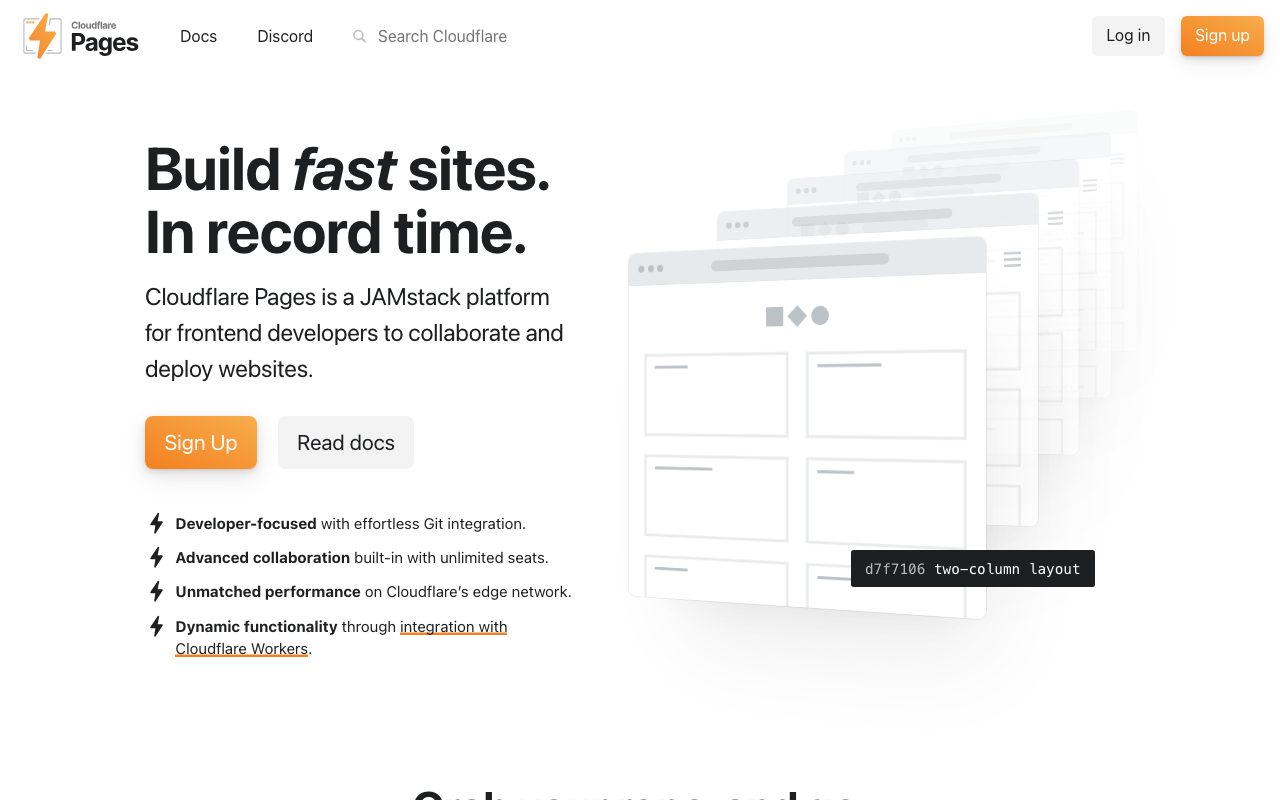
Free Jamstack hosting on Cloudflares edge with unlimited bandwidth and tight integration with Workers.
Gallery
About Cloudflare Pages
Cloudflare Pages is Cloudflare's Jamstack hosting product. Free tier, unlimited bandwidth, edge-deployed across one of the largest CDNs on the planet. The pitch writes itself.
It's not flashier than Vercel or Netlify. It's just cheaper and faster at scale. That's a tradeoff plenty of teams happily make.
What Cloudflare Pages actually does
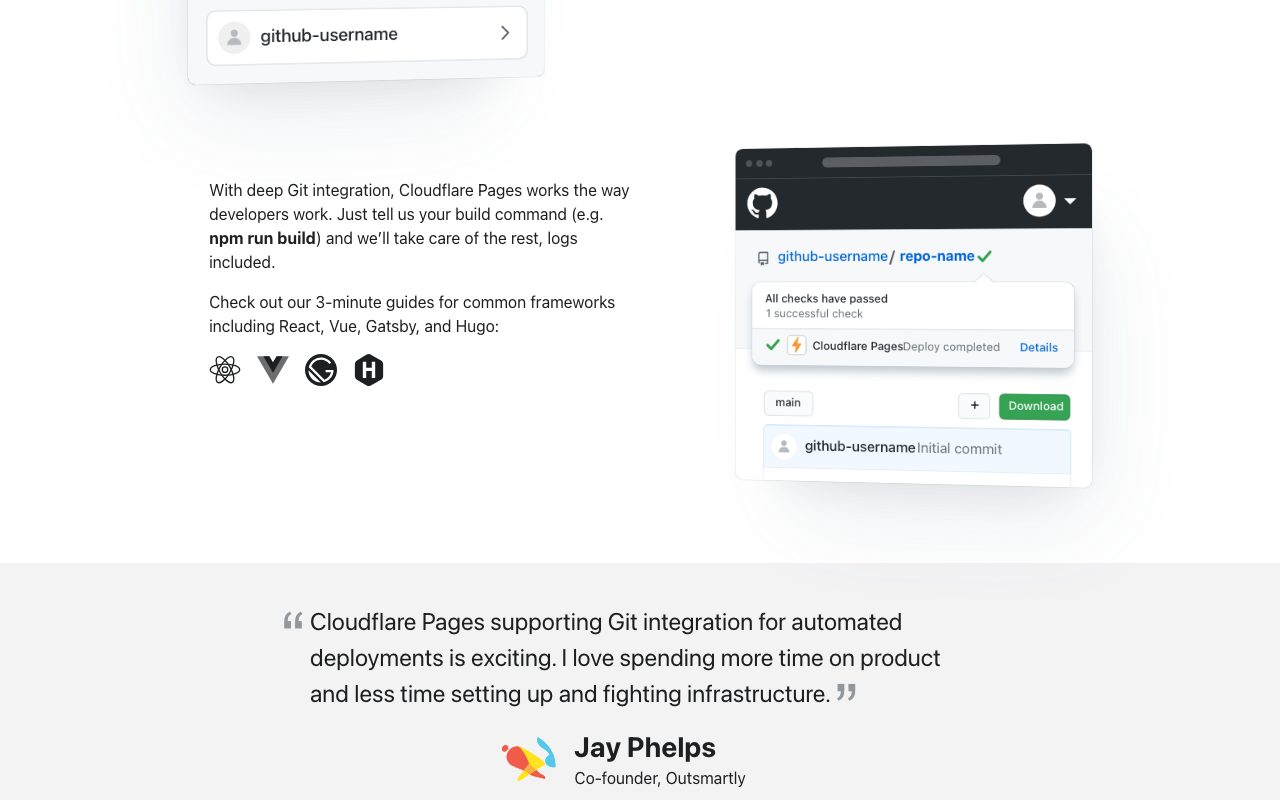
You connect a Git repo. Cloudflare Pages builds your static site or framework output and deploys it to the Cloudflare edge. That's the standard Jamstack flow.
Pull requests get preview deployments. The main branch gets the production URL. Custom domains, TLS, and HTTPS are free and one-click.
The interesting part is the integration with Workers. Pages Functions let you write server-side handlers that run on the same edge network. Add D1, R2, KV, or Durable Objects and you're building real apps, not just hosting marketing sites.
Who Cloudflare Pages is for
Cost-conscious teams. Pages' free tier really is free at scale. No bandwidth caps, no traffic-based bills, no surprise overages.
Teams already inside the Cloudflare ecosystem also benefit. If you're using Workers, R2, or D1 already, Pages drops in cleanly. Auth, storage, edge logic, and hosting all run under one roof.
Cloudflare Pages pricing breakdown
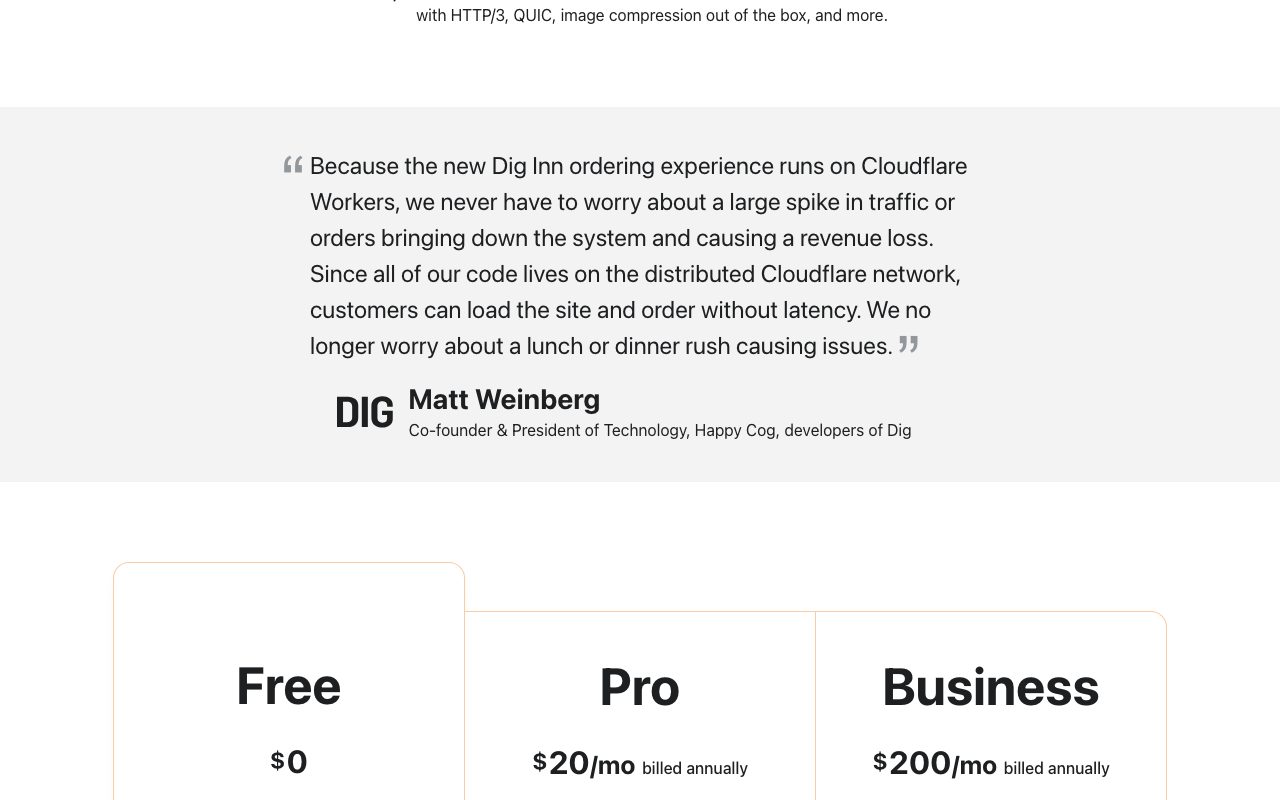
The free tier includes unlimited sites, unlimited requests, unlimited bandwidth, and 500 builds per month. Most projects never need more.
The Workers Paid plan runs $5 per month. That increases build minutes, function invocations, and other quotas. It's still cheap by hosting standards.
Storage and other Cloudflare products bill separately. R2 charges by storage and egress. D1 has its own row and read budget. None of those bills surprise you.
Standout Cloudflare Pages features
Edge deploys to 300-plus cities mean genuinely fast cold loads worldwide. Cloudflare's network is the part of the business they bet the company on for over a decade.
Tight pairing with Workers, D1, R2, and KV is the moat. You can build a real app, not just host a static one. The edge model is consistent across all of them.
Branch preview deployments come standard, not gated behind a paid plan. Every PR gets a unique URL. That's how it should be everywhere.
Honest tradeoffs
The build environment is more limited than Vercel's. Some Next.js features and exotic frameworks don't behave the same way. SSR support has gaps, though it keeps improving.
Documentation can lag behind product changes. The Cloudflare docs site is enormous and sometimes contradicts itself between sections. Patience helps.
And the developer experience around full-stack apps is still maturing. Vercel and Netlify polish the framework integrations harder. Cloudflare is catching up but not there yet on every framework.
If you don't need the latest Next.js bells and whistles, Cloudflare Pages is the cheapest serious hosting available.
Cloudflare Pages vs the alternatives
The headline rivals are Vercel and Netlify. Both have slicker DX for Next.js and richer build environments. Cloudflare Pages is dramatically cheaper at scale.
GitHub Pages is even cheaper but limited to static sites only. No functions, no edge logic, no previews per PR.
For Astro, SvelteKit, or static-first projects, Cloudflare Pages is honestly the best price-performance pick. The Workers integration also makes Supabase or D1 dead simple to wire in.
See best Jamstack hosting, Cloudflare Pages alternatives, and Cloudflare Pages vs Vercel.
Bottom line on Cloudflare Pages
Cloudflare Pages is the cost winner. The free tier alone solves most marketing sites and docs portals forever. Pair it with Workers and you've got a real edge platform.
If you're shipping a Jamstack site and the bandwidth bills on Vercel make you flinch, switch. You'll save real money and lose almost nothing.
Cloudflare Pages with Workers
The real story isn't Pages alone. It's Pages plus Workers plus the rest of Cloudflare's edge platform. Treat Pages as the static frontend layer and Workers as the dynamic backend layer.
Pages Functions let you write server-side handlers that ship to the same edge network as your static assets. The DX feels like Vercel's API routes but runs at Cloudflare's edge instead of regional Lambda.
Add D1 for SQLite at the edge, R2 for object storage, KV for key-value caching, and Durable Objects for stateful coordination. The whole platform talks to itself with sub-millisecond latency.
Migrating to Cloudflare Pages
From Vercel: most static and Astro/SvelteKit/Next.js sites migrate cleanly. The build command stays similar. The edge runtime has gaps for some advanced Next.js features. Test before flipping DNS.
From Netlify: even simpler. Netlify's Functions map to Pages Functions roughly one-to-one. Some redirect rules need tweaks.
From GitHub Pages: trivial. Cloudflare Pages adds previews, custom domains for free, and the ability to run dynamic code later when you need it.
The git-driven build flow means you switch by pointing Cloudflare Pages at your repo and updating DNS. Most teams do it in an afternoon.
Cloudflare Pages common questions
"Does Cloudflare Pages support Next.js?" Yes via the @cloudflare/next-on-pages adapter. Some App Router features have gaps but it works for most marketing and content sites.
"What's the bandwidth limit?" There isn't one on the free tier. Genuinely unlimited.
"Are previews per pull request free?" Yes. Every PR gets a unique preview URL automatically.
"Can I bring my own domain?" Yes for free. TLS certificates issue automatically.
Final word on Cloudflare Pages
Cloudflare Pages is the cost-conscious developer's hosting. The free tier alone is enough for most projects. The paid tiers stay reasonable as you grow.
Pair it with Workers and you've got a real edge platform. Skip the bandwidth bills that plague Vercel and Netlify customers at scale.
If your project doesn't need every Next.js feature on the bleeding edge, Cloudflare Pages is the smart pick. The savings compound month over month.
Cloudflare Pages with frameworks
Astro on Cloudflare Pages is the dream stack for content sites. Static-first builds, optional server islands, edge functions for dynamic bits. Performance is hard to beat.
SvelteKit support is solid. The framework's edge-friendly architecture pairs well with Cloudflare's runtime.
Next.js support exists via @cloudflare/next-on-pages. App Router works for most use cases. Some features (like middleware regex matching, certain rewrites) have gaps.
Remix works cleanly. The framework's data loading patterns map well to Cloudflare's edge runtime.
For static-only frameworks (Hugo, Eleventy, Jekyll), Cloudflare Pages handles them effortlessly. Build, serve, done.
Cloudflare Pages with edge data
D1 is Cloudflare's SQLite-at-the-edge database. Pair it with Pages Functions for serverless backends running on the same edge as your frontend.
R2 is object storage with no egress fees. Store images, videos, downloads. Pair with Cloudflare Image Transformations for on-the-fly resizing.
KV is key-value storage at the edge. Cache user sessions, feature flags, configuration. Read latency is single-digit milliseconds globally.
Durable Objects handle stateful coordination. WebSocket gateways, real-time collaboration, distributed counters. The right tool when KV's eventual consistency isn't enough.
Cloudflare Pages cost story
The free tier handles unlimited bandwidth. That alone saves real money compared to Vercel's metered approach.
Adding Workers paid ($5 per month) raises function call quotas, build minutes, and other limits. Most production sites land here.
D1 storage and reads are billed separately at predictable per-unit rates. R2 charges by storage with no egress. KV is metered per read and write but the free tier is generous.
Total bills for typical projects rarely exceed $20 to $50 per month even at meaningful scale. That's the value proposition.
Cloudflare Pages strategic positioning
Cloudflare's broader bet is "edge-first computing." Pages is the entry point to that strategy. You start with static hosting, add Workers, expand to D1 or R2 or KV, and end up running serious applications entirely on Cloudflare's network.
That bundling is a strength. One vendor, one bill, tightly integrated services, all running on the same edge network. The simplicity matters at scale.
It's also a lock-in concern. Migrating off Cloudflare's stack means re-architecting if you've gone deep on Workers, D1, and Durable Objects. Plan accordingly.
For teams just hosting static sites or simple Jamstack apps, lock-in is minimal. The exit cost is "switch DNS to a different host." Easy.
For teams running full applications on the Cloudflare stack, lock-in is real but the value usually justifies it. The performance and cost profile are hard to match elsewhere.
Cloudflare Pages developer experience
The CLI (wrangler) handles local development, deploys, and resource management. The DX has improved substantially over the past two years.
Local previews run via wrangler dev. Pages Functions execute locally. The whole stack runs on your laptop before deploying.
Deploy logs are clear. Build errors surface readable messages. Most production deployment issues debug in minutes rather than hours.
The dashboard handles environment variables, secrets, and custom domains. Most configuration happens through the UI rather than CLI commands.
Tutorial / Demo
Key Features
- Unlimited bandwidth on the free tier
- Git-driven builds with branch preview deployments
- Tight pairing with Workers, D1, R2, and KV
- Custom domains and TLS at no charge
- Edge deploys to Cloudflares global network
Pros & Cons
What we like
- Free tier is hard to beat on cost
- Cloudflare network is one of the fastest CDNs
- Plays nicely with the rest of the Cloudflare stack
Room for improvement
- Build environment is more limited than Vercels
Frequently Asked Questions
Is Cloudflare Pages really free?
Cloudflare Pages vs Vercel vs Netlify, which is best?
Does Cloudflare Pages support SSR?
Can I use a custom domain?
What about preview deployments and branch URLs?
Best For
Featured in
Tags
Alternatives to Cloudflare Pages
View all
Coolify
Self-hostable, open source alternative to Heroku and Netlify

Fly.io
Run full-stack apps and Postgres close to your users by deploying Firecracker microVMs to dozens of regions.

Railway
Deploy apps to production infrastructure in seconds

Render
Managed cloud hosting for web services, static sites, cron jobs, and Postgres without the AWS console.
Our take
Tool Index Editorial · May 2026· 4.6/5
What Cloudflare Pages is really selling — beyond the marketing copy — is free jamstack hosting on cloudflares edge with unlimited bandwidth and tight integration with workers.
What it actually does well: Free tier is hard to beat on cost, Cloudflare network is one of the fastest CDNs, and Plays nicely with the rest of the Cloudflare stack. Less impressive: Build environment is more limited than Vercels.
In short: Cloudflare Pages is a strong pick when you need marketing sites and docs portals on a budget, and a harder sell if build environment is more limited than Vercels would be a dealbreaker.
Editorial opinion from the Tool Index team, written from the public product pages. Not a user review.
Reviews (5)
Pulled its weight from week one
Cloudflare Pages solves a real problem for me, but it's not magic. Honestly impressed by how plays nicely with the rest of the Cloudflare stack. Mostly using it for edge-rendered apps using Workers for API routes. Hard to imagine going back to my previous setup.
Pros
- Free tier is hard to beat on cost
- Cloudflare network is one of the fastest CDNs
Mixed feelings, but mostly positive
Found Cloudflare Pages on a Reddit thread, glad I clicked. Honestly impressed by how plays nicely with the rest of the Cloudflare stack. Found it works best for marketing sites and docs portals on a budget. Wish they'd address how build environment is more limited than Vercels. Solid pick for my use case, your mileage may vary.
Pros
- Free tier is hard to beat on cost
- Cloudflare network is one of the fastest CDNs
- Plays nicely with the rest of the Cloudflare stack
Cons
- Build environment is more limited than Vercels
Genuinely impressed
Skeptical at first because Cloudflare Pages looked too simple. It's not. The biggest win has been plays nicely with the rest of the Cloudflare stack. Their take on edge deploys to Cloudflares global network is solid. Glad I made the switch.
Pros
- Plays nicely with the rest of the Cloudflare stack
- Free tier is hard to beat on cost
Trade offs worth knowing about
Two months of using Cloudflare Pages, here's what holds up. Genuine strength: free tier is hard to beat on cost. Worth a trial if you're in the same boat.
Pros
- Free tier is hard to beat on cost
- Cloudflare network is one of the fastest CDNs
- Plays nicely with the rest of the Cloudflare stack
Cons
- Build environment is more limited than Vercels
Cloudflare Pages, better than expected
Cloudflare Pages isn't perfect but it's the best I've used in this category. The thing I keep coming back to: plays nicely with the rest of the Cloudflare stack. Found it works best for static dashboards backed by D1 or KV. Would buy again without thinking twice.
Badge builder
Add Cloudflare Pages to your website
Choose a badge style and size, preview it here, then copy the generated HTML. Badge images are self-contained SVGs and do not require an external script.

<a href="https://toolindex.net/tools/cloudflare-pages?ref=badge" target="_blank" rel="noopener">
  <img src="https://toolindex.net/badge/cloudflare-pages/medium.svg" alt="Cloudflare Pages - Listed on Tool Index" width="180" height="50" />
</a>How to use the badge
- 1. Pick the style, size, and theme that fit your layout.
- 2. Copy the generated HTML from the code block.
- 3. Paste it into your footer, homepage, or press page.
Score badge available
Cloudflare Pages qualifies for the score and circle badges based on its current top-10 positionin Cloud.
Badge clicks return visitors to this profile with a referral tag so the source remains identifiable.
Related Tools

Kevin Gabeci
Solo developer building web apps, cozy browser games, and AI creator toolkits.
Coolify
Self-hostable, open source alternative to Heroku and Netlify
Hetzner
High-performance European cloud hosting at unbeatable prices

Warp
The modern terminal reimagined with AI and collaboration
Work on Cloudflare Pages? Request listing access or correction