Turborepo
High-performance build system for JavaScript and TypeScript monorepos
Gallery

About Turborepo
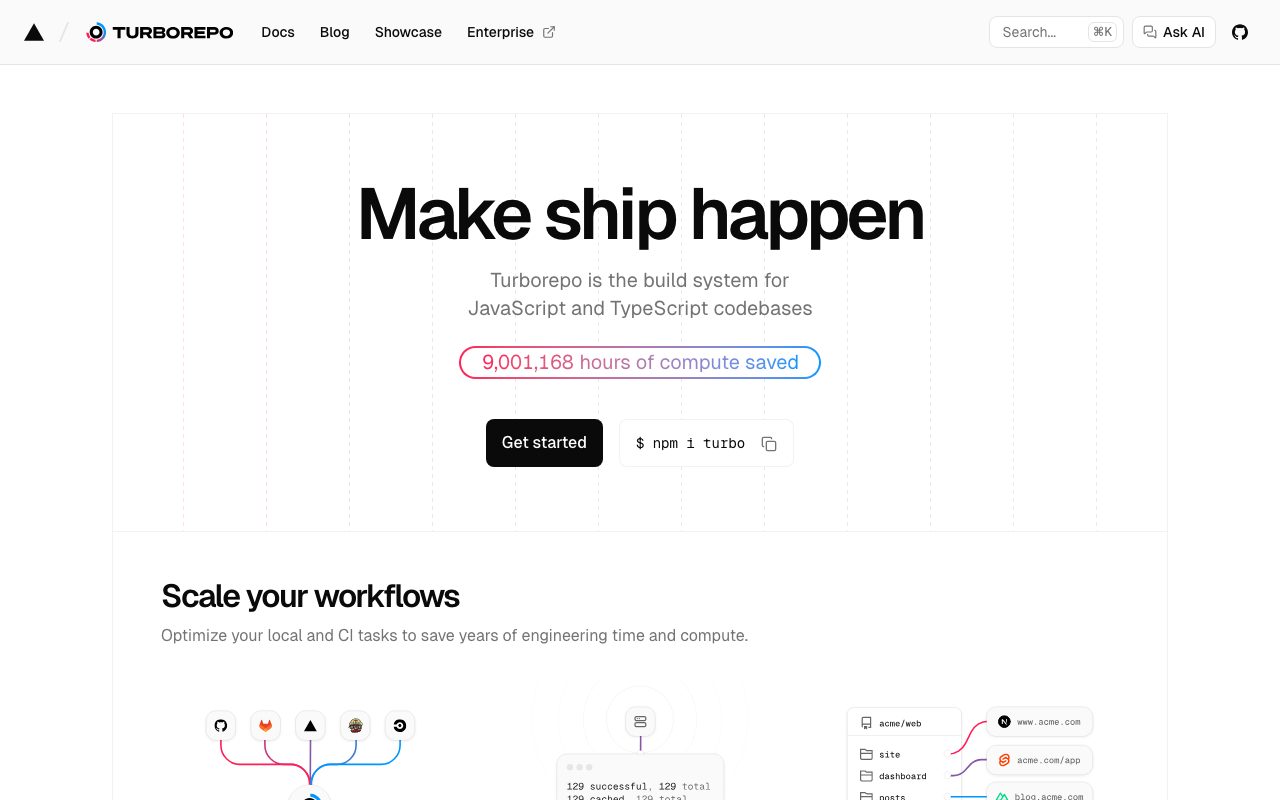
Turborepo is the high-performance build system that makes JavaScript and TypeScript monorepos feel fast even at huge scale. The whole pitch is incremental builds with smart task graphs and a remote cache that turns "this project takes 12 minutes to build" into "this project takes 18 seconds."
For any team running multiple Next.js apps, shared packages, and a bunch of TypeScript libraries in one repo, Turborepo is the standard answer in 2026. It's now part of Vercel, used by Vercel and Netlify themselves, and shipping steadily.
What Turborepo does
Turborepo is a task runner and build orchestrator for npm, yarn, and pnpm monorepos. You define tasks in turbo.json, like build, test, lint, and dev. Turborepo figures out the dependency graph between packages, runs tasks in parallel where it can, and caches every output by content hash.
If nothing has changed since the last run, Turborepo restores cached outputs in seconds instead of rebuilding. If only one package has changed, Turborepo rebuilds that package and reuses cache for the rest. The math compounds enormously across CI runs and team members.
Remote caching
Remote Cache shares cache across machines. When CI builds your monorepo, the cache uploads to a shared store. When a developer runs the same build locally with the same input, the cache restores from remote and the build skips entirely. Vercel's hosted Remote Cache is free to use; you can self-host alternatives too.
Who Turborepo is for
Turborepo fits engineering teams running monorepos with multiple JavaScript or TypeScript packages. Common shapes are: a Next.js web app plus a marketing site plus shared design system; a SaaS app plus an admin dashboard plus shared API client; a multi-platform SDK with examples and docs.
Turborepo is overkill for single-package projects. It's also not the right fit for non-JavaScript codebases. If you have a Go backend and a Python ML pipeline in the same repo, you'd want Bazel, Pants, or Nx with multi-language support.
Turborepo pricing
Turborepo the tool is free and open source under MIT. You can use it as much as you want without paying. The Remote Cache hosted by Vercel is free for the open-source plan and reasonable per seat for teams.
You can self-host Remote Cache using turborepo-remote-cache or similar projects to avoid vendor dependence. The cache protocol is documented and stable. Most small and mid-size teams use Vercel's hosted version because it's simpler and the free tier is generous.
Turborepo features that matter
The pipeline configuration in turbo.json is short. You declare what tasks exist, which depend on which, and which inputs they care about. Turborepo handles the rest. The configuration scales gracefully from a five-package monorepo to a 200-package one.
Output caching is content-addressed. The cache key is a hash of the source files, environment variables, and dependencies. If anything that affects the output changes, the cache misses and Turborepo rebuilds. If nothing relevant changed, you get the cached output.
Filtering and scopes
The --filter flag runs tasks against specific packages, dependents, or affected packages since a git ref. CI commonly runs "build everything affected by this PR" using turbo run build --filter=...[origin/main]. The filter syntax handles complex cases like "the marketing site and everything it depends on" cleanly.
Tradeoffs
Turborepo is JavaScript and TypeScript focused. Multi-language monorepos either use it for the JS slice and another tool for the rest, or pick something more general like Nx, Bazel, or Pants. The tradeoff is that Turborepo's surface area stays small and easy to learn.
Remote cache requires trust in either Vercel's hosted service or your self-hosted setup. If your build outputs contain secrets, you need to be careful about what gets cached and where. The team has solid documentation on this, and it's mostly a non-issue with proper environment hygiene.
Turborepo plus pnpm is the default JavaScript monorepo stack in 2026. The setup time is hours, the payoff is years of saved CI minutes.
Turborepo vs alternatives
Compared to Nx, Turborepo is simpler and more focused while Nx is more featureful with code generators, plugins, and language coverage. Nx wins for teams that want generators and structure; Turborepo wins for teams that just want builds to be fast.
Compared to Bazel, Turborepo is dramatically simpler at the cost of generality. Bazel handles arbitrary languages and reproducibility at extreme scale. Turborepo handles the JavaScript case excellently and stops there. See our best monorepo tools roundup and Turborepo vs Nx breakdown.
Bottom line on Turborepo
Turborepo is the right default for any JavaScript or TypeScript monorepo. The setup is a few hours. The configuration is a few lines per task. The speedup on CI is enormous and shows up the day you turn on Remote Cache.
If you're starting a monorepo in 2026, default to pnpm plus Turborepo. If you have multi-language needs, look at Nx or Bazel. If you have a single-package project, you don't need Turborepo at all. For everyone else in the JS ecosystem, this is the boring correct choice.
Turborepo migration paths
Migrating an existing monorepo to Turborepo takes a day or two for most teams. The steps: install Turborepo, define tasks in turbo.json, replace package.json scripts to call "turbo run" instead of running each package directly, configure remote cache, run the first build to populate cache. After the first run, every subsequent run benefits from cache.
Migrating from Lerna is straightforward. Lerna's parallel script execution maps cleanly to Turborepo tasks. Migrating from Nx is more involved because Nx has more concepts (executors, generators, project graph) that don't map directly. Most Nx-to-Turborepo migrations are partial; teams keep some Nx features and add Turborepo for caching.
Remote cache architecture
The Vercel-hosted Remote Cache is the easy choice for teams that don't want to operate cache infrastructure. Configure once with a token, and your CI plus every developer's machine shares the same cache. Cache hit rates in active monorepos commonly exceed 80 percent for incremental work.
For teams that want self-hosted cache, the open-source turborepo-remote-cache project runs on most cloud platforms. Or you can implement the Turborepo cache protocol yourself; it's documented and stable. Most teams pick Vercel's hosted version because the self-hosting overhead isn't worth the savings until very large scale.
Turborepo with pnpm workspaces
The pnpm plus Turborepo combination is the dominant JavaScript monorepo stack in 2026. pnpm handles dependency installation and workspace linking. Turborepo handles task orchestration and caching. Each tool does one thing well. The combination is fast, lean, and well-supported.
npm workspaces and yarn workspaces also work with Turborepo, but pnpm's strict dependency resolution and significant disk space savings make it the preferred choice for new projects. Migrating from npm or yarn to pnpm takes an afternoon and usually pays back through faster installs and cleaner dependency graphs.
Common Turborepo questions
How fast is Turborepo really? The speedup depends entirely on cache hit rate. With remote cache and an incremental change to one package, builds that took 10 minutes can complete in 30 seconds. Without cache, Turborepo's overhead over running scripts directly is small but not zero. The compounding effect across CI runs and team members is where the value lives.
Does Turborepo support arbitrary languages? Officially JavaScript and TypeScript. In practice, Turborepo runs whatever scripts you tell it to, so it can orchestrate Python, Go, or any other language. The dependency graph features assume Node-style package.json files. For mixed-language monorepos, Turborepo handles the JS slice and other tools handle other languages.
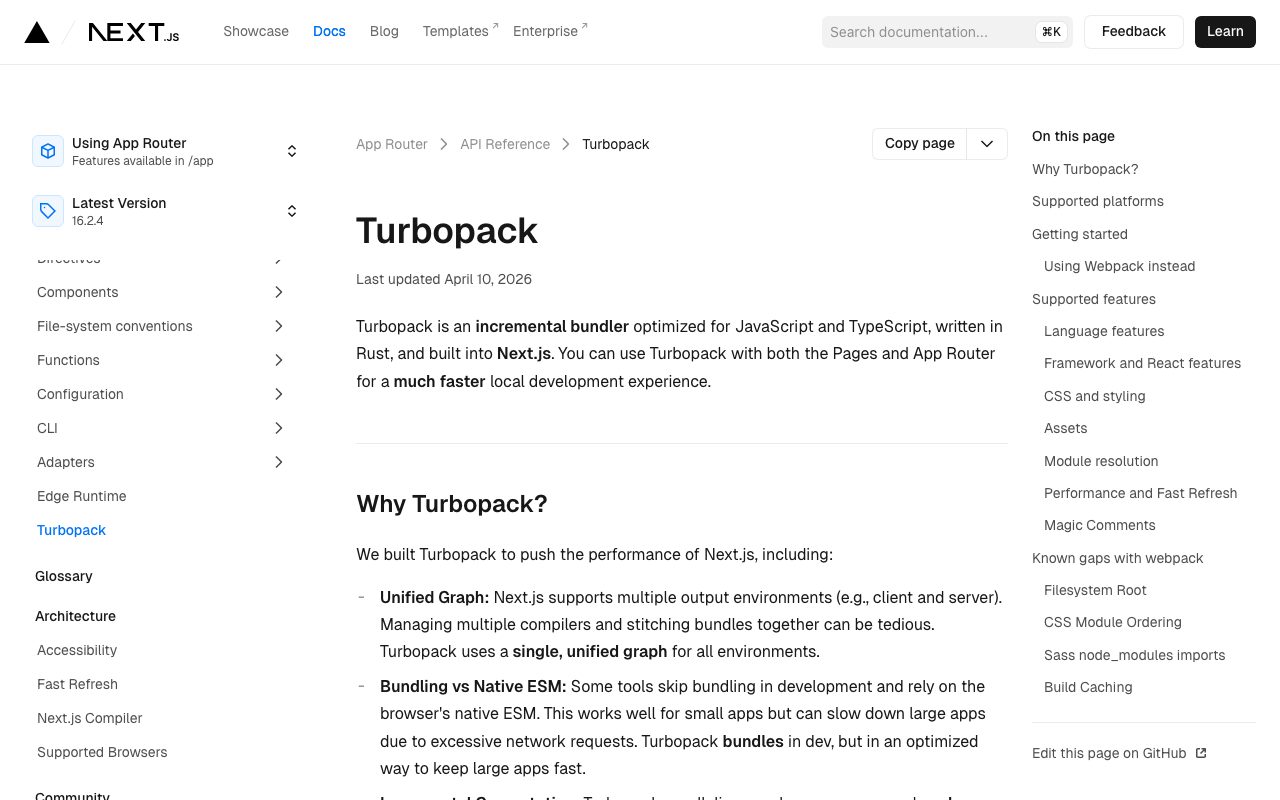
How does it integrate with build tools like Webpack or Vite? Cleanly. Turborepo wraps your existing build commands. It doesn't replace Webpack, Vite, esbuild, or Turbopack. Those continue running inside Turborepo tasks. The cache key includes inputs that affect the build output, so cache invalidation works correctly across build tool changes.
Turborepo at scale
Very large monorepos with hundreds of packages and dozens of contributors push Turborepo's limits. The remote cache's storage and bandwidth become real costs. The dependency graph computation can slow down. The team has been investing in performance for these scenarios; the engine has gotten faster across releases.
For monorepos at the scale of Google or Meta, Bazel remains the choice. The reproducibility, granular caching at the file level, and language-agnostic design fit those needs. For everyone short of hyperscale, Turborepo handles JavaScript and TypeScript monorepos better than the alternatives. The sweet spot is pretty broad.
Final take on Turborepo
Turborepo has won the JavaScript and TypeScript monorepo space. The combination of pnpm plus Turborepo plus a remote cache is the standard stack for new monorepo projects in 2026. The simplicity, performance, and integration with the broader Vercel ecosystem make it the obvious default choice for most teams.
The product has matured significantly. The configuration model is stable. The remote cache infrastructure is reliable. The Daggerverse-style module ecosystem (turbo-gen, sharable configs) is growing. Vercel's continued investment ensures the project will keep shipping. The community has produced extensive documentation, recipes, and example configurations that accelerate adoption.
For new monorepos, Turborepo is the right choice unless you have specific multi-language needs that require Nx or Bazel. The setup is fast, the speedup is dramatic, and the cost is essentially zero for the open-source tool. The remote cache pricing is reasonable for teams that want hosted convenience. Most JavaScript engineering teams will find that adopting Turborepo is one of the highest-leverage CI improvements available, with payoff measured in saved minutes per build across hundreds of builds per week.
Tutorial / Demo
Key Features
- Incremental builds with intelligent caching
- Remote caching for sharing build artifacts across teams
- Parallel task execution
- Pipeline configuration for task dependencies
- Pruned subsets for Docker deployments
- Support for npm, yarn, and pnpm workspaces
- Vercel integration for seamless deployment
Pros & Cons
What we like
- Dramatically speeds up monorepo builds
- Easy to adopt incrementally in existing repos
- Remote caching saves CI minutes significantly
- Simple configuration compared to alternatives
- Backed and maintained by Vercel
Room for improvement
- Focused on JavaScript and TypeScript ecosystems
- Remote caching requires Vercel or self-hosted setup
- Less flexible than Nx for non-JS projects
- Configuration can be confusing for complex pipelines
Frequently Asked Questions
Is Turborepo free?
Turborepo vs Nx, which should I use?
Does Turborepo only work with Vercel?
Can I self-host the remote cache?
Does Turborepo work with TypeScript project references?
Best For
Featured in
Tags
Alternatives to Turborepo

Vercel
Develop, preview, and ship delightful user experiences

GitHub
Where the world builds software

CircleCI
Hosted continuous integration that runs your test suite in parallel containers across Linux, macOS, Windows, and ARM.

Buildkite
Hybrid CI/CD where the control plane is hosted but the build agents run on your own infrastructure.
Our take
Tool Index Editorial · May 2026· 4.5/5
Turborepo positions itself as high-performance build system for javascript and typescript monorepos, and on the whole it earns the framing.
On the strengths side: Dramatically speeds up monorepo builds, Easy to adopt incrementally in existing repos, and Remote caching saves CI minutes significantly. Honest gripes: Focused on JavaScript and TypeScript ecosystems and Remote caching requires Vercel or self-hosted setup.
In short: Turborepo is a solid pick when you need managing large JavaScript and TypeScript monorepos, and a harder sell if focused on JavaScript and TypeScript ecosystems would be a dealbreaker.
Editorial opinion from the Tool Index team, written from the public product pages. Not a user review.
Reviews (3)
Genuinely impressed
Found Turborepo on a Reddit thread, glad I clicked. The thing I keep coming back to: simple configuration compared to alternatives. Worth calling out the parallel task execution too. It fits well for sharing build artifacts across development teams. Glad I made the switch.
Best decision this quarter
Tried Turborepo on a side project first. Genuine strength: remote caching saves CI minutes significantly. Mostly using it for sharing build artifacts across development teams.
Pros
- Simple configuration compared to alternatives
Onboarded the team in a day
Six months of using Turborepo, here's what holds up. Genuine strength: backed and maintained by Vercel. The support for npm, yarn, and pnpm workspaces is more useful than I expected. Found it works best for speeding up CI and CD pipelines with caching. Worth the price for what I get out of it.
Pros
- Remote caching saves CI minutes significantly
- Dramatically speeds up monorepo builds
- Backed and maintained by Vercel
Badge builder
Add Turborepo to your website
Choose a badge style and size, preview it here, then copy the generated HTML. Badge images are self-contained SVGs and do not require an external script.

<a href="https://toolindex.net/tools/turborepo?ref=badge" target="_blank" rel="noopener">
  <img src="https://toolindex.net/badge/turborepo/medium.svg" alt="Turborepo - Listed on Tool Index" width="180" height="50" />
</a>How to use the badge
- 1. Pick the style, size, and theme that fit your layout.
- 2. Copy the generated HTML from the code block.
- 3. Paste it into your footer, homepage, or press page.
Standard badge available
The standard listing badge is available now. Score and circle badges are limited to tools currently ranked in the top 10 of a category.
Badge clicks return visitors to this profile with a referral tag so the source remains identifiable.
Related Tools

Kevin Gabeci
Solo developer building web apps, cozy browser games, and AI creator toolkits.

Coolify
Self-hostable, open source alternative to Heroku and Netlify

Warp
The modern terminal reimagined with AI and collaboration

Bolt.new
Prompt-to-deployed full-stack app inside the browser
Work on Turborepo? Request listing access or correction