
Typesense
Open source search engine, a faster alternative to Algolia
Gallery
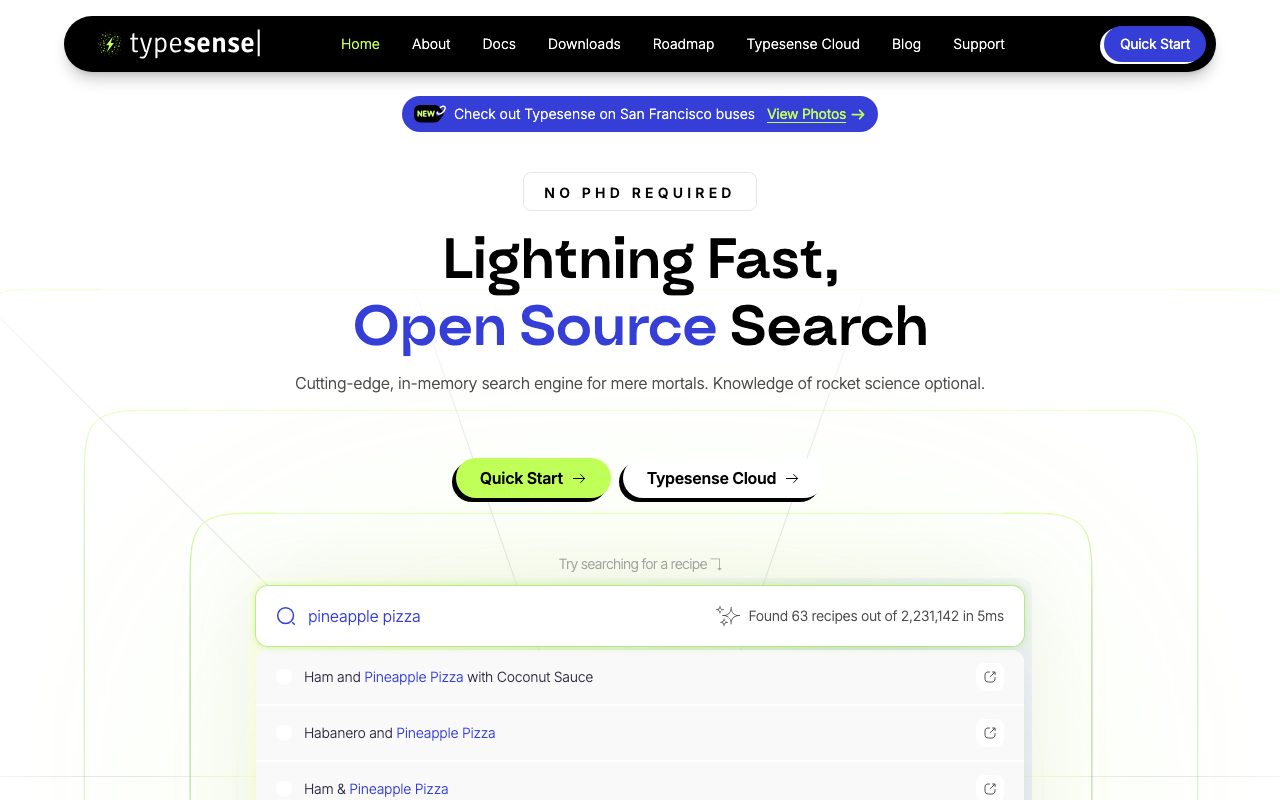
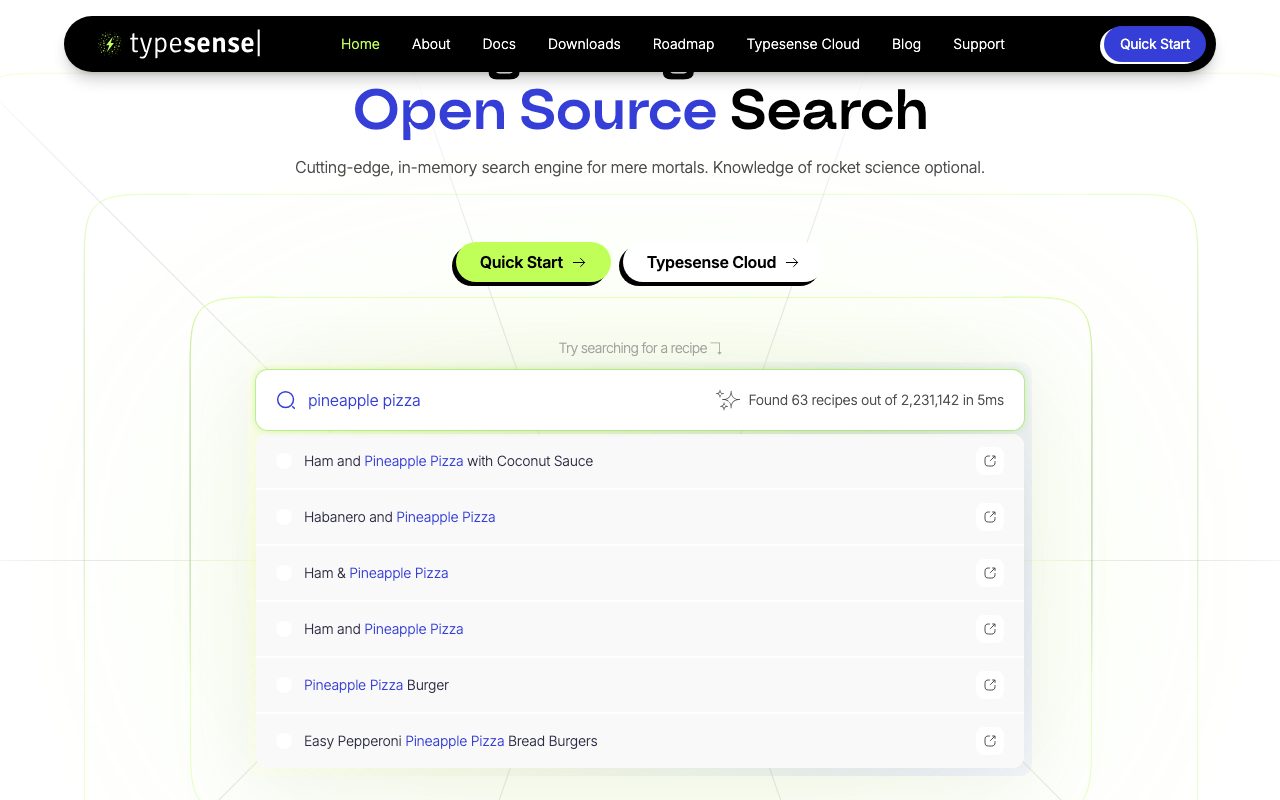
About Typesense
Typesense is the open-source search engine built as a friendlier alternative to Elasticsearch and a self-hostable alternative to Algolia. Fast, typo-tolerant, and refreshingly simple to operate.
You spin up Typesense, push your documents, and get instant search-as-you-type results with relevance ranking, faceting, geo search, and vector search. The API is sane. The defaults are good.
Customers include Figma's docs site, Lyrics.com, Ada Health, and many YC startups. Typesense fills the gap between "Postgres full-text search isn't enough" and "we can't afford Algolia."
What Typesense actually does
Typesense is a search server you run as a binary, Docker container, or managed cloud service. You define collections (like tables), insert documents, and query with the REST API or one of the client SDKs.
It supports typo tolerance, prefix search, faceted filtering, geo queries, multi-search, semantic search via vector embeddings, and hybrid (keyword + vector) search out of the box.
Typesense Cloud handles scaling, replication, and failover for those who don't want to manage clusters. Self-hosted users get the same engine for free under GPL.
Who Typesense is for
Engineering teams building search into product features. SaaS apps, e-commerce sites, internal documentation portals, and content directories all fit perfectly.
Indie developers and startups love the self-hosting option. You can run Typesense on a $20/month VPS and serve millions of queries.
If your search workload is genuinely massive (billions of docs, hundreds of nodes) Elasticsearch and OpenSearch still win. Typesense targets the 99% of use cases where complexity isn't justified.
Pricing breakdown
Self-hosted Typesense is free under GPL-3. You only pay for the servers you run.
Typesense Cloud starts around $0.124/hour ($89/month) for a small instance. Bigger plans scale CPU, RAM, and replicas. Pricing is transparent on the website.
Compared to Algolia ($1 per 1000 search operations after the free tier), self-hosted Typesense is dramatically cheaper at any meaningful scale.
Standout features
Search latency is genuinely fast. Typesense routinely returns results in under 50ms even on fuzzy queries against millions of documents.
Vector search and hybrid search are built into the same API. You don't run a separate vector DB. RAG-style retrieval workflows just work.
The InstantSearch.js compatibility layer means you can swap Typesense in for Algolia with minimal frontend changes. Migration is much easier than expected.
Honest tradeoffs
Distributed clustering is supported but operationally newer than Elasticsearch. Heavy ops teams familiar with ES sometimes prefer the older option.
The plugin and analyzer ecosystem is smaller. Custom tokenizers and esoteric language support sometimes lag.
Cloud pricing is fair but adds up for large instances. At scale, self-hosting on dedicated hardware wins economically.
Typesense is what Algolia would be if you owned the cluster and never paid per query again.
Typesense vs Algolia vs Meilisearch
Algolia is the polished SaaS leader with the best dashboard and analytics, but pricing scales harshly. Meilisearch is the closest open-source peer with similar DX and a younger feature set. Typesense sits in the middle with mature features and self-host friendliness.
See best search engines and Algolia alternatives. Our Typesense vs Meilisearch guide covers the close fight.
Other Typesense alternatives: Elasticsearch, OpenSearch, MeiliSearch, ZincSearch, and Quickwit. Each one targets a different blend of scale and operational complexity.
Bottom line on Typesense
Typesense is the search engine for teams who want Algolia's developer experience without the per-query bill. It's fast, friendly, and ships with vector search built in.
Browse tools for backend developers and the Meilisearch profile. Tool-Index itself runs on Typesense, by the way.
Self-host it on a VPS in 10 minutes. The operational simplicity will surprise you.
Typesense for ecommerce search
Ecommerce search is Typesense's natural use case. Fast typo tolerance, faceted filtering by category and price, and instant search-as-you-type all matter for conversion.
The InstantSearch.js compatibility layer means you can swap Typesense in for Algolia on your existing storefront with minimal frontend changes. Server change, indexer change, frontend mostly unchanged.
For marketplaces with many seller-controlled facets, Typesense's flexible schema and per-document overrides handle complexity that simpler engines can't.
Vector search and RAG with Typesense
Typesense supports vector search natively. Store embeddings as fields, query by similarity, and combine with traditional keyword search in one query.
For RAG (retrieval-augmented generation) workflows, Typesense replaces a dedicated vector DB. One server, one query, hybrid keyword-and-semantic search.
The performance is good for collections up to millions of documents. For billion-scale vector workloads, dedicated vector DBs (Pinecone, Weaviate, Qdrant) still win. Typesense covers most application use cases.
Self-hosting vs Typesense Cloud
Self-hosting Typesense is straightforward. A binary, a Docker image, or a simple systemd unit on a VPS. Backups are file-based snapshots.
For high availability, you run a 3-node cluster with replication. Setup is cleaner than Elasticsearch's. Most teams get it running in an afternoon.
Typesense Cloud handles scaling and HA for you. The pricing is fair for managed peace of mind. Most early-stage startups go cloud, then self-host once usage justifies it.
Final word on Typesense
Typesense is the search engine for teams who want Algolia's DX without the bill. Self-host for cost or use Typesense Cloud for convenience. The engine is the same.
Tool-Index runs on Typesense, by the way. It's the search behind every page on this site.
Typesense for documentation search
Documentation search is one of Typesense's most popular use cases. Algolia DocSearch was the dominant option for years. Typesense provides a free, self-hostable alternative.
The setup is straightforward. Index your docs (Markdown, MDX, or HTML), configure the InstantSearch UI, and deploy. Sites like Typesense's own docs and many open-source projects use this pattern.
Latency for docs search routinely lands under 30ms. Users get results as they type without perceptible lag.
Typesense's docs-search starter kits and community-maintained scrapers cover most static site generators (Hugo, Jekyll, Docusaurus, Astro, Nextra). You're not building from scratch.
For multi-language docs, Typesense supports per-locale collections and unified queries. International communities get search that works in their language without configuration gymnastics.
Open-source projects often run Typesense on a small cloud instance for $20-50/month and serve unlimited docs queries. The cost predictability is a real win versus per-query Algolia pricing.
Browse our best search engines roundup and our Algolia and Meilisearch profiles.
Typesense FAQ
Is Typesense really faster than Elasticsearch? For typical application search workloads, yes. Cold start times, query latency, and indexing speed are all faster on similar hardware. For massive distributed search, Elasticsearch still has an operational advantage.
Can I migrate from Algolia to Typesense? Yes, with the InstantSearch.js compatibility layer. Frontend code stays mostly unchanged. Backend swaps from Algolia to a Typesense server. Migrations typically take a day or two.
Does Typesense support fuzzy matching? Yes, with configurable typo tolerance per query. Match thresholds, prefix search, and synonym handling are all built in.
What's the storage model? Typesense holds the entire collection in memory by default for speed. Disk-based collections are supported for cost-sensitive workloads at the cost of slower queries.
How is community support? Active Slack community, responsive GitHub issues, and steady release cadence. The Typesense team replies to issues quickly. The OSS health is genuinely good.
Typesense is the search engine for teams who want Algolia's developer experience without the per-query bill. Self-host for cost or use Typesense Cloud for convenience. Either way, the engine delivers on its pitch.
Operating Typesense in production
Run a 3-node cluster for high availability. Single-node deployments work for development but risk downtime in production. Replication is straightforward to set up.
Monitor memory usage carefully. Typesense holds collections in RAM by default. Sizing your nodes for peak collection size plus headroom matters.
Use snapshot backups. The on-demand snapshot API gives you point-in-time recovery. Schedule snapshots regularly and store them off-cluster.
Tune typo tolerance per use case. Stricter for code search. Looser for product search. The defaults are sensible but worth tuning for your specific application.
Use scoped API keys for client-side queries. Embed read-only keys in your frontend. Admin keys stay on the server. Standard security hygiene applies.
Test with realistic data volumes. Performance characteristics change with collection size. Generate test data at production scale before going live.
Browse our best search engines roundup and Algolia and Meilisearch profiles for additional options.
Closing thoughts on Typesense in 2026
Typesense has matured into a serious option for teams across the spectrum. Indie developers self-host on a small VPS and serve millions of queries cheaply. Larger teams use Typesense Cloud for managed scaling and replication.
The product roadmap continues to deliver. Vector search, hybrid search, and improvements to relevance ranking have shipped consistently. The team treats community feedback seriously.
For startups choosing search infrastructure today, Typesense should be on the shortlist. The combination of speed, developer experience, and friendly pricing makes it competitive against Algolia for most use cases.
For documentation search specifically, Typesense has become a default. Open source projects from Tailwind to FastAPI have adopted it. The pattern is well-trodden and reliable.
Open source matters. The codebase is on GitHub. Issues are addressed publicly. Contributing back is encouraged. That transparency is rare among search vendors.
Browse our best search engines roundup, our Typesense alternatives page, and the Typesense vs Meilisearch guide for additional context. Tool-Index runs on Typesense, by the way.
Tutorial / Demo
Key Features
- Typo-tolerant instant search out of the box
- Faceted search and filtering
- Geo-search for location-based queries
- Vector search for AI and semantic use cases
- Simple REST API with client libraries
- High availability with built-in replication
- Typesense Cloud for managed hosting
Pros & Cons
What we like
- Extremely fast search responses under 50ms
- Much simpler to set up than Elasticsearch
- Open source with managed cloud option
- Generous managed cloud pricing compared to Algolia
- Built-in typo tolerance without configuration
Room for improvement
- Smaller ecosystem than Elasticsearch
- Less suitable for log analytics or complex aggregations
- Self-hosted version requires RAM proportional to dataset
- Community is growing but smaller than alternatives
Frequently Asked Questions
Is Typesense really faster than Algolia?
Is Typesense fully open source?
Typesense vs Meilisearch, which one wins?
Can I run Typesense on a single VPS?
Does Typesense have client libraries?
Best For
Featured in
Tags
Alternatives to Typesense
Drizzle ORM
Lightweight TypeScript ORM that feels like writing SQL

Supabase
The open source Firebase alternative

1Lookup
Real-time data verification API for phone, email, IP, and domain validation to fight fraud

Codedex
A gamified, story-driven platform that teaches Python, web dev, and more like an RPG quest
Our take
Tool Index Editorial · May 2026· 4.5/5
What Typesense is really selling — beyond the marketing copy — is open source search engine, a faster alternative to algolia.
Worth highlighting: Extremely fast search responses under 50ms, Much simpler to set up than Elasticsearch, and Open source with managed cloud option. What to watch for: Smaller ecosystem than Elasticsearch and Less suitable for log analytics or complex aggregations.
In short: Typesense is a solid pick when you need adding instant search to e-commerce product catalogs, and a harder sell if smaller ecosystem than Elasticsearch would be a dealbreaker.
Editorial opinion from the Tool Index team, written from the public product pages. Not a user review.
Reviews (2)
Did exactly what I needed
Tried half a dozen options before landing on Typesense. What stands out is how built-in typo tolerance without configuration. Got real value out of high availability with built-in replication. Mostly using it for geo-search for location-based applications.
Pros
- Generous managed cloud pricing compared to Algolia
- Built-in typo tolerance without configuration
Cons
- Less suitable for log analytics or complex aggregations
Surprised how much we use this
Tried half a dozen options before landing on Typesense. The thing I keep coming back to: generous managed cloud pricing compared to Algolia. Got real value out of high availability with built-in replication. Main use case: building autocomplete and suggestion features. Would buy again without thinking twice.
Badge builder
Add Typesense to your website
Choose a badge style and size, preview it here, then copy the generated HTML. Badge images are self-contained SVGs and do not require an external script.

<a href="https://toolindex.net/tools/typesense?ref=badge" target="_blank" rel="noopener">
  <img src="https://toolindex.net/badge/typesense/medium.svg" alt="Typesense - Listed on Tool Index" width="180" height="50" />
</a>How to use the badge
- 1. Pick the style, size, and theme that fit your layout.
- 2. Copy the generated HTML from the code block.
- 3. Paste it into your footer, homepage, or press page.
Standard badge available
The standard listing badge is available now. Score and circle badges are limited to tools currently ranked in the top 10 of a category.
Badge clicks return visitors to this profile with a referral tag so the source remains identifiable.
Related Tools

Kevin Gabeci
Solo developer building web apps, cozy browser games, and AI creator toolkits.

Coolify
Self-hostable, open source alternative to Heroku and Netlify

Warp
The modern terminal reimagined with AI and collaboration

Bolt.new
Prompt-to-deployed full-stack app inside the browser
Work on Typesense? Request listing access or correction