
PostHog
All-in-one product analytics, feature flags, and session replay
Gallery
About PostHog
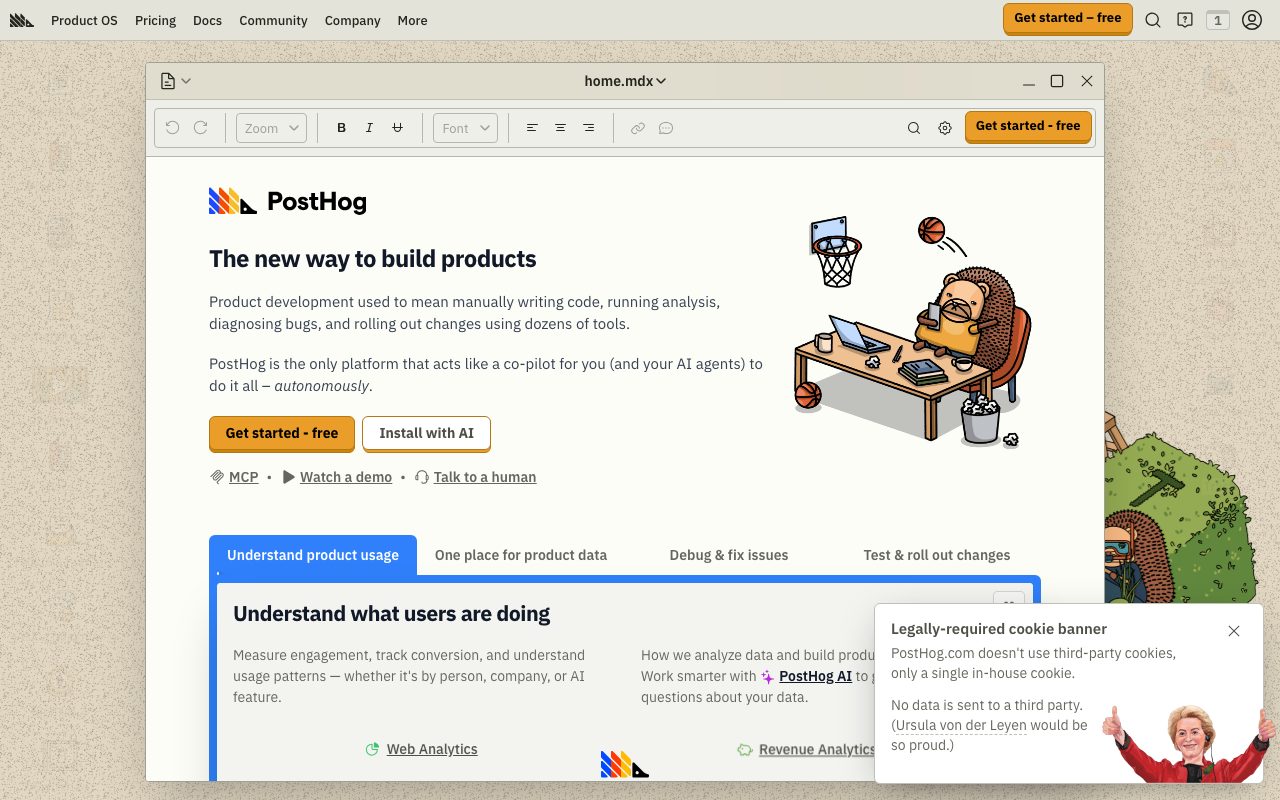
PostHog is the open-source product analytics platform that grew teeth. It started as a Mixpanel alternative you could self-host, then kept adding features until it became a legit all-in-one. Analytics, session replay, feature flags, A/B testing, surveys, and a CDP, all under one roof. The pricing is generous. The product is good.
The London-based team has been one of the loudest open-source success stories of the last few years. They publish their handbook publicly, ship features at a clip, and price aggressively to win against Amplitude and Mixpanel.
If you've been running Mixpanel and feeling the bill creep, or if you wanted Amplitude but couldn't justify it, PostHog is the obvious next look. The free tier alone covers most early-stage startups indefinitely.
What PostHog actually does
PostHog tracks user events, builds funnels and retention curves, records sessions, manages feature flags, runs A/B tests, ships surveys, and pipes data out to your warehouse. That's a lot. The thing that makes it work is one event graph powering everything.
You instrument once, then every product gets the same data. Funnel analysis sees the same events as feature flags. Session replay links to the same users as analytics. The unified data model is what bigger competitors charge a lot more for.
Product analytics
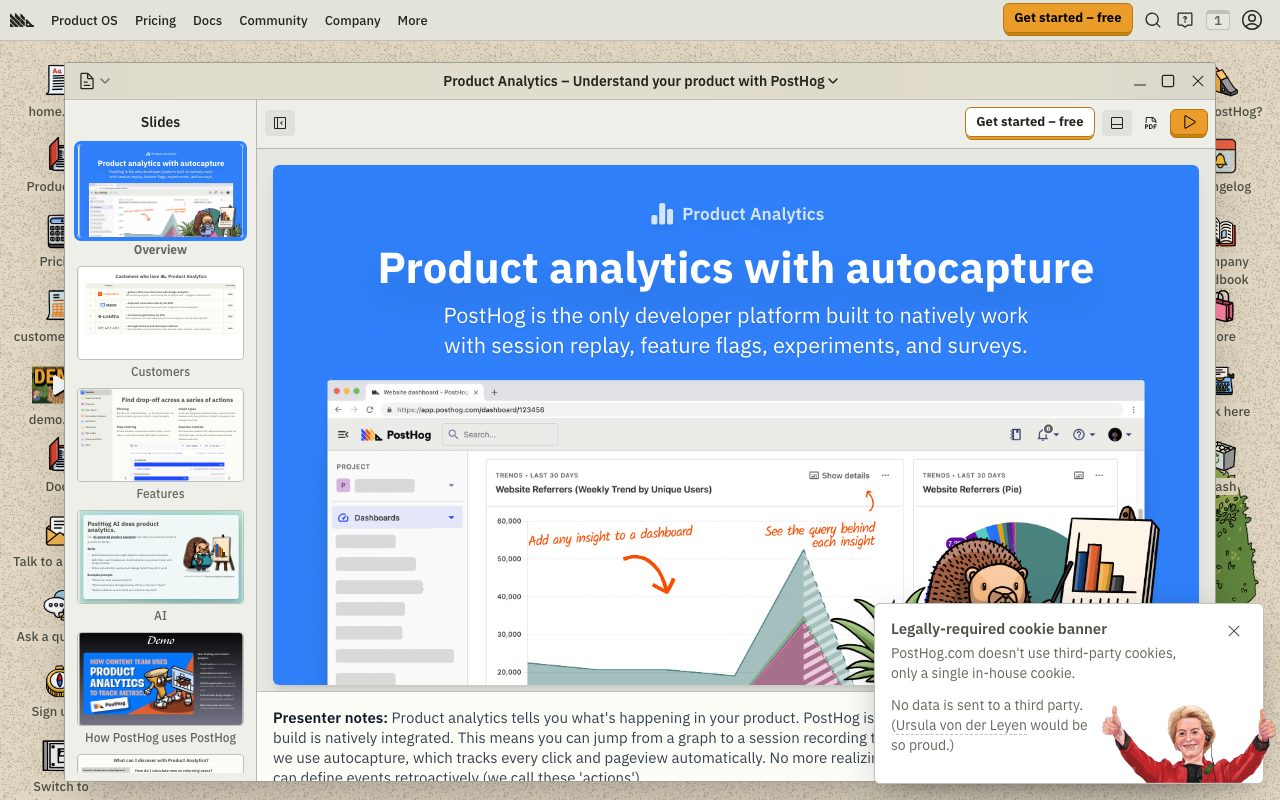
Funnels, retention, paths, trends, correlations. The standard product analytics primitives, executed competently. Insights save to dashboards. Dashboards share via URL. Cohorts sync to other tools.
The interface is busier than Amplitude's but more powerful. Once you know where things live, you can answer most product questions without leaving PostHog.
Session replay and feature flags bundled
Session replay records what users actually saw. It's bundled into the platform. Feature flags ship with targeting, rollouts, and experiments. Both would be separate paid tools elsewhere. PostHog gives them to you in one bill.
PostHog's free tier is so generous it's almost suspicious. Most product teams can run on it for years before paying. That's how they win you over.
Who PostHog is for
Startups, indie hackers, and product teams who want analytics plus session replay plus flags without three separate vendors. Especially good for technical teams who like the open-source ethos and aren't afraid of a slightly busier UI.
It's also a strong pick for teams with privacy or sovereignty requirements. You can self-host PostHog on your own infrastructure. Few competitors offer that.
PostHog pricing
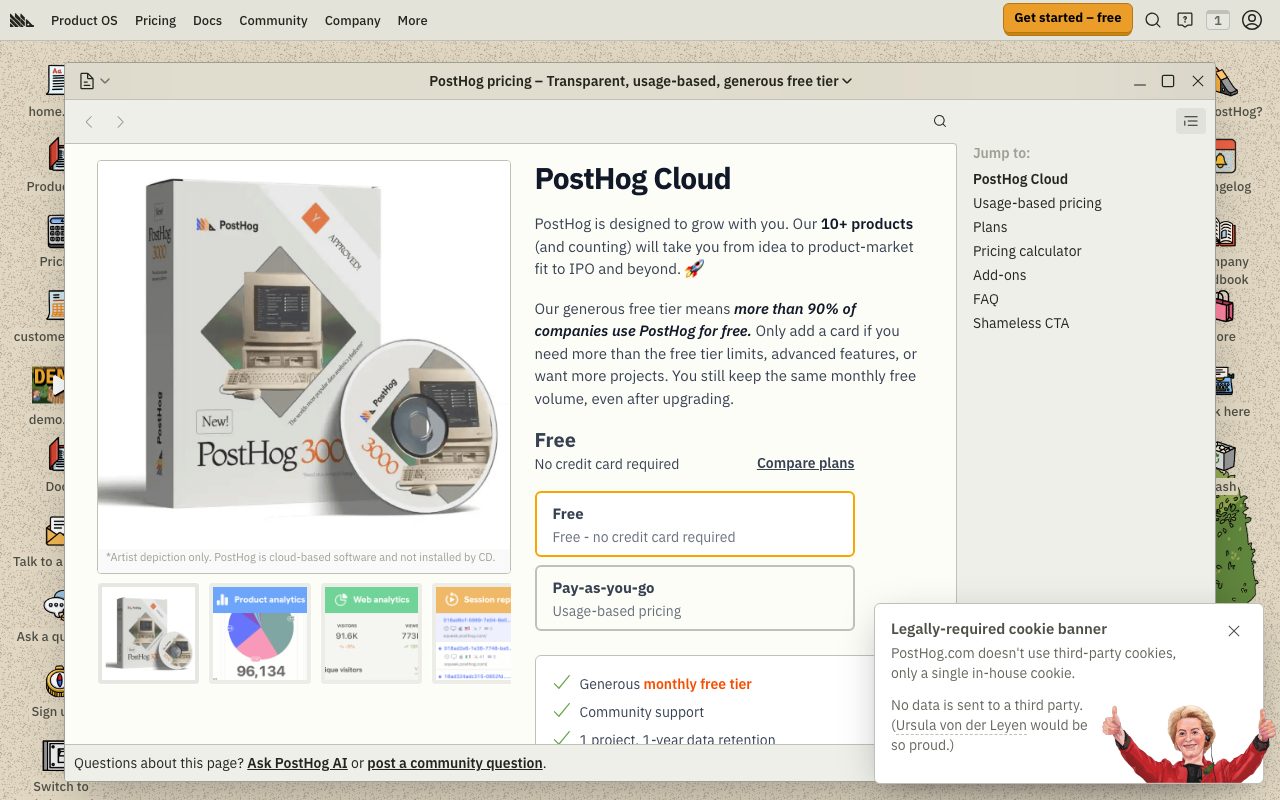
The free tier covers 1 million events, 5,000 session replays, 1 million feature flag requests, and 1,000 surveys per month. That's a lot. Past the free tier, pricing is usage-based per product.
Events cost $0.00005 each past the first million. Session replays cost $0.005 each past 5,000. Feature flag requests cost $0.0001 each past a million. The pricing scales gradually rather than jumping at tier boundaries.
For startups, this works out way cheaper than Amplitude or Mixpanel. For mid-size companies, it's competitive. For massive scale, you'd negotiate a custom contract.
Features worth knowing
Self-hosting
Open-source under the MIT-derived PostHog license. You can run PostHog on your own Kubernetes cluster, your own VMs, or in your VPC. The hosted version is easier, but the option to self-host changes risk profile for some buyers.
Data warehouse integration
PostHog can sync events to and from BigQuery, Snowflake, Redshift, and others. You can do analytics in PostHog or in your warehouse, depending on your team's comfort level.
HogQL
SQL-like query language for ad-hoc analysis. Power users build queries that the standard Insights can't express. Less polished than Amplitude's chart builder, more flexible than anything else.
Experiments and feature flags
Run A/B tests with proper stats, gate features by user attribute, do gradual rollouts. The flag SDK is solid. Tightly integrated with the analytics, so you can see how variants affect downstream events without extra plumbing.
The tradeoffs
PostHog's UI is denser than Amplitude or Mixpanel. There are more knobs. The learning curve is steeper. Don't expect a marketer to spin up a dashboard their first day without help.
The all-in-one bet is real. If you only need analytics, PostHog is overbuilt. If you only need flags, LaunchDarkly is more focused. PostHog wins when you need most or all of the bundle.
PostHog vs alternatives
The honest comparisons are PostHog vs Amplitude, PostHog vs Mixpanel, and PostHog vs LaunchDarkly. Amplitude is more polished. Mixpanel is more focused. LaunchDarkly is more enterprise on flags.
For best value across the bundle, PostHog wins. See PostHog alternatives or browse the best analytics tools.
Bottom line on PostHog
PostHog is the modern open-source pick for product analytics and adjacent tooling. It's not the prettiest. It's the most generous, the most open, and arguably the most ambitious.
If you're starting a product today, PostHog covers analytics, replay, flags, and experiments under one bill that's free until you have real traffic. That's a significantly better deal than what most teams default to.
Common PostHog questions
Is PostHog open source actually open? Yes, with an MIT-derived license. You can self-host the entire platform. Some enterprise features require a license, but the core analytics, replay, and flags are open.
Should I self-host PostHog? Only if you have ops capacity or hard data residency requirements. PostHog is non-trivial to operate (Postgres, ClickHouse, Kafka, Redis). Hosted PostHog is cheaper for most teams when you account for engineering time.
How does PostHog compare to Amplitude on usability? Amplitude is more polished. PostHog has more features but a steeper learning curve. For technical teams, PostHog wins. For marketers and PMs without engineering support, Amplitude is friendlier.
What about session replay quality?
Solid. Recording fidelity is good. Privacy controls (mask sensitive fields) are robust. Replays are linked to events so you can jump from a funnel drop to the actual session. Few competitors integrate this tightly.
Are feature flags fast enough for real apps?
Yes. Flag evaluation runs locally in the SDK after fetching configurations. Latency is sub-millisecond. The bootstrap pattern lets you ship initial flag values with your HTML to avoid flicker.
Workflow tips for PostHog
Standardize event names. Like Amplitude, PostHog rewards consistent taxonomy. Document your tracking plan. Use the Data Management tools to spot inconsistencies.
Bundle replay with feature flag rollouts. Roll a flag to 5%, watch the recordings of those users. You catch UX issues before scaling the rollout.
Use HogQL for complex questions. The visual builders cover 80% of needs. SQL covers the rest. Don't fight the tool; jump to HogQL when needed.
Self-hosted is easier on Kubernetes than docker-compose. The Helm chart is the supported path. Plan for ClickHouse storage growth and Postgres backups. Browse tools for product managers for related picks.
Real-world PostHog scenarios
An indie SaaS team runs everything on PostHog: analytics, session replay, feature flags, and A/B tests. Free tier covers their volume. They ship a feature, flag it, watch replays of beta users, decide on full rollout. One tool, one bill, one mental model.
A growth team uses PostHog session replay alongside Amplitude analytics. Amplitude handles the deep analysis. PostHog replays show them what users actually did. The combo is more powerful than either alone, though more expensive.
A regulated startup self-hosts PostHog on their VPC. Data residency requirement met. The product team gets analytics. The legal team gets sovereignty. The ops team gets a real ClickHouse cluster to babysit. Tradeoffs.
Operational tips
Use the bootstrap pattern for feature flags on first page load. Avoids flicker. The SDK supports it. Skip this and users see UI flash.
Tag releases. PostHog correlates errors and metric drops to releases when you do. Without release tags, debugging deploys is much harder.
Sample session replays. Recording every session is expensive and noisy. Sample 10% or 20%. Save more recordings on rare events (errors, key conversions).
For startups, PostHog is one of the rare all-in-one tools that delivers on the all-in-one promise. The pricing model rewards using more of the platform. Browse the PostHog page for community reviews.
Why PostHog keeps winning
Open source plus generous free tier plus all-in-one bundle is a hard combination to beat. PostHog launched with that thesis and executed on it for years. The result is a product that's grown faster than most product analytics competitors despite charging less.
The bundle matters. Buying analytics, session replay, feature flags, and experiments separately costs a fortune. PostHog packages them under one bill. The integration between them is real, not just bundled marketing. A funnel insight links to relevant replays. A feature flag rollout shows up in analytics.
The open source angle changes the buyer dynamic. Engineers can prototype on self-hosted, validate the product, and recommend it internally. By the time procurement gets involved, the team is already using PostHog. That bottom-up adoption beats sales-led competitors.
For teams in 2026 picking product analytics, PostHog is one of the few products where the price gets cheaper as you use more of the platform. That's an unusual property in SaaS, and it explains why PostHog keeps showing up on best-of lists.
PostHog's competitive moat
The PostHog moat is the bundle plus the open source story. Competitors can match individual features. Few can match the integrated experience across analytics, replay, flags, and experiments without dramatically higher prices. The bundle's value compounds the more features a team uses.
The open source angle protects against vendor lock-in concerns. Teams know they can self-host if hosted prices climb. That option, even if rarely exercised, changes the negotiation dynamic and limits how much hosted PostHog can charge. Pricing stays competitive because the alternative is real.
For 2026 and beyond, PostHog continues to ship features at a clip. The team is well-funded and motivated. The community contributions add up. For startups picking analytics today, PostHog is increasingly the obvious starting point. Outgrow it later if needed; benefit from the generous free tier now.
Tutorial / Demo
Key Features
- Product analytics with funnels, paths, and retention
- Session recording and replay
- Feature flags with multivariate support
- A/B testing and experimentation
- User surveys and feedback collection
- Data warehouse for custom SQL queries
- Self-hostable open source version
Pros & Cons
What we like
- Replaces multiple tools: analytics, flags, recordings, surveys
- Generous free tier with 1M events per month
- Open source with self-hosting option
- Great developer experience with SDKs for all platforms
- EU-hosted cloud option for GDPR compliance
Room for improvement
- Can be resource-intensive when self-hosted
- UI can feel overwhelming with so many features
- Session recordings add up in storage quickly
- Learning curve to set up all features properly
Frequently Asked Questions
What is PostHog used for?
Is PostHog free to use?
What are the pros and cons of PostHog?
Who should use PostHog?
Best For
Featured in
Tags
Alternatives to PostHog

Amplitude
Digital analytics platform for product, growth, and marketing teams to analyze user behavior across web and mobile.
Mixpanel
Product analytics tool for tracking user events, funnels, retention, and cohorts to understand how people use your app.

Cometly
Marketing attribution for B2B SaaS that ties ad spend to pipeline and closed-won revenue

Plausible
Privacy-friendly Google Analytics alternative
Our take
Tool Index Editorial · May 2026· 4.6/5
PostHog sits in a crowded category, differentiating itself as all-in-one product analytics, feature flags, and session replay.
The standout points: Replaces multiple tools: analytics, flags, recordings, surveys, Generous free tier with 1M events per month, and Open source with self-hosting option. Where it stumbles: Can be resource-intensive when self-hosted and UI can feel overwhelming with so many features.
In short: PostHog is a strong pick when you need tracking user behavior and product usage patterns, and a harder sell if can be resource-intensive when self-hosted would be a dealbreaker.
Editorial opinion from the Tool Index team, written from the public product pages. Not a user review.
Reviews (10)
PostHog, better than expected
Adopted PostHog for one project, ended up using it for more. The biggest win has been great developer experience with SDKs for all platforms. Got real value out of feature flags with multivariate support. Honest gripe: can be resource-intensive when self-hosted.
Pros
- Great developer experience with SDKs for all platforms
- Replaces multiple tools: analytics, flags, recordings, surveys
Did exactly what I needed
Picked PostHog for the lower price, stayed for the actual quality. Where it really wins is EU-hosted cloud option for GDPR compliance. Main use case: tracking user behavior and product usage patterns. Would buy again without thinking twice.
Pros
- Open source with self-hosting option
The kind of tool you forget you're paying for
Tried half a dozen options before landing on PostHog. The biggest win has been great developer experience with SDKs for all platforms. The product analytics with funnels, paths, and retention is more useful than I expected. Mostly using it for tracking user behavior and product usage patterns.
Pros
- EU-hosted cloud option for GDPR compliance
- Replaces multiple tools: analytics, flags, recordings, surveys
PostHog, better than expected
Found PostHog on a Reddit thread, glad I clicked. Honestly impressed by how open source with self-hosting option. Worth calling out the self-hostable open source version too. Would buy again without thinking twice.
Pros
- EU-hosted cloud option for GDPR compliance
- Great developer experience with SDKs for all platforms
- Generous free tier with 1M events per month
Easy 5 from me
Honest take: PostHog delivers most of what the marketing promises. Real selling point: EU-hosted cloud option for GDPR compliance. Mostly using it for running A/B tests on new features. Easy yes for anyone weighing the same trade-offs.
PostHog is fine, here's the real take
Started using PostHog casually, now it's pinned in my dock. Real selling point: open source with self-hosting option. Got real value out of product analytics with funnels, paths, and retention. That said, UI can feel overwhelming with so many features is a real gripe. Decent value once you accept the rough edges.
Pros
- EU-hosted cloud option for GDPR compliance
Surprised how much we use this
PostHog isn't perfect but it's the best I've used in this category. The biggest win has been generous free tier with 1M events per month. Got real value out of user surveys and feedback collection. Found it works best for gradual feature rollouts with feature flags. Easy yes for anyone weighing the same trade-offs.
Pros
- Generous free tier with 1M events per month
- Great developer experience with SDKs for all platforms
- Open source with self-hosting option
Recommended without reservation
Got PostHog on the recommendation of someone I trust. Genuine strength: generous free tier with 1M events per month. Worth calling out the feature flags with multivariate support too. Main use case: tracking user behavior and product usage patterns. Would buy again without thinking twice.
Pros
- Great developer experience with SDKs for all platforms
Two months in, no regrets
PostHog is one of those tools you stop noticing because it just works. What stands out is how great developer experience with SDKs for all platforms. Their take on self-hostable open source version is solid. It fits well for running A/B tests on new features. Not perfect: UI can feel overwhelming with so many features.
Pros
- Great developer experience with SDKs for all platforms
- Generous free tier with 1M events per month
Best decision this quarter
Tried half a dozen options before landing on PostHog. Real selling point: great developer experience with SDKs for all platforms. Worth calling out the product analytics with funnels, paths, and retention too. Honest gripe: can be resource-intensive when self-hosted. Sticking with PostHog.
Pros
- Generous free tier with 1M events per month
Cons
- UI can feel overwhelming with so many features
- Session recordings add up in storage quickly
Badge builder
Add PostHog to your website
Choose a badge style and size, preview it here, then copy the generated HTML. Badge images are self-contained SVGs and do not require an external script.

<a href="https://toolindex.net/tools/posthog?ref=badge" target="_blank" rel="noopener">
  <img src="https://toolindex.net/badge/posthog/medium.svg" alt="PostHog - Listed on Tool Index" width="180" height="50" />
</a>How to use the badge
- 1. Pick the style, size, and theme that fit your layout.
- 2. Copy the generated HTML from the code block.
- 3. Paste it into your footer, homepage, or press page.
Score badge available
PostHog qualifies for the score and circle badges based on its current top-10 positionin Analytics.
Badge clicks return visitors to this profile with a referral tag so the source remains identifiable.
Related Tools

Kevin Gabeci
Solo developer building web apps, cozy browser games, and AI creator toolkits.

Coolify
Self-hostable, open source alternative to Heroku and Netlify

Warp
The modern terminal reimagined with AI and collaboration

Bolt.new
Prompt-to-deployed full-stack app inside the browser
Work on PostHog? Request listing access or correction