
Amplitude
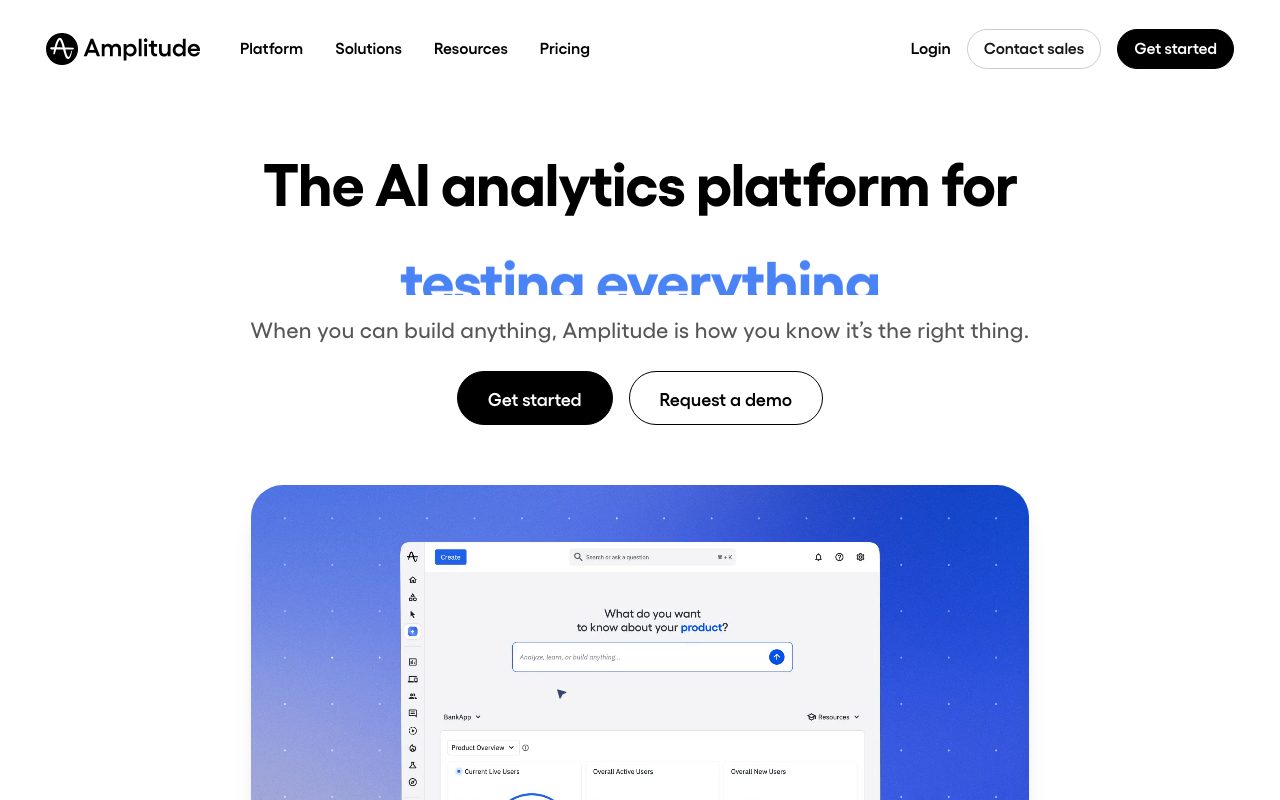
Digital analytics platform for product, growth, and marketing teams to analyze user behavior across web and mobile.
Gallery
About Amplitude
Amplitude is the analytics platform you reach for when "how many pageviews?" stops being a useful question. It's built around event tracking, user journeys, and the kind of behavioral cohorts that actually move product decisions. PMs and growth folks tend to live in it.
The pitch hasn't changed much since Amplitude launched in 2012. Track what users do, slice it by who they are, find where they drop off. What changed is the depth. Amplitude now ships experimentation, session replay, and a CDP, all sitting on the same event graph.
If you've been muddling along with Google Analytics dashboards and a quarterly export to a spreadsheet, Amplitude feels like turning the lights on. It's also one of the few tools where the free tier is genuinely usable for small teams.
What Amplitude actually does
At its core, Amplitude ingests events. A user signs up, clicks a button, completes a checkout, opens a feature. Each event carries properties about the user and the action. Amplitude stitches those into sessions, funnels, and retention curves.
From there the questions get interesting. Which onboarding step loses the most users? Do paid signups retain better than organic? What did people do in the seven days before they upgraded? Amplitude answers those without you writing SQL.
The product analytics core
Funnels, retention, user paths, and behavioral cohorts are the four workhorses. You build a chart, save it to a dashboard, and share. The interface is dense but learnable. Most teams onboard new analysts in a week.
Amplitude's behavioral cohorts are the standout. You can define a cohort as "users who did X but not Y in the last 14 days" and then push it to your CRM, ad platform, or experiment tool. It's the kind of segmentation that used to require a data team.
Beyond charts
Session Replay records what users actually saw and clicked. Experiment runs A/B tests with proper stats. CDP unifies data sources and pipes events out to wherever you need them. AI features like Ask Amplitude let you query the data in plain English.
Who Amplitude is for
Product teams at companies past the "do people use this?" stage. Once you're shipping features and need to know which ones work, Amplitude earns its keep. It's also a favorite of growth teams running activation and retention experiments.
It's overkill for a marketing site or a five-page brochure. Use Amplitude when behavior matters more than traffic. If you're tracking signups, feature adoption, or conversion funnels, you're in the right place. Browse the best analytics tools if you're still scoping options.
Amplitude pricing
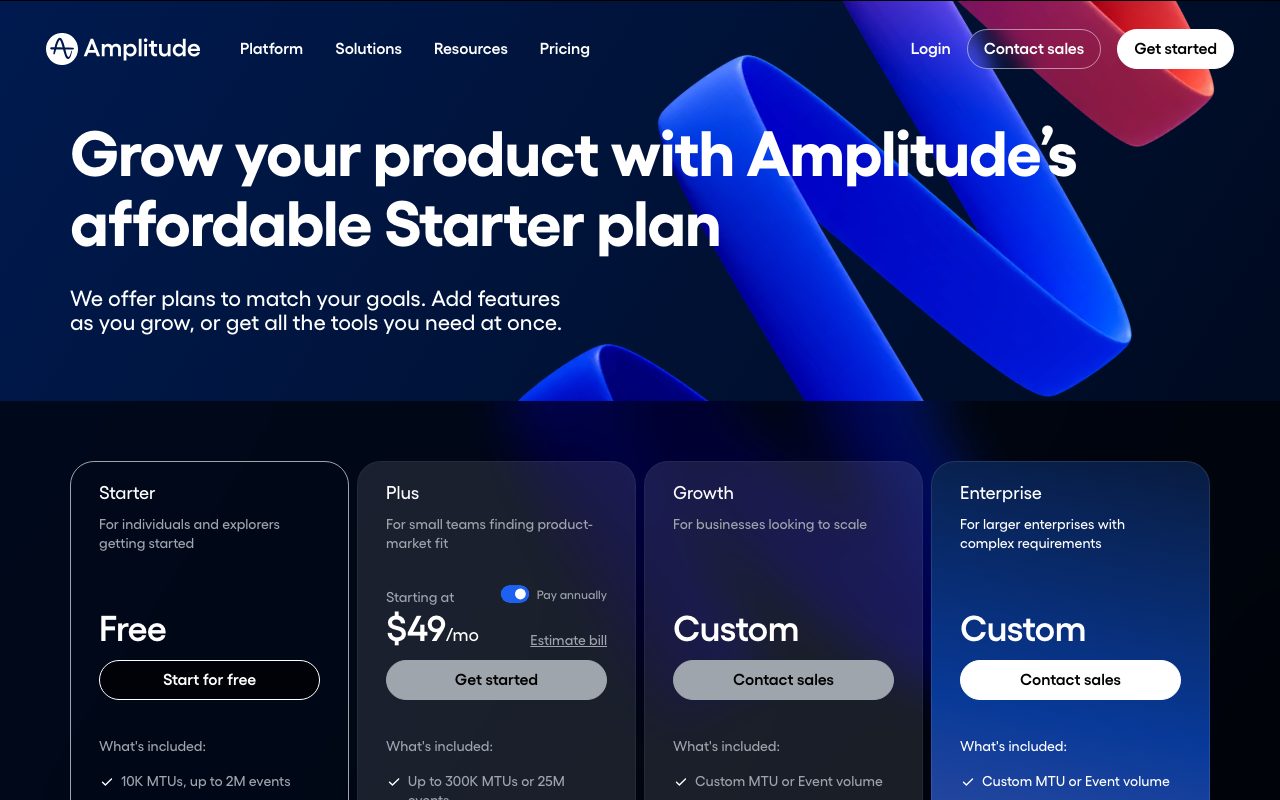
The free Starter plan covers 50,000 monthly tracked users with the core analytics. That's a real free tier, not a trial. Most pre-seed startups can run on it indefinitely.
Plus starts around $49 a month for small teams who need more events and seats. Growth and Enterprise plans are quote-based and scale with event volume. Pricing isn't cheap once you cross into Growth territory, which is the most common gripe.
Features that actually matter
Behavioral cohorts and audiences
Define a user segment based on actions, properties, or both. Sync it to Braze, HubSpot, Facebook Ads, or wherever. Marketing finally gets the same audience the product team uses.
Funnels and pathfinder
Build a multi-step funnel and watch where users fall off. Pathfinder shows the actual paths users take, which often differs wildly from what you designed.
Session replay
Bundled into the platform now. You can jump from a confusing funnel drop into the actual session of a user who dropped. That tight loop saves hours.
Experiment
Server-side and client-side flags with proper statistical analysis. If you're doing real A/B testing, this beats rolling your own.
The tradeoffs
Amplitude is opinionated. It expects events with a consistent taxonomy. If your tracking is messy, Amplitude makes the mess visible, which is good but also painful at first. Plan for an afternoon of cleanup before the dashboards start making sense.
The other tradeoff is cost at scale. Once you cross a few million MTUs, the bill climbs fast. Several teams we know moved to PostHog or Mixpanel when the renewal quote got uncomfortable.
Amplitude vs alternatives
The honest comparisons are Amplitude vs Mixpanel, Amplitude vs PostHog, and Amplitude vs Heap. Mixpanel is a closer feature match. PostHog is open-source and bundles session replay plus feature flags. Heap auto-captures everything, which sounds great until your event graph balloons.
If you want session replay first and analytics second, look at Amplitude alternatives. PostHog is the most common switch when budget tightens.
Bottom line on Amplitude
Amplitude is the safe, capable choice for product analytics in 2026. It's not the cheapest, and it's not the flashiest, but the depth on cohorts, funnels, and retention is hard to match. If your team takes product decisions seriously, Amplitude pays for itself.
For teams just starting out, the free tier is generous enough to learn the workflow. Outgrow it, and you'll know exactly what you need next. That's a much better problem than not knowing what your users do.
Common Amplitude questions
Is Amplitude better than Google Analytics? For product analytics, yes. GA is built around marketing reports and pageviews. Amplitude is built around user behavior and product decisions. They cover different jobs and most teams end up using both.
Can Amplitude replace a data warehouse? Not really. Amplitude is great for behavioral analysis on event data. It's not where you join orders to invoices to support tickets across your business. For that you still want BigQuery or Snowflake. Amplitude can pipe events into your warehouse if you need a single source of truth.
How long does Amplitude take to set up? A first useful dashboard usually takes a day. Cleaning up your event taxonomy takes longer, especially if your tracking grew organically. Plan a focused week if you're starting from messy events. The cleanup pays for itself many times over.
What about privacy and GDPR?
Amplitude offers EU data residency on Enterprise plans. PII redaction, user deletion, and consent integration are built in. You can configure cookie banners and only fire events after consent. Most regulated teams find Amplitude workable, though Enterprise pricing is the access ticket for full controls.
Does Amplitude integrate with reverse ETL?
Yes. Hightouch, Census, and Polytomic all sync Amplitude cohorts to other tools. Amplitude's CDP also handles outbound sync natively if you want one vendor. The audience-sync workflow is a major reason marketers like the platform.
Workflow tips for Amplitude
Standardize event names early. Past-tense verbs work well: "Signup Completed" beats "complete signup". Document the schema in a tracking plan. Amplitude's Data product helps enforce the plan, but only if you actually use it.
Use behavioral cohorts for everything. Static lists go stale. Cohorts update as users qualify or stop qualifying. Most other tools end up consuming the same cohorts, which keeps your audiences consistent.
Don't try to track everything. Track the events that matter for decisions: signup, activation milestones, key feature use, conversion. Auto-capture sounds great but produces noise. Curated tracking ages better.
For pricing predictability, watch your MTU growth. Anonymous users count. If your top-of-funnel surges, your bill surges. Mitigate by filtering bot traffic and being deliberate about anonymous tracking. Browse tools for product managers for adjacent picks.
Real-world Amplitude scenarios
A growth team at a B2C app uses Amplitude to find the activation moment. They define activation as "completed onboarding plus 3 sessions in 7 days." Behavioral cohort. They funnel against it. They learn that users who hit a specific feature in their first session activate at twice the rate. That's the kind of insight that drives product decisions.
A B2B SaaS startup uses Amplitude to track feature adoption. They ship a new dashboard, watch which paid customers use it, segment by ARR. The data tells them which segment finds the feature valuable, which informs sales messaging and roadmap. Without Amplitude this would be guesswork.
An ecommerce store uses Amplitude alongside Google Analytics. GA tracks acquisition. Amplitude tracks behavior post-click. Funnels measure cart-to-checkout. Cohorts measure repeat purchase rate. Two tools, two jobs, both useful.
Things to set up in your first week
Define your North Star metric and the events that feed it. Build a single dashboard for it. Set up alerts on regressions. Tag releases so you can correlate metric drops to deploys. Document the event schema so future hires don't reinvent it.
Connect Amplitude to your data warehouse for the queries Amplitude can't answer. Sync key cohorts to your ad platforms and CRM. Set up Slack alerts for funnel drops. None of this is fancy. All of it earns its keep within a quarter.
For a team picking analytics in 2026, Amplitude remains a defensible choice. It's not the cheapest. It's not the most open. It is one of the most capable products at what it does, and the depth shows up in workflows where lesser tools start to creak. Browse the Amplitude page for community reviews.
Why teams switch to or from Amplitude
Teams arrive at Amplitude when their existing analytics no longer answers the questions they're asking. Google Analytics shows pageviews but not conversion paths. A homegrown SQL dashboard answers known questions but not exploratory ones. Amplitude fills that gap with a tool built for behavioral analysis.
Teams leave Amplitude usually for cost reasons. The pricing scales with MTU and event volume, and at consumer scale the renewal can land at hundreds of thousands per year. PostHog and Mixpanel become the common alternatives. Some teams move to a warehouse-native stack (BigQuery plus Looker plus Hightouch) for more flexibility.
The good news is that Amplitude exports cleanly. You're not locked in. The data model is portable. Most migrations involve setting up the new tool with similar tracking, running both in parallel, and cutting over once dashboards match. The week of overlap is the cost of switching.
For teams in growth mode where every product decision needs to be measurable, Amplitude continues to earn its place. The depth on cohorts and funnels is the differentiator that keeps it ahead of cheaper alternatives. The sticker shock is real, but so is the value.
Tutorial / Demo
Key Features
- Behavioral product analytics on events
- Pathfinder, compass, and impact analysis
- Predictive cohorts and segmentation
- Built-in A/B experimentation
- Tracking plan and data governance tools
- Native CDP and warehouse integrations
Pros & Cons
What we like
- Powerful analytics suite for mature product teams
- Strong governance and taxonomy tooling
- Free tier is generous for early-stage usage
Room for improvement
- Steep learning curve for new analysts
- Paid tiers are priced for larger organizations
Frequently Asked Questions
Does Amplitude have a free tier?
Amplitude vs Mixpanel, which should I pick?
Amplitude vs PostHog?
Does Amplitude support reverse ETL or warehouse sync?
Is Amplitude overkill for a solo founder?
Best For
Featured in
Tags
Alternatives to Amplitude
View allMixpanel
Product analytics tool for tracking user events, funnels, retention, and cohorts to understand how people use your app.

Cometly
Marketing attribution for B2B SaaS that ties ad spend to pipeline and closed-won revenue

PostHog
All-in-one product analytics, feature flags, and session replay

rilev
Structured psychological insights for people, professionals, teams, and AI.
Our take
Tool Index Editorial · May 2026· 4.8/5
If you're evaluating Amplitude, the headline is simple: digital analytics platform for product, growth, and marketing teams to analyze user behavior across web and mobile, and most teams will get value out of the box.
Worth highlighting: Powerful analytics suite for mature product teams, Strong governance and taxonomy tooling, and Free tier is generous for early-stage usage. The friction points: Steep learning curve for new analysts and Paid tiers are priced for larger organizations.
Recommendation: this is a strong default when you need behavioral analysis for digital products. If steep learning curve for new analysts would be a dealbreaker, the alternatives section below is worth a scroll.
Editorial opinion from the Tool Index team, written from the public product pages. Not a user review.
Reviews (10)
Did exactly what I needed
Picked Amplitude for the lower price, stayed for the actual quality. Where it really wins is strong governance and taxonomy tooling. Worth calling out the predictive cohorts and segmentation too. Still recommending it to people in similar setups.
Pros
- Powerful analytics suite for mature product teams
- Free tier is generous for early-stage usage
- Strong governance and taxonomy tooling
Surprised how much we use this
Started using Amplitude casually, now it's pinned in my dock. The biggest win has been free tier is generous for early-stage usage.
Pros
- Free tier is generous for early-stage usage
Quietly excellent
Amplitude isn't perfect but it's the best I've used in this category. The thing I keep coming back to: strong governance and taxonomy tooling. Still recommending it to people in similar setups.
Pros
- Strong governance and taxonomy tooling
- Powerful analytics suite for mature product teams
Solid product, even better support
Skeptical at first because Amplitude looked too simple. It's not. Real selling point: free tier is generous for early-stage usage. It fits well for cross-team product and growth reporting.
Pros
- Strong governance and taxonomy tooling
- Free tier is generous for early-stage usage
- Powerful analytics suite for mature product teams
Solid product, even better support
First impression of Amplitude was 'huh, this is actually thought through.' Real selling point: strong governance and taxonomy tooling. Would buy again without thinking twice.
Pros
- Strong governance and taxonomy tooling
Amplitude, better than expected
Amplitude solves a real problem for me, but it's not magic. Real selling point: strong governance and taxonomy tooling. Got real value out of predictive cohorts and segmentation. Mostly using it for experimentation tied to analytics events.
Bought it for one feature, stayed for ten
Have been using Amplitude for a while, here's where I land. Where it really wins is free tier is generous for early-stage usage. Got real value out of built-in A/B experimentation.
Pros
- Powerful analytics suite for mature product teams
- Free tier is generous for early-stage usage
- Strong governance and taxonomy tooling
Almost perfect, almost
Hadn't planned on switching, but Amplitude was hard to ignore. Genuine strength: powerful analytics suite for mature product teams. It fits well for experimentation tied to analytics events. That said, steep learning curve for new analysts is a real gripe. Decent value once you accept the rough edges.
Cons
- Steep learning curve for new analysts
- Paid tiers are priced for larger organizations
Finally something that fits
Been using Amplitude for three months now. Where it really wins is powerful analytics suite for mature product teams. Worth calling out the pathfinder, compass, and impact analysis too. Main use case: cross-team product and growth reporting.
Pros
- Free tier is generous for early-stage usage
- Strong governance and taxonomy tooling
Amplitude, better than expected
Tried half a dozen options before landing on Amplitude. Honestly impressed by how free tier is generous for early-stage usage. Behavioral product analytics on events works the way you'd hope. Found it works best for event governance across large engineering orgs. It would be a 5 if not for steep learning curve for new analysts. Worth the price for what I get out of it.
Pros
- Free tier is generous for early-stage usage
- Strong governance and taxonomy tooling
Badge builder
Add Amplitude to your website
Choose a badge style and size, preview it here, then copy the generated HTML. Badge images are self-contained SVGs and do not require an external script.

<a href="https://toolindex.net/tools/amplitude?ref=badge" target="_blank" rel="noopener">
  <img src="https://toolindex.net/badge/amplitude/medium.svg" alt="Amplitude - Listed on Tool Index" width="180" height="50" />
</a>How to use the badge
- 1. Pick the style, size, and theme that fit your layout.
- 2. Copy the generated HTML from the code block.
- 3. Paste it into your footer, homepage, or press page.
Score badge available
Amplitude qualifies for the score and circle badges based on its current top-10 positionin Analytics.
Badge clicks return visitors to this profile with a referral tag so the source remains identifiable.
Related Tools

Sleep Suivour
Track your sleep, improve your rest
Notionlytics
Page-view analytics and reader feedback widgets for public Notion pages
Mixpanel
Product analytics tool for tracking user events, funnels, retention, and cohorts to understand how people use your app.

Simple Analytics
Privacy-friendly web analytics with a clean dashboard, event tracking, and a strong stance against personal data collection.
Work on Amplitude? Request listing access or correction