
Voidleap Code
Desktop IDE for agentic coding with multi-model support and full visibility into AI workflows
Gallery
About Voidleap Code
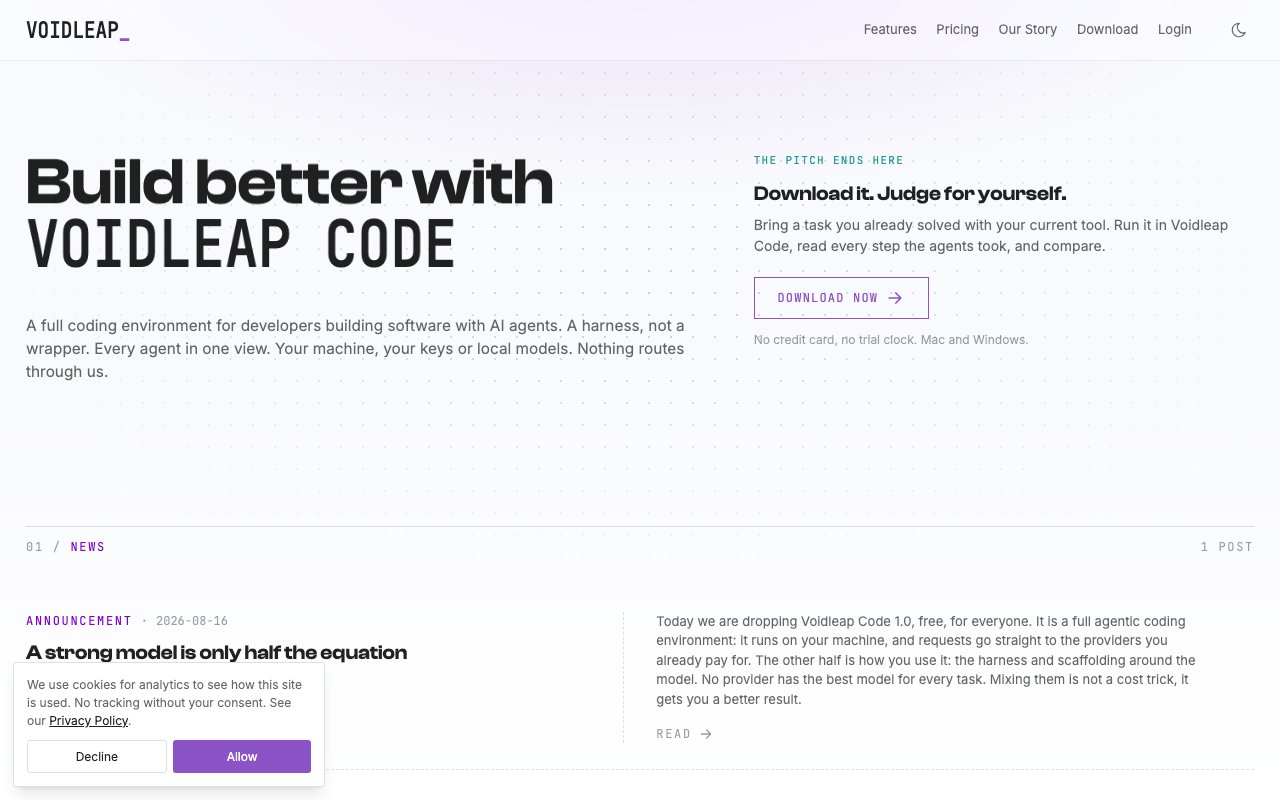
Voidleap Code is a desktop IDE designed for developers who want to run AI coding agents with full visibility into what those agents are doing. It positions itself as a harness for agentic coding rather than a wrapper around a single model provider. The application runs locally on macOS and Windows, connects to multiple AI services using your own API keys, and exposes detailed analytics on cost, token usage, and agent behavior that most competing tools keep hidden behind simple chat interfaces. If you've been frustrated by the opacity of AI coding assistants that give you a chat window and a monthly bill with no breakdown of what happened in between, this is built to address that exact gap.
The architecture is local first, which means nothing routes through Voidleap's servers. You bring API keys from providers like Anthropic, OpenAI, Gemini, GitHub Copilot, Azure, or Bedrock, or you run local models through Ollama or LM Studio. Your code, your prompts, and your conversations stay on your machine. For developers working on proprietary or sensitive projects, this matters. It also matters if you simply don't want another company sitting between you and your AI provider, logging requests you didn't ask them to log. The application acts as a passthrough to your chosen providers rather than an intermediary with its own data collection.
Observability is where Voidleap diverges most sharply from alternatives in the space. The interface includes over 30 analytics charts covering cost trends, per model metrics, per agent metrics, cache hit rates, latency distributions, and token consumption over time. All of this data is exportable, so you can analyze it externally or feed it into your own dashboards and monitoring systems. If you're trying to understand what your AI usage actually costs across different providers and tasks, or if you want to optimize how agents use context to reduce spend, the telemetry is there and visible by default. Most tools hide these numbers or require digging through billing dashboards after the fact. Voidleap surfaces them as a first class feature in the main interface.
Context management is visual and gives you direct control over what the agent sees. As conversations grow, AI agents accumulate context that can become noisy or counterproductive to the task at hand. Voidleap lets you selectively remove individual messages, tool calls, or files from an agent's context without restarting the entire thread and losing everything. Slash commands like context, trim, and prune give you keyboard shortcuts for common operations. You can also swap models mid conversation, which is useful when you want to start with a fast, cheap model for routine work and escalate to something more capable for complex reasoning steps. This kind of granular control isn't common in AI coding tools, which tend to treat the conversation as an opaque stream that you either continue or abandon entirely.
Customization goes deeper than most competitors allow. Agents, skills, system prompts, and security rules are all editable at multiple scopes, including global, workspace, and project levels. There are four execution modes available to match different risk tolerances. Default applies reasonable guardrails that prevent obvious mistakes. Read only prevents the agent from writing any files, useful for analysis tasks. Careful requires confirmation before any action is taken. Yolo removes most restrictions for developers who want maximum autonomy and are confident they can supervise the output. Security features include AST aware command parsing that understands code structure and protections for sensitive paths like .ssh and .env directories. You define how much trust to extend rather than accepting whatever defaults the tool decided for you.
The application supports nine AI providers out of the box, including local model runners. This means you're not locked into a single vendor's pricing or capabilities. You can mix providers within a single workflow, using different models for different tasks based on their individual strengths and cost profiles. That flexibility becomes increasingly important as the model landscape keeps shifting and pricing changes quarterly across providers.
Voidleap Code is currently free. Version 1.0 launched with no payment required, no credit card entry, and no trial clock. That's an aggressive accessibility stance, and it raises reasonable questions about long term sustainability and how the project plans to fund ongoing development. But for now, there's no cost barrier to trying it beyond your own API spend with the model providers you connect. It's aimed at developers who already understand AI assisted development and want more control over the process than simpler tools offer. If you're comfortable with command line tools and want to orchestrate agents with precision rather than just chat with an autocomplete assistant, this fits that workflow better than alternatives that prioritize convenience over transparency.
Key Features
- Multi-provider support including local models
- 30+ analytics charts for cost and usage tracking
- Visual context management with selective pruning
- Four execution modes from read-only to unrestricted
- Model swapping mid-conversation
- AST-aware security with sensitive path protection
Pros & Cons
What we like
- Local-first with no data routing through external servers
- Works with multiple AI providers and local models
- Detailed observability into cost and token usage
- Free with no trial limitations
Room for improvement
- Only available on macOS and Windows, no Linux
- Newer product still building community and documentation
- Free pricing raises long-term sustainability questions
- Requires own API keys for cloud model access
Frequently Asked Questions
What is Voidleap Code?
Is Voidleap Code free?
What AI providers does Voidleap Code support?
Does Voidleap Code send my code to external servers?
Best For
Featured in
Alternatives to Voidleap Code
Cursor
VS Code fork built around an AI pair-programmer

Replit
Browser IDE plus Replit Agent that builds and deploys apps from a prompt
Windsurf
Codeium's AI editor with Cascade agent and deep IDE integration
Vibe Built
Building real apps with agentic AI. What worked, what broke, what shipped.
Reviews (0)
Badge builder
Add Voidleap Code to your website
Choose a badge style and size, preview it here, then copy the generated HTML. Badge images are self-contained SVGs and do not require an external script.

<a href="https://toolindex.net/tools/voidleap-code?ref=badge" target="_blank" rel="noopener">
  <img src="https://toolindex.net/badge/voidleap-code/medium.svg" alt="Voidleap Code - Listed on Tool Index" width="180" height="50" />
</a>How to use the badge
- 1. Pick the style, size, and theme that fit your layout.
- 2. Copy the generated HTML from the code block.
- 3. Paste it into your footer, homepage, or press page.
Standard badge available
The standard listing badge is available now. Score and circle badges are limited to tools currently ranked in the top 10 of a category.
Badge clicks return visitors to this profile with a referral tag so the source remains identifiable.
Related Tools

Bolt.new
Prompt-to-deployed full-stack app inside the browser

Tabnine
Privacy-first enterprise AI code assistant you control, with SaaS, VPC, on-prem, or fully air-gapped deployment
Cursor
VS Code fork built around an AI pair-programmer

Skeezo
Agent-native macOS IDE for coordinating Claude Code and AI agents
Work on Voidleap Code? Request listing access or correction