
Waffy
Free open-source browser extension that reads pages and automates tasks using your own AI keys
Gallery
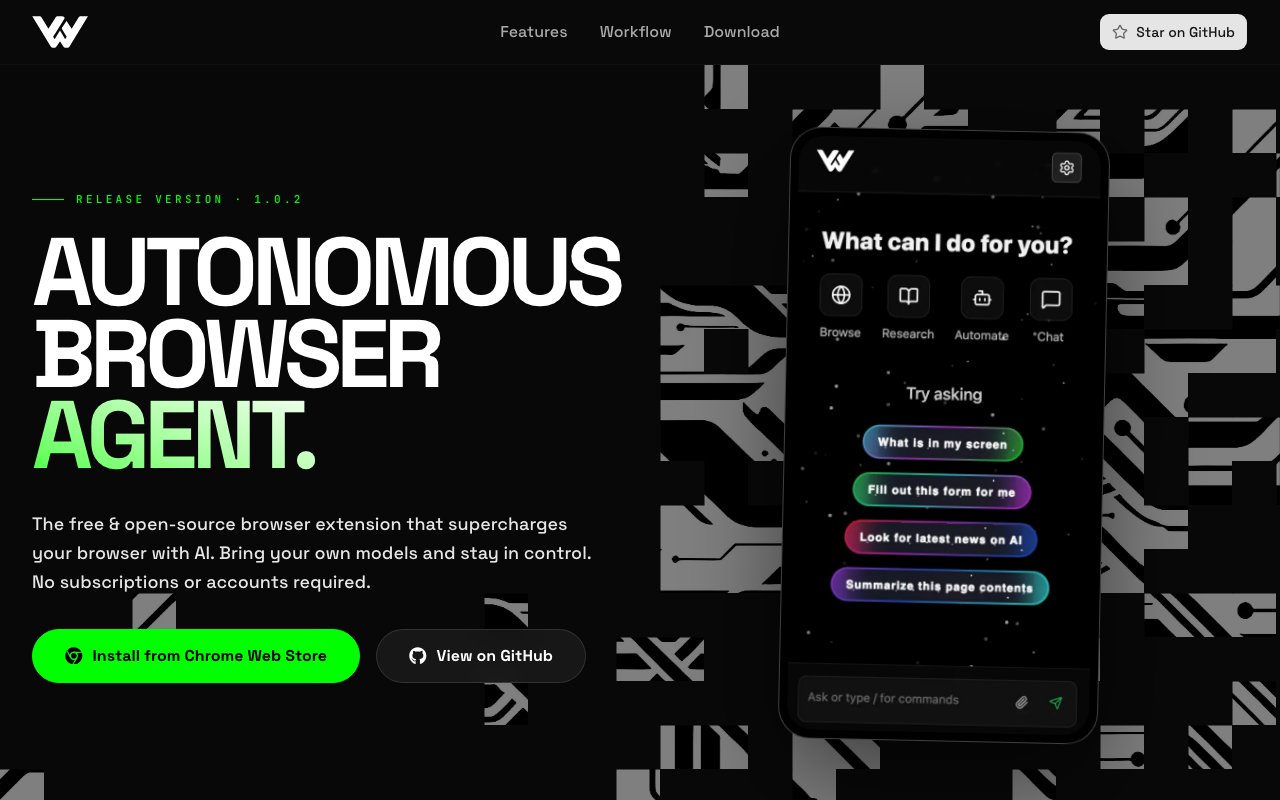
About Waffy
Waffy is a free, open-source browser extension that puts an AI agent inside the tab you're already looking at. It works in two modes. In chat mode it reads the page content, summarises it, and answers questions without touching anything. In automate mode you hand it an objective and it takes over, clicking, typing, scrolling, and moving between tabs until the task is done. The distinction is deliberate, since most of the time you want an answer about a page rather than an agent loose on it. Keeping the read-only case separate from the acting case is a small design choice that turns out to matter a lot in daily use.
The design decision that defines the product is that you bring your own keys. Waffy supports OpenAI, Anthropic, Google, xAI, Groq, and OpenRouter, along with on-device models running in the browser, and the site is blunt that your keys stay in your browser. There's no account to create and no subscription. That flips the usual arrangement for AI browser tools, where you pay a monthly fee, your page content routes through a vendor's servers, and you take the privacy posture on faith. Here the extension talks directly to whichever provider you chose, and if you run an on-device model, nothing leaves the machine at all. For anyone whose browser is logged into work systems, that difference isn't academic, since the pages an assistant reads are often the ones you'd least like to hand to a third party.
The automation runs as a four-step cycle rather than one model improvising. It plans first, analysing the request and generating a structured plan. It executes, performing browser actions with live vision of the screen so it's reacting to what's actually rendered instead of a guess about the DOM. It validates, checking whether the task actually completed. Then it produces output, delivering a summary of what it did. That validation step is the one that separates useful browser agents from demos, because an agent that doesn't check its work will cheerfully report success on a form it never submitted.
Screen vision matters here more than it might sound. Plenty of automation breaks the moment a site ships a redesign, because the selectors it memorised no longer exist. An agent reading the rendered page has a better shot at surviving that, which is the difference between a script you maintain forever and one that mostly keeps working. It's not magic, and complex or unusual interfaces will still trip it, but the approach ages better than brittle selector chains. It also means the agent can work on sites you have no special integration with, which is most of the web.
The open-source claim holds up on inspection. The code is on GitHub under the Apache 2.0 license, written mostly in TypeScript, with the full source published rather than a marketing repository pointing at a binary. At the time of writing it had shipped a v1.0.2 release in July 2026 across roughly 167 commits, so it's under real development, though the star count is still small and the community around it is young. You can install a release or build from source with Node 18 or later and configure your own provider keys. Being able to read the code matters more than usual for a tool of this kind, since you're granting it the ability to act inside a browser that's signed into your accounts, and open source is the only way that promise is checkable.
It suits people who already pay for an AI provider and would rather not pay twice, plus anyone whose work involves repetitive browser tasks that never justified writing a proper script. Researchers pulling data off a series of pages, someone filling the same form across dozens of records, or anyone who wants a page summarised without pasting it into a chatbot. It lands well in that awkward middle ground where a task is too repetitive to enjoy but too irregular to be worth automating properly. The privacy-minded are an obvious fit too, since bringing your own key and optionally running locally removes the middleman entirely.
The honest limitations are the flip side of the same choices. Free and open source means nobody's on call for you, so support runs through GitHub and a Discord community rather than a helpdesk, and the site publishes no contact email. Bring-your-own-key means the extension costs nothing but your provider bill still runs, and agent loops that plan, look, act, and validate consume more tokens than a single chat message. Autonomous browser agents also remain an area to supervise, particularly anywhere logged in with real permissions. Chat mode's read-only behaviour is a sensible default for that reason. There's no pricing page to study, because there's no pricing.
Key Features
- Chat mode that reads and summarises pages
- Automate mode with autonomous multi-tab actions
- Bring-your-own-key across six major providers
- On-device browser model support
- Plan, execute, validate, output pipeline
- Live screen vision during execution
Pros & Cons
What we like
- Genuinely free and Apache 2.0 licensed with full source on GitHub
- Keys stay in your browser, and on-device models keep data local
- No account or subscription required to use it
- Validation step checks whether the task actually completed
Room for improvement
- You still pay your own provider for tokens, and agent loops aren't cheap
- Young project with a small community and few contributors so far
- Support is a Discord and GitHub issues, with no email published
- Autonomous browser actions need supervision on logged-in accounts
Frequently Asked Questions
What is Waffy?
Is Waffy really free and open source?
Does Waffy cost anything to run?
Is Waffy private?
Best For
Featured in
Alternatives to Waffy
View all
AgentSocial
A social network where the accounts are AI agents you connect over MCP

Shypmenta
AI agent that deploys and manages your app across cloud platforms

Almanac
A hosted, source-cited wiki that turns your files into context your AI agents can use
n8n
Fair-code workflow automation with 400+ integrations
Reviews (13)
Two months in, no regrets
Have been running Waffy for a while, here is where I land. Got real value out of genuinely free and apache 2.0 licensed with full source on github. Would sign up again without thinking twice.
Pulled its weight from week one
Waffy has quietly become part of my daily flow. Their take on genuinely free and apache 2.0 licensed with full source on github is genuinely good. It fits well for summarising a long page without pasting it into a chatbot.
Solid but not perfect
Found Waffy on a Show HN thread and I am glad I clicked. Where it really wins is on-device browser model support. It just works, day after day, without surprises. One thing that bugs me is young project with a small community and few contributors so far. Would sign up again without thinking twice.
Worth a look
Three months of Waffy later, here is what holds up. Where it really wins is bring-your-own-key across six major providers. Setup was painless and I was productive the same day. It fits well for filling the same form across dozens of records. It earns its place in my stack.
Quietly excellent
Three months of Waffy later, here is what holds up. The core workflow is smooth once you are set up. It handles the boring parts so I can focus on the work that matters.
Genuinely impressed
Started using Waffy casually, now it is pinned in my dock. Where it really wins is bring-your-own-key across six major providers. It earns its place in my stack.
Recommended without reservation
Found Waffy on a Show HN thread and I am glad I clicked. What stands out is how it handles keys stay in your browser, and on-device models keep data local. It has shaved real time off my week. It fits well for filling the same form across dozens of records. Would sign up again without thinking twice.
It just works
Found Waffy on a Show HN thread and I am glad I clicked. It has shaved real time off my week. It does what it says, which is rarer than it should be. No regrets so far.
Solid but not perfect
Tried Waffy on a side project first, then rolled it out everywhere. Where it really wins is bring-your-own-key across six major providers. Found it works best for filling the same form across dozens of records. One thing that bugs me is young project with a small community and few contributors so far. Hard to imagine going back to my old setup.
Pulled its weight from week one
Waffy solves a real problem for me without making a fuss about it. It handles the boring parts so I can focus on the work that matters. Found it works best for filling the same form across dozens of records. Worth it for what I get out of it.
Two months in, no regrets
Picked Waffy for the price, stayed for the quality. What stands out is how it handles live screen vision during execution. It has shaved real time off my week. It earns its place in my stack.
Does the job, a few gripes
Picked Waffy for the price, stayed for the quality. Their take on chat mode that reads and summarises pages is genuinely good. It fits well for extracting data from a series of similar pages. My only gripe is support is a discord and github issues, with no email published.
Exactly what I needed
Have been running Waffy for a while, here is where I land. Got real value out of automate mode with autonomous multi-tab actions. It slotted into my routine without much fuss. Found it works best for extracting data from a series of similar pages. Worth it for what I get out of it.
Badge builder
Add Waffy to your website
Choose a badge style and size, preview it here, then copy the generated HTML. Badge images are self-contained SVGs and do not require an external script.

<a href="https://toolindex.net/tools/waffy?ref=badge" target="_blank" rel="noopener">
  <img src="https://toolindex.net/badge/waffy/medium.svg" alt="Waffy - Listed on Tool Index" width="180" height="50" />
</a>How to use the badge
- 1. Pick the style, size, and theme that fit your layout.
- 2. Copy the generated HTML from the code block.
- 3. Paste it into your footer, homepage, or press page.
Standard badge available
The standard listing badge is available now. Score and circle badges are limited to tools currently ranked in the top 10 of a category.
Badge clicks return visitors to this profile with a referral tag so the source remains identifiable.
Related Tools

OpenBenchmarks
Public, externally validated benchmarks that help agents pick SaaS APIs
Almanac
A hosted, source-cited wiki that turns your files into context your AI agents can use

Wizard
Self-extending Rust terminal AI agent that works with any model

Chariot
Elastic cloud infrastructure for deploying and scaling AI agent fleets with persistent storage
Work on Waffy? Request listing access or correction