
Workaround
Review your GitHub stars and clear out the repos that stopped mattering
Gallery
About Workaround
Workaround is a tool for going back through your GitHub stars and working out which ones still deserve to be there. It loads everything you've starred, flags the repos that have quietly died, and gives you a way to clear them out in bulk instead of one at a time. The framing on the site is broader than that, it calls itself small practical fixes for everyday software, and says Git is the first workaround, so the star cleanup is the opening tool rather than the whole intended scope.
The problem is real if unglamorous. The star button is the cheapest action on GitHub, so people press it constantly and never look back. A few years in you have several hundred starred repos, and the list has stopped being a bookmark collection and become sediment. Some of those projects are archived. Some were deprecated in favor of something else. Some haven't taken a commit since 2020. You can't tell which is which from the stars page, because GitHub shows you the same row for a thriving project and an abandoned one.
The way it works is straightforward. You connect through GitHub OAuth, and it pulls your stars in and builds a view around them. Each repo shows the owner and name, the description, the primary language, the star count, when it was last pushed to, and, usefully, when you starred it. That last field is the one that does the quiet work, because a repo you starred two years ago and never touched tells a different story from one you starred last week.
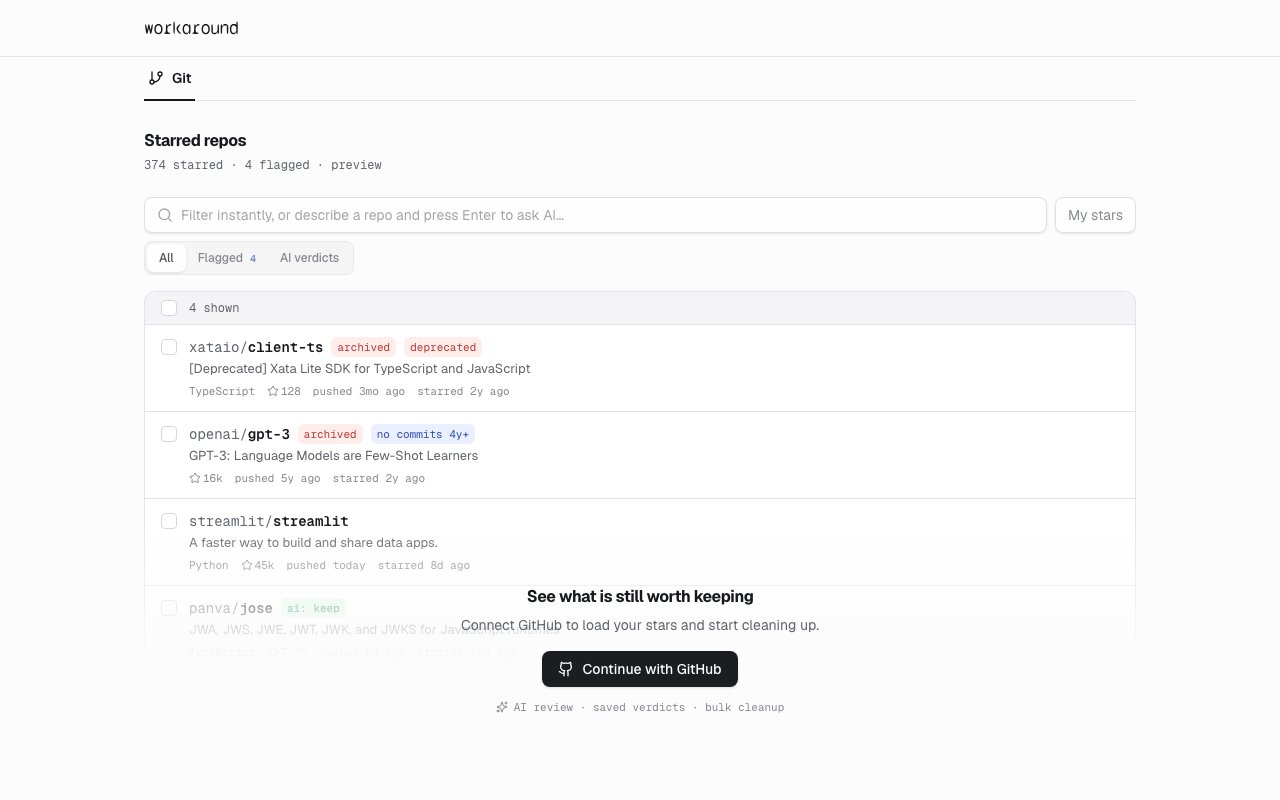
The preview on the landing page is a good illustration of the taxonomy, because the four example repos it shows are each a different kind of problem. There's an archived and deprecated TypeScript SDK whose own description now opens with the word deprecated. There's a famous research repo that's archived and hasn't taken a commit in four years or more, the kind of thing everyone stars and nobody revisits. There's a large, healthy project that was pushed to today and is obviously a keeper. And there's a widely used library carrying an AI verdict of keep. Those four cover most of what's actually sitting in a long star list, and sorting them apart by hand is exactly the tedium the tool is aimed at.
On top of that it layers flags and verdicts. Repos get marked as archived, deprecated, or with staleness notes along the lines of no commits in four years or more, which are all facts pulled from the repo itself rather than opinions. Then there's an AI layer that issues verdicts on whether something is worth keeping, shown inline against the repo. You can filter the list instantly by typing, or describe a repo in plain language and press Enter to ask the AI instead, which covers the case where you remember roughly what a project did but not what it was called. The view splits into your stars, everything, just the flagged ones, and just the AI verdicts, and there's a detail route per repository for a closer look. Verdicts save, which matters more than it sounds. Working through several hundred repos isn't a single sitting, so being able to make calls, leave, and come back to where you were is what makes a cleanup finishable at all. When you've decided, bulk cleanup handles the actual unstarring rather than making you click through the list again. The GitHub authorization asks for the public_repo scope, which is what's needed to unstar on your behalf and is worth knowing before you approve it.
Who it's for is narrow and that's fine. This is for developers with a star list that got away from them, particularly anyone who has ever gone looking for a tool they know they starred and given up scrolling. It isn't a discovery product and doesn't try to recommend new repos, it only deals with what you already collected. If your star list is short or you already keep it tidy with GitHub Lists, there's nothing here for you. The counter on the landing page showing several hundred stars against a handful of flagged repos is a fair picture of the ratio you should expect, most of what you starred is neither obviously dead nor obviously worth keeping, and the flags are there to find the clear cases fast.
Access is free with nothing to install and no pricing published anywhere on the site. The fair warning is that this is an early and thin product. Signed out, the site is a single page showing a mocked preview of the interface with example repos, and the real thing sits entirely behind the GitHub sign-in, so you're authorizing before you've seen it work on your own data. There's no about page, no documentation, no terms and no privacy policy published yet, and no contact address listed, which is a real gap for a tool asking for a write-capable GitHub scope. What's behind the button is a working app rather than a mockup, but going in you're taking the product mostly on faith.
Key Features
- GitHub OAuth star import
- Archived, deprecated and stale flags
- AI verdicts on whether to keep a repo
- Natural-language search across your stars
- Saved verdicts across sessions
- Bulk unstar cleanup
Pros & Cons
What we like
- Surfaces archived, deprecated and long-dead repos automatically
- Shows when you starred a repo, not just when it was last updated
- Verdicts save, so a large cleanup can span several sittings
- Free to use with nothing to install
Room for improvement
- Very narrow, it only handles GitHub stars today
- No terms, privacy policy or contact address published yet
- Signed-out visitors see only a mocked preview, not the real app
- No documentation or public track record to evaluate first
Frequently Asked Questions
What is Workaround?
Is Workaround free?
What GitHub permissions does it need?
Who is Workaround for?
Best For
Featured in
Alternatives to Workaround

1Lookup
Real-time data verification API for phone, email, IP, and domain validation to fight fraud

Kevin Gabeci
Solo developer building web apps, cozy browser games, and AI creator toolkits.

Codedex
A gamified, story-driven platform that teaches Python, web dev, and more like an RPG quest
Hack2hire
Practice real SDE interview questions from top tech companies with expert worked solutions
Reviews (11)
Genuinely impressed
Came to Workaround after getting frustrated with what I had before. Their take on shows when you starred a repo, not just when it was last updated is genuinely good. It fits well for searching your own stars in plain language.
Quietly excellent
Three months of Workaround later, here is what holds up. The bulk unstar cleanup is more useful than I expected. It earns its place in my stack.
Quietly excellent
Came to Workaround after getting frustrated with what I had before. Got real value out of saved verdicts across sessions. No regrets so far.
Worth a look
Came to Workaround after getting frustrated with what I had before. The output quality holds up better than I expected. Hard to imagine going back to my old setup.
It just works
Started using Workaround casually, now it is pinned in my dock. Where it really wins is saved verdicts across sessions. Recommending it to people in a similar spot.
Does the job, a few gripes
Hadn't planned on switching, but Workaround was hard to ignore. What stands out is how it handles saved verdicts across sessions. The catch is very narrow, it only handles github stars today. Glad I made the switch.
Good, with a few caveats
Started using Workaround casually, now it is pinned in my dock. The saved verdicts across sessions is more useful than I expected. Mostly using it for searching your own stars in plain language. My only gripe is no terms, privacy policy or contact address published yet.
Quietly excellent
Three months of Workaround later, here is what holds up. Setup was painless and I was productive the same day. Found it works best for searching your own stars in plain language. Hard to imagine going back to my old setup.
Finally something that fits
Started using Workaround casually, now it is pinned in my dock. Where it really wins is natural-language search across your stars. It fits well for bulk unstarring dead tooling in one pass. No regrets so far.
Recommended without reservation
Have been running Workaround for a while, here is where I land. The interface stays out of my way, which I appreciate. Performance has been steady even when I lean on it hard. Mostly using it for searching your own stars in plain language. Recommending it to people in a similar spot.
Two months in, no regrets
Found Workaround on a Show HN thread and I am glad I clicked. It just works, day after day, without surprises. It earns its place in my stack.
Badge builder
Add Workaround to your website
Choose a badge style and size, preview it here, then copy the generated HTML. Badge images are self-contained SVGs and do not require an external script.

<a href="https://toolindex.net/tools/workaround?ref=badge" target="_blank" rel="noopener">
  <img src="https://toolindex.net/badge/workaround/medium.svg" alt="Workaround - Listed on Tool Index" width="180" height="50" />
</a>How to use the badge
- 1. Pick the style, size, and theme that fit your layout.
- 2. Copy the generated HTML from the code block.
- 3. Paste it into your footer, homepage, or press page.
Standard badge available
The standard listing badge is available now. Score and circle badges are limited to tools currently ranked in the top 10 of a category.
Badge clicks return visitors to this profile with a referral tag so the source remains identifiable.
Related Tools
Kevin Gabeci
Solo developer building web apps, cozy browser games, and AI creator toolkits.

Coolify
Self-hostable, open source alternative to Heroku and Netlify

Warp
The modern terminal reimagined with AI and collaboration

Bolt.new
Prompt-to-deployed full-stack app inside the browser
Work on Workaround? Request listing access or correction