AI Visibility
Audit how ready your website is to be crawled, understood, and cited by AI answer engines
Gallery
About AI Visibility
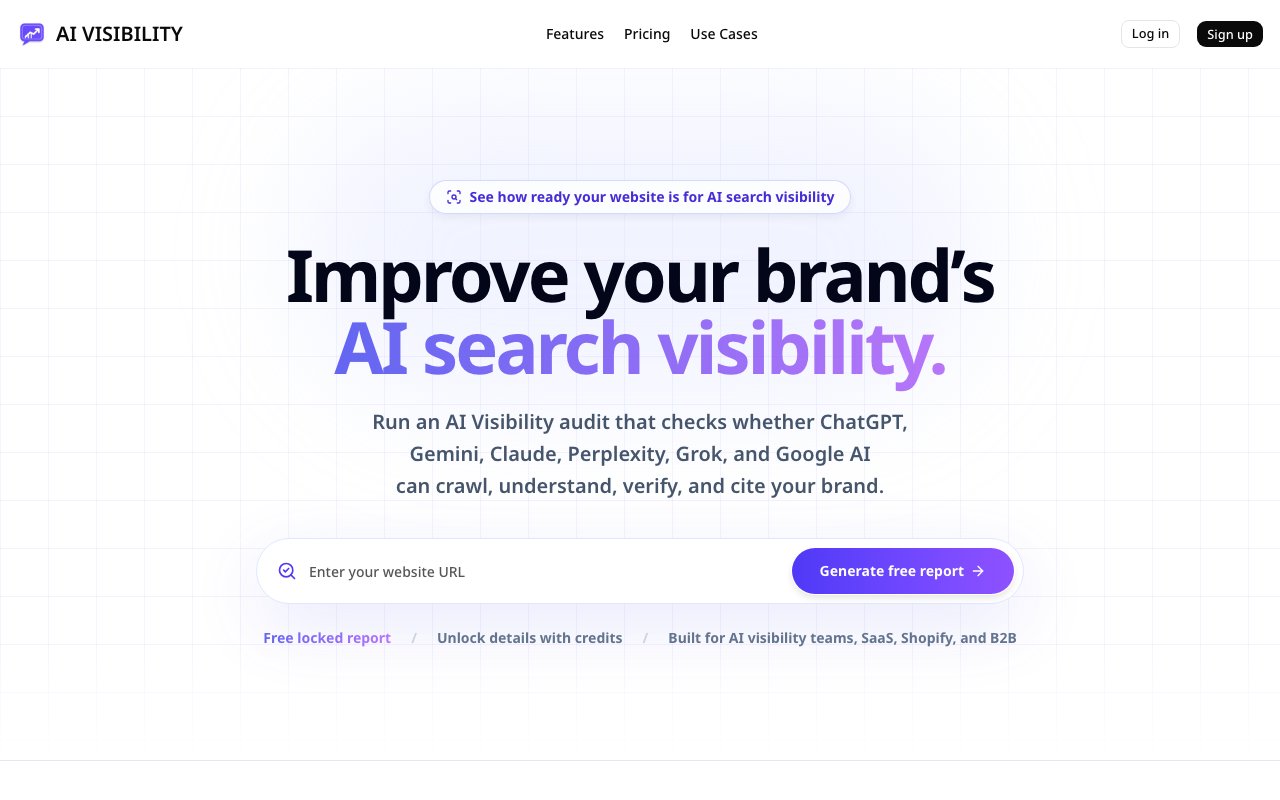
AI Visibility is an audit tool that measures how ready a website is to be crawled, understood, verified, and cited by AI answer engines such as ChatGPT, Gemini, Claude, Perplexity, Grok, and Google AI Mode. The premise behind it is that buyers increasingly ask an assistant a question instead of scrolling a page of blue links, and if a brand's site isn't legible to those systems, it quietly gets left out of the answer the buyer actually reads. The tool exists to make that gap visible. You give it a URL, it studies your site the way an AI crawler would, and it reports back on where your pages are clear, where they're thin, and where the facts a model needs to recommend you are missing or hard to verify.
Getting a report is straightforward. You enter your website URL and the tool generates a free locked report, then you spend credits to unlock the full findings. The crawl goes wide across the homepage, product and pricing pages, case studies, docs, help center, blog, sitemap, robots file, and even PDFs and less obvious entry points, so the picture reflects your whole site rather than a single landing page. From there it scores your presence across twelve audit domains, and that's the point where the free preview ends and the paid detail begins. The idea is that you can see the shape of the diagnosis before deciding whether the full breakdown is worth unlocking.
The depth is in what those domains cover. A brand entity profile clarifies who you are, what you sell, where your product boundaries sit, and which aliases or lookalikes could confuse a model. A claim-level evidence ledger maps each important claim to a source, a verification status, a freshness risk, and a note on whether it's ready to be cited. An AI intent coverage matrix checks whether your site can actually answer the recommendation, comparison, alternative, tutorial, pricing, trust, and buying questions people put to assistants. On the technical side it audits crawlability across robots, sitemaps, canonical tags, status codes, JavaScript rendering, PDF text, and image alt text, then recommends structured data like Organization, Product, FAQ, and Article markup where the visible content supports it.
Trust and competitive context round out the report. A trust signal gap analysis reviews authorship, update dates, company proof, certifications, named customers, contact details, and correction paths, since those are the things a model leans on to decide whether a source is credible. A competitor and off-site evidence map compares where rivals have stronger public proof across media, reports, partners, communities, app stores, and third-party references, which helps explain why an assistant might be recommending them and not you. Taken together, the twelve domains are meant to read less like a score and more like a working diagnosis your team can act on.
What keeps it practical is the output. Findings don't stop at a number, they turn into a P0, P1, and P2 roadmap with owner-ready tasks and acceptance criteria, which separates the technical blockers your engineers should fix from the content and authority work that belongs to marketing. Agencies and independent consultants tend to like this because the report packages cleanly as a client deliverable, and prospects can see partial results before anyone pays. It's aimed at AI visibility and growth teams, SaaS companies, Shopify and other ecommerce stores, and B2B service firms that have real credibility offline but weak, hard-to-verify proof online.
The sample cases on the site give a sense of the fixes the report surfaces. A Shopify skincare brand used it to find thin product education pages, missing FAQ blocks, and weak source references, then rewrote category guides and added schema-backed buyer questions. An early-stage AI workflow SaaS clarified product boundaries, added comparison pages, and published integration-specific use cases so it could answer buying-intent queries directly. A regional B2B services firm with strong offline credibility prioritized case evidence, service-area pages, and author details so both buyers and AI systems could verify it faster.
On pricing, the free locked report lets you review the structure and top-level findings at no cost, and unlocking full reports runs on credits rather than a subscription. Credit packs start small and stay valid for a year, so occasional audits don't force a recurring bill. It's worth knowing that the tool is upfront that it can't guarantee AI citations, since no product controls how a model chooses to answer. What it aims to do instead is make your site easier for those systems to crawl, understand, verify, and quote, and hand your team a clear queue of the work that gets you there.
Key Features
- Full-site crawl inventory
- Brand entity profile
- Claim-level evidence ledger
- AI intent coverage matrix
- Technical crawlability and schema audit
- P0/P1/P2 execution roadmap
Pros & Cons
What we like
- Free locked report lets you preview findings before paying
- Covers twelve audit domains, not just a single score
- Turns findings into owner-ready tasks with acceptance criteria
- Credits are one-off and valid for a year, no subscription
Room for improvement
- Cannot guarantee that AI systems will cite your brand
- Full detail requires spending credits to unlock
- Younger product with a small published track record
- Value depends on acting on the roadmap it produces
Frequently Asked Questions
What is AI Visibility?
Is AI Visibility free?
Does it guarantee my brand gets cited by AI?
Who is AI Visibility built for?
Best For
Featured in
Alternatives to AI Visibility

Moz Pro
SEO toolset with keyword research, site audits, link analysis, and the well-known Domain Authority and Page Authority metrics.
Frase
AI-assisted SEO content tool that turns SERP research into briefs, outlines, and optimized drafts inside one editor.
Screaming Frog SEO Spider
Desktop website crawler trusted by SEO professionals for technical audits, broken link checks, and structured data analysis.
Semrush
Comprehensive SEO and digital marketing suite covering keywords, backlinks, competitive research, content, and PPC.
Reviews (7)
Worth a look
Started using AI Visibility casually, now it is pinned in my dock. The covers twelve audit domains, not just a single score is more useful than I expected. It does what it says, which is rarer than it should be. Mostly using it for finding where competitors have stronger off-site proof.
It just works
Found AI Visibility on a Show HN thread and I am glad I clicked. The full-site crawl inventory is more useful than I expected. Would sign up again without thinking twice.
Genuinely impressed
Have been running AI Visibility for a while, here is where I land. Setup was painless and I was productive the same day. Mostly using it for auditing whether ai assistants can crawl and cite your site. No regrets so far.
Finally something that fits
Found AI Visibility on a Show HN thread and I am glad I clicked. Their take on p0/p1/p2 execution roadmap is genuinely good. The defaults are sensible, so I was not fighting settings on day one. Recommending it to people in a similar spot.
Two months in, no regrets
Three months of AI Visibility later, here is what holds up. Their take on full-site crawl inventory is genuinely good. Mostly using it for auditing whether ai assistants can crawl and cite your site. Glad I made the switch.
Decent with some rough edges
Came to AI Visibility after getting frustrated with what I had before. The interface stays out of my way, which I appreciate. Found it works best for auditing whether ai assistants can crawl and cite your site. My only gripe is value depends on acting on the roadmap it produces. Would sign up again without thinking twice.
Recommended without reservation
Hadn't planned on switching, but AI Visibility was hard to ignore. The full-site crawl inventory is more useful than I expected. Mostly using it for finding where competitors have stronger off-site proof. It earns its place in my stack.
Badge builder
Add AI Visibility to your website
Choose a badge style and size, preview it here, then copy the generated HTML. Badge images are self-contained SVGs and do not require an external script.
<a href="https://toolindex.net/tools/ai-visibility?ref=badge" target="_blank" rel="noopener">
  <img src="https://toolindex.net/badge/ai-visibility/medium.svg" alt="AI Visibility - Listed on Tool Index" width="180" height="50" />
</a>How to use the badge
- 1. Pick the style, size, and theme that fit your layout.
- 2. Copy the generated HTML from the code block.
- 3. Paste it into your footer, homepage, or press page.
Score badge available
AI Visibility qualifies for the score and circle badges based on its current top-10 positionin SEO Tools.
Badge clicks return visitors to this profile with a referral tag so the source remains identifiable.
Related Tools

SEOdata.dev
Simple API for keyword search volume, CPC, and competition data
Frase
AI-assisted SEO content tool that turns SERP research into briefs, outlines, and optimized drafts inside one editor.
Surfer SEO
Content optimization tool that scores drafts in real time against the top-ranking pages for any target keyword.
Screaming Frog SEO Spider
Desktop website crawler trusted by SEO professionals for technical audits, broken link checks, and structured data analysis.
Work on AI Visibility? Request listing access or correction