
AlgoDeploy
Python algo trading platform with backtesting, live execution, and no cloud lock-in
Gallery
About AlgoDeploy
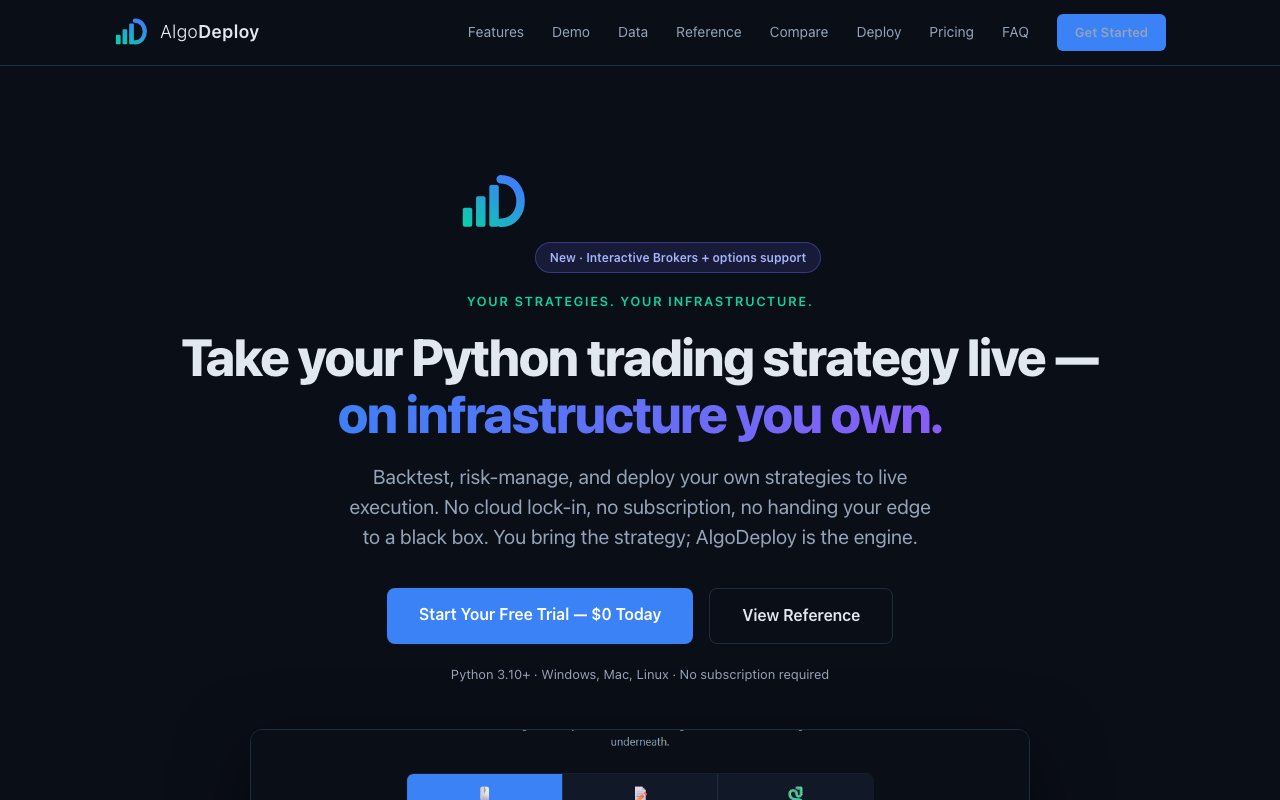
AlgoDeploy is a Python-based algorithmic trading platform that lets you build, backtest, and deploy strategies to live markets. It connects to Alpaca Markets and Interactive Brokers, supporting US equities, ETFs, options, and crypto pairs like BTC/USD and ETH/USD. The premise is that you own your infrastructure and data rather than renting time on someone else's cloud, so everything runs locally or on your own servers.
The platform handles the full lifecycle of a trading strategy. You start with backtesting, and AlgoDeploy offers two modes: a vectorized engine for fast iteration and an event-driven mode for more complex logic that needs to simulate order fills and account state realistically. Backtests produce interactive HTML reports with equity curves, drawdown charts, Sharpe ratios, win rates, and slippage modeling. For parameter tuning, there's a grid search optimizer, walk-forward optimization, and Monte Carlo simulation to stress-test your results against random sampling.
Once you're confident in a strategy, you can push it to live trading through the same codebase. The live trading dashboard updates in real-time over WebSockets, showing open positions, pending orders, trade history, and risk metrics. Risk management is built into the core: there are four position sizers, eight pre-trade checks that can block dangerous orders, and drawdown monitoring that can pause or halt a strategy if losses exceed your limits.
AlgoDeploy is accessible through three different interfaces. You can write Python directly using their API, configure strategies in YAML files, or use the dashboard UI to build rules without code. All three approaches share the same engine underneath, so a strategy built in the UI can be exported to Python if you need more control later. The signal scanner provides ten built-in technical indicators and a composable rule system for combining them, so common setups like moving average crossovers or RSI filters don't require custom code.
Notifications go out over Telegram, Discord, or generic webhooks, so you can stay informed without watching the dashboard constantly. This is particularly useful for strategies that trade infrequently and don't need constant supervision but do need you to know when something happens.
Pricing is a one-time purchase, which is unusual in a space dominated by monthly subscriptions. Students with a valid .edu email get full access for free. The Starter tier is $99, Pro is $249, and Quant is $499, each adding more features and broker integrations. There's an optional maintenance subscription at $10 per month or $100 per year that covers updates and support, but it's not required to keep using the software you bought.
AlgoDeploy fits retail traders and small quant teams who want professional-grade tooling without giving up control of their code or data. It's Python-native, so anyone comfortable with that ecosystem can extend it, and the no-code options lower the barrier for traders who aren't developers.
Key Features
- Dual-mode backtesting engine
- Live trading dashboard with WebSocket updates
- Alpaca and Interactive Brokers integration
- Grid search and Monte Carlo optimization
- Risk management with pre-trade checks
- Python, YAML, or no-code configuration
Pros & Cons
What we like
- One-time pricing instead of monthly subscription
- Free tier for students with .edu email
- Supports equities, ETFs, options, and crypto
- Runs locally so you own your data and infrastructure
Room for improvement
- Requires Python 3.10 or newer
- Broker support limited to Alpaca and IBKR
- Optional maintenance fee for ongoing updates
- No mobile app for monitoring on the go
Frequently Asked Questions
What is AlgoDeploy?
Is AlgoDeploy free?
What brokers does AlgoDeploy support?
Do I need to know Python to use AlgoDeploy?
Best For
Featured in
Alternatives to AlgoDeploy
View all

Reviews (0)
Badge builder
Add AlgoDeploy to your website
Choose a badge style and size, preview it here, then copy the generated HTML. Badge images are self-contained SVGs and do not require an external script.

<a href="https://toolindex.net/tools/algodeploy?ref=badge" target="_blank" rel="noopener">
  <img src="https://toolindex.net/badge/algodeploy/medium.svg" alt="AlgoDeploy - Listed on Tool Index" width="180" height="50" />
</a>How to use the badge
- 1. Pick the style, size, and theme that fit your layout.
- 2. Copy the generated HTML from the code block.
- 3. Paste it into your footer, homepage, or press page.
Standard badge available
The standard listing badge is available now. Score and circle badges are limited to tools currently ranked in the top 10 of a category.
Badge clicks return visitors to this profile with a referral tag so the source remains identifiable.
Related Tools

Simple RMD
Calculate, aggregate, and manage your annual IRA required minimum distributions.
Stripe
Payment infrastructure for the internet
FreshBooks
Cloud accounting designed for service-based small businesses and freelancers
Deel
Global payroll, contractor, and EOR platform
Work on AlgoDeploy? Request listing access or correction