Ant
A lightweight, from-scratch JavaScript runtime that runs real npm packages
Gallery
About Ant
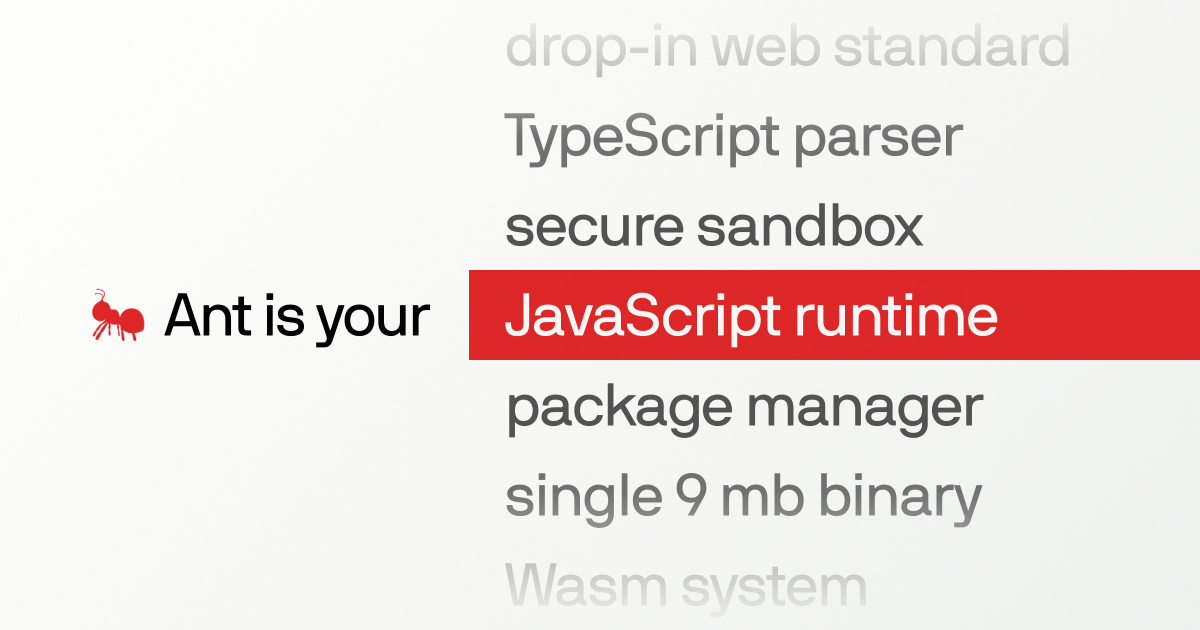
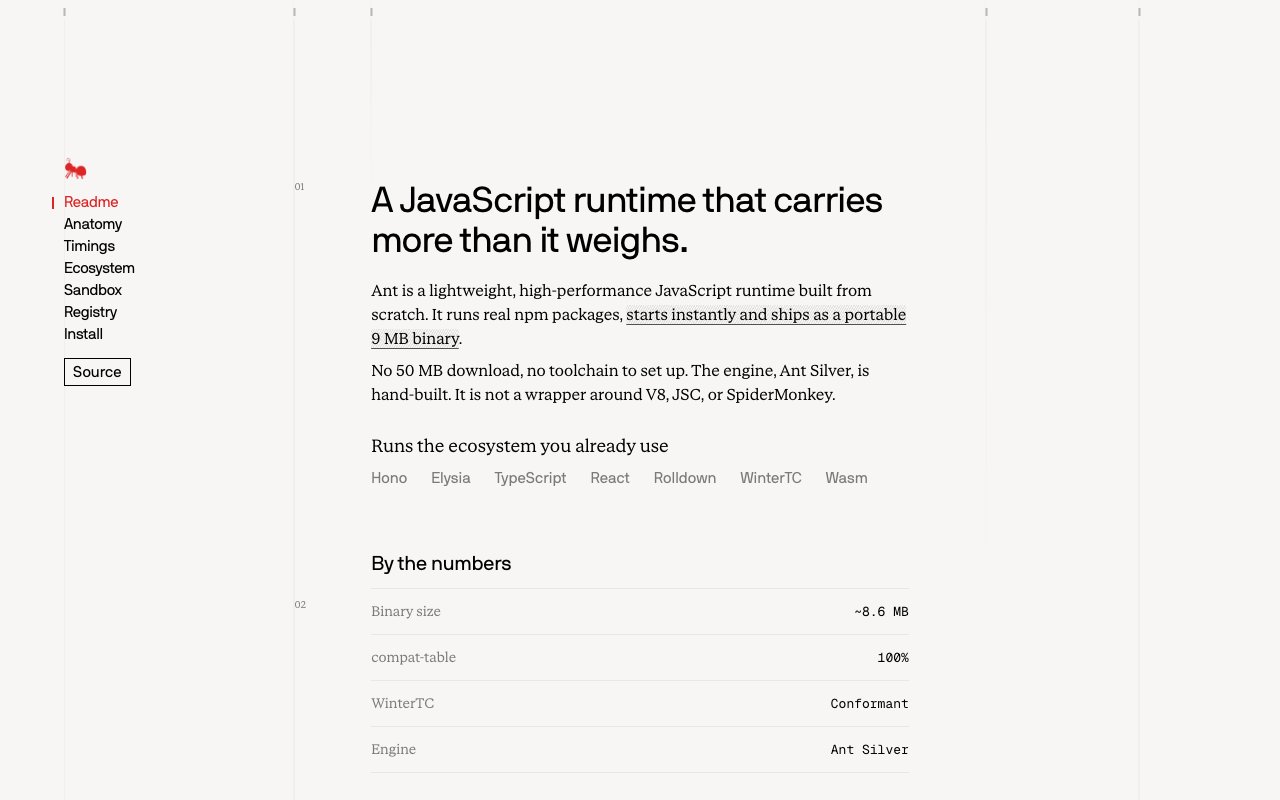
Ant is a JavaScript runtime built from scratch that aims to carry more than it weighs. It runs real npm packages, starts almost instantly, and ships as a portable binary of around nine megabytes. There's no fifty megabyte download and no toolchain to set up first, so getting from nothing to running a file is meant to take seconds rather than an afternoon of configuration.
The part that sets it apart from most alternatives is the engine underneath. Ant runs on a hand-built engine called Ant Silver, and it isn't a wrapper around V8, JavaScriptCore, or SpiderMonkey. Building the engine rather than borrowing one is an unusual choice, and it's what lets the project chase a small binary and fast startup without inheriting the bulk of a browser-grade engine. The makers report a full pass on the compat-table and conformance with WinterTC, so the goal isn't a stripped-down dialect, it's the ecosystem you already write. The compatibility claim isn't only about npm installs. The site lists frameworks and tools it runs, including Hono, Elysia, TypeScript, React, Rolldown, and Wasm, and it targets WinterTC as the standard for server-side JavaScript. Running the ecosystem you already use is the whole pitch, because a fast runtime that can't run your existing code isn't much use, and the project leans on standards conformance rather than a bespoke API to get there.
Speed shows up in two places that developers feel every day. Cold start is quick, and the project publishes a benchmark that imports Hono, registers two routes, and exits, isolating module resolution and startup rather than server throughput. In that test Ant comes in fastest against Bun, Deno, and Node. Installing packages is fast too, with a built-in installer the makers describe as up to forty times faster than npm, so pulling in a dependency finishes in a fraction of a second with no extra tooling to wire up. Real frameworks work without adapters. Ant serves a default fetch export, which means you can write a Hono handler, run the file, and have a server listening without gluing on a bridge. TypeScript runs directly as well, so instead of compiling to a dist folder and then running the output, you point Ant at the .ts file and it runs. That removes a build step that most projects otherwise carry around by default.
Security is treated as a first-class feature rather than a prompt you click through. Ant ships with a VM-isolated sandbox, where each sandbox is its own hardware-backed virtual machine using KVM or the Hypervisor framework. You mount the filesystem read-only unless you explicitly grant writes, network access is deny-all until you name the ports you want forwarded, and untrusted code runs behind a hard boundary. For anyone running code they didn't write, that's a stronger stance than a permission flag.
There's an ecosystem story too. Packages live on ants.land, an open registry that speaks the npm protocol, so what you publish installs by scope or by bare name and works across common package managers. Packages can also load straight in the browser from the registry's ESM endpoint. Publishing is a couple of commands, and the registry scores packages on documentation, license, and compatibility. That scoring is a small but useful touch. Each package carries a rating from zero to one hundred drawn from its documentation, license, and compatibility, which gives a quick read on quality before you pull something in. Because the registry speaks the npm protocol, packages install by scope or bare name across the common package managers rather than being locked to Ant, and they can load directly in a browser from the registry's ESM endpoint, so the same package can serve a server script and a browser experiment without repackaging.
Ant is aimed at developers who want a fast, portable runtime for servers, scripts, and TypeScript without a heavy install or a build pipeline, and at anyone who needs to run untrusted JavaScript inside a real isolation boundary. It's a young project, publicly documented through 2026 with write-ups on how it was built, and the source lives on GitHub under a public repository. Installation is a single curl command, it targets macOS and Linux on both arm64 and x86_64, and because the source is open you can read, self-host, and build on it rather than treating it as a closed binary.
It's worth being clear about maturity. Ant is new, documented publicly through 2026 with write-ups covering how the runtime was built in about a month and where it went next, which signals a project moving quickly rather than a finished, settled tool. A custom engine also means it hasn't had the years of adversarial use that V8-based runtimes have behind them, so it reads best as a fast, promising runtime to try on new work rather than a drop-in replacement for a large production system on day one.
Key Features
- Portable binary around nine megabytes
- Hand-built Ant Silver engine, not a V8 wrapper
- Runs real npm packages
- Built-in package installer, very fast
- Direct TypeScript execution, no build step
- VM-isolated sandbox for untrusted code
Pros & Cons
What we like
- Small footprint and fast cold start
- Runs the npm ecosystem and frameworks like Hono unmodified
- Runs TypeScript directly with no compile step
- Open source with hardware-backed sandboxing built in
Room for improvement
- Very young project with a small community
- Custom engine means less battle-testing than V8-based runtimes
- macOS and Linux only, no Windows listed
- Sandbox depends on platform virtualization support
Frequently Asked Questions
What is Ant?
Is Ant open source?
How is Ant different from Node, Deno, or Bun?
Can it run untrusted code safely?
Best For
Featured in
Alternatives to Ant

1Lookup
Real-time data verification API for phone, email, IP, and domain validation to fight fraud

Codedex
A gamified, story-driven platform that teaches Python, web dev, and more like an RPG quest
Hack2hire
Practice real SDE interview questions from top tech companies with expert worked solutions
Cloudflare Pages
Free Jamstack hosting on Cloudflares edge with unlimited bandwidth and tight integration with Workers.
Reviews (8)
Quietly excellent
Ant solves a real problem for me without making a fuss about it. Support actually answered when I had a question, which surprised me. Glad I made the switch.
Solid daily driver
Ant has quietly become part of my daily flow. Their take on open source with hardware-backed sandboxing built in is genuinely good. What stands out is how little babysitting it needs. No regrets so far.
Exactly what I needed
Hadn't planned on switching, but Ant was hard to ignore. Where it really wins is built-in package installer, very fast. Easy yes for anyone weighing the same trade offs.
Pulled its weight from week one
Picked Ant for the price, stayed for the quality. What stands out is how it handles runs typescript directly with no compile step. The thing I keep coming back to is how reliable it is.
Recommended without reservation
Picked Ant for the price, stayed for the quality. Their take on vm-isolated sandbox for untrusted code is genuinely good. Hard to imagine going back to my old setup.
Two months in, no regrets
Came to Ant after getting frustrated with what I had before. Where it really wins is runs the npm ecosystem and frameworks like hono unmodified. Found it works best for running untrusted javascript inside an isolated vm. Easy yes for anyone weighing the same trade offs.
Does the job, a few gripes
Three months of Ant later, here is what holds up. What stands out is how it handles hand-built ant silver engine, not a v8 wrapper. One thing that bugs me is sandbox depends on platform virtualization support. Easy yes for anyone weighing the same trade offs.
Powerful once it clicks
Three months of Ant later, here is what holds up. The small footprint and fast cold start is more useful than I expected. Performance has been steady even when I lean on it hard. Found it works best for standing up a hono server with no adapter. One thing that bugs me is macos and linux only, no windows listed. No regrets so far.
Badge builder
Add Ant to your website
Choose a badge style and size, preview it here, then copy the generated HTML. Badge images are self-contained SVGs and do not require an external script.

<a href="https://toolindex.net/tools/ant?ref=badge" target="_blank" rel="noopener">
  <img src="https://toolindex.net/badge/ant/medium.svg" alt="Ant - Listed on Tool Index" width="180" height="50" />
</a>How to use the badge
- 1. Pick the style, size, and theme that fit your layout.
- 2. Copy the generated HTML from the code block.
- 3. Paste it into your footer, homepage, or press page.
Standard badge available
The standard listing badge is available now. Score and circle badges are limited to tools currently ranked in the top 10 of a category.
Badge clicks return visitors to this profile with a referral tag so the source remains identifiable.
Related Tools

Kevin Gabeci
Solo developer building web apps, cozy browser games, and AI creator toolkits.

Coolify
Self-hostable, open source alternative to Heroku and Netlify

Warp
The modern terminal reimagined with AI and collaboration

Bolt.new
Prompt-to-deployed full-stack app inside the browser
Work on Ant? Request listing access or correction