DNS Skills
Machine-readable DNS and domain utilities that AI agents can call as skills
Gallery
About DNS Skills
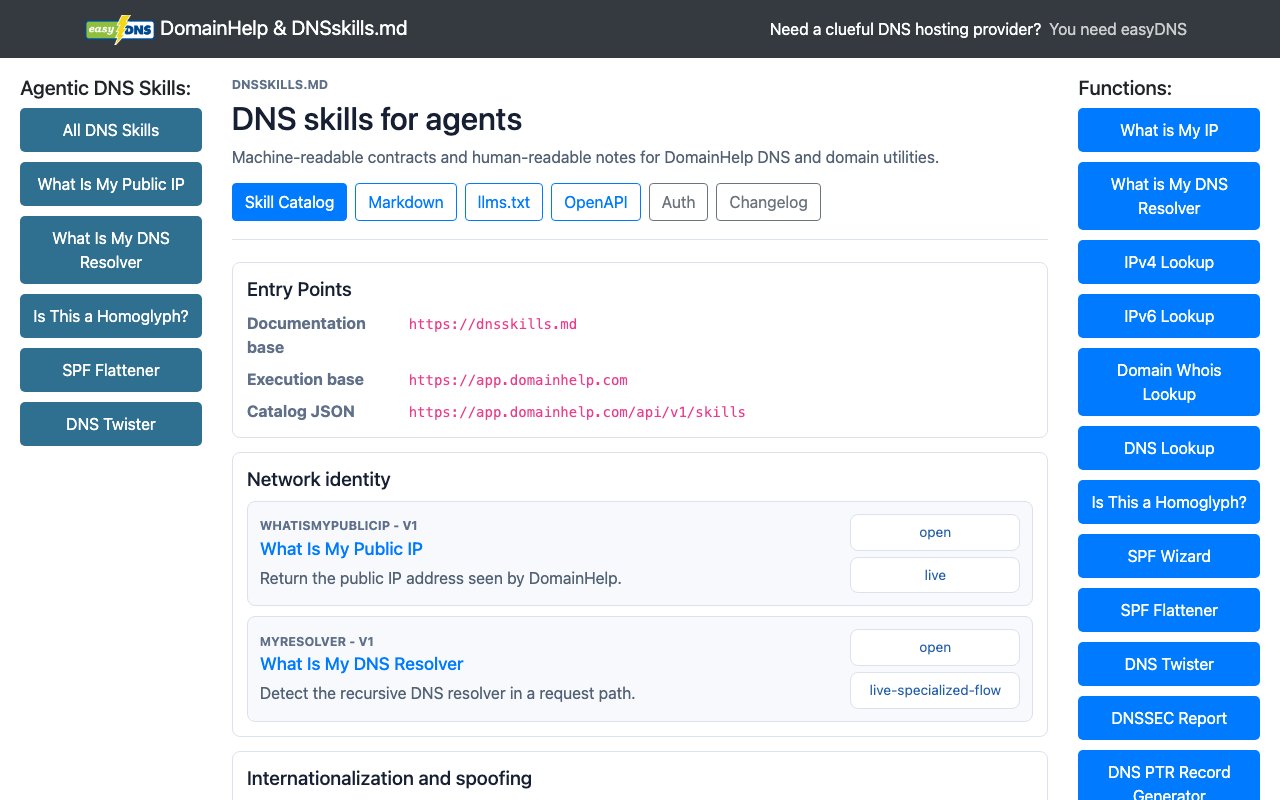
DNS Skills is a catalog of machine-readable contracts for DNS and domain utilities, built so AI agents can call them reliably. It's published by DomainHelp, which is part of easyDNS Technologies, and its job is to hand agents both a human-readable description and a strict schema for each utility so a model knows exactly how to invoke a tool and read the result back. The documentation lives at dnsskills.md and the utilities themselves execute on the DomainHelp app, so the site is the contract and the app is the runtime.
The problem it addresses is that DNS lookups and domain checks are everywhere in security and infrastructure work, but wiring an agent up to them usually means stitching together a handful of one-off endpoints with inconsistent inputs and outputs. One returns plain text, another returns HTML, a third needs a query string nobody documented, and an agent has to guess at all of it. DNS Skills standardizes that surface. Each skill is described in a way an agent can discover and call without a human hand-holding the request format, which turns a pile of scattered DNS tools into something an automated workflow can depend on.
The core set covers the checks people reach for constantly. What Is My Public IP returns the public address DomainHelp sees, and What Is My DNS Resolver detects the recursive resolver in the request path. Is This a Homoglyph analyzes internationalized domain names and visually confusable characters, which matters for spotting spoofed lookalikes that read as a trusted brand at a glance. SPF Flattener resolves SPF includes and produces a flattened TXT record, useful when a domain has blown past the DNS lookup limit that quietly breaks email authentication. DNS Twister generates and inspects lookalike domain permutations for security review.
Beyond those headline skills there's a longer list of web-based utilities, covering IPv4 and IPv6 lookups, WHOIS, DNSSEC reports, PTR record generation, and more. Together they form a fairly complete toolkit for the routine diagnostics that domain and email operators run day to day, exposed in a shape that both people and agents can use rather than only a human-facing web form. The same check you might run by hand in a browser is available as a callable contract underneath.
Access is designed around machine consumption first. The skill catalog is published as a JSON endpoint, an OpenAPI specification, Markdown documentation, and an llms.txt file, so whatever format your agent framework prefers, there's a contract it can ingest without conversion. Execution happens through the DomainHelp API, while dnsskills.md serves as the readable front door describing what each skill does, what it takes, and how to call it. That mix of formats means the same skill definition works for a code generator, an LLM, and a human reading the docs.
It's aimed at developers building agents and automations that need DNS intelligence, along with security-minded users chasing homoglyph attacks, lookalike domains, and email authentication problems. Anyone who has manually run an SPF flatten or eyeballed a suspicious domain will recognize the value of having those same checks callable on demand by a script or an assistant instead of doing them by hand each time. For a security workflow, having the lookalike and homoglyph checks as skills an agent can chain is the difference between a one-off spot check and continuous monitoring.
A useful way to think about it is as the connective tissue between a general-purpose agent and a set of DNS tools it would otherwise have no clean way to reach. An assistant asked to vet a domain can, in one chain, check whether the name is a homoglyph of a known brand, generate lookalike permutations to see what an attacker might register, and confirm the email authentication records line up, all through skills with predictable inputs and outputs. Because the catalog advertises each skill's contract up front, the agent isn't guessing at parameters or scraping a results page, it's calling a documented endpoint and parsing a defined response. Sitting inside the easyDNS DomainHelp ecosystem also means the underlying utilities are the same ones a domain professional would trust for the manual version of these checks, rather than a thin reimplementation. For a team already leaning on agents for operational work, that turns DNS from a manual detour into a set of building blocks the automation can call whenever it needs them.
The skills are offered through the easyDNS DomainHelp ecosystem and read as community-oriented utilities rather than a boxed commercial product, with no pricing posted on the catalog itself. That makes it an easy thing to point an agent at when you need a reliable DNS or domain check without standing up your own tooling or paying for a heavier platform. Because the contracts are machine-readable and openly documented, adding one of these skills to an existing agent is mostly a matter of pointing it at the right endpoint and reading back the schema it advertises.
Key Features
- Machine-readable DNS skill contracts
- JSON, OpenAPI, Markdown, and llms.txt formats
- Public IP and resolver detection
- Homoglyph and lookalike domain analysis
- SPF flattening to a TXT record
- IPv4, IPv6, WHOIS, and DNSSEC utilities
Pros & Cons
What we like
- Standard contracts agents can discover and call
- Covers common DNS, security, and email checks
- Multiple machine-readable formats to ingest
- Backed by the easyDNS DomainHelp ecosystem
Room for improvement
- No pricing or terms posted on the catalog
- Depends on the DomainHelp app to execute
- Narrow focus on DNS and domain utilities
- Smaller, developer-oriented audience
Frequently Asked Questions
What is DNS Skills?
Is DNS Skills free?
Who is DNS Skills for?
How do agents use DNS Skills?
Best For
Featured in
Alternatives to DNS Skills

1Lookup
Real-time data verification API for phone, email, IP, and domain validation to fight fraud

Codedex
A gamified, story-driven platform that teaches Python, web dev, and more like an RPG quest
Hack2hire
Practice real SDE interview questions from top tech companies with expert worked solutions
Cloudflare Pages
Free Jamstack hosting on Cloudflares edge with unlimited bandwidth and tight integration with Workers.
Reviews (11)
Two months in, no regrets
Picked DNS Skills for the price, stayed for the quality. The multiple machine-readable formats to ingest is more useful than I expected. It fits well for checking a domain for homoglyph spoofing. Would sign up again without thinking twice.
Two months in, no regrets
DNS Skills has quietly become part of my daily flow. What stands out is how it handles covers common dns, security, and email checks. Recommending it to people in a similar spot.
Two months in, no regrets
DNS Skills has quietly become part of my daily flow. Got real value out of json, openapi, markdown, and llms.txt formats. The output quality holds up better than I expected. Easy yes for anyone weighing the same trade offs.
Quietly excellent
Came to DNS Skills after getting frustrated with what I had before. Their take on backed by the easydns domainhelp ecosystem is genuinely good. It handles the boring parts so I can focus on the work that matters. It fits well for generating lookalike domain permutations for review.
Good, with a few caveats
DNS Skills solves a real problem for me without making a fuss about it. What stands out is how it handles ipv4, ipv6, whois, and dnssec utilities. One thing that bugs me is smaller, developer-oriented audience.
Solid daily driver
Hadn't planned on switching, but DNS Skills was hard to ignore. What stands out is how it handles standard contracts agents can discover and call. Found it works best for generating lookalike domain permutations for review. It earns its place in my stack.
Quietly excellent
Came to DNS Skills after getting frustrated with what I had before. Performance has been steady even when I lean on it hard. It fits well for flattening spf includes into a txt record.
Exactly what I needed
DNS Skills has quietly become part of my daily flow. The multiple machine-readable formats to ingest is more useful than I expected. The thing I keep coming back to is how reliable it is. Hard to imagine going back to my old setup.
It just works
Have been running DNS Skills for a while, here is where I land. The spf flattening to a txt record is more useful than I expected. Found it works best for giving an agent reliable dns lookup skills. No regrets so far.
Good, with a few caveats
Have been running DNS Skills for a while, here is where I land. Setup was painless and I was productive the same day. It slotted into my routine without much fuss. It fits well for giving an agent reliable dns lookup skills. The catch is depends on the domainhelp app to execute. Recommending it to people in a similar spot.
Exactly what I needed
Have been running DNS Skills for a while, here is where I land. The interface stays out of my way, which I appreciate. It handles the boring parts so I can focus on the work that matters. Glad I made the switch.
Badge builder
Add DNS Skills to your website
Choose a badge style and size, preview it here, then copy the generated HTML. Badge images are self-contained SVGs and do not require an external script.

<a href="https://toolindex.net/tools/dnsskills?ref=badge" target="_blank" rel="noopener">
  <img src="https://toolindex.net/badge/dnsskills/medium.svg" alt="DNS Skills - Listed on Tool Index" width="180" height="50" />
</a>How to use the badge
- 1. Pick the style, size, and theme that fit your layout.
- 2. Copy the generated HTML from the code block.
- 3. Paste it into your footer, homepage, or press page.
Standard badge available
The standard listing badge is available now. Score and circle badges are limited to tools currently ranked in the top 10 of a category.
Badge clicks return visitors to this profile with a referral tag so the source remains identifiable.
Related Tools

Kevin Gabeci
Solo developer building web apps, cozy browser games, and AI creator toolkits.

Coolify
Self-hostable, open source alternative to Heroku and Netlify

Warp
The modern terminal reimagined with AI and collaboration

Bolt.new
Prompt-to-deployed full-stack app inside the browser
Work on DNS Skills? Request listing access or correction