
Dowe
Fullstack compiler that generates server, web, desktop, Android, and iOS from one source
Gallery
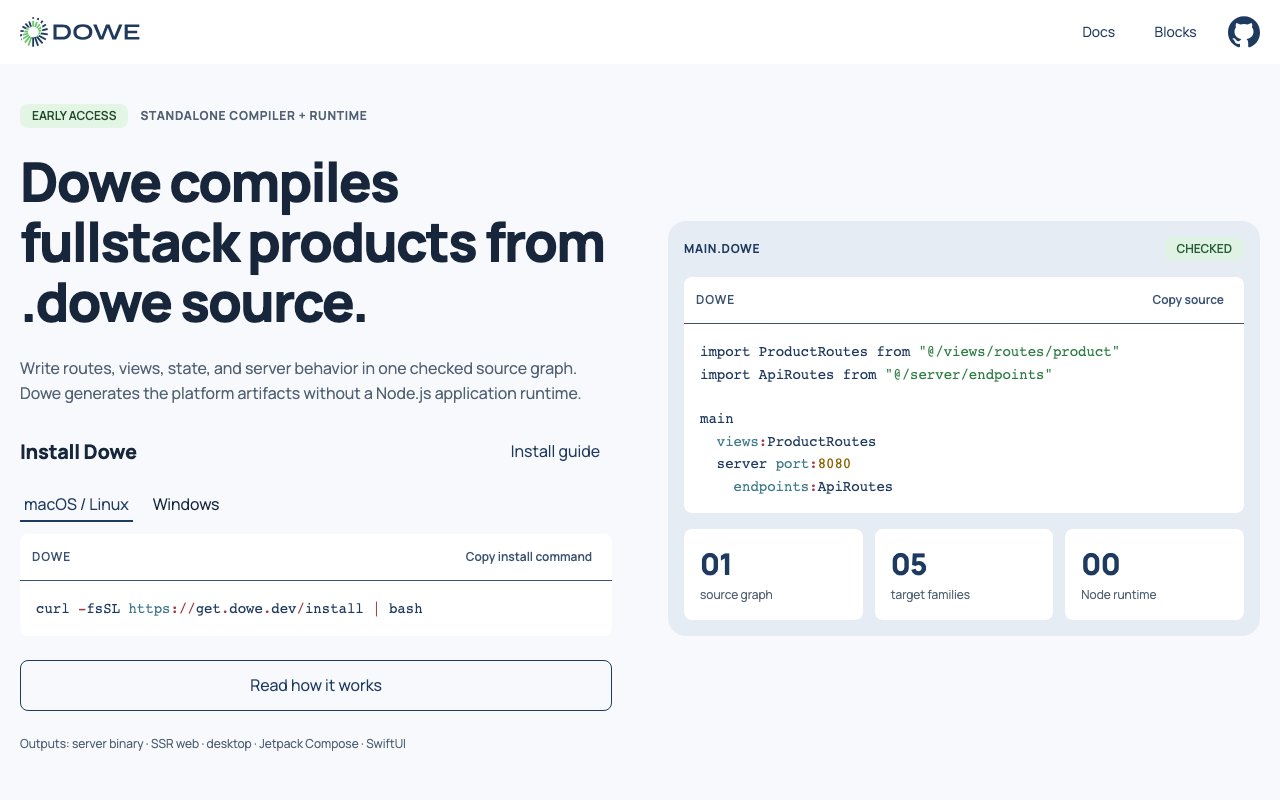
About Dowe
Dowe is a standalone compiler that takes a single source file and generates complete applications for five different platforms: server binaries, web frontends with server-side rendering, native desktop apps, Android projects using Jetpack Compose, and iOS projects using SwiftUI. The idea is that you define your routes, views, state, and server behavior in one checked source graph, and the compiler handles the platform-specific translation so you're not maintaining five separate codebases.
The source files use a .dowe extension and a custom language designed around composable contracts. You build routes, layouts, and components within a type-checked system that catches binding issues, type errors, and unsupported patterns at compile time rather than at runtime. This is a deliberate choice: the compiler validates comprehensively before generating anything, so if the build succeeds, you know the output is structurally sound.
For the web target, Dowe generates server-rendered HTML, CSS, and JavaScript without relying on external frameworks. There's no React, Vue, or Svelte under the hood. The compiler produces its own rendering logic tuned to the structure you defined. Route-based asset loading keeps pages lean by only shipping what each route actually needs.
Desktop output uses web assets wrapped in native windows, which is conceptually similar to Electron or Tauri but without pulling in a Node.js runtime or external dependencies. The server target compiles to a native binary with routing and host capabilities baked in, so deployment is just running an executable.
For mobile, Dowe generates complete project files rather than interpreted bundles. Android output is a Jetpack Compose project you can open in Android Studio and build normally. iOS output is a SwiftUI project that compiles through Xcode. This means you're not debugging through an abstraction layer; when something goes wrong on mobile, you're looking at real Kotlin or Swift.
The compiler itself is written in Rust and distributed as a standalone binary. You don't need Rust installed to use it, and there's no Node.js runtime required for the generated artifacts. This keeps the toolchain minimal compared to typical JavaScript-based fullstack frameworks.
Dowe is open source on GitHub and currently in early access. There's no pricing listed because the project appears to be free during this phase, though that could change as it matures. Documentation is available, but the ecosystem is small and you should expect to be an early adopter rather than a user of stable, battle-tested software.
It fits developers who want to target multiple platforms from a single source without the complexity of maintaining separate stacks, especially those who are comfortable working with newer, less proven tools. The tradeoff is that you're committing to a custom language and compiler rather than standard web frameworks, so portability outside of Dowe is limited.
Key Features
- Single source compiles to five platforms
- Type-checked component and routing system
- Server-rendered web without external frameworks
- Native Android output via Jetpack Compose
- Native iOS output via SwiftUI
- Standalone binary with no Node.js runtime
Pros & Cons
What we like
- One codebase for server, web, desktop, and mobile
- Compile-time validation catches errors before runtime
- No external framework dependencies in generated output
- Open source and self-contained Rust binary
Room for improvement
- Early access with limited production mileage
- Custom .dowe language has a learning curve
- Small community and ecosystem
- Portability to other frameworks is limited
Frequently Asked Questions
What is Dowe?
Is Dowe free?
What language does Dowe use?
How does Dowe handle mobile output?
Best For
Featured in
Alternatives to Dowe
View all
1Lookup
Real-time data verification API for phone, email, IP, and domain validation to fight fraud

Kevin Gabeci
Solo developer building web apps, cozy browser games, and AI creator toolkits.

Codedex
A gamified, story-driven platform that teaches Python, web dev, and more like an RPG quest
Hack2hire
Practice real SDE interview questions from top tech companies with expert worked solutions
Reviews (0)
Badge builder
Add Dowe to your website
Choose a badge style and size, preview it here, then copy the generated HTML. Badge images are self-contained SVGs and do not require an external script.

<a href="https://toolindex.net/tools/dowe?ref=badge" target="_blank" rel="noopener">
  <img src="https://toolindex.net/badge/dowe/medium.svg" alt="Dowe - Listed on Tool Index" width="180" height="50" />
</a>How to use the badge
- 1. Pick the style, size, and theme that fit your layout.
- 2. Copy the generated HTML from the code block.
- 3. Paste it into your footer, homepage, or press page.
Standard badge available
The standard listing badge is available now. Score and circle badges are limited to tools currently ranked in the top 10 of a category.
Badge clicks return visitors to this profile with a referral tag so the source remains identifiable.
Related Tools
Kevin Gabeci
Solo developer building web apps, cozy browser games, and AI creator toolkits.

Warp
The modern terminal reimagined with AI and collaboration

Bolt.new
Prompt-to-deployed full-stack app inside the browser

Supabase
The open source Firebase alternative
Work on Dowe? Request listing access or correction