
Intercom
Customer service platform with messenger, helpdesk, and AI agent
Gallery
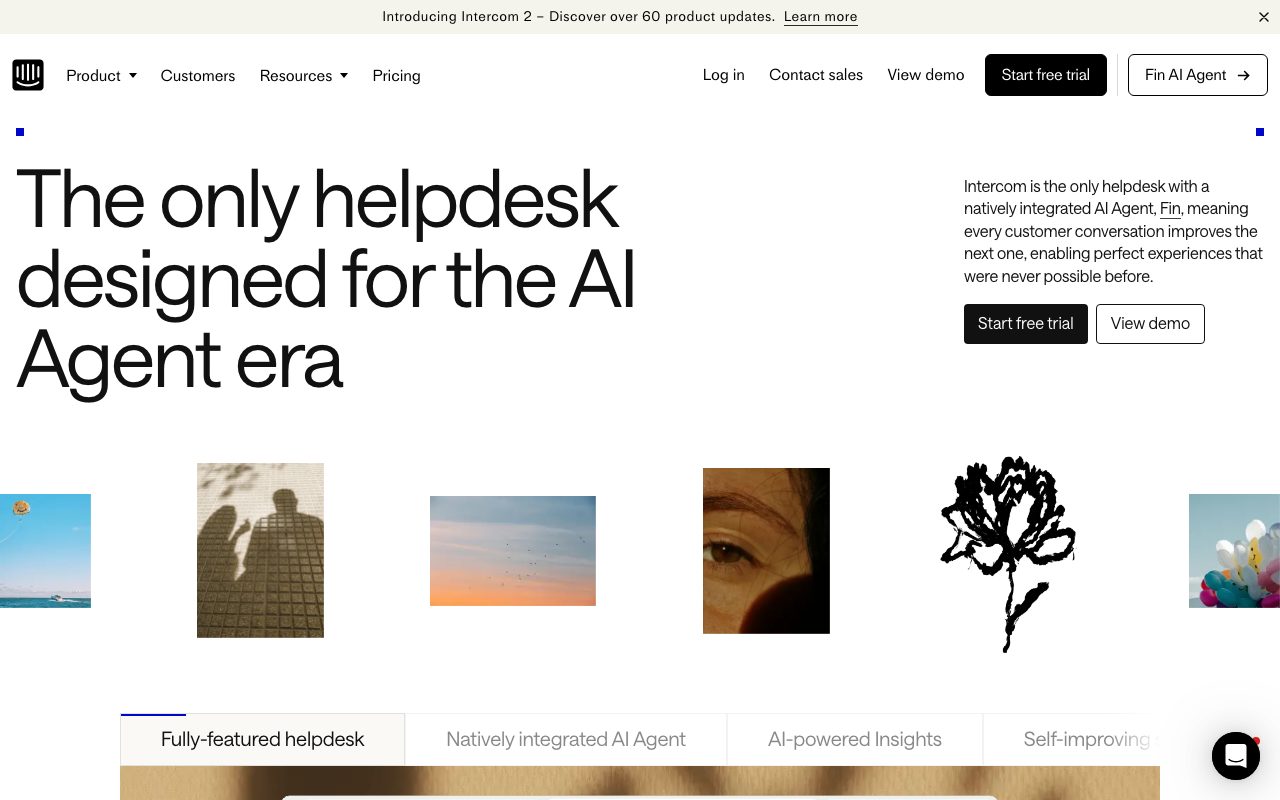

About Intercom
Intercom is the customer messaging platform that turned the in-app chat bubble into a category. It started as live chat and grew into a full customer service stack with help center, ticketing, AI agents, and proactive outbound messaging. Intercom is what most modern SaaS products run when they outgrow Crisp or Tawk.
The product has shifted hard toward AI agents in the last two years. Their flagship Fin AI agent answers a meaningful share of inbound conversations without a human, and the marketing leans into that. The reality is mixed in interesting ways.
This review reflects current pricing and capabilities, which have changed several times. Confirm specifics before signing.
What Intercom does
Intercom covers four pillars. The Inbox is where human agents and AI agents handle conversations from chat, email, social, and forms. The Help Center hosts public articles indexed for search and trained into the AI. Outbound messaging lets you send proactive chats, emails, push, and tours. Tickets handle longer-running structured workflows.
Fin, the AI agent, sits across all of it. Customers ask questions in chat or email, Fin retrieves from your help center and product data, and answers in natural language. It can take actions through tool integrations, escalate to a human, and log everything for review.
The data model centers on the customer record. Intercom tracks events, attributes, and conversation history for every user, which makes targeting and personalization at-scale realistic.
Who Intercom is for
Mid-market SaaS, B2B platforms with self-serve flows, and consumer apps with high-volume support. The sweet spot is companies that want a serious unified support platform but cannot stomach the implementation tax of Salesforce Service Cloud or Zendesk Enterprise.
It is less of a fit for the smallest teams (free Crisp or Tidio is fine) and the largest enterprise contact centers (Salesforce or Zendesk often win on integration and procurement).
Pricing
Intercom shifted to a hybrid model. Seat-based pricing covers your human agents, with tiers from Essential to Expert. Fin AI resolutions are billed separately on a per-resolution basis. The math gets interesting at scale; model it carefully.
Add-ons include the Help Center, advanced workflows, and outbound messaging volume. The startup tier offers a meaningful discount for early-stage companies, with documentation requirements.
Features worth knowing
The Inbox is genuinely good. Conversations from every channel land in one workspace, with macros, automated assignment, and a sidebar that shows the customer's events and attributes. Agents can see what the customer was doing right before they reached out.
Fin's quality depends entirely on your help center. Garbage in, garbage out applies harder than usual here. Teams that invest in clean, structured articles get good results. Teams that throw old PDFs at it get the inverse.
Outbound messaging supports event-triggered campaigns across in-app, email, push, and SMS. The targeting is granular enough to feel like a marketing automation platform.
Reporting covers conversation volume, response times, CSAT, agent performance, and Fin resolution rates. The reports are good; the dashboards are flexible enough to actually answer questions.
Tradeoffs
Pricing is the biggest complaint in the market. Intercom has changed pricing several times, sometimes in ways that surprised existing customers. Lock your model and rate clearly in the contract.
Migration in and out is non-trivial. Conversations, tags, articles, automations, all of it has been built for the assumption you stay. Plan for a real project if you switch tools.
Fin's quality varies by industry and content depth. It works well for SaaS with rich docs; it struggles with heavily regulated or relationship-heavy domains.
Intercom is the platform you pick when support volume is real and your help center is or can be clean. Picking it before either of those is true is a costly experiment.
Intercom vs alternatives
Versus Zendesk, Intercom is more product-y, with stronger in-app messaging and AI. Zendesk is more contact-center-traditional and stronger on phone, voice, and enterprise procurement. Pick on the shape of your support, not the brand.
Versus Front, Intercom is more conversational and product-led. Front is stronger for shared inbox workflows tied to email-heavy operations.
Versus HubSpot Service Hub, Intercom is more focused on support depth, less integrated with marketing and sales. If you are already deep in HubSpot, Service Hub has gravity.
Versus open-source Chatwoot, Intercom has more polish and AI; Chatwoot has self-hosting and far lower cost.
See best customer service software, Zendesk alternatives, and Intercom vs Zendesk.
Common questions
How much does Fin cost? Per resolution, with rates that have changed over time; check current pricing. Is Intercom good for small teams? It is overkill for the smallest; consider Crisp or Tidio. Does Intercom integrate with Salesforce? Yes, with a real two-way sync. Can I migrate from Zendesk? Yes, with effort.
Bottom line
Intercom is the right pick if you have meaningful support volume, a SaaS or product-led shape, and the appetite to invest in the help center that powers AI deflection. It is the wrong pick if you want the cheapest live chat or the most enterprise-traditional contact center.
Used well, Intercom plus Fin replaces a meaningful chunk of tier-one support headcount. Used poorly, it is an expensive chat bubble. Browse tools for customer success and the Intercom profile for current details.
Implementing Intercom well
Help center first. Before you turn on Fin, your help center needs to be clean: clear titles, structured articles, accurate content. AI deflection only works if the source material is good. Plan for a content audit as part of rollout.
Customer attributes matter. Intercom uses attributes for targeting, segmentation, and AI personalization. Pump in plan tier, signup date, last login, feature usage. The richer the customer record, the better every downstream feature works.
Macros and saved replies remove a real chunk of agent typing. Identify the top ten responses your team writes daily; turn them into macros. Update them quarterly.
Workflow automation handles routing, escalation, and SLA management. The visual builder is approachable; complex workflows take real thought.
Measuring Intercom's value
Resolution rate by AI: what percentage of inbound conversations does Fin resolve without human escalation? This is the headline metric. Healthy deployments hit 30-60% on tier-one questions.
First response time: with Intercom's automation, this should be near-zero. Customer-perceived response is the right metric, not internal handle time.
CSAT after AI vs human: track separately. Some teams discover that AI-resolved conversations have higher CSAT than human ones because the response is instant.
Cost per resolution: model the all-in cost (Fin per-resolution, agent time, software seat) and compare across channels.
Common mistakes
Turning on Fin without a clean help center. The AI sounds confident and gets things wrong; CSAT tanks. Fix the help center first.
Treating Intercom as just chat. The platform's value is in the data model and outbound messaging; using only the inbox leaves money on the table.
Underestimating migration. Coming off Zendesk or another platform is a real project. Plan three to six weeks for a serious migration.
Intercom Fin, in detail
Fin retrieves from your help center, Q&A pairs you provide, and structured product data. The retrieval quality depends on the source quality. Plan for content investment.
Fin can take actions through tool integrations. Look up an order, refund a charge, update a subscription. Each action requires explicit configuration and permissions.
Fin escalates to humans when the answer is unclear, the customer asks for a person, or the topic is out of scope. The escalation logic is configurable.
Resolution rate metrics show what Fin handled fully versus what escalated. Tune the help center based on what failed; the loop improves over months.
Intercom analytics
Conversation volume by source: where do conversations come from? Email, chat, social, in-app? Optimize the channels that actually drive volume.
Response time and resolution time: median, P90, P99. The averages hide the worst cases; the percentiles tell the truth.
CSAT by team and by topic: surface the patterns that hurt or help satisfaction. Topics with low CSAT are content investment opportunities.
Agent performance: ticket count, response time, CSAT. Use carefully; metrics-driven management has tradeoffs.
Intercom and the future
The platform is investing heavily in AI. Fin will keep getting better at deflection. Predictive routing and automated workflows will handle more.
The shape of customer service is changing. Tier-one support is increasingly AI; humans handle the complex and emotional cases. Intercom is building for this future.
The pricing model will likely keep evolving as AI economics shift. Lock contracts that work for you when you sign.
Intercom support roles
Live chat agents handle real-time conversations; metrics focus on response time and CSAT.
Email and ticket agents handle longer-form work; metrics focus on resolution time and quality.
Customer success managers use Intercom for proactive outreach; the outbound messaging product is their workspace.
Operations and admins manage automation, AI training, and analytics.
Intercom on a small team
A four-person startup uses Intercom for inbound chat, a basic help center, and outbound onboarding messages. The Essential tier covers it.
The cost feels high relative to revenue early; the value compounds as the help center and Fin start deflecting volume.
Most small teams skip Intercom for the first year (Crisp or Tidio is enough) and adopt Intercom around series A when support volume grows.
Intercom power users
Macros, custom attributes, automated workflows, AI rules, segment-targeted outbound. Power users build a finely tuned support machine.
The platform rewards investment. A team that uses 30% of Intercom is paying enterprise prices for chat. A team that uses 80% is replacing a support headcount with software.
Tutorial / Demo
Key Features
- Website and in-app messenger
- Shared inbox with team workflows
- AI agent (Fin) trained on your help content
- Knowledge base and help center
- Outbound product tours and announcements
- Reporting on resolution time, CSAT, and AI deflection
Pros & Cons
What we like
- Mature support stack with AI baked in
- Strong fit for SaaS with in-app conversations
- Fin can deflect a real percentage of tickets
Room for improvement
- Pricing model is complex and seat-plus-resolution based
- Costs add up fast for volume support teams
- Some legacy features are being phased into the new platform
Frequently Asked Questions
How much does Intercom cost?
Intercom vs Zendesk, which is better?
Is Fin AI worth the resolution price?
Does Intercom have email-only support?
Can I export my Intercom data?
Best For
Featured in
Tags
Alternatives to Intercom
View all

Our take
Tool Index Editorial · May 2026· 4.8/5
Intercom is the kind of tool you adopt when you want customer service platform with messenger, helpdesk, and ai agent.
What it actually does well: Mature support stack with AI baked in, Strong fit for SaaS with in-app conversations, and Fin can deflect a real percentage of tickets. Less impressive: Pricing model is complex and seat-plus-resolution based and Costs add up fast for volume support teams.
Verdict: Intercom comfortably earns its spot in the category — a smart default when you need saaS support teams adding AI deflection.
Editorial opinion from the Tool Index team, written from the public product pages. Not a user review.
Reviews (10)
Honest take after the past year
Intercom isn't perfect but it's the best I've used in this category. What stands out is how mature support stack with AI baked in. It fits well for saaS support teams adding AI deflection. Sticking with Intercom.
Pros
- Strong fit for SaaS with in-app conversations
Did exactly what I needed
Intercom isn't perfect but it's the best I've used in this category. The thing I keep coming back to: strong fit for SaaS with in-app conversations. Still recommending it to people in similar setups.
Two months in, no regrets
Adopted Intercom for one project, ended up using it for more. What stands out is how strong fit for SaaS with in-app conversations. The knowledge base and help center is more useful than I expected. Sticking with Intercom.
Pros
- Mature support stack with AI baked in
- Fin can deflect a real percentage of tickets
Does the job, doesn't sparkle
Skeptical at first because Intercom looked too simple. It's not. What stands out is how strong fit for SaaS with in-app conversations. Worth calling out the AI agent (Fin) trained on your help content too. One thing that bugs me: costs add up fast for volume support teams.
Pros
- Fin can deflect a real percentage of tickets
- Strong fit for SaaS with in-app conversations
Did exactly what I needed
Got Intercom on the recommendation of someone I trust. Where it really wins is strong fit for SaaS with in-app conversations. The outbound product tours and announcements is more useful than I expected. Main use case: saaS support teams adding AI deflection. One thing that bugs me: costs add up fast for volume support teams. Sticking with Intercom.
Pros
- Strong fit for SaaS with in-app conversations
- Mature support stack with AI baked in
- Fin can deflect a real percentage of tickets
It just works
Came to Intercom after frustration with what I had before. The biggest win has been mature support stack with AI baked in. Worth calling out the outbound product tours and announcements too. Mostly using it for product-led companies needing in-app messaging. One thing that bugs me: some legacy features are being phased into the new platform. Worth the price for what I get out of it.
Honest take after the past year
Tried half a dozen options before landing on Intercom. Honestly impressed by how fin can deflect a real percentage of tickets. Got real value out of outbound product tours and announcements. Sticking with Intercom.
Easy 5 from me
Adopted Intercom for one project, ended up using it for more. Genuine strength: strong fit for SaaS with in-app conversations. Reporting on resolution time, csat, and ai deflection works the way you'd hope.
Bought it for one feature, stayed for ten
First impression of Intercom was 'huh, this is actually thought through.' Genuine strength: mature support stack with AI baked in. Ai agent (fin) trained on your help content works the way you'd hope. It fits well for product-led companies needing in-app messaging. Hard to imagine going back to my previous setup.
Pros
- Mature support stack with AI baked in
- Strong fit for SaaS with in-app conversations
- Fin can deflect a real percentage of tickets
Cons
- Some legacy features are being phased into the new platform
Underrated honestly
Tried Intercom on a side project first. Genuine strength: fin can deflect a real percentage of tickets. The website and in-app messenger is more useful than I expected. Mostly using it for product-led companies needing in-app messaging. Worth the price for what I get out of it.
Badge builder
Add Intercom to your website
Choose a badge style and size, preview it here, then copy the generated HTML. Badge images are self-contained SVGs and do not require an external script.

<a href="https://toolindex.net/tools/intercom?ref=badge" target="_blank" rel="noopener">
  <img src="https://toolindex.net/badge/intercom/medium.svg" alt="Intercom - Listed on Tool Index" width="180" height="50" />
</a>How to use the badge
- 1. Pick the style, size, and theme that fit your layout.
- 2. Copy the generated HTML from the code block.
- 3. Paste it into your footer, homepage, or press page.
Score badge available
Intercom qualifies for the score and circle badges based on its current top-10 positionin Customer Support.
Badge clicks return visitors to this profile with a referral tag so the source remains identifiable.
Related Tools

Probed
Customer chat, feedback, and public roadmaps in one shared space

QuickPing
A dead-simple contact link so customers can message you and you reply from one inbox

Zendesk
Enterprise customer service suite for ticketing, chat, and voice
Crisp
Multichannel customer messaging platform with a generous free tier
Work on Intercom? Request listing access or correction