Crisp
Multichannel customer messaging platform with a generous free tier
Gallery
About Crisp
Crisp is the chat widget that small teams pick when Intercom feels overpriced and Drift feels overbuilt. It bundles live chat, a shared inbox, a help center, and a basic CRM into one tool. The pricing is famously reasonable, which is half the appeal.
The product launched in France in 2015 and stayed indie. No big funding rounds, no IPO push, just a steady product that lots of small SaaS teams use to talk to customers. The widget is one of the most recognizable on the web.
Crisp doesn't try to be the AI customer service revolution. It's a solid chat tool with the basics done well. That's enough for most teams under 50 people.
What Crisp actually does
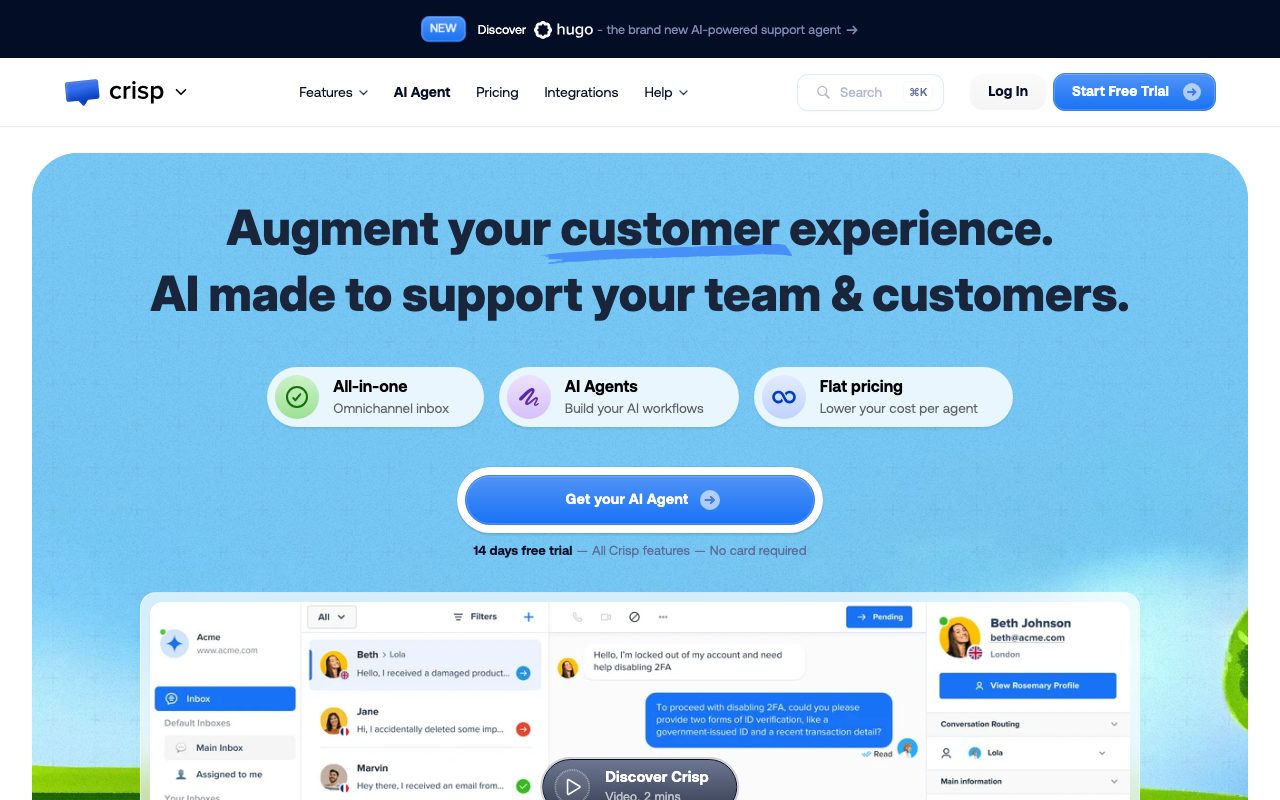
Crisp puts a chat widget on your site, routes conversations to your team's shared inbox, and stores customer history. It also runs a help center, a chatbot builder, and email channels. You can reply to chat, email, and Messenger in the same inbox.
The mobile apps are decent. The desktop app handles notifications well. The widget itself is fast, customizable, and unobtrusive. That last bit matters because chat widgets can absolutely tank site performance if done badly.
The shared inbox
All your channels (chat, email, Messenger, Telegram, WhatsApp on higher tiers) flow into one inbox. Conversations get assigned, tagged, and threaded. The interface is clean and fast. It's not Front, but it's a real shared inbox.
Chatbot and automation
Crisp has a visual chatbot builder. You build flows with branching, capture leads, route based on answers. It's not as powerful as Intercom's but it's free or cheap depending on tier.
Who Crisp is for
Small SaaS teams, indie startups, and ecommerce stores that need chat and a shared inbox without paying $1,000 a month. Crisp's sweet spot is teams of 2-20 doing customer support and sales chat. Larger teams tend to graduate to Intercom or Zendesk.
It's also popular with non-English markets. Crisp's i18n is solid and the team is responsive to feedback from non-US customers.
Crisp pricing
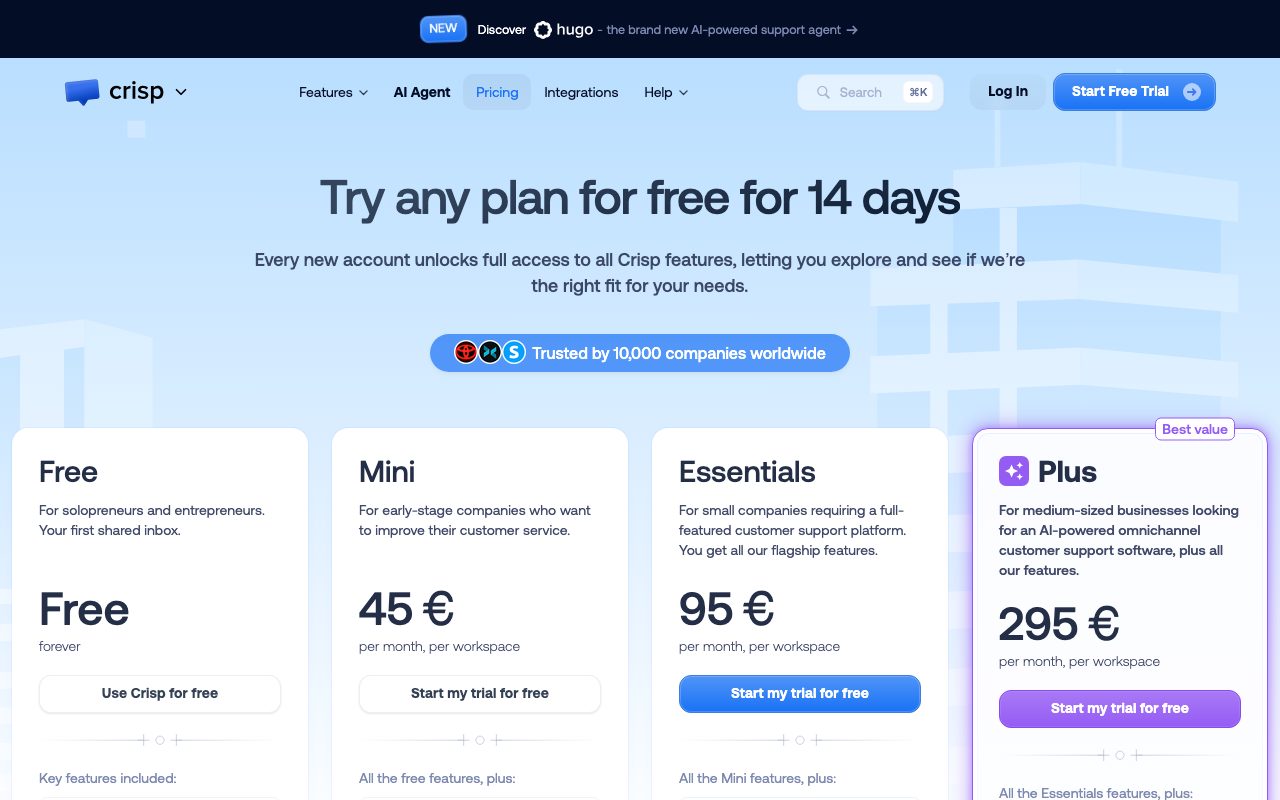
Free tier covers 2 seats, basic chat, and a single Crisp-branded widget. Mini at $25 a month per workspace adds custom branding, mobile apps, and unlimited operators. Essentials at $95/month/workspace adds the chatbot, automations, and integrations.
That last bit is wild. Most chat tools charge per seat. Crisp charges per workspace. If you have a 10-person support team, that alone saves hundreds a month versus Intercom.
Features worth knowing
Multi-channel inbox
Chat, email, Messenger, Telegram, Twitter, WhatsApp (on Plus), and SMS (on Plus). One inbox, one workflow. The integrations are real, not afterthoughts.
Help center
Crisp ships a hosted help center on its higher tiers. Articles, categories, search, and embedding into the chat widget. Not as polished as HelpScout's but functional.
CRM and contacts
Each conversation is tied to a contact with a profile, history, and segments. You can build basic email sequences and target visitors with specific messages. Lightweight CRM, not full Salesforce energy.
Co-browsing and video
Higher tiers include co-browsing and video calls inside the chat. For technical support that needs "show me your screen" moments, this is genuinely useful.
The tradeoffs
Crisp is good, not great, at most things. The chatbot builder works but isn't as flexible as Intercom Fin. The reporting is basic. The AI features are still catching up to bigger players. If you need cutting-edge AI customer support, Crisp is behind.
The product is also less polished than Intercom in places. Some integrations are fiddly. Some settings are buried. It's a small-team product priced like one. You get what you pay for, but you also save what you save.
Crisp vs alternatives
The honest comparisons are Crisp vs Intercom, Crisp vs Tawk, and Crisp vs HelpScout. Intercom wins on AI, polish, and enterprise. Tawk is free but less capable. HelpScout is email-first.
For most small teams, Crisp's the sweet spot. See Crisp alternatives or browse the best live chat tools.
Bottom line on Crisp
Crisp is the pragmatic chat tool for small teams who'd rather spend the Intercom budget on something else. It's not the most powerful product in the category. It's probably the best value.
If you're a 5-person SaaS doing customer chat, Crisp covers 90% of what you need at 10% of the cost. That's a trade most small teams happily make.
Common Crisp questions
Is Crisp good for ecommerce? Yes for small Shopify or WooCommerce stores. The Shopify integration shows order history in chat. The cart-recovery automations work. For larger stores doing real CX automation, Gorgias is more specialized.
Does Crisp do AI customer support? It has AI suggestions and a chatbot, but it's not on Intercom Fin's level for true AI deflection. Crisp's AI is better thought of as autocomplete and routing helpers, not a full AI agent.
How is Crisp's mobile experience? The mobile apps are functional. Push notifications work. Reply quality is fine for short responses. For complex conversations, you'll want a desktop. Most teams use mobile as backup, desktop as primary.
Can I self-host Crisp?
No. Crisp is hosted-only. If you need self-hosted live chat, look at Chatwoot or Tawk's self-hosted options. Crisp's data residency options cover EU and US, which works for most regulatory needs.
What's the WhatsApp situation?
WhatsApp Business integration is on the Plus tier. It uses the WhatsApp Business API, so you need a Meta business account. Once set up, WhatsApp messages flow into the same inbox as chat and email. For markets where WhatsApp is the primary channel, this matters a lot.
Workflow tips for Crisp
Set up canned responses early. They cut response time in half for common questions. Crisp's snippet system supports variables, so you can have personalized templates.
Use triggers wisely. Auto-greet visitors on specific pages. Pop up a chat after 30 seconds on pricing. Don't be annoying. The conversion lift from targeted triggers is real, the brand damage from over-popping is also real.
Sync conversations to your CRM. Crisp has integrations to HubSpot, Pipedrive, and Salesforce. The conversation history shows up on the contact record. Sales loops in. The handoff stops being painful.
Tag everything. Tags drive reporting, segmentation, and follow-up workflows. Even simple tags (bug, feature request, billing) let you slice support volume meaningfully. Browse tools for customer success for adjacent picks.
Real-world Crisp scenarios
A 5-person SaaS startup runs all customer support through Crisp. One shared inbox, three channels (chat, email, Messenger), unlimited operators on the Mini plan. Total cost: $25/month. Intercom would charge them $1,500+/month for similar coverage. The savings fund a full marketing experiment monthly.
A Shopify store uses Crisp for pre-sales chat and post-purchase support. The cart-recovery automations catch some abandoned carts. The Shopify integration shows order history alongside conversations. Conversion lift is small but real, and the support quality jumped.
An EU-based SaaS uses Crisp partly for the data residency. Crisp is French and EU servers are first-class. Privacy-conscious customers respond well. The product is fine; the geographic alignment is the bonus.
Setup checklist
Install on your site (script tag or plugin). Configure your widget appearance. Set business hours. Configure the welcome message. Set up canned responses. That's the first hour.
Add the mobile apps for the team. Configure assignment rules so conversations go to the right person. Tag conversations as you handle them so reporting works.
Connect your CRM if you have one. The conversation history on contact records is genuinely useful for sales follow-up. The integration is a checkbox in most cases.
For small teams looking at chat tools, Crisp is the value pick. It's not the prettiest. It's the most reasonable. Browse the Crisp page for community reviews.
Why Crisp wins on value
The chat tool category has become bloated. Intercom adds AI features. Drift pivots to revenue-attribution. Everyone's pricing climbs. Crisp stays focused on chat, the basics done well, and pricing that respects small teams. That's a competitive position that's getting more valuable as competitors get more expensive.
The unlimited operators on per-workspace pricing is the killer feature for small teams. A 5-person support team pays $25/month. Same team on Intercom pays around $1,500/month. The savings fund real things: ads, contractors, more product development.
The product trades polish for affordability and that trade is fine for most use cases. Conversations get answered. Tickets get tagged. Customers get helped. The fancy AI deflection that Intercom charges $10k/month for isn't necessary for a 5-person team handling 50 conversations a day.
For startups under 50 people doing customer chat, Crisp is the pragmatic pick. Most teams stick with it well past where they "should" upgrade, because the value-for-money keeps making sense.
Crisp's roadmap risk
The biggest risk with Crisp is feature pace. Intercom and Drift outspend Crisp on R&D by orders of magnitude. AI customer support is a moving target. Crisp's AI features in 2026 are competent but trail the leaders. Whether they'll catch up matters for teams investing for the long term.
The bet for most Crisp users is that "good enough" plus low price beats "best" plus high price. For small teams that bet keeps paying off. For larger teams the math gets tighter as AI deflection becomes more important.
For now, Crisp continues to be the value pick in live chat. The product works, the pricing respects small teams, the focus stays on the basics done well. That's a defensible position even if AI changes the category dramatically.
Tutorial / Demo
Key Features
- Multichannel inbox: web chat, email, WhatsApp, Messenger, Instagram
- Knowledge base and chatbot
- Co-browsing and screen sharing
- CRM with contact timelines
- Triggers and campaigns
- Mobile and desktop apps
Pros & Cons
What we like
- Genuinely free for small teams
- Single inbox covers most consumer channels
- Affordable paid tiers compared to Intercom or Zendesk
Room for improvement
- Reporting is lighter than enterprise tools
- AI features are newer and less mature
- Heavy customization needs custom code
Frequently Asked Questions
How generous is Crisp's free tier?
Crisp vs Intercom, what's the trade-off?
Does Crisp have a chatbot builder?
What channels does Crisp support?
Can I self-host Crisp?
Best For
Featured in
Tags
Alternatives to Crisp
View all

Our take
Tool Index Editorial · May 2026· 4.8/5
Crisp positions itself as multichannel customer messaging platform with a generous free tier, and on the whole it earns the framing.
Worth highlighting: Genuinely free for small teams, Single inbox covers most consumer channels, and Affordable paid tiers compared to Intercom or Zendesk. What to watch for: Reporting is lighter than enterprise tools and AI features are newer and less mature.
Verdict: Crisp comfortably earns its spot in the category — a smart default when you need bootstrapped SaaS adding live chat and shared inbox.
Editorial opinion from the Tool Index team, written from the public product pages. Not a user review.
Reviews (7)
Surprised how much we use this
Hadn't planned on switching, but Crisp was hard to ignore. Honestly impressed by how single inbox covers most consumer channels. Worth calling out the mobile and desktop apps too. One thing that bugs me: AI features are newer and less mature. Hard to imagine going back to my previous setup.
Crisp has been a quiet upgrade
Found Crisp on a Reddit thread, glad I clicked. Real selling point: single inbox covers most consumer channels. The co-browsing and screen sharing is more useful than I expected. Found it works best for two-person support teams replacing Gmail aliases. Easy yes for anyone weighing the same trade-offs.
Onboarded the team in a day
Crisp solves a real problem for me, but it's not magic. Honestly impressed by how single inbox covers most consumer channels. Got real value out of knowledge base and chatbot. Main use case: bootstrapped SaaS adding live chat and shared inbox. Worth the price for what I get out of it.
Does the job, doesn't sparkle
Crisp has quietly become part of my daily flow. Honestly impressed by how affordable paid tiers compared to Intercom or Zendesk. One thing that bugs me: heavy customization needs custom code. Not perfect but better than the alternatives I tried.
Hit the Crisp sweet spot
Crisp solves a real problem for me, but it's not magic. The biggest win has been single inbox covers most consumer channels. Would buy again without thinking twice.
Underrated honestly
Skeptical at first because Crisp looked too simple. It's not. The biggest win has been single inbox covers most consumer channels. Their take on CRM with contact timelines is solid. Not perfect: heavy customization needs custom code. Easy yes for anyone weighing the same trade-offs.
It just works
Tried half a dozen options before landing on Crisp. Honestly impressed by how affordable paid tiers compared to Intercom or Zendesk. Found it works best for e-commerce stores supporting customers across WhatsApp and Messenger. Sticking with Crisp.
Pros
- Genuinely free for small teams
- Affordable paid tiers compared to Intercom or Zendesk
Badge builder
Add Crisp to your website
Choose a badge style and size, preview it here, then copy the generated HTML. Badge images are self-contained SVGs and do not require an external script.

<a href="https://toolindex.net/tools/crisp?ref=badge" target="_blank" rel="noopener">
  <img src="https://toolindex.net/badge/crisp/medium.svg" alt="Crisp - Listed on Tool Index" width="180" height="50" />
</a>How to use the badge
- 1. Pick the style, size, and theme that fit your layout.
- 2. Copy the generated HTML from the code block.
- 3. Paste it into your footer, homepage, or press page.
Score badge available
Crisp qualifies for the score and circle badges based on its current top-10 positionin Customer Support.
Badge clicks return visitors to this profile with a referral tag so the source remains identifiable.
Related Tools

Probed
Customer chat, feedback, and public roadmaps in one shared space

QuickPing
A dead-simple contact link so customers can message you and you reply from one inbox

Zendesk
Enterprise customer service suite for ticketing, chat, and voice

Front
Customer operations platform built on a shared inbox
Work on Crisp? Request listing access or correction