Last EHR
Open-source AI agent layer for Medplum and FHIR with human approval on every write
Gallery
About Last EHR
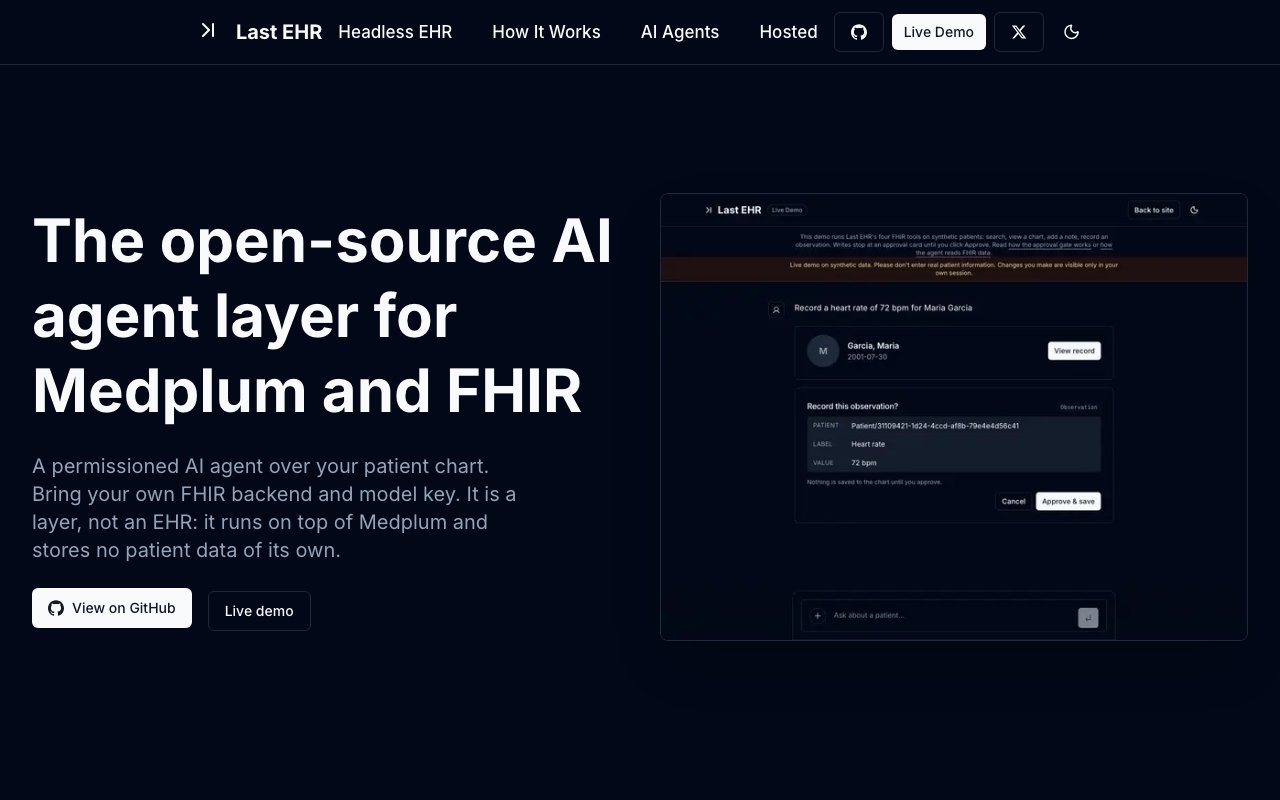
Last EHR is an open-source AI agent layer that sits on top of an existing FHIR backend rather than trying to be a full electronic health record on its own. Its own description is the open-source AI agent layer for Medplum and FHIR. You point it at a Medplum server you already run, and it gives clinicians a permissioned assistant that can read charts and propose updates without ever becoming the system of record itself. The record stays where it already lives, and the agent works against it as a careful helper rather than a replacement.
The problem it addresses is that bolting an AI assistant onto healthcare data is genuinely risky. Patient records demand strict access control, a clear audit trail, and a human in the loop before anything is written, which is exactly where a generic chat tool pointed at a database falls short. An assistant that can silently edit a chart is a liability, and one that copies patient data into a third-party platform is a compliance headache. Last EHR is built so the AI never has free rein over the chart, and so the data stays inside infrastructure the provider already controls.
It works through a small, deliberate set of four tools. The agent can search for patients in your FHIR backend and open a chart to show conditions, allergies, medications, observations, immunizations, and notes in one view. The two write actions, adding a free-text clinical note and recording an observation, are gated behind human approval. The agent proposes a change, a clinician reviews it, approves it, and only then does it reach the chart, so nothing is written silently in the background. Keeping the toolset this narrow is a deliberate safety choice rather than a gap, since every capability is one a clinician can reason about.
Data governance is the point rather than an afterthought. You run it against your own Medplum, hosted or self-hosted, and Last EHR stores no patient data of its own at any point. Everything the agent can see and do is scoped by Medplum's AccessPolicy and runs as the signed-in user, so the AI inherits the exact same permissions the clinician already has instead of a broad service account that can see everything. You bring your own model key from OpenAI or Anthropic, which keeps the choice of model and the spend under your control rather than baked into a vendor's markup.
It's aimed at healthcare teams and developers already invested in Medplum who want AI-assisted workflows without giving up oversight. The same tools also run as an MCP server, read-only by default, so you can wire the chart into Claude Desktop or another MCP client for safe lookups. That makes it a fit both for a clinician using an approval-gated assistant during a visit and for a developer scripting read-only queries against real FHIR data while building something on top. The two modes share the same underlying tools, so what you learn in one carries over to the other.
In day-to-day use the approval gate is what makes the whole thing usable in a clinical setting. A clinician can ask the assistant to pull up a patient, review what it found across conditions, medications, and recent observations, and then have it draft a note or record a reading, all while knowing that draft is a proposal and not a committed change. Nothing lands in the chart until a person has looked at it and said yes, which keeps the clinician firmly in the loop and the record accurate. That single design decision is what separates a helper you can trust with real patients from a chatbot you would never let near a live system. It also means the audit trail reflects human decisions, since every write is tied to an approval by the signed-in user rather than an opaque automated action.
What sets it apart is the posture, not a long feature list. Most AI health tools ask you to move data into their platform and trust their controls, then hope the audit story holds up. Last EHR keeps the record in your Medplum, runs as the user, and forces approval on every write, so the safe path is the default rather than something you have to remember to configure. Being open source under the Apache-2.0 license means the whole approval flow is auditable rather than a black box you take on faith, which matters a lot when the data is clinical.
It's free and open source today, with the code on GitHub and no charge to run it against your own backend beyond the model key you supply. A managed hosted tier with hosted Medplum and a signed BAA is described as in development for teams that would rather not operate the stack themselves and need the paperwork that comes with handling protected health information. For anyone piloting AI in a clinical setting who needs governance from day one, the appeal is that the guardrails come built in instead of being something you bolt on after an incident.
Key Features
- Agent layer over Medplum and FHIR
- Approval-gated chart writes
- Patient search and chart viewing
- Scoped by Medplum AccessPolicy
- Bring your own OpenAI or Anthropic key
- Optional read-only MCP server
Pros & Cons
What we like
- Human approval required before any write reaches the chart
- Stores no patient data of its own
- Runs as the signed-in user with existing permissions
- Open source under Apache-2.0 and self-hostable
Room for improvement
- Requires an existing Medplum or FHIR backend
- Managed hosted tier with a BAA is still in development
- Narrow four-tool scope by design
- You supply and pay for your own model key
Frequently Asked Questions
What is Last EHR?
Does Last EHR store patient data?
Is Last EHR free?
Who is Last EHR for?
Best For
Featured in
Alternatives to Last EHR

Stack AI
No-code platform for building and deploying enterprise AI agents and workflows on a visual canvas

Mtok Market
Non-custodial spot market for AI inference tokens, settled in USDC on Base

Lindy
No-code AI agents that handle email, meetings, and recurring workflows
Vapi
Build voice AI agents that take and place phone calls
Reviews (12)
Does the job, a few gripes
Last EHR has quietly become part of my daily flow. Where it really wins is bring your own openai or anthropic key. My only gripe is managed hosted tier with a baa is still in development. Recommending it to people in a similar spot.
Decent with some rough edges
Tried Last EHR on a side project first, then rolled it out everywhere. The agent layer over medplum and fhir is more useful than I expected. It would be a five if not for requires an existing medplum or fhir backend. No regrets so far.
Genuinely impressed
Tried Last EHR on a side project first, then rolled it out everywhere. What stands out is how it handles open source under apache-2.0 and self-hostable. It fits well for querying fhir charts read-only from claude desktop. Recommending it to people in a similar spot.
Genuinely impressed
Last EHR solves a real problem for me without making a fuss about it. The optional read-only mcp server is more useful than I expected. Found it works best for piloting clinical ai without moving patient data. Hard to imagine going back to my old setup.
Solid daily driver
Last EHR has quietly become part of my daily flow. The approval-gated chart writes is more useful than I expected. It has shaved real time off my week. No regrets so far.
Powerful once it clicks
Picked Last EHR for the price, stayed for the quality. Their take on patient search and chart viewing is genuinely good. Support actually answered when I had a question, which surprised me. Found it works best for querying fhir charts read-only from claude desktop. It would be a five if not for requires an existing medplum or fhir backend. Hard to imagine going back to my old setup.
It just works
Last EHR has quietly become part of my daily flow. The human approval required before any write reaches the chart is more useful than I expected. Setup was painless and I was productive the same day. No regrets so far.
Worth a look
Three months of Last EHR later, here is what holds up. Got real value out of approval-gated chart writes.
It just works
Picked Last EHR for the price, stayed for the quality. What stands out is how little babysitting it needs. It slotted into my routine without much fuss.
Genuinely impressed
Last EHR solves a real problem for me without making a fuss about it. What stands out is how it handles scoped by medplum accesspolicy. It fits well for adding an approval-gated assistant to a medplum ehr. It earns its place in my stack.
Worth a look
Tried Last EHR on a side project first, then rolled it out everywhere. The runs as the signed-in user with existing permissions is more useful than I expected. Support actually answered when I had a question, which surprised me. It fits well for letting clinicians draft notes for review before saving. Recommending it to people in a similar spot.
Finally something that fits
Have been running Last EHR for a while, here is where I land. Their take on optional read-only mcp server is genuinely good. Found it works best for piloting clinical ai without moving patient data. It earns its place in my stack.
Badge builder
Add Last EHR to your website
Choose a badge style and size, preview it here, then copy the generated HTML. Badge images are self-contained SVGs and do not require an external script.

<a href="https://toolindex.net/tools/last-ehr?ref=badge" target="_blank" rel="noopener">
  <img src="https://toolindex.net/badge/last-ehr/medium.svg" alt="Last EHR - Listed on Tool Index" width="180" height="50" />
</a>How to use the badge
- 1. Pick the style, size, and theme that fit your layout.
- 2. Copy the generated HTML from the code block.
- 3. Paste it into your footer, homepage, or press page.
Standard badge available
The standard listing badge is available now. Score and circle badges are limited to tools currently ranked in the top 10 of a category.
Badge clicks return visitors to this profile with a referral tag so the source remains identifiable.
Related Tools

OpenBenchmarks
Public, externally validated benchmarks that help agents pick SaaS APIs

Almanac
A hosted, source-cited wiki that turns your files into context your AI agents can use

Wizard
Self-extending Rust terminal AI agent that works with any model

Chariot
Elastic cloud infrastructure for deploying and scaling AI agent fleets with persistent storage
Work on Last EHR? Request listing access or correction