LinkedRecords
Backend-as-a-Service for collaborative SaaS apps with user-owned data and real-time sync
Gallery
About LinkedRecords
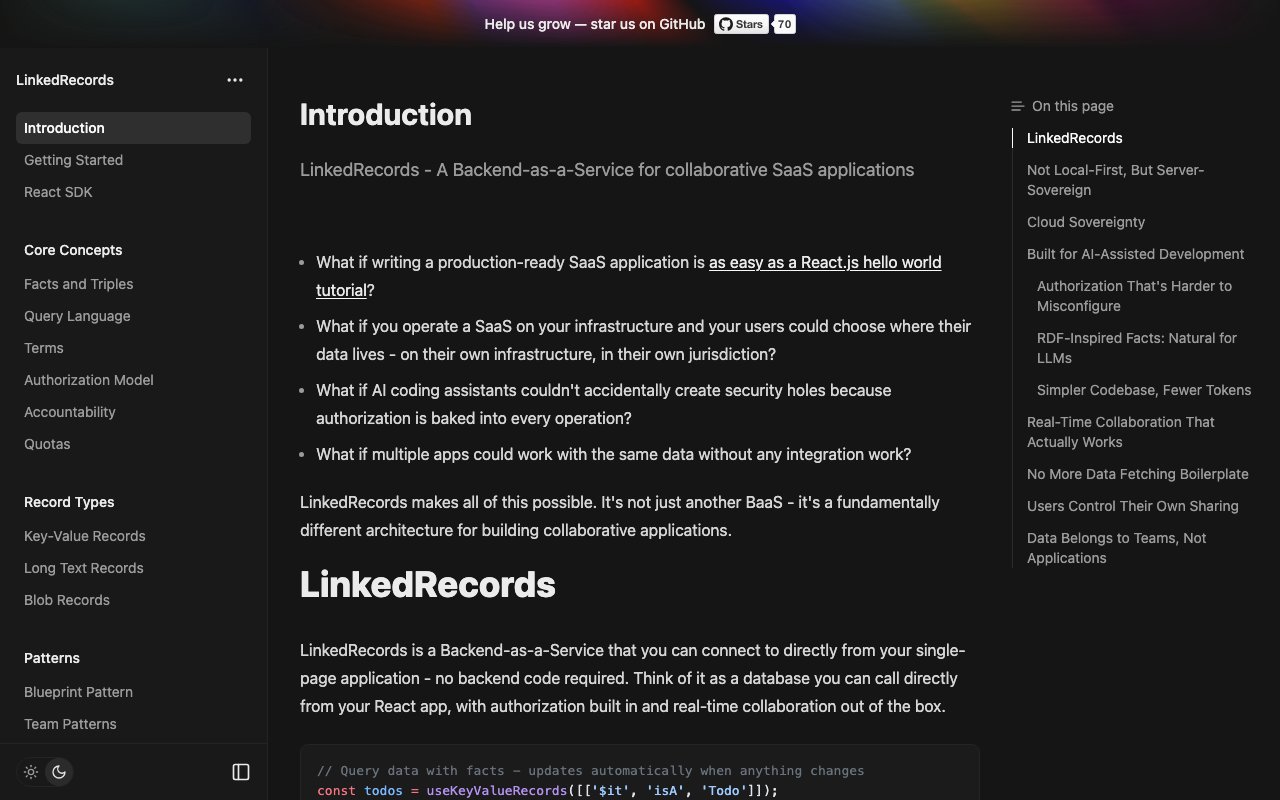
LinkedRecords is a Backend-as-a-Service platform that lets developers build collaborative SaaS applications without writing traditional backend code. Instead of setting up servers, configuring databases, and wiring up API routes, developers connect a single-page application directly to LinkedRecords and get persistence, authorization, and real-time collaboration out of the box. The pitch is straightforward: if you've ever wanted to build something like Notion, Figma, or a collaborative whiteboard but dreaded the backend complexity involved in synchronizing state across users, this is the infrastructure layer that handles it for you. You focus on the product; LinkedRecords handles the plumbing.
The data model draws from triplestore and RDF concepts, structuring information as facts in the form of subject, predicate, and object tuples. That sounds academic, but in practice it means you can represent relationships naturally, almost like writing sentences. A todo item isn't just a JSON blob sitting in a table; it's a set of facts that describe what it is, who created it, when it was created, and how it connects to other records. This structure makes querying flexible and permissions easier to reason about, since access rules apply directly to the facts rather than sitting in a separate authorization layer that you have to configure and maintain separately. The model supports key-value records using CRDTs for concurrent edits, long text records with Operational Transform for character-by-character collaboration, and blob records with version history for files and attachments.
Real-time collaboration is where LinkedRecords earns its keep. When multiple users edit the same document or record, changes merge automatically rather than clobbering each other with last-write-wins logic. Anyone who has tried to build collaborative features from scratch knows how painful conflict resolution becomes once two users touch the same data at the same moment. LinkedRecords packages the hard parts into a React SDK that handles synchronization, conflict resolution, and even multi-tab consistency without extra code on your end. You query data declaratively, describing what facts you want, and the SDK takes care of fetching, caching, updating, and reconciling changes in real time. There's no manual state management, no backend endpoints to wire up, no database migrations to run.
Authorization works differently here than in most systems. Rather than checking permissions in middleware or sprinkling access control logic throughout your routes, permission constraints are embedded in the data operations themselves. The default is restrictive: only the creator of a record can access it unless you explicitly open it up. This reduces the surface area for security mistakes, which matters especially if you're leaning on AI coding assistants that might not catch subtle authorization bugs buried in your middleware. By making authorization structural rather than procedural, LinkedRecords tries to eliminate an entire class of errors that plague traditional backend architectures.
One feature that stands out is what LinkedRecords calls Bring Your Own Backend. In a typical SaaS setup, customer data lives on your servers in your region, and you're responsible for compliance with whatever regulations apply. LinkedRecords flips that model: the single-page app distributes through a CDN, but the data stays under the customer's control, hosted on their own infrastructure or in a jurisdiction they choose. For businesses dealing with GDPR, data residency requirements, or enterprise customers who refuse to let sensitive information leave their walls, this is a structural answer rather than a policy promise. You're not asking customers to trust your security practices; you're giving them a deployment model where the question doesn't arise.
The developer experience centers on reducing boilerplate. You describe what you want to happen, and the platform handles how it happens. For teams that move fast and prototype often, the reduction in setup time is significant. For teams that need production-grade authorization and collaboration from day one, the tradeoff is that you're buying into LinkedRecords' data model rather than rolling your own. If your application fits the collaborative, multi-user pattern, that's probably a good tradeoff. If you need unusual data access patterns or deep control over your database layer, you might find the abstraction limiting.
LinkedRecords fits teams building productivity tools, internal apps, or any SaaS where multiple users interact with shared data in real time. It's particularly well suited for applications where the alternative would be months of backend development just to get collaboration right. It's less suited for simple CRUD apps where collaboration isn't a factor, or for situations where you need raw SQL access or custom database optimizations. Pricing details aren't published prominently on the site, so expect to talk to the team if you're evaluating it for a production use case.
Key Features
- Bring Your Own Backend architecture
- CRDT and OT real-time sync
- Built-in authorization in data ops
- OpenID Connect identity support
- Team-scoped cross-app data
- Versioned file and blob storage
Pros & Cons
What we like
- Users keep control of their own data location
- Real-time collaboration without custom sync code
- Permissions embedded in data operations simplify audits
- Works with existing identity providers
Room for improvement
- Pricing details not published publicly
- Requires server connection, not offline-first
- Learning curve for the data-scoping model
- Smaller ecosystem than mainstream BaaS options
Frequently Asked Questions
What is LinkedRecords?
Is LinkedRecords free?
Who is LinkedRecords for?
Does LinkedRecords work offline?
Best For
Featured in
Alternatives to LinkedRecords
View all
1Lookup
Real-time data verification API for phone, email, IP, and domain validation to fight fraud

Kevin Gabeci
Solo developer building web apps, cozy browser games, and AI creator toolkits.

Codedex
A gamified, story-driven platform that teaches Python, web dev, and more like an RPG quest
Hack2hire
Practice real SDE interview questions from top tech companies with expert worked solutions
Reviews (10)
Solid daily driver
Have been running LinkedRecords for a while, here is where I land. What stands out is how it handles built-in authorization in data ops. It just works, day after day, without surprises. Worth it for what I get out of it.
Recommended without reservation
LinkedRecords solves a real problem for me without making a fuss about it. What stands out is how it handles versioned file and blob storage. Easy yes for anyone weighing the same trade offs.
Recommended without reservation
Three months of LinkedRecords later, here is what holds up. Their take on versioned file and blob storage is genuinely good. The output quality holds up better than I expected. It earns its place in my stack.
Quietly excellent
Have been running LinkedRecords for a while, here is where I land. It handles the boring parts so I can focus on the work that matters. It does what it says, which is rarer than it should be. Glad I made the switch.
It just works
LinkedRecords has quietly become part of my daily flow. What stands out is how little babysitting it needs. Mostly using it for creating multi-user editors with real-time sync. No regrets so far.
Genuinely impressed
Picked LinkedRecords for the price, stayed for the quality. Their take on works with existing identity providers is genuinely good. The thing I keep coming back to is how reliable it is. Mostly using it for unifying data across a suite of related tools. No regrets so far.
Worth a look
Came to LinkedRecords after getting frustrated with what I had before. Support actually answered when I had a question, which surprised me. It slotted into my routine without much fuss. Glad I made the switch.
Good, with a few caveats
LinkedRecords has quietly become part of my daily flow. It just works, day after day, without surprises. Mostly using it for unifying data across a suite of related tools. My only gripe is smaller ecosystem than mainstream baas options. Hard to imagine going back to my old setup.
Genuinely impressed
LinkedRecords has quietly become part of my daily flow. The openid connect identity support is more useful than I expected. It just works, day after day, without surprises. Mostly using it for creating multi-user editors with real-time sync.
Quietly excellent
Found LinkedRecords on a Show HN thread and I am glad I clicked. The real-time collaboration without custom sync code is more useful than I expected. Support actually answered when I had a question, which surprised me. It fits well for unifying data across a suite of related tools. Would sign up again without thinking twice.
Badge builder
Add LinkedRecords to your website
Choose a badge style and size, preview it here, then copy the generated HTML. Badge images are self-contained SVGs and do not require an external script.

<a href="https://toolindex.net/tools/linkedrecords?ref=badge" target="_blank" rel="noopener">
  <img src="https://toolindex.net/badge/linkedrecords/medium.svg" alt="LinkedRecords - Listed on Tool Index" width="180" height="50" />
</a>How to use the badge
- 1. Pick the style, size, and theme that fit your layout.
- 2. Copy the generated HTML from the code block.
- 3. Paste it into your footer, homepage, or press page.
Standard badge available
The standard listing badge is available now. Score and circle badges are limited to tools currently ranked in the top 10 of a category.
Badge clicks return visitors to this profile with a referral tag so the source remains identifiable.
Related Tools
Kevin Gabeci
Solo developer building web apps, cozy browser games, and AI creator toolkits.

Coolify
Self-hostable, open source alternative to Heroku and Netlify

Warp
The modern terminal reimagined with AI and collaboration

Bolt.new
Prompt-to-deployed full-stack app inside the browser
Work on LinkedRecords? Request listing access or correction