
Memsprout
Share AI context across your team's coding assistants and agents
Gallery
About Memsprout
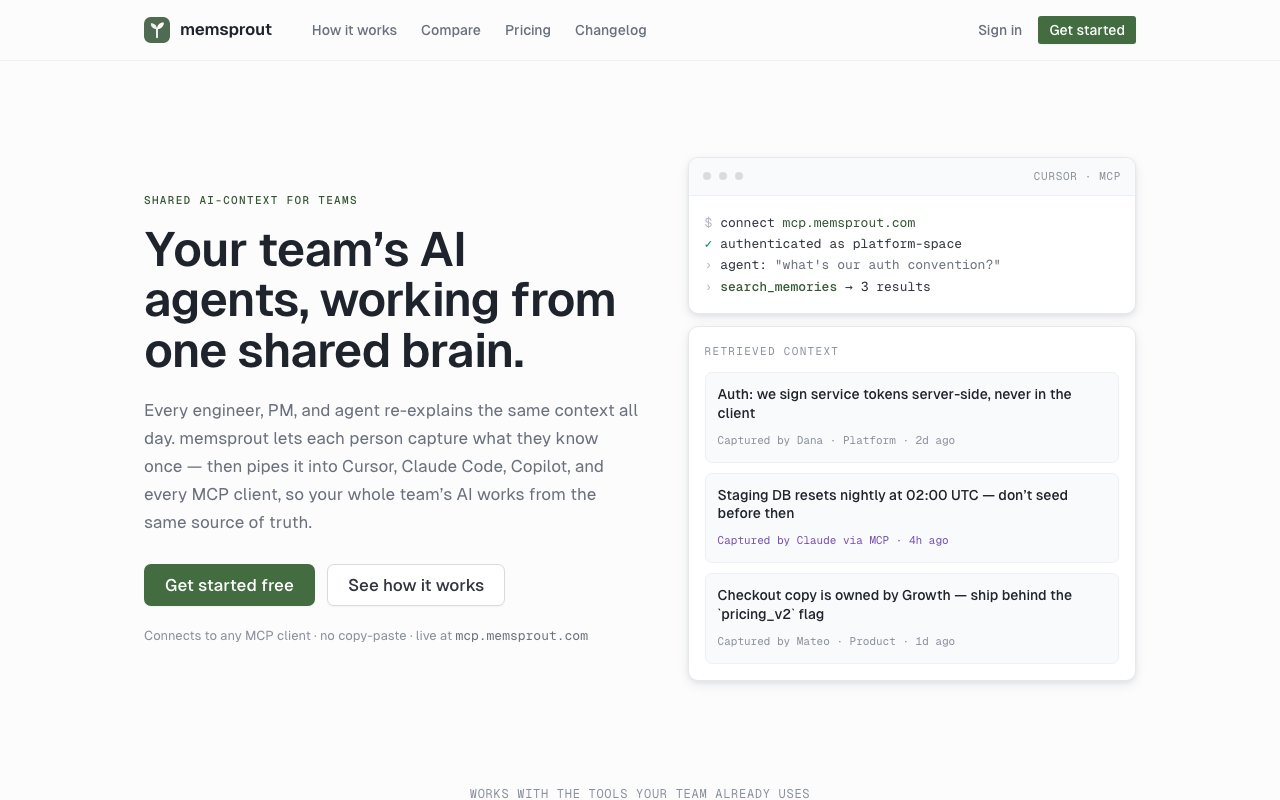
Memsprout is a shared context platform that centralizes what your team knows and pipes it into every AI coding tool you use. If you've ever watched a teammate explain the same architectural decision to Cursor, then to Claude Code, then to Copilot, you already understand the problem it solves. Instead of repeating yourself across tools and people, you capture context once and let Memsprout distribute it wherever your agents need it. The platform bills itself as one shared brain for your team's AI agents, and that's a fair description of what it actually does. The waste of context that evaporates between conversations is real, and this is a direct attempt to fix it.
The core model revolves around three concepts: memories, spaces, and topics. Memories are chunks of knowledge about your codebase, your conventions, your business logic, or anything else an AI assistant would benefit from knowing. These might be explanations of why a particular module works the way it does, or notes on which third-party APIs to avoid, or the unwritten rules that live in senior engineers' heads and never make it into documentation. Spaces contain memories and carry their own access controls, so you can scope what gets shared and with whom. A space might cover a single project, a team, or the whole company depending on how you want to organize. Topics let you group related memories within a space, which becomes important when you're dealing with a large engineering team where different groups care about different parts of the system. The hierarchy is flexible enough to map to how your organization actually works.
What makes Memsprout genuinely useful in practice is the integration layer. It connects to Cursor, Claude Code, GitHub Copilot, ChatGPT, and any MCP client, so the context you've captured shows up wherever your developers are working. You don't have to think about which tool someone is using today. The memory just appears in whatever assistant they've opened. The platform keeps version history on every memory, tracks who contributed each piece of knowledge, and enforces row-level security in Postgres so access control isn't an afterthought. If you've ever had a security audit ask who has access to what institutional knowledge, that provenance tracking matters. You can see exactly when a memory was created, who created it, and what changed since then.
The target audience is engineering teams, product managers, and QA folks who spend too much time re-explaining context to AI tools. The pitch is that your AI assistants should already know what your team knows, without every person having to repeat it. For distributed teams especially, where institutional knowledge doesn't transfer naturally over lunch or hallway conversations, having a structured way to capture and share that context is a real productivity gain. It's the kind of tooling that becomes more valuable as teams grow and as AI assistants become more central to how developers work. The time you save compounds with every person who doesn't have to ask the same question twice.
There's also an ambient capture mode where agents themselves can write back memories as they learn things about your codebase. That means the system gets smarter over time without requiring manual upkeep from humans. If an agent figures out that a particular function has a quirk that matters for future calls, it can record that as a memory for the next agent or developer who encounters the same code. Every memory tracks its provenance, so you know whether a human or an agent created it and can weigh it accordingly. This kind of self-improving knowledge base is where the value compounds. The more you use it, the less you have to maintain it.
The collaboration features follow the patterns you'd expect from enterprise tooling. Role-based access gives you owner, editor, and viewer permissions on spaces. You can control who can create memories, who can edit them, and who can only read. For teams that handle sensitive codebases or have compliance requirements around who knows what, this granularity is necessary. The platform also supports team-wide access controls so admins can manage permissions at scale rather than per-memory or per-space. For organizations that have grown past informal knowledge sharing, these controls let you maintain structure without creating bottlenecks.
Pricing runs $10 a month for individuals who want unlimited personal spaces and MCP connections. This covers solo developers who use multiple AI tools and want their context to follow them around. Teams pay $15 per user per month, which unlocks team-wide access and admin controls. Enterprise plans add SSO, SAML, audit logs, and a 99.9% SLA for organizations that need those compliance boxes checked. There's a 14-day free trial across all tiers, so you can test whether the integration with your existing tools is worth committing to before paying anything. Given how much time engineers waste re-explaining context, the ROI calculation isn't hard if the integrations work smoothly with your stack.
Key Features
- Shared context across Cursor, Claude Code, and Copilot
- Team spaces with role-based access control
- Version history on all memories
- Agent-written ambient memory capture
- MCP client integration
- Row-level security in Postgres
Pros & Cons
What we like
- Captures context once and distributes it across all your AI tools
- Integrates with the major coding assistants out of the box
- Access controls let you scope knowledge by team or project
- Agents can contribute memories, so the system improves itself
Room for improvement
- Value depends on how many AI tools your team actually uses
- Requires discipline to keep memories current and accurate
- No free tier beyond the 14-day trial
- Newer product with a smaller user community
Frequently Asked Questions
What is Memsprout?
Which AI tools does Memsprout integrate with?
Is Memsprout free?
Who is Memsprout for?
Best For
Featured in
Alternatives to Memsprout

1Lookup
Real-time data verification API for phone, email, IP, and domain validation to fight fraud

Kevin Gabeci
Solo developer building web apps, cozy browser games, and AI creator toolkits.

Codedex
A gamified, story-driven platform that teaches Python, web dev, and more like an RPG quest
Hack2hire
Practice real SDE interview questions from top tech companies with expert worked solutions
Reviews (10)
Pulled its weight from week one
Hadn't planned on switching, but Memsprout was hard to ignore. The access controls let you scope knowledge by team or project is more useful than I expected. Performance has been steady even when I lean on it hard. It fits well for onboarding new engineers through captured institutional knowledge. It earns its place in my stack.
It just works
Started using Memsprout casually, now it is pinned in my dock. Setup was painless and I was productive the same day. Mostly using it for building a living knowledge base that agents maintain. Easy yes for anyone weighing the same trade offs.
Solid but not perfect
Memsprout solves a real problem for me without making a fuss about it. Performance has been steady even when I lean on it hard. One thing that bugs me is value depends on how many ai tools your team actually uses. Recommending it to people in a similar spot.
Worth a look
Found Memsprout on a Show HN thread and I am glad I clicked. It just works, day after day, without surprises. It fits well for building a living knowledge base that agents maintain. No regrets so far.
Exactly what I needed
Started using Memsprout casually, now it is pinned in my dock. Their take on row-level security in postgres is genuinely good. The thing I keep coming back to is how reliable it is. Found it works best for keeping distributed teams aligned on architectural decisions. Hard to imagine going back to my old setup.
Pulled its weight from week one
Picked Memsprout for the price, stayed for the quality. Support actually answered when I had a question, which surprised me. Recommending it to people in a similar spot.
Pulled its weight from week one
Three months of Memsprout later, here is what holds up. What stands out is how it handles agents can contribute memories, so the system improves itself. Glad I made the switch.
Finally something that fits
Three months of Memsprout later, here is what holds up. Where it really wins is agents can contribute memories, so the system improves itself. It slotted into my routine without much fuss. It fits well for onboarding new engineers through captured institutional knowledge. No regrets so far.
Quietly excellent
Tried Memsprout on a side project first, then rolled it out everywhere. Their take on integrates with the major coding assistants out of the box is genuinely good. Worth it for what I get out of it.
Two months in, no regrets
Memsprout solves a real problem for me without making a fuss about it. Got real value out of mcp client integration. Found it works best for keeping distributed teams aligned on architectural decisions. Easy yes for anyone weighing the same trade offs.
Badge builder
Add Memsprout to your website
Choose a badge style and size, preview it here, then copy the generated HTML. Badge images are self-contained SVGs and do not require an external script.

<a href="https://toolindex.net/tools/memsprout?ref=badge" target="_blank" rel="noopener">
  <img src="https://toolindex.net/badge/memsprout/medium.svg" alt="Memsprout - Listed on Tool Index" width="180" height="50" />
</a>How to use the badge
- 1. Pick the style, size, and theme that fit your layout.
- 2. Copy the generated HTML from the code block.
- 3. Paste it into your footer, homepage, or press page.
Standard badge available
The standard listing badge is available now. Score and circle badges are limited to tools currently ranked in the top 10 of a category.
Badge clicks return visitors to this profile with a referral tag so the source remains identifiable.
Related Tools
Kevin Gabeci
Solo developer building web apps, cozy browser games, and AI creator toolkits.

Coolify
Self-hostable, open source alternative to Heroku and Netlify

Warp
The modern terminal reimagined with AI and collaboration

Bolt.new
Prompt-to-deployed full-stack app inside the browser
Work on Memsprout? Request listing access or correction