
Merge
Code review assessments that test how engineers actually work, not algorithm puzzles
Gallery
About Merge
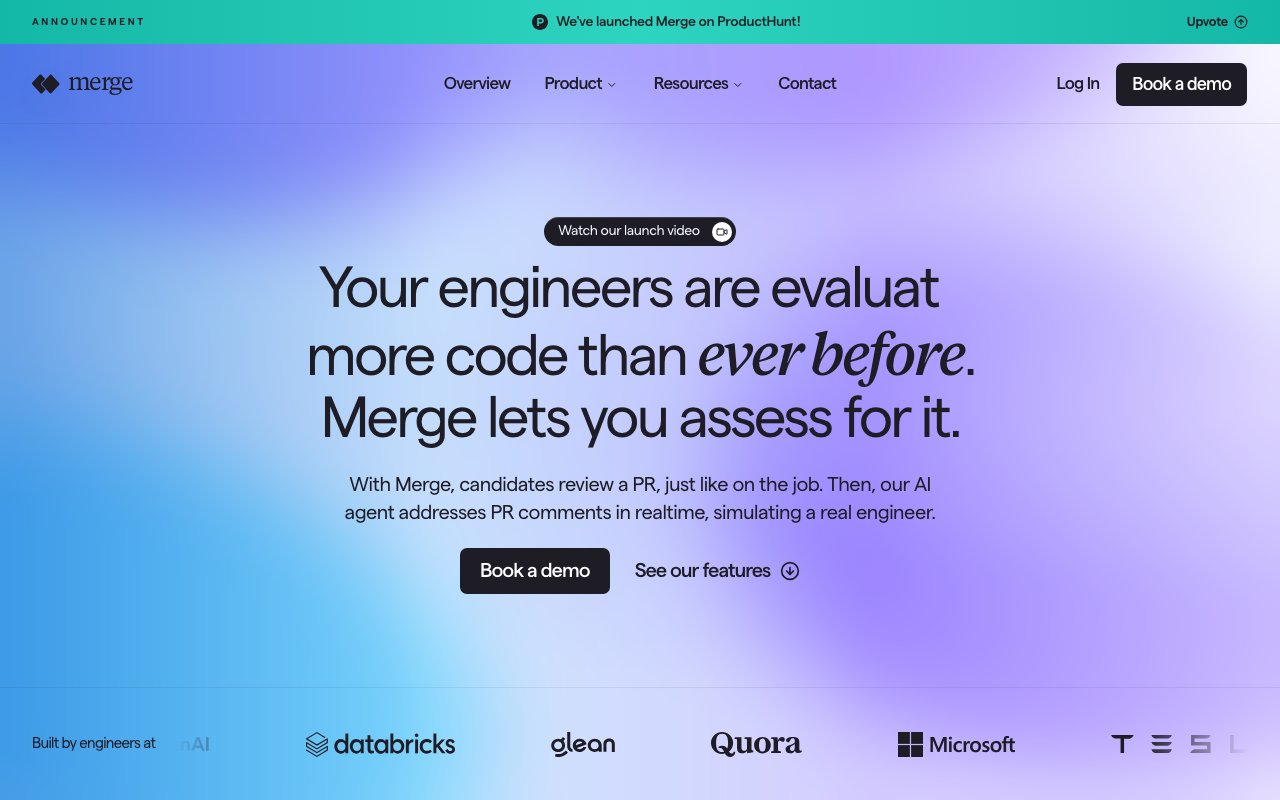
Merge is an assessment platform that evaluates engineering candidates through realistic code review tasks instead of isolated algorithm challenges. Candidates examine a small codebase with a pull request, identify bugs and issues, submit feedback, and then watch an AI agent revise the code in response. The loop continues until time runs out or the candidate approves the changes. It is closer to the daily work of a software engineer than anything you would find on a whiteboard, testing practical judgment and communication rather than memorized patterns or trick questions.
The problem it addresses is the disconnect between how companies evaluate engineers and how those engineers actually spend their time on the job. Most developers rarely write sorting algorithms from scratch after their first year. They do spend significant hours every week reviewing pull requests, catching subtle bugs before they reach production, suggesting cleaner patterns that make code easier to maintain, and communicating technical tradeoffs to teammates. Merge tests that skill directly rather than using proxies that barely correlate with job performance. If you have ever hired someone who aced a coding challenge but struggled with real code reviews once they started, this is trying to close that gap by testing what the job actually requires.
The review loop is the core mechanic and runs through five distinct stages. First, candidates inspect a realistic codebase that looks like something they might encounter in a real engineering environment. Second, they review an open pull request and leave comments identifying bugs, potential refactors, security vulnerabilities, and other issues they notice. Third, they submit those comments for evaluation by the platform. Fourth, an AI agent publishes a revised version of the code that addresses the feedback the candidate provided. Fifth, the candidate reviews again to see if the changes resolved the issues or introduced new ones, and the cycle repeats. This back and forth continues until time expires or the candidate approves the final version, letting evaluators see how a candidate reasons through incremental improvements, not just whether they spotted the first obvious bug on their initial pass.
Assessments are highly configurable by difficulty level and technical specialization. You can target frontend, backend, infrastructure, networking, core database, performance, distributed systems, data pipelines, security, platform, systems, or API roles. The platform scales from intern and new graduate levels all the way up to staff and principal engineer, adjusting the codebase complexity and the kinds of issues hidden inside accordingly. Language options can focus on specific stacks for specialized roles or remain broad for generalist positions. This flexibility means one tool can serve hiring pipelines across an engineering organization without needing separate test banks for each position or seniority level.
After the assessment, Merge generates a detailed scorecard that connects the candidate's feedback to measurable outcomes. It evaluates code quality judgment, risk detection, and revision decisions across the entire session, then provides a hiring recommendation based on how the candidate performed. There is also a token efficiency metric that shows how efficiently the candidate worked with the AI agent during the review loop, along with estimated cost and PR revision patterns. This proxy for thoughtfulness helps distinguish candidates who gave focused, effective feedback that moved the code forward from those who scattered comments without follow through or got stuck in unproductive cycles.
Pricing is not published on the site. Merge encourages teams to book a demo for details, which suggests enterprise or volume based pricing rather than a self serve checkout. That is common for hiring tools where contracts depend on the number of candidates assessed, the level of support required, and the size of the engineering organization using the platform. The narrow focus on code review means it is not a full hiring suite, so teams will likely pair it with other tools for resume screening, initial phone screens, or culture interviews.
The target user is any engineering team tired of algorithm puzzles that do not predict job performance. Merge tests engineering judgment directly and lets you compare candidates on the work they will actually do once they join. If your interview process currently asks candidates to invert a binary tree or implement quicksort on a whiteboard but your real job is reviewing pull requests and giving constructive feedback, this is a more honest signal of who will succeed in the role.
Key Features
- Realistic code review based assessments
- AI agent that revises code from feedback
- Configurable difficulty and specialization
- Detailed scorecards with hiring recommendations
- Token efficiency tracking
- Multi level support from intern to principal
Pros & Cons
What we like
- Tests the skill engineers actually use every day
- Iterative review loop reveals reasoning, not just first impressions
- Customizable for different roles and seniority levels
- Scorecards connect feedback quality to hiring decisions
Room for improvement
- Pricing requires a demo, no self serve option visible
- Narrow focus on code review, not a full hiring suite
- Younger product compared to established assessment platforms
- Depends on AI revision quality to simulate realistic responses
Frequently Asked Questions
What is Merge?
How does the review loop work?
Is Merge free?
What roles can Merge assess?
Best For
Featured in
Alternatives to Merge
Reviews (0)
Badge builder
Add Merge to your website
Choose a badge style and size, preview it here, then copy the generated HTML. Badge images are self-contained SVGs and do not require an external script.

<a href="https://toolindex.net/tools/merge?ref=badge" target="_blank" rel="noopener">
  <img src="https://toolindex.net/badge/merge/medium.svg" alt="Merge - Listed on Tool Index" width="180" height="50" />
</a>How to use the badge
- 1. Pick the style, size, and theme that fit your layout.
- 2. Copy the generated HTML from the code block.
- 3. Paste it into your footer, homepage, or press page.
Standard badge available
The standard listing badge is available now. Score and circle badges are limited to tools currently ranked in the top 10 of a category.
Badge clicks return visitors to this profile with a referral tag so the source remains identifiable.
Related Tools
Deel
Global payroll, contractor, and EOR platform

Rippling
Workforce platform unifying HR, IT, and finance

Lattice
People management platform for performance, engagement, and growth

OfferFlow AI
AI email tool that detects recruiter messages and drafts professional replies
Work on Merge? Request listing access or correction