
OpenHermit
Make any website agent-ready with one script tag
Gallery
About OpenHermit
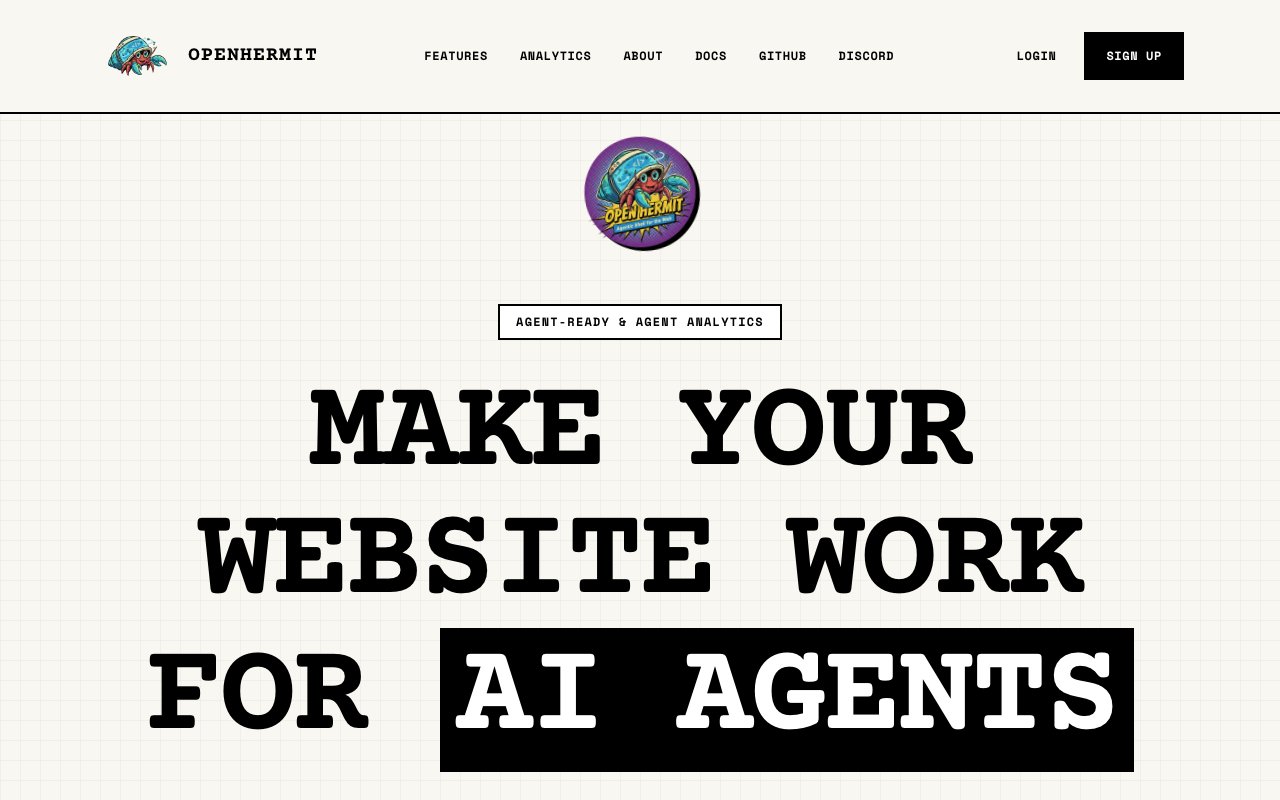
OpenHermit is a service that makes an ordinary website usable by AI agents through a single script tag. The premise is that agents are already browsing the web on people's behalf, and most sites are readable to them but not actually operable. OpenHermit closes that gap, so an agent can do more than scrape text off a page, it can complete a form, book a slot, or make a purchase the way a person would. The homepage states it plainly, "AI agents are already visiting your site. OpenHermit lets them actually use it."
The shift it responds to is that a growing share of web traffic now comes from autonomous agents rather than people clicking around. Those agents can read a page well enough, but they hit a wall when they need to take an action, because buttons and multi-step forms were built for a human, not a machine, to drive reliably. Site owners also have almost no visibility into this traffic, so they can't tell which agents show up, what they try to do, or whether those attempts turn into anything. OpenHermit works on both halves of that gap, making the actions usable and making the activity visible at the same time. For a lot of sites that traffic is effectively invisible today, showing up in logs as odd user agents that nobody has a real way to act on.
Setup is a single script tag dropped into the page, which the company says takes under two minutes with nothing else to configure. Once it's in, OpenHermit auto-injects WebMCP, which it describes as the open standard for AI-web interaction, so the site's forms and actions become things an agent can discover and execute rather than just read. It detects those forms and actions automatically, so a site owner doesn't have to hand-map every button, and developers can also expose specific ones deliberately by marking them up with a data-tool attribute. Configuration and reporting then happen from a dashboard rather than in code.
Beyond making a site operable, OpenHermit adds an analytics layer built specifically for agent traffic. It identifies which agents visit, tracks what actions they attempt, and shows the funnel, so owners can see where agents succeed and where they drop off. There's also a guardrails layer where owners write custom instructions, set approval rules, and define routing logic, so agents don't act with a completely free hand on the site. Enabling actions, measuring what happens, and constraining how far an agent can go is the overall shape of the product, and each piece answers a different worry a site owner has about letting agents in at all. The instructions and approval rules matter because an agent acting on a real checkout or booking is doing something with consequences, not just reading, so owners want a say in how far it can go before anything is committed.
It fits any site that already sees agent traffic and wants to turn it into completed bookings, purchases, or form submissions instead of abandoned attempts. Teams running a service, a booking flow, or a checkout are the obvious case, along with anyone simply curious about how autonomous tools are interacting with their product. What sets it apart is the bet on WebMCP as an open standard rather than a proprietary integration, so the interaction layer isn't locked to a single vendor and can work with whatever agents adopt the standard, and the fact that it ships as one script instead of a full rebuild of the site keeps the barrier to trying it low.
Pricing is freemium and tiered by the number of sites and monthly interactions. The free Hatchling plan covers one site with a thousand interactions a month, automatic WebMCP, basic analytics, and Discord support. The Hermit plan at twenty dollars a month raises that to five sites and fifty thousand interactions with full analytics, custom prompts, and data export. The Colony plan at fifty dollars a month covers twenty sites and a quarter of a million interactions and adds A/B testing, advanced analytics, and API access, with an enterprise tier for higher volume handled by contacting sales.
OpenHermit is a young product in a category that's still forming as agents become a real source of web traffic. It's built by the team behind loaded.ch, with documentation, a public GitHub presence, and a Discord community around it, and it leans on WebMCP being an open standard rather than a walled garden. For a site owner who suspects agents are already showing up and wants both to serve them and to see what they're doing, the free tier is a low-commitment way to find out before paying for anything.
Key Features
- One script-tag installation
- Automatic WebMCP injection
- Auto-detection of forms and actions
- Agent analytics and funnel tracking
- Custom instructions and guardrails
- Built on the open WebMCP standard
Pros & Cons
What we like
- Adds agent support without rebuilding the site
- Gives owners real visibility into agent traffic
- Built on an open standard, not a proprietary lock-in
- Free tier available to try it on one site
Room for improvement
- Value depends on how much agent traffic a site gets
- Interaction limits scale the paid tiers up quickly
- Younger product with a smaller community
- Tied to WebMCP standard adoption
Frequently Asked Questions
What is OpenHermit?
Is OpenHermit free?
How long does setup take?
How is OpenHermit different?
Best For
Featured in
Alternatives to OpenHermit

1Lookup
Real-time data verification API for phone, email, IP, and domain validation to fight fraud

Codedex
A gamified, story-driven platform that teaches Python, web dev, and more like an RPG quest
Hack2hire
Practice real SDE interview questions from top tech companies with expert worked solutions
Cloudflare Pages
Free Jamstack hosting on Cloudflares edge with unlimited bandwidth and tight integration with Workers.
Reviews (9)
Recommended without reservation
Have been running OpenHermit for a while, here is where I land. Their take on automatic webmcp injection is genuinely good. It fits well for exposing checkout actions to autonomous shoppers. Worth it for what I get out of it.
Good, with a few caveats
OpenHermit solves a real problem for me without making a fuss about it. It does what it says, which is rarer than it should be. One thing that bugs me is tied to webmcp standard adoption. Hard to imagine going back to my old setup.
Pulled its weight from week one
Have been running OpenHermit for a while, here is where I land. The core workflow is smooth once you are set up. It has shaved real time off my week. Would sign up again without thinking twice.
Two months in, no regrets
OpenHermit has quietly become part of my daily flow. Their take on one script-tag installation is genuinely good. Setup was painless and I was productive the same day. Found it works best for letting agents complete a booking on your site. Hard to imagine going back to my old setup.
Finally something that fits
OpenHermit solves a real problem for me without making a fuss about it. What stands out is how it handles automatic webmcp injection. The interface stays out of my way, which I appreciate. Recommending it to people in a similar spot.
Solid but not perfect
OpenHermit solves a real problem for me without making a fuss about it. Performance has been steady even when I lean on it hard. It does what it says, which is rarer than it should be. The catch is younger product with a smaller community. Recommending it to people in a similar spot.
Recommended without reservation
Started using OpenHermit casually, now it is pinned in my dock. Got real value out of one script-tag installation. No regrets so far.
Finally something that fits
Hadn't planned on switching, but OpenHermit was hard to ignore. Setup was painless and I was productive the same day. It fits well for letting agents complete a booking on your site.
Quietly excellent
Found OpenHermit on a Show HN thread and I am glad I clicked. The core workflow is smooth once you are set up. The interface stays out of my way, which I appreciate. Found it works best for exposing checkout actions to autonomous shoppers. It earns its place in my stack.
Badge builder
Add OpenHermit to your website
Choose a badge style and size, preview it here, then copy the generated HTML. Badge images are self-contained SVGs and do not require an external script.

<a href="https://toolindex.net/tools/openhermit?ref=badge" target="_blank" rel="noopener">
  <img src="https://toolindex.net/badge/openhermit/medium.svg" alt="OpenHermit - Listed on Tool Index" width="180" height="50" />
</a>How to use the badge
- 1. Pick the style, size, and theme that fit your layout.
- 2. Copy the generated HTML from the code block.
- 3. Paste it into your footer, homepage, or press page.
Standard badge available
The standard listing badge is available now. Score and circle badges are limited to tools currently ranked in the top 10 of a category.
Badge clicks return visitors to this profile with a referral tag so the source remains identifiable.
Related Tools

Kevin Gabeci
Solo developer building web apps, cozy browser games, and AI creator toolkits.

Coolify
Self-hostable, open source alternative to Heroku and Netlify

Warp
The modern terminal reimagined with AI and collaboration

Bolt.new
Prompt-to-deployed full-stack app inside the browser
Work on OpenHermit? Request listing access or correction