
Patchless
Linux kernel vulnerability monitor that scans stable kernel commits for potential security issues
Gallery
About Patchless
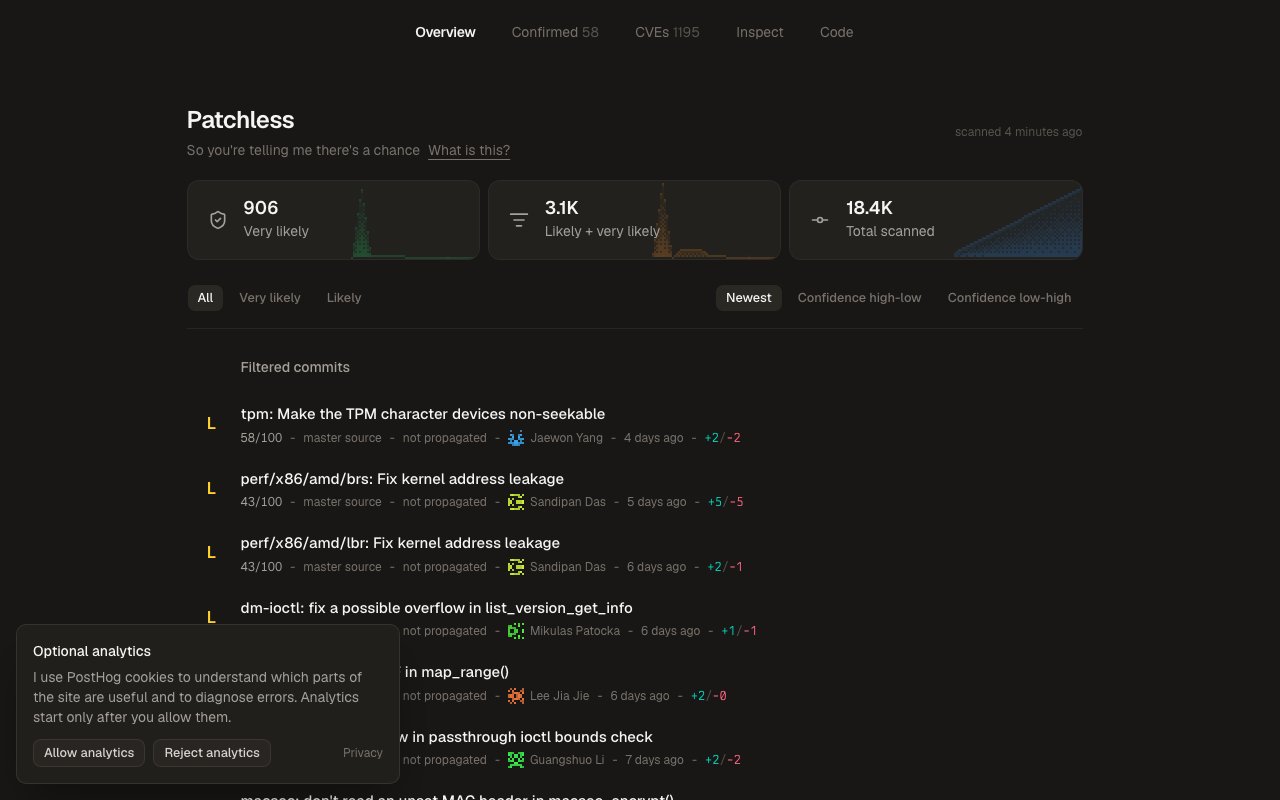
Patchless is a monitoring tool that tracks the Linux stable kernel for commits that might indicate security vulnerabilities. It scans publicly available kernel commits within a configurable time window, applies heuristics to estimate which ones are likely security fixes, and presents the findings through a dashboard with risk categorization. The goal is to help system administrators and security researchers stay ahead of issues before they become public CVEs with exploit code circulating in the wild.
The problem it addresses is timing. Many kernel vulnerabilities start as commits to the stable tree long before they get a CVE number or a security advisory. A privilege escalation might be patched quietly in a merge commit that looks routine to anyone skimming the changelog. Someone maintaining Linux servers might not realize a fix they applied last month was actually patching a serious vulnerability until months later when researchers disclose it publicly and attackers start scanning for unpatched systems. Patchless tries to surface these earlier by analyzing commit patterns that historically correlate with security fixes.
Under the hood, the tool scans commits within a set window, defaulting to around 150 days. It reads commit messages, examines file changes, looks at which subsystems are affected, and applies a set of heuristics based on patterns seen in past security-related commits. Keywords in commit messages, types of code changes, and historical data about which files tend to have vulnerabilities all factor into the analysis. The output gets classified into buckets: very likely, likely, or candidate, depending on how strongly the commit matches known vulnerability signatures. Confirmed CVEs that appear in the codebase are tracked separately with their identifiers so you can see what is already disclosed versus what is still speculative.
The dashboard displays metrics like how many commits were scanned, how many findings fell into each category, and what the most recent potential issues look like. You can browse the findings directly and see which commits triggered the heuristics and why. This gives you something to review rather than just a number, so you can make your own judgment about whether a particular finding is worth investigating further or is likely a false positive.
The positioning is honest and sets expectations appropriately. The tagline references uncertainty directly: these are automated estimates from public commits, not authoritative security advisories. The tool explicitly cannot guarantee accuracy. False positives will happen because commit patterns are not a perfect signal. Some real vulnerabilities will not match the patterns and will be missed because attackers and maintainers do not always leave obvious traces. It is a signal, not a verdict. For teams that want an early warning layer on top of their existing vulnerability scanning and patch management process, that framing is realistic and useful.
The target audience is Linux system administrators, DevOps engineers running fleets of servers, and security researchers who follow kernel development closely. If you are responsible for keeping production Linux systems patched and want to catch potential issues before they trend on security Twitter or get a dramatic name and logo, this is the kind of tool you might add to your monitoring stack. It supplements rather than replaces your CVE feeds, package manager security alerts, and manual review of changelogs. Think of it as one more input into your triage process.
Where Patchless stands apart is its focus on the stable kernel specifically. General vulnerability databases cover disclosed CVEs across all software, but they do not help you notice the commit that will become a CVE in three months. By scanning commits directly and applying heuristics, Patchless occupies a niche between reading kernel changelogs manually and waiting for official advisories. It is proactive rather than reactive, which has value if you prefer to be ahead of the curve even at the cost of some noise in your findings.
The tool appears to be a side project rather than a commercial product. There is no pricing page, subscription model, or company behind it. Access is through the web interface at patchless.natey.sh, and the straightforward presentation suggests this is something built for the maintainer's own use and shared publicly. There is no sign-up, no account required, and no stated SLA or support channel. You can browse the findings immediately and decide whether the signal quality is useful for your environment before relying on it for anything serious.
For security-conscious Linux administrators who want an experimental early warning system, Patchless offers something you cannot get from the usual CVE feeds: a head start. The tradeoff is uncertainty. You will need to review findings yourself, separate genuine concerns from false positives, and make your own decisions about urgency. If that sounds like worthwhile work and you have the expertise to evaluate kernel commits, the tool is free to explore and might surface something valuable before it makes headlines.
Key Features
- Automated scanning of Linux stable kernel commits
- Risk categorization of potential vulnerabilities
- Configurable commit time window
- CVE tracking for confirmed vulnerabilities
- Dashboard with scan metrics and findings
- Heuristic-based likelihood estimates
Pros & Cons
What we like
- Surfaces potential kernel vulnerabilities before official CVE disclosure
- Focused specifically on the Linux stable kernel
- Free to use with no account required
- Honest about being an estimate, not an authoritative source
Room for improvement
- Experimental heuristics may produce false positives
- Not a substitute for official security advisories
- Appears to be a side project with unclear support
- Linux kernel only, not applicable to other software
Frequently Asked Questions
What is Patchless?
Is Patchless an authoritative security advisory?
How far back does Patchless scan?
Who is Patchless for?
Best For
Featured in
Alternatives to Patchless

1Password
Password and secrets manager for individuals, families, and developer teams with strong CLI and SSH agent support.
Clerk
Drop-in authentication and user management for modern apps

Tailscale
WireGuard-based mesh VPN that connects your devices, servers, and cloud resources into one private network in minutes.

BackPedal
UK bike theft protection that sends recovery agents after your stolen bike
Reviews (11)
Two months in, no regrets
Picked Patchless for the price, stayed for the quality. Where it really wins is free to use with no account required. Setup was painless and I was productive the same day. No regrets so far.
Quietly excellent
Came to Patchless after getting frustrated with what I had before. It handles the boring parts so I can focus on the work that matters. It has shaved real time off my week. Found it works best for researching patterns in kernel security fixes.
Quietly excellent
Patchless has quietly become part of my daily flow. Their take on risk categorization of potential vulnerabilities is genuinely good. It earns its place in my stack.
Solid daily driver
Three months of Patchless later, here is what holds up. What stands out is how little babysitting it needs. It has shaved real time off my week. Worth it for what I get out of it.
Two months in, no regrets
Patchless has quietly become part of my daily flow. Where it really wins is automated scanning of linux stable kernel commits. The output quality holds up better than I expected. It fits well for triaging stable kernel updates for security relevance. Would sign up again without thinking twice.
Worth a look
Tried Patchless on a side project first, then rolled it out everywhere. Their take on free to use with no account required is genuinely good. It fits well for triaging stable kernel updates for security relevance. Glad I made the switch.
Genuinely impressed
Patchless has quietly become part of my daily flow. Got real value out of heuristic-based likelihood estimates. It fits well for triaging stable kernel updates for security relevance. It earns its place in my stack.
Exactly what I needed
Patchless solves a real problem for me without making a fuss about it. What stands out is how it handles automated scanning of linux stable kernel commits. The output quality holds up better than I expected. Found it works best for triaging stable kernel updates for security relevance. No regrets so far.
It just works
Three months of Patchless later, here is what holds up. The output quality holds up better than I expected. Found it works best for researching patterns in kernel security fixes. Recommending it to people in a similar spot.
Does the job, a few gripes
Three months of Patchless later, here is what holds up. The defaults are sensible, so I was not fighting settings on day one. What stands out is how little babysitting it needs. It would be a five if not for not a substitute for official security advisories. Would sign up again without thinking twice.
Finally something that fits
Three months of Patchless later, here is what holds up. The cve tracking for confirmed vulnerabilities is more useful than I expected. It fits well for supplementing cve feeds with leading indicator data. Recommending it to people in a similar spot.
Badge builder
Add Patchless to your website
Choose a badge style and size, preview it here, then copy the generated HTML. Badge images are self-contained SVGs and do not require an external script.

<a href="https://toolindex.net/tools/patchless?ref=badge" target="_blank" rel="noopener">
  <img src="https://toolindex.net/badge/patchless/medium.svg" alt="Patchless - Listed on Tool Index" width="180" height="50" />
</a>How to use the badge
- 1. Pick the style, size, and theme that fit your layout.
- 2. Copy the generated HTML from the code block.
- 3. Paste it into your footer, homepage, or press page.
Standard badge available
The standard listing badge is available now. Score and circle badges are limited to tools currently ranked in the top 10 of a category.
Badge clicks return visitors to this profile with a referral tag so the source remains identifiable.
Related Tools
Clerk
Drop-in authentication and user management for modern apps

DomeSOC
Autonomous SOC that grades every AI claim against evidence before it reaches an analyst
Reel
Forensic evidence capture for regulated Kubernetes, plus a free open-source VEX hub

HeimWall
Menu bar app that catches secrets and PII before you paste them into AI coding tools
Work on Patchless? Request listing access or correction