
Puzzle Quandary DSA
Learn data structures and algorithms through interactive visual jigsaw puzzles
Gallery
About Puzzle Quandary DSA
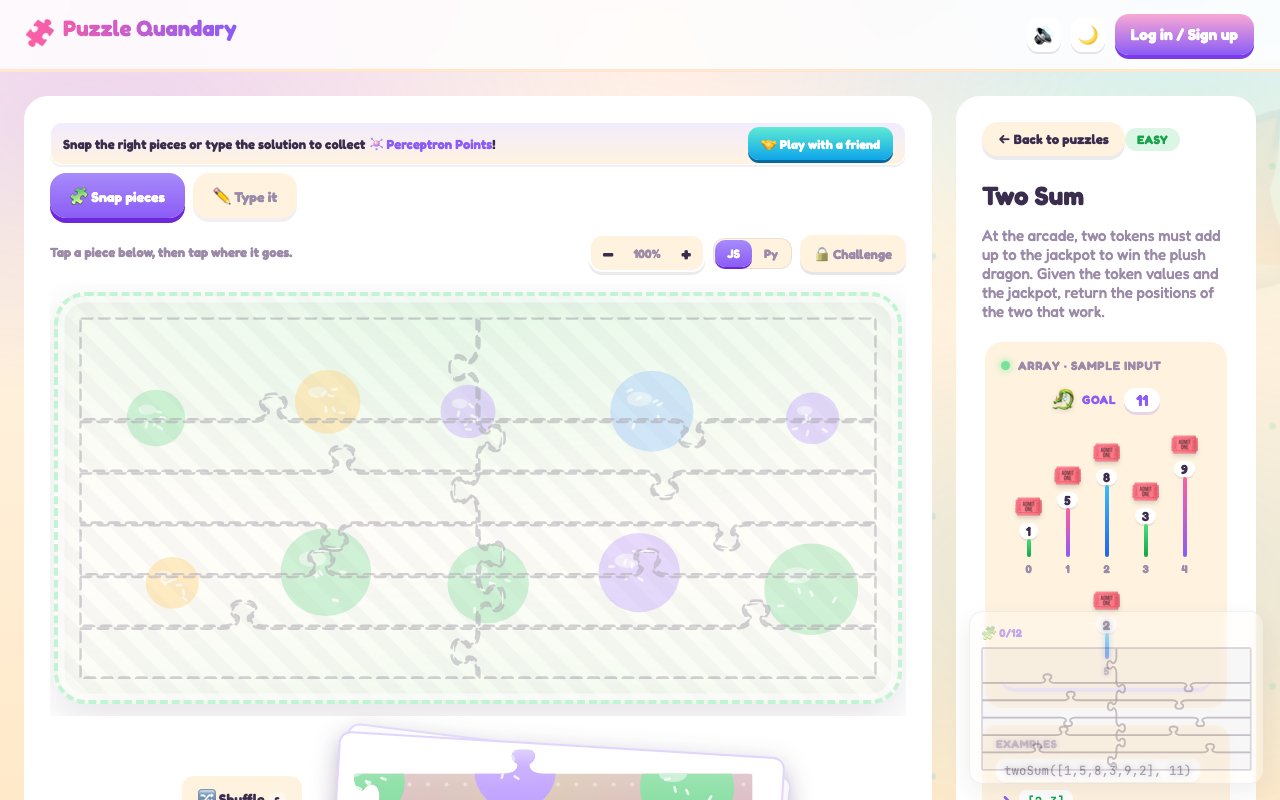
Puzzle Quandary DSA is an interactive learning platform built specifically for developers preparing for technical interviews. The service offers 464 data structure and algorithm puzzles available in both Python and JavaScript, covering the core patterns that appear repeatedly in coding interviews at technology companies. Rather than presenting problems as static text with hidden solutions that learners reveal after giving up, the platform takes a fundamentally visual approach where each puzzle includes a step by step replay showing exactly how the solution executes. This replay mechanism lets learners trace through variable changes, pointer movements, recursive calls, and data structure modifications at their own pace, building genuine algorithmic intuition rather than rote memorization of solution templates.
The puzzle library spans fundamental algorithmic concepts that form the backbone of technical assessments. Two pointer techniques appear throughout the collection, including variations for sorted arrays, linked lists, and sliding window problems. Binary search variations cover standard implementations along with tricky edge cases around boundary conditions. Tree traversals include depth first and breadth first approaches with problems requiring different traversal orders. Heap operations cover priority queue construction, heapification, and common interview patterns like finding k largest elements. Backtracking strategies address permutation, combination, and constraint satisfaction problems. Greedy algorithm applications demonstrate when local optimization produces global solutions. Bit manipulation problems round out the collection with techniques that appear less frequently but can dramatically simplify certain problem types.
The dual language support means Python developers and JavaScript developers can work in their preferred syntax without mental translation overhead that distracts from learning the underlying concepts. Those who use both languages professionally can practice switching between them, which mirrors real interview situations where candidates often choose their preferred language. The platform doesn't treat the two languages as afterthoughts with mechanical translations. Instead, solutions demonstrate idiomatic approaches appropriate to each language, so Python solutions use list comprehensions and built in functions where appropriate while JavaScript solutions leverage modern ES6 features.
The platform distinguishes itself through its jigsaw style puzzle format. Instead of simply coding a solution from scratch in a blank editor, learners interact with puzzle pieces that represent different parts of an algorithm. This format encourages active engagement with the logical structure of solutions before worrying about syntax details or typing speed. The step by step replays complement this approach by demystifying what happens when code runs. This visualization is particularly valuable for recursive algorithms where the call stack behavior isn't immediately obvious from reading code, and for data structures like heaps where internal array representations differ substantially from conceptual tree visualizations.
Software engineers at various career stages will find value here, though the content specifically targets interview preparation rather than general computer science education. Junior developers encountering these algorithmic patterns for the first time can use the visual explanations to build mental models that would otherwise require extensive debugging to develop. More experienced engineers returning to the job market after years of production work focused on architecture or team leadership can use the platform to refresh rusty algorithm skills without starting from zero. The structured puzzle format also suits people who learn better through interaction than through video lectures or textbook reading.
The pricing structure follows a freemium model designed to let users evaluate before committing. Basic access to the platform is free, allowing users to explore the interface, understand the puzzle format, and work through a meaningful subset of puzzles before deciding whether to pay. Premium access costs $4.99 per month and unlocks the complete puzzle library across all topic areas along with all step by step solution replays. A 14 day free trial is available for the premium tier, giving enough time to evaluate whether the visual learning approach works for a particular individual's study style. For developers actively interviewing, even a single month of focused practice could justify the modest subscription cost, and the trial period means there's essentially no risk in trying it out.
The platform fills a specific niche in the crowded interview preparation market by focusing narrowly on pattern recognition and algorithmic thinking through visual and interactive methods. It isn't trying to be a comprehensive computer science education. It isn't a mock interview simulator with timed sessions and behavioral questions. Instead, it concentrates on making algorithm execution comprehensible through visualization, which addresses a pain point that text based resources and even video explanations often fail to resolve. Developers who've struggled to retain information from passive video courses or found themselves stuck rereading the same algorithm explanations might find that the puzzle based format finally makes certain concepts click.
Key Features
- Interactive jigsaw puzzle learning format
- Visual representation of data structures
- Algorithm concepts as spatial challenges
- Machine learning and AI topic modules
- Web-based with no installation required
- One-time purchase with no subscription
Pros & Cons
What we like
- Visual approach makes abstract concepts more concrete
- Low one-time price of $4.99 with no recurring fees
- Covers fundamentals through to ML and AI topics
- Browser-based and accessible on any device
Room for improvement
- Does not replace hands-on coding practice
- Limited information available about curriculum depth
- Newer product with smaller community
- Puzzle format may not suit all learning styles
Frequently Asked Questions
What is Puzzle Quandary DSA?
How much does Puzzle Quandary DSA cost?
Who is Puzzle Quandary DSA for?
Does this replace coding practice?
Best For
Featured in
Alternatives to Puzzle Quandary DSA
View all
1Lookup
Real-time data verification API for phone, email, IP, and domain validation to fight fraud

Kevin Gabeci
Solo developer building web apps, cozy browser games, and AI creator toolkits.

Codedex
A gamified, story-driven platform that teaches Python, web dev, and more like an RPG quest
Hack2hire
Practice real SDE interview questions from top tech companies with expert worked solutions
Reviews (12)
Worth a look
Found Puzzle Quandary DSA on a Show HN thread and I am glad I clicked. Got real value out of one-time purchase with no subscription. It fits well for introducing ml and ai topics in a low-pressure format. Worth it for what I get out of it.
Exactly what I needed
Puzzle Quandary DSA has quietly become part of my daily flow. What stands out is how it handles browser-based and accessible on any device. It does what it says, which is rarer than it should be. Mostly using it for introducing ml and ai topics in a low-pressure format. Glad I made the switch.
Solid but not perfect
Picked Puzzle Quandary DSA for the price, stayed for the quality. The thing I keep coming back to is how reliable it is. The defaults are sensible, so I was not fighting settings on day one. Found it works best for supplementing interview prep with visual learning. The catch is does not replace hands-on coding practice. It earns its place in my stack.
Recommended without reservation
Found Puzzle Quandary DSA on a Show HN thread and I am glad I clicked. What stands out is how it handles visual representation of data structures. Found it works best for learning algorithm concepts through spatial puzzles. Hard to imagine going back to my old setup.
Solid but not perfect
Picked Puzzle Quandary DSA for the price, stayed for the quality. What stands out is how it handles algorithm concepts as spatial challenges. Performance has been steady even when I lean on it hard. It would be a five if not for puzzle format may not suit all learning styles. It earns its place in my stack.
Solid daily driver
Found Puzzle Quandary DSA on a Show HN thread and I am glad I clicked. Got real value out of machine learning and ai topic modules. Found it works best for building intuition for data structure behavior. Would sign up again without thinking twice.
Two months in, no regrets
Have been running Puzzle Quandary DSA for a while, here is where I land. The visual representation of data structures is more useful than I expected. It has shaved real time off my week. Found it works best for introducing ml and ai topics in a low-pressure format. Easy yes for anyone weighing the same trade offs.
Solid daily driver
Puzzle Quandary DSA has quietly become part of my daily flow. Where it really wins is browser-based and accessible on any device. Mostly using it for introducing ml and ai topics in a low-pressure format.
Decent with some rough edges
Three months of Puzzle Quandary DSA later, here is what holds up. The covers fundamentals through to ml and ai topics is more useful than I expected. The output quality holds up better than I expected. Mostly using it for introducing ml and ai topics in a low-pressure format. One thing that bugs me is does not replace hands-on coding practice. It earns its place in my stack.
Finally something that fits
Found Puzzle Quandary DSA on a Show HN thread and I am glad I clicked. What stands out is how it handles one-time purchase with no subscription. What stands out is how little babysitting it needs.
Exactly what I needed
Puzzle Quandary DSA has quietly become part of my daily flow. The browser-based and accessible on any device is more useful than I expected. Recommending it to people in a similar spot.
Quietly excellent
Found Puzzle Quandary DSA on a Show HN thread and I am glad I clicked. What stands out is how it handles browser-based and accessible on any device. Support actually answered when I had a question, which surprised me. Mostly using it for building intuition for data structure behavior. No regrets so far.
Badge builder
Add Puzzle Quandary DSA to your website
Choose a badge style and size, preview it here, then copy the generated HTML. Badge images are self-contained SVGs and do not require an external script.

<a href="https://toolindex.net/tools/pqdsa?ref=badge" target="_blank" rel="noopener">
  <img src="https://toolindex.net/badge/pqdsa/medium.svg" alt="Puzzle Quandary DSA - Listed on Tool Index" width="180" height="50" />
</a>How to use the badge
- 1. Pick the style, size, and theme that fit your layout.
- 2. Copy the generated HTML from the code block.
- 3. Paste it into your footer, homepage, or press page.
Standard badge available
The standard listing badge is available now. Score and circle badges are limited to tools currently ranked in the top 10 of a category.
Badge clicks return visitors to this profile with a referral tag so the source remains identifiable.
Related Tools
Kevin Gabeci
Solo developer building web apps, cozy browser games, and AI creator toolkits.

Coolify
Self-hostable, open source alternative to Heroku and Netlify

Warp
The modern terminal reimagined with AI and collaboration

Bolt.new
Prompt-to-deployed full-stack app inside the browser
Work on Puzzle Quandary DSA? Request listing access or correction