
PrepMe
DevOps interview prep that turns job descriptions into personalized practice with live Kubernetes labs
Gallery
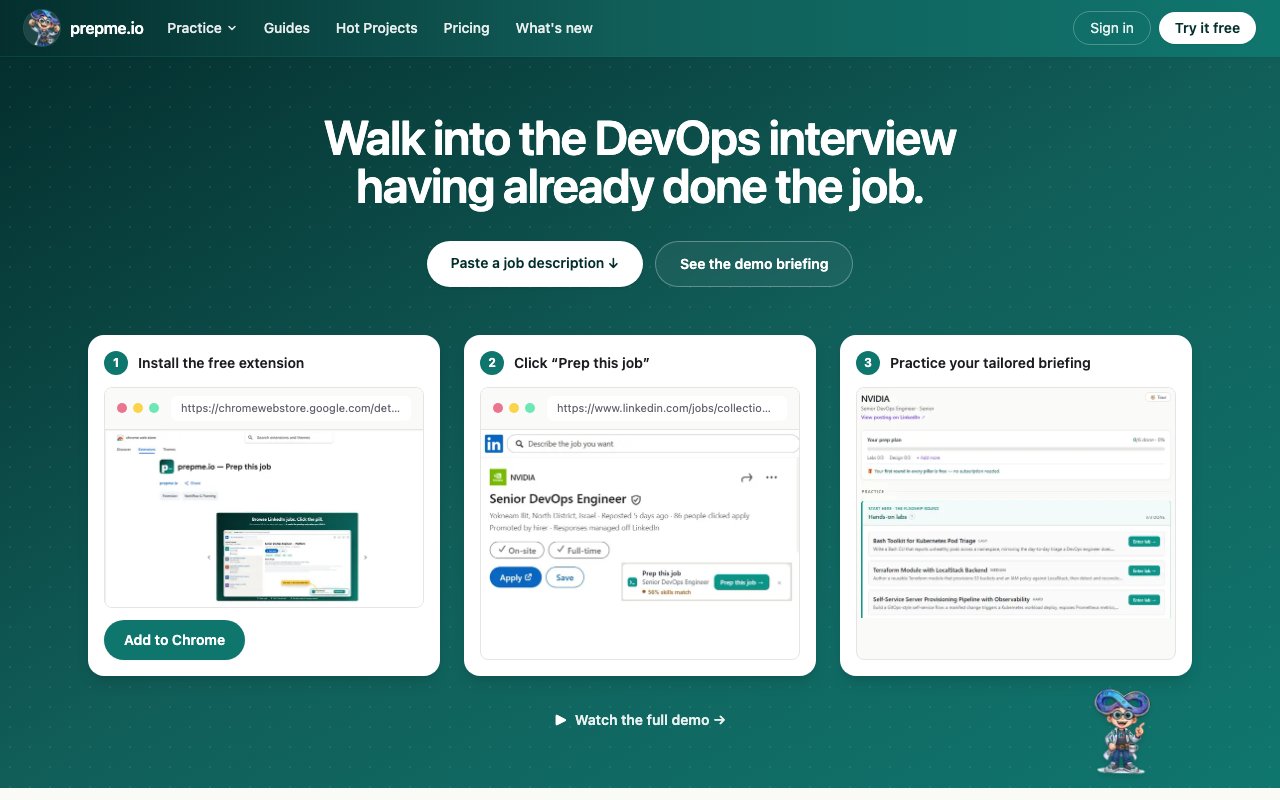
About PrepMe
PrepMe is an interview preparation platform built specifically for DevOps engineers, SREs, and platform engineers. You paste a job description and it generates a tailored briefing that simulates the actual interview experience across three distinct rounds. The idea is that generic question banks do not reflect how technical interviews actually work, so the platform builds practice material directly from the role you are applying for. If the job description mentions Kubernetes, Terraform, AWS, ArgoCD, or specific observability tools, the generated practice will focus on those technologies rather than giving you a generic infrastructure quiz. The practice you get for a GitOps role looks different from the practice you get for an AWS infrastructure role, because the job descriptions are different.
The hands-on lab round is where it stands apart from flashcard apps and question lists. You debug live Kubernetes and Terraform infrastructure in a browser container. These are real break-and-fix scenarios running on actual systems, not multiple choice questions or simulated terminals that accept any answer. When you misdiagnose a problem, the environment responds the way production would. When you fix it, the fix actually takes effect. You might find a pod stuck in CrashLoopBackOff and have to work through the logs, events, and configuration to figure out what went wrong. The lab does not tell you what to look for. You have to figure it out the way you would in an actual interview where someone hands you a broken system and watches how you approach it. Grading is specific. You might score 78 out of 100 with feedback noting that you read the logs instead of guessing, but lost points for not checking events on the failing pod or for taking too long to identify the root cause. The feedback tells you exactly where you gained and lost points, which is more useful than a pass/fail or a vague encouragement.
The architecture design round puts you in front of a whiteboard where you diagram a system and then defend it against an interviewer persona that challenges your choices. The platform scores your design against a reference solution, but the scoring is not just about matching the reference. The defense matters. When the interviewer asks why you chose a particular database or how you would handle a specific failure mode, your response affects the score. This is the round most prep tools ignore entirely, but it is a common gate at companies hiring senior infrastructure roles. Practicing under pushback is harder to simulate than memorizing diagrams, which is why most prep tools skip it. The experience is closer to what you will actually face when a senior engineer at your target company asks you to walk them through your design choices and pokes holes in your answers.
The behavioral round tailors questions to your resume. It does not ask generic situational questions like describing a time you disagreed with a coworker. It probes specific bullets on your resume that are relevant to the target role, then grades your responses on how well you framed the situation, your actions, and the outcome. If your resume says you reduced deployment time by 40%, expect to explain exactly how you measured that, what you changed, and what obstacles you ran into. The grading mimics what a senior interviewer would actually care about, not just whether you told a coherent story. This forces you to prepare concrete details for the claims on your resume, which is exactly what interviewers dig into.
Beyond the interview rounds, the platform includes company research. It pulls news, funding history, culture signals, and risk flags for the employer, with cited sources. You can see recent press coverage, whether they have had layoffs, what glassdoor sentiment looks like, and any red flags that might inform whether you actually want the role. This is free for every job you analyze, even without paying for hands-on practice. The first two briefings are free with no account required. After that, you can unlock a single briefing for seven dollars or pay twenty dollars a month for unlimited access.
Language support covers Hebrew, German, French, Spanish, Portuguese, Russian, Ukrainian, Polish, Dutch, Japanese, Korean, and Hindi. The platform detects the job market from the posting and generates prep material in the appropriate language, though the terminal environments stay in English since that is how the tooling works in practice. A Chrome extension lets you click on LinkedIn job postings and generate prep with one click, including a skill match percentage that tells you how well your background fits the role before you invest time practicing.
PrepMe fits engineers preparing for roles at companies where the interview includes live debugging or system design. If you are applying for a platform engineering role at a company that will hand you a broken cluster and ask you to fix it, this is practice that matches the format. The grading is honest and specific, which is more useful than encouragement from tools that want you to feel good rather than get better.
Key Features
- Live Kubernetes and Terraform debugging labs
- Whiteboard architecture design with interviewer pushback
- Resume-tailored behavioral interview practice
- Job description driven personalized briefings
- Detailed scoring with specific feedback
- Free company research with cited sources
Pros & Cons
What we like
- Real infrastructure labs instead of simulated environments
- Practice material generated from actual job descriptions
- Architecture round includes defending your design under challenge
- Grading is specific and honest rather than generic encouragement
Room for improvement
- Focused on DevOps and infrastructure roles only
- Terminal environments remain in English regardless of locale
- Single briefing unlock at seven dollars adds up across applications
- Newer platform with a smaller user community
Frequently Asked Questions
What is PrepMe?
Are the labs real or simulated?
Is PrepMe free?
Who is PrepMe for?
Best For
Featured in
Alternatives to PrepMe
View all
1Lookup
Real-time data verification API for phone, email, IP, and domain validation to fight fraud

Kevin Gabeci
Solo developer building web apps, cozy browser games, and AI creator toolkits.

Codedex
A gamified, story-driven platform that teaches Python, web dev, and more like an RPG quest
Hack2hire
Practice real SDE interview questions from top tech companies with expert worked solutions
Reviews (9)
Worth a look
PrepMe solves a real problem for me without making a fuss about it. What stands out is how it handles whiteboard architecture design with interviewer pushback. What stands out is how little babysitting it needs. No regrets so far.
Two months in, no regrets
Three months of PrepMe later, here is what holds up. Got real value out of live kubernetes and terraform debugging labs. It fits well for practicing terraform debugging before a live technical screen. No regrets so far.
Recommended without reservation
Found PrepMe on a Show HN thread and I am glad I clicked. Their take on real infrastructure labs instead of simulated environments is genuinely good. Hard to imagine going back to my old setup.
Pulled its weight from week one
Found PrepMe on a Show HN thread and I am glad I clicked. The architecture round includes defending your design under challenge is more useful than I expected. Glad I made the switch.
Finally something that fits
Tried PrepMe on a side project first, then rolled it out everywhere. Got real value out of free company research with cited sources. Found it works best for practicing terraform debugging before a live technical screen. It earns its place in my stack.
Recommended without reservation
Picked PrepMe for the price, stayed for the quality. What stands out is how little babysitting it needs. It just works, day after day, without surprises. It earns its place in my stack.
Finally something that fits
Tried PrepMe on a side project first, then rolled it out everywhere. What stands out is how it handles architecture round includes defending your design under challenge. Would sign up again without thinking twice.
Two months in, no regrets
Hadn't planned on switching, but PrepMe was hard to ignore. It has shaved real time off my week. It earns its place in my stack.
Finally something that fits
Have been running PrepMe for a while, here is where I land. What stands out is how little babysitting it needs. Mostly using it for rehearsing system design defense for a senior sre role. Glad I made the switch.
Badge builder
Add PrepMe to your website
Choose a badge style and size, preview it here, then copy the generated HTML. Badge images are self-contained SVGs and do not require an external script.

<a href="https://toolindex.net/tools/prepme?ref=badge" target="_blank" rel="noopener">
  <img src="https://toolindex.net/badge/prepme/medium.svg" alt="PrepMe - Listed on Tool Index" width="180" height="50" />
</a>How to use the badge
- 1. Pick the style, size, and theme that fit your layout.
- 2. Copy the generated HTML from the code block.
- 3. Paste it into your footer, homepage, or press page.
Standard badge available
The standard listing badge is available now. Score and circle badges are limited to tools currently ranked in the top 10 of a category.
Badge clicks return visitors to this profile with a referral tag so the source remains identifiable.
Related Tools
Kevin Gabeci
Solo developer building web apps, cozy browser games, and AI creator toolkits.

Coolify
Self-hostable, open source alternative to Heroku and Netlify

Warp
The modern terminal reimagined with AI and collaboration

Bolt.new
Prompt-to-deployed full-stack app inside the browser
Work on PrepMe? Request listing access or correction