
Re:Likes
Open source library for attaching granular like and dislike reactions to specific text passages
Gallery
About Re:Likes
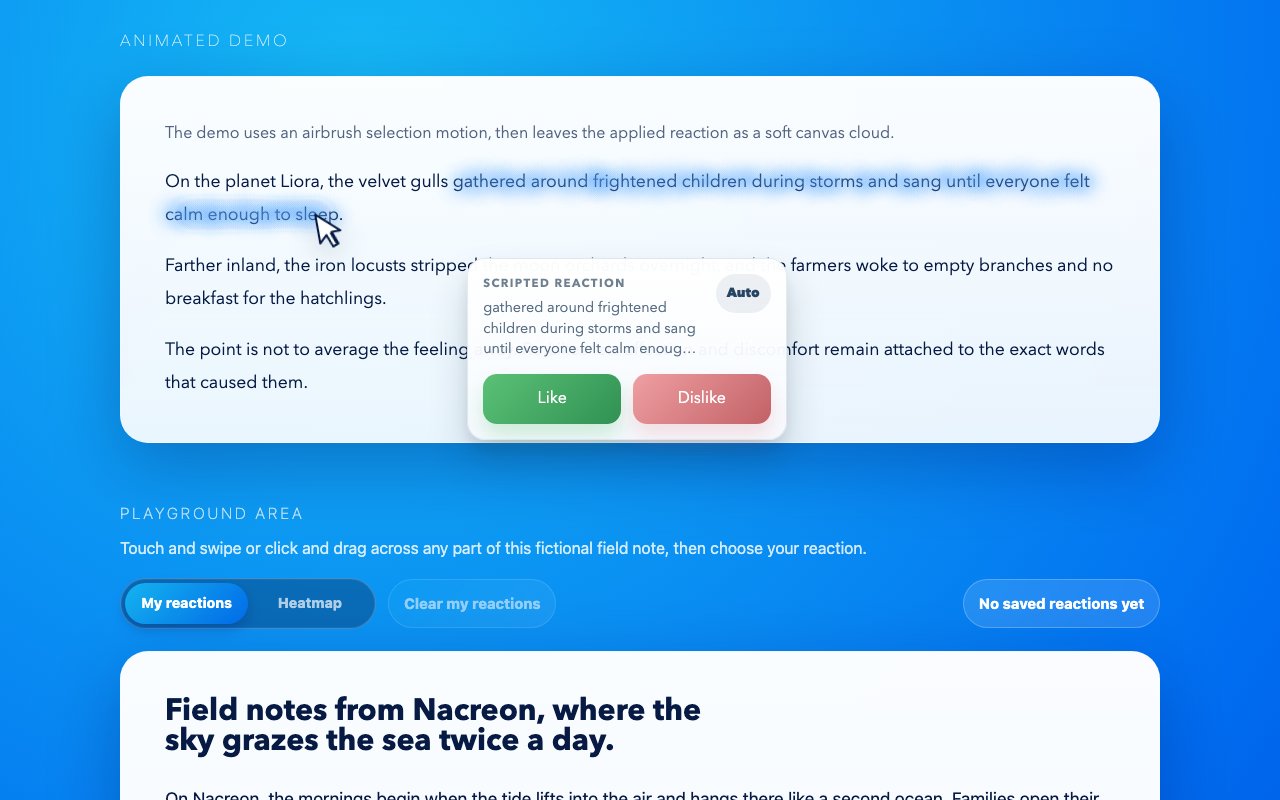
Re:Likes lets readers attach reactions to specific passages of text rather than rating entire pages with a single thumbs up or down. The conventional like button at the bottom of an article loses all the nuance of which parts resonated and which fell flat, collapsing hundreds or thousands of words into one binary signal. Re:Likes changes that by letting readers drag across sentences to highlight them, then choose a like or dislike reaction from a popup that appears at their selection. These reactions persist as soft visual clouds on the text, visible when you return later and integrated into the reading experience rather than hidden in a comment section nobody checks. You can revise them as your opinion develops, partially erase them by right-clicking specific sections, or see how your reactions compare against an anonymous aggregate from other readers who marked the same passages.
The technical foundation relies on a library called Clean Selection that handles the tactile text selection mechanics across browsers and devices. When integrated into a page, Re:Likes tracks reactions in local storage so they survive between visits without requiring accounts or logins. The visual presentation is configurable through a JavaScript API that exposes parameters for selection colors, reaction opacity, cloud radius, padding, and scaling options for how aggregate data displays. Publishers who want to collect aggregate data can configure backend synchronization to send anonymous reaction data to their servers while respecting user privacy, but the library functions perfectly in local-only mode where reactions stay on individual devices. The system supports both individual reader views showing your personal reactions and heatmap displays that layer how groups responded to the same content.
Reading experiences benefit from this granularity in several concrete ways. Authors and editors get specific feedback about which paragraphs work rather than trying to infer reactions from overall engagement metrics that don't distinguish between a piece that was excellent throughout and one that had one viral paragraph readers shared despite the rest being forgettable. Readers can express more than a binary opinion about an entire piece, marking some sections as insightful while flagging others as confusing, unconvincing, or wrong within the same article. The aggregate heatmap view creates a new way to approach contentious or complex material by seeing where other readers agreed or disagreed most strongly, turning reading into a conversation even without explicit comments.
The library works with articles, comments, long-form essays, and extended reading experiences where passage-level reactions add meaningful signal that page-level metrics can't capture. Publishers hosting opinion pieces, educational content, documentation, or argumentative writing can embed it to gather richer feedback than analytics showing time on page or scroll depth provide. Community platforms where readers debate and discuss can surface agreement and disagreement patterns at the specific claims being made rather than whole posts that might contain multiple distinct arguments. The erasable, revisable nature of reactions means readers can change their minds as they read further or think more, reflecting how opinions actually form during reading rather than requiring a final verdict at the end.
Integration requires adding the Clean Selection dependency along with Re:Likes itself, then configuring geometry and appearance through the provided API to match your site's design language. Backend integration for aggregate data collection is optional and well-documented, with the library functional in local-only mode where reactions stay on individual devices and nothing gets transmitted. The heatmap scaling options let publishers tune how aggregate data displays, from subtle shading that suggests patterns to prominent highlighting that makes controversial passages immediately visible. Whether you want readers to see each other's reactions in real time, show them only their own, or toggle between views is a configuration choice that different use cases will answer differently.
The core idea driving Re:Likes is that emotional precision matters in reading feedback and shouldn't be averaged away for convenience. Collapsing a reader's feelings about an entire piece into a single number throws away useful information that could improve writing, surface the actually valuable sections, and create richer engagement between readers and content. By anchoring reactions to exact text positions, Re:Likes preserves where enthusiasm peaked, where skepticism set in, where arguments convinced, and where they failed. This makes it genuinely useful for both readers wanting to engage more actively with content than passive scrolling allows and publishers trying to understand what actually works in their writing beyond basic traffic numbers that can't tell you why readers stayed or left.
Key Features
- Passage level like and dislike reactions
- Persistent overlay visualization on text
- Aggregate heatmap across readers
- Touch and pointer input support
- Local storage with optional backend sync
- Configurable rendering and cursor styles
Pros & Cons
What we like
- Captures granular sentiment traditional likes miss
- Open source and free to use
- Works on both mobile and desktop
- Backend agnostic, integrate with any stack
Room for improvement
- Requires developer integration, no hosted version
- Value depends on reader willingness to engage
- Overlay visuals may clutter dense text
- Smaller community than mainstream reaction libraries
Frequently Asked Questions
What is Re:Likes?
Is Re:Likes free?
How do reactions appear on the page?
Can anonymous users leave reactions?
Best For
Featured in
Alternatives to Re:Likes

1Lookup
Real-time data verification API for phone, email, IP, and domain validation to fight fraud

Kevin Gabeci
Solo developer building web apps, cozy browser games, and AI creator toolkits.

Codedex
A gamified, story-driven platform that teaches Python, web dev, and more like an RPG quest
Hack2hire
Practice real SDE interview questions from top tech companies with expert worked solutions
Reviews (7)
Decent with some rough edges
Re:Likes solves a real problem for me without making a fuss about it. Got real value out of captures granular sentiment traditional likes miss. The interface stays out of my way, which I appreciate. It would be a five if not for smaller community than mainstream reaction libraries. Worth it for what I get out of it.
Genuinely impressed
Three months of Re:Likes later, here is what holds up. The works on both mobile and desktop is more useful than I expected. Performance has been steady even when I lean on it hard. Worth it for what I get out of it.
Genuinely impressed
Three months of Re:Likes later, here is what holds up. Support actually answered when I had a question, which surprised me. Performance has been steady even when I lean on it hard. Worth it for what I get out of it.
It just works
Started using Re:Likes casually, now it is pinned in my dock. Support actually answered when I had a question, which surprised me. It fits well for testing article drafts before wider publication. No regrets so far.
Two months in, no regrets
Came to Re:Likes after getting frustrated with what I had before. Got real value out of open source and free to use. Mostly using it for researching reading patterns in long form content. It earns its place in my stack.
Pulled its weight from week one
Came to Re:Likes after getting frustrated with what I had before. The backend agnostic, integrate with any stack is more useful than I expected. The defaults are sensible, so I was not fighting settings on day one. Would sign up again without thinking twice.
Solid daily driver
Found Re:Likes on a Show HN thread and I am glad I clicked. Their take on touch and pointer input support is genuinely good. Support actually answered when I had a question, which surprised me. Found it works best for testing article drafts before wider publication. Hard to imagine going back to my old setup.
Badge builder
Add Re:Likes to your website
Choose a badge style and size, preview it here, then copy the generated HTML. Badge images are self-contained SVGs and do not require an external script.

<a href="https://toolindex.net/tools/re-likes?ref=badge" target="_blank" rel="noopener">
  <img src="https://toolindex.net/badge/re-likes/medium.svg" alt="Re:Likes - Listed on Tool Index" width="180" height="50" />
</a>How to use the badge
- 1. Pick the style, size, and theme that fit your layout.
- 2. Copy the generated HTML from the code block.
- 3. Paste it into your footer, homepage, or press page.
Standard badge available
The standard listing badge is available now. Score and circle badges are limited to tools currently ranked in the top 10 of a category.
Badge clicks return visitors to this profile with a referral tag so the source remains identifiable.
Related Tools
Kevin Gabeci
Solo developer building web apps, cozy browser games, and AI creator toolkits.

Coolify
Self-hostable, open source alternative to Heroku and Netlify

Warp
The modern terminal reimagined with AI and collaboration

Bolt.new
Prompt-to-deployed full-stack app inside the browser
Work on Re:Likes? Request listing access or correction