
Recoverflow
Recovers failed Stripe subscription payments with decline-aware retries and branded dunning emails
Gallery
About Recoverflow
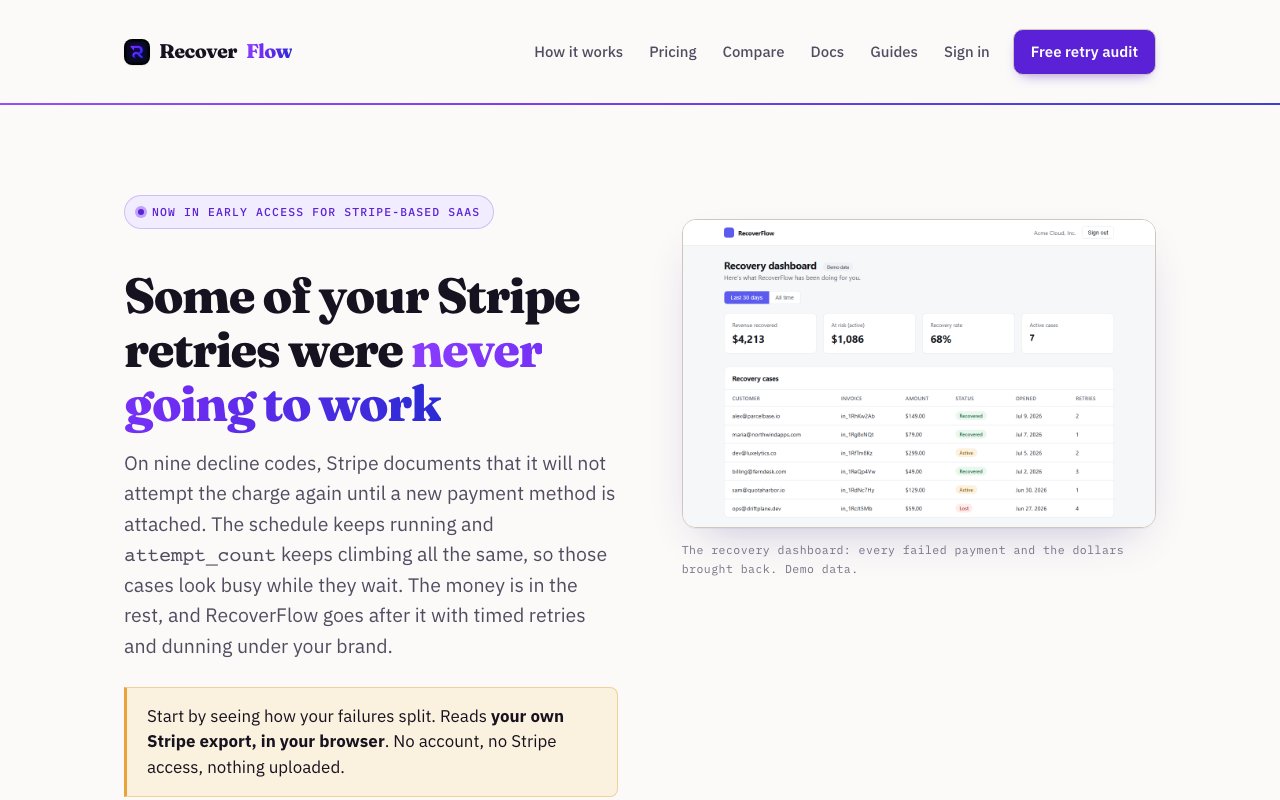
Recoverflow is a Stripe add-on that recovers failed subscription payments, the quiet revenue leak usually filed under involuntary churn. When a renewal charge fails, most of the time the customer didn't decide to leave. Their card expired, their balance was short on the wrong day, or the bank hiccupped. Recoverflow connects to your Stripe account, watches for those failures, and works each one with retries and card-update emails until the money is recovered or genuinely unrecoverable.
The core idea is that decline codes mean different things and deserve different treatment. Recoverflow classifies every decline as hard, soft, or unknown before doing anything. Hard declines, like stolen or lost cards, closed accounts, and revoked authorizations, are never retried, because retrying them wastes attempts and can look like abuse to the card networks. Instead the customer gets asked for a new card. Soft declines go into intelligent retry schedules tuned to why the payment failed. Insufficient funds gets retried around common paydays, the 1st, the 15th, and month-end, rather than pointlessly a few hours later. Processing errors get a short backoff and then spaced attempts. Attempts are spaced and capped throughout to stay on the right side of network rules and avoid disputes.
Retries only recover payments where the money eventually shows up, so the other half of the product is dunning. Recoverflow sends branded, sequenced emails under your own name prompting the customer to update their card, following the pattern of a day 0, day 3, and day 7 sequence rather than a single ignorable message. The site is explicit that this is the gap in Stripe's built-in tooling, which retries and emails but doesn't classify each decline reason and react differently, or run branded sequences tuned to why a payment failed.
The billing model is where the product shows its posture. Recoverflow charges 25% of recovered revenue, but only for recoveries it can attribute to a specific action it took, either a scheduled retry or a card-update email. Payments that come back on their own through Stripe's native retries or a refreshed customer balance aren't billed. If a recovered payment is later reversed, the fee is credited back. There's a minimum of $29 a month, waived for the first 30 days, and a hard cap at $299 a month no matter how much is recovered.
Getting started is deliberately low commitment. You connect through Stripe OAuth with three permissions, reading customers, reading invoices, and paying unpaid invoices, and you can revoke access anytime from your own Stripe dashboard. Before you commit to anything, a free 90-day backtest scans your historical failed payments and shows what could have been recovered. There's also a free retry waste calculator on the site that analyzes a Stripe CSV export entirely in your browser, with no upload, no server, and no account, to show how much of your failed revenue sits on decline codes that retrying can never fix.
That calculator is worth a detour even if you never sign up, because it encodes the product's whole thesis. It splits your failed charges into three buckets, the 9 decline codes Stripe blocks from retrying entirely, the 4 that need a new card before any retry can work, and the genuinely retryable remainder. It also surfaces how many days customers sat in a failed state and flags exposure to Visa's reattempt budget, the limit of 10 attempts per card within 30 days that naive retry loops burn through. Since the arithmetic runs in your own browser using the file reader, you can watch the network tab and confirm nothing leaves your machine, which is a small but telling piece of trust-building from a product that will later ask for payment permissions.
The product is aimed squarely at indie SaaS founders running subscriptions on Stripe. That focus shows in the sizing of the pricing bands, the no-contract terms, and the tone of the docs and guides, which read like a founder explaining decline codes to another founder rather than an enterprise sales pitch. Larger dunning platforms exist, but they tend to price and integrate for teams, not for a single person watching their MRR.
Access is trial-then-pay. The first 30 days are free with no card required to start, the backtest costs nothing, and after that the 25% success fee applies with the $29 floor and $299 ceiling. Since the fee only triggers on recoveries the product itself caused, the worst realistic case is the monthly minimum, which keeps the downside easy to reason about for a small SaaS.
Key Features
- Decline code classification before any retry
- Payday-aware retry scheduling
- Branded dunning email sequences
- Attribution-based success pricing
- Free 90-day historical backtest
- Stripe OAuth with revocable access
Pros & Cons
What we like
- Only bills for recoveries it actually caused
- Fee capped at $299 a month
- Hard declines are never wastefully retried
- Free backtest shows the value before you pay
Room for improvement
- Stripe only, no other payment processors
- 25% success fee is meaningful on large recoveries
- Needs permission to pay unpaid invoices on your account
- Younger product from a solo founder
Frequently Asked Questions
What is Recoverflow?
How much does Recoverflow cost?
How is Recoverflow different from Stripe's Smart Retries?
What access does Recoverflow need to my Stripe account?
Best For
Featured in
Alternatives to Recoverflow



Reviews (0)
Badge builder
Add Recoverflow to your website
Choose a badge style and size, preview it here, then copy the generated HTML. Badge images are self-contained SVGs and do not require an external script.

<a href="https://toolindex.net/tools/recoverflow?ref=badge" target="_blank" rel="noopener">
  <img src="https://toolindex.net/badge/recoverflow/medium.svg" alt="Recoverflow - Listed on Tool Index" width="180" height="50" />
</a>How to use the badge
- 1. Pick the style, size, and theme that fit your layout.
- 2. Copy the generated HTML from the code block.
- 3. Paste it into your footer, homepage, or press page.
Standard badge available
The standard listing badge is available now. Score and circle badges are limited to tools currently ranked in the top 10 of a category.
Badge clicks return visitors to this profile with a referral tag so the source remains identifiable.
Related Tools

Simple RMD
Calculate, aggregate, and manage your annual IRA required minimum distributions.
FreshBooks
Cloud accounting designed for service-based small businesses and freelancers
Deel
Global payroll, contractor, and EOR platform
Chargebee
Subscription billing and revenue management for B2B SaaS
Work on Recoverflow? Request listing access or correction