
RMCP
Searchable registry of over 5,000 remote MCP servers for AI agents
Gallery
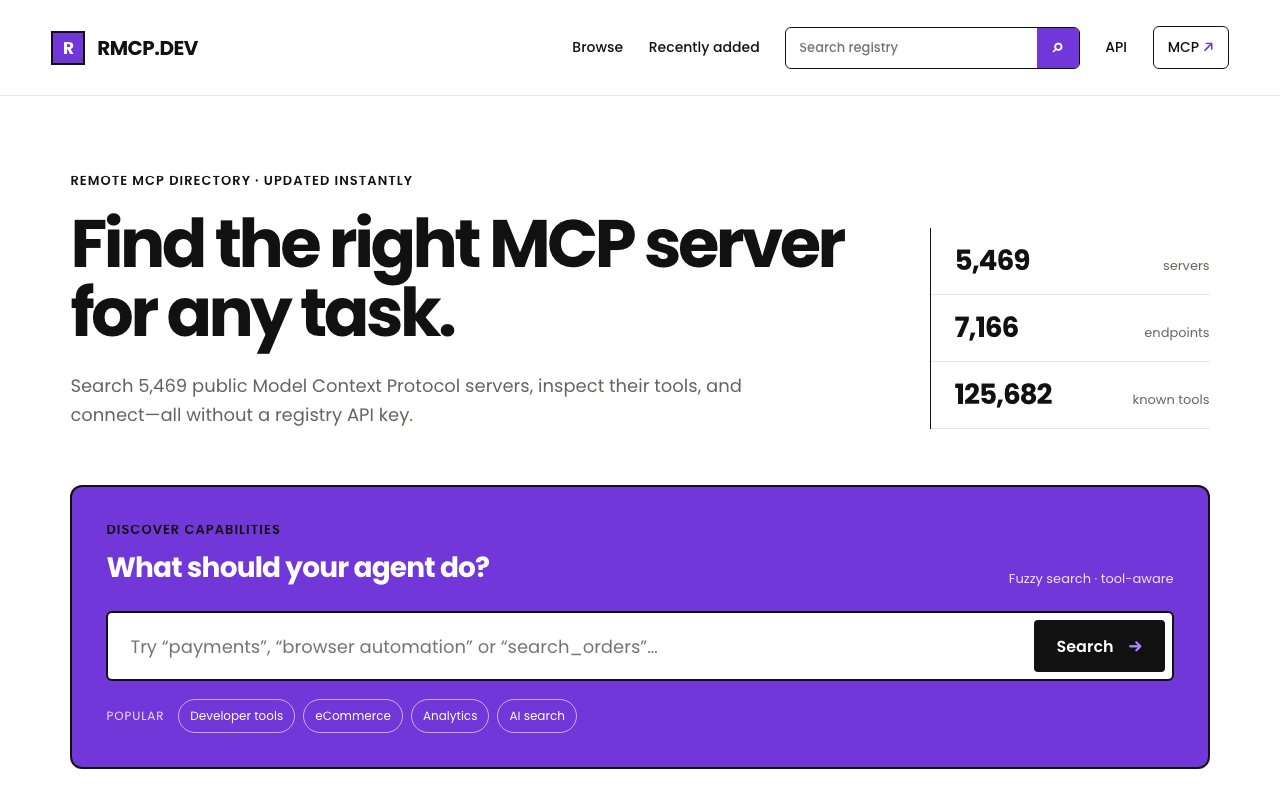
About RMCP
RMCP is a public registry that indexes remote MCP servers, giving developers a single place to discover and search more than 5,400 servers built on the Model Context Protocol. If you are building AI agents or assistants that need to connect to external tools, databases, or services through MCP, this directory surfaces what is available so you can wire up the right server without hunting through GitHub repos or random blog posts. The registry focuses specifically on remote servers, meaning the ones you can actually connect to over the network, which is the practical need for most production agent deployments rather than local reference implementations or demo code. For teams building multi-agent systems or deploying autonomous workflows, having a centralized discovery layer eliminates one of the more tedious parts of the integration process.
The problem it addresses is visibility in a fragmented ecosystem. MCP has become a popular way to give large language models access to external capabilities, but server discovery remains a pain point. Someone publishes a server that wraps a particular API or data source, and unless you already know it exists, you will never find it. The official MCP registry launched by the Model Context Protocol project itself uses namespace authentication and reverse DNS formatting for verification, but RMCP offers an alternative index that emphasizes volume and searchability over formal verification. Whether you need a server that wraps a weather API, a database connector, a code execution sandbox, an integration with a specific SaaS tool, or a custom capability someone built for their own agent and decided to share, RMCP collects those servers into a searchable index so the discovery step takes seconds instead of hours. That speed matters when you are iterating on an agent and want to test different integrations quickly.
Under the hood, the registry exposes two access paths. One is a web interface at the main domain where you can browse and search manually, exploring what exists across different categories and use cases. The other is a dedicated API endpoint at /api/search, which means you can query the registry programmatically from your own tooling, CI pipelines, or even from an agent itself. That dual interface makes it useful both for quick lookups while you are building and for automated workflows that need to resolve server references on the fly. The API design appears straightforward, accepting search queries and returning matching server entries with their metadata. If you are building an agent that can discover and connect to new tools at runtime, this API becomes a key piece of infrastructure rather than just a convenience.
It fits developers working with Claude, GPT, or any model that supports MCP. The Model Context Protocol specification lives at modelcontextprotocol.io, and the ecosystem continues to grow as more teams build agents that need tool access beyond what the base model provides. If you are standing up an agent that needs to call external services and you want to skip the boilerplate of writing your own server for common integrations, this is where you look first. The registry is especially handy when you are prototyping and want to see what is already out there before committing to build something custom. For teams that maintain multiple agents across different domains, having a single discovery layer also helps standardize how integrations are found and evaluated, ensuring consistency across projects.
Where it stands apart is the scale of the index and the focus on remote, network-accessible servers. Many MCP resources are local or reference implementations designed for learning rather than production use. RMCP concentrates on servers you can actually connect to, which makes it more practical for deployment scenarios where network connectivity matters. The registry does not appear to curate or verify the quality of each server, so you will still need to evaluate whether a given integration meets your reliability and security requirements. That said, having a centralized place to start the search beats the alternative of scattered GitHub searches and forum threads. You can narrow down candidates quickly and then do your own due diligence on the ones that look promising.
Access appears to be free. There is no visible paywall, and both the web search and the API are publicly available without requiring an account. Whether the project adds paid tiers later for priority indexing, analytics, or private server listings remains to be seen, but for now it is a community resource you can use without signing up or paying. The registry complements the official Model Context Protocol registry rather than replacing it, offering a different approach to server discovery that prioritizes breadth and ease of access over namespace verification. For developers who want to move fast and explore what exists in the MCP ecosystem, RMCP provides a useful starting point that saves time and surfaces options you would not have found otherwise.
Key Features
- Index of over 5,400 remote MCP servers
- Full-text search across server metadata
- Public API endpoint for programmatic queries
- Web interface for manual browsing
- Focus on network-accessible servers only
- No signup required to search
Pros & Cons
What we like
- Largest known public index of MCP servers in one place
- API access makes it embeddable in your own tooling
- Free to use with no account required
- Saves hours of manual discovery when building agents
Room for improvement
- Limited metadata shown for each server
- No quality ratings or community reviews yet
- Documentation on the registry itself is minimal
- Relies on external servers you do not control
Frequently Asked Questions
What is RMCP?
Is RMCP free to use?
Who is RMCP for?
Can I query the registry from my own code?
Best For
Featured in
Alternatives to RMCP
View all
1Lookup
Real-time data verification API for phone, email, IP, and domain validation to fight fraud

Kevin Gabeci
Solo developer building web apps, cozy browser games, and AI creator toolkits.

Codedex
A gamified, story-driven platform that teaches Python, web dev, and more like an RPG quest
Hack2hire
Practice real SDE interview questions from top tech companies with expert worked solutions
Reviews (0)
Badge builder
Add RMCP to your website
Choose a badge style and size, preview it here, then copy the generated HTML. Badge images are self-contained SVGs and do not require an external script.

<a href="https://toolindex.net/tools/rmcp?ref=badge" target="_blank" rel="noopener">
  <img src="https://toolindex.net/badge/rmcp/medium.svg" alt="RMCP - Listed on Tool Index" width="180" height="50" />
</a>How to use the badge
- 1. Pick the style, size, and theme that fit your layout.
- 2. Copy the generated HTML from the code block.
- 3. Paste it into your footer, homepage, or press page.
Standard badge available
The standard listing badge is available now. Score and circle badges are limited to tools currently ranked in the top 10 of a category.
Badge clicks return visitors to this profile with a referral tag so the source remains identifiable.
Related Tools
Kevin Gabeci
Solo developer building web apps, cozy browser games, and AI creator toolkits.

Warp
The modern terminal reimagined with AI and collaboration

Bolt.new
Prompt-to-deployed full-stack app inside the browser

Supabase
The open source Firebase alternative
Work on RMCP? Request listing access or correction