
SecondHandTokens
Marketplace to buy AI inference at half of retail or sell your unused credits
Gallery
About SecondHandTokens
SecondHandTokens is a marketplace for buying AI model inference at roughly half of retail price. The idea is simple. Developers routinely buy more API credits than they end up using, and those leftovers usually just sit there unspent. SecondHandTokens lets sellers list that unused balance and lets buyers draw on it, so you can run models like Claude, GPT-4o, Gemini, Llama, and DeepSeek for about 50 percent of what you'd normally pay per token. The framing on the site is the same models at half the cost, with sellers recovering value and buyers saving money on the exact same request. The bet is that unused inference is a real and recurring surplus, since teams frequently pre-purchase credits or land on plans with more capacity than they actually burn through.
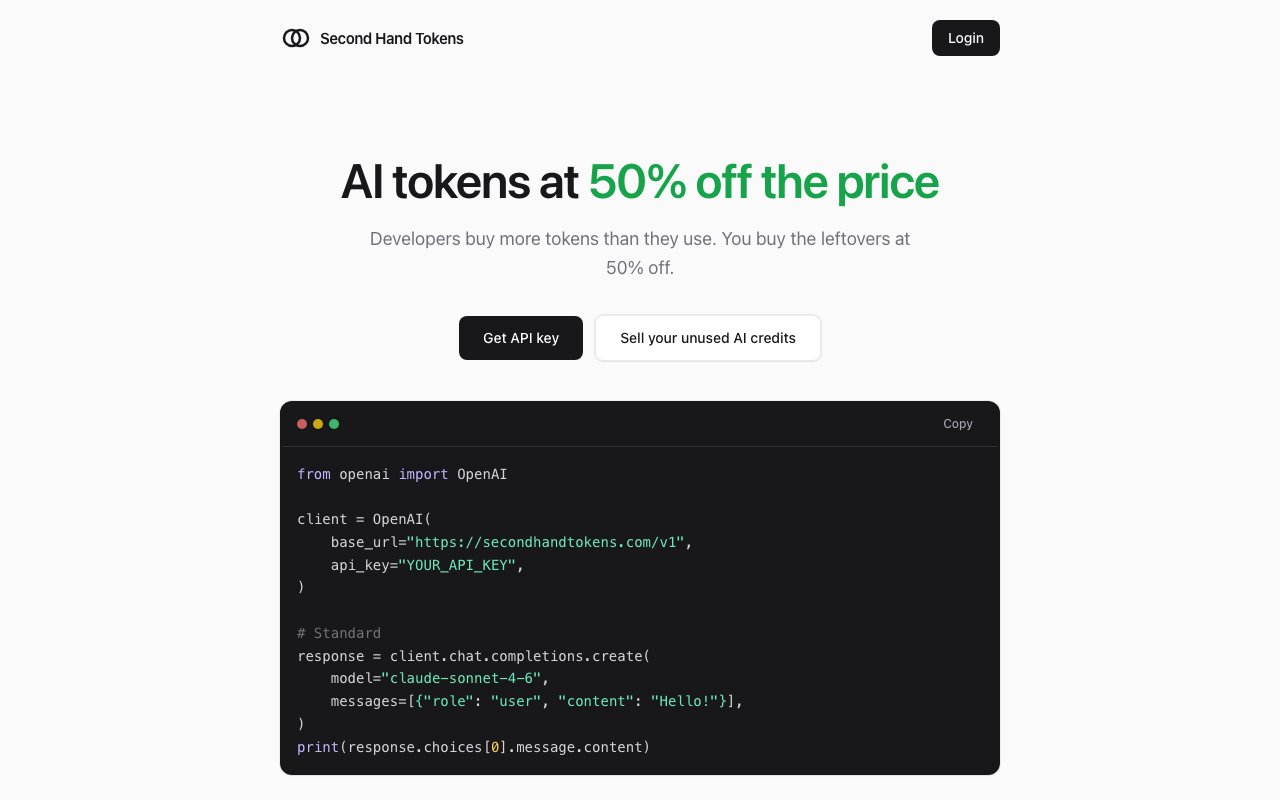
For a buyer it behaves like any other inference API. You pick a model, see live second-hand pricing for input and output per million tokens, and pay with Stripe to fund a balance. You get an API key and call an endpoint that's drop-in compatible with the standard OpenAI SDK, so wiring it into existing code is mostly a matter of swapping the base URL and the key. Behind the scenes your requests are routed through pre-funded seller accounts and billed at 50 percent of retail, with the balance updating after each call. Common parameters carry over too, since the platform forwards standard options through to the underlying model. That compatibility is the point, because it means you can test the marketplace against an existing codebase by changing a couple of configuration values rather than adopting a new client library.
The routing is what makes the economics work, and it's worth understanding before you commit. You're not being handed another developer's raw provider key to use directly. Instead the platform proxies your calls through seller accounts on its own servers, which means buyers never see a seller's account details and sellers never see who is buying. The tradeoff is that your requests pass through a third party rather than going straight to the model provider, so it suits workloads where cost matters more than a direct provider relationship. For batch jobs and non-sensitive work that framing is easy to accept, and for regulated or highly confidential data it's worth thinking twice. The upside of the proxy design is that neither side has to trust the other with account access, and the downside is simply that a middle layer now sits between your app and the model.
Selling is the other half of the marketplace. If you're sitting on credits you know you won't use, you tell the platform how much balance you have and on which platform, it verifies the balance, and it lists the credits for sale. When they're bought you recover 50 percent of their retail value, which is money you'd otherwise have written off entirely. The whole thing runs on a Google login for accounts and Stripe for payments, so both sides of the trade use familiar rails rather than anything exotic, and the seller side is framed as turning stranded balances back into cash.
Who it's for is developers running real inference workloads who care mostly about the bill, along with anyone holding unused API credits they'd rather turn back into money. If your app is already built against an OpenAI-compatible client, the buyer side is meant to be a near drop-in that quietly cuts your token spend without a rewrite. On the seller side it's aimed at teams and individuals who front-loaded credits, changed plans, or simply overestimated their usage and are left with a balance they can't easily use up before it becomes wasted spend. For a buyer the appeal is a lower bill on work they were going to run anyway, and for a seller it's recovering money that would otherwise evaporate, which is what a functioning market on both sides looks like.
Where it's different is the premise itself, since it's a genuine secondary market for inference rather than a discount plan from a single provider. That also shapes its limits, and the honest version matters here. Availability depends on what sellers have actually listed, so model choice and how much cheap capacity exists will vary over time. Reselling API access sits in a gray area against some providers' terms of service. And because everything is proxied, you're trusting the platform with your prompts and depending on its uptime rather than the provider's. It's an early product, so liquidity and reliability are still being proven.
Access is pay-as-you-go. There's no subscription to buy into. You fund a balance and you're billed per token at half of retail, so what you spend tracks what you actually use rather than a flat monthly fee. That makes it low-commitment to try against a non-critical workload, running a batch job or a side project through it first, before you decide whether to route anything important or high-volume through a marketplace instead of straight to the provider. Starting small also lets you check the latency and reliability of the proxy path for yourself, which is the sensible way to adopt any inference layer that sits in front of the providers.
Key Features
- OpenAI-SDK-compatible inference endpoint
- Inference at 50% of retail price
- Live second-hand token pricing
- Requests proxied through seller accounts
- Marketplace to sell unused credits
- Stripe payments and Google login
Pros & Cons
What we like
- Cuts token costs to roughly half of retail
- Drop-in compatible with the OpenAI SDK
- Turns unused credits back into cash for sellers
- Pay-as-you-go with no subscription
Room for improvement
- Requests are proxied through a third party
- Model choice depends on seller availability
- Reselling API access sits in a provider gray area
- Early product with a limited track record
Frequently Asked Questions
What is SecondHandTokens?
How much cheaper is it?
Which models can I use?
How does the resale model work?
Best For
Featured in
Alternatives to SecondHandTokens

1Lookup
Real-time data verification API for phone, email, IP, and domain validation to fight fraud

Codedex
A gamified, story-driven platform that teaches Python, web dev, and more like an RPG quest
Hack2hire
Practice real SDE interview questions from top tech companies with expert worked solutions
Cloudflare Pages
Free Jamstack hosting on Cloudflares edge with unlimited bandwidth and tight integration with Workers.
Reviews (11)
Finally something that fits
Three months of SecondHandTokens later, here is what holds up. The output quality holds up better than I expected. Performance has been steady even when I lean on it hard. Worth it for what I get out of it.
Finally something that fits
Have been running SecondHandTokens for a while, here is where I land. Where it really wins is inference at 50% of retail price. Easy yes for anyone weighing the same trade offs.
Recommended without reservation
SecondHandTokens solves a real problem for me without making a fuss about it. The inference at 50% of retail price is more useful than I expected. The core workflow is smooth once you are set up. Mostly using it for testing models cheaply before committing.
Worth a look
Started using SecondHandTokens casually, now it is pinned in my dock. What stands out is how it handles requests proxied through seller accounts. Found it works best for recovering value from unused api credits. Recommending it to people in a similar spot.
Solid daily driver
Three months of SecondHandTokens later, here is what holds up. The thing I keep coming back to is how reliable it is. It earns its place in my stack.
Worth a look
Started using SecondHandTokens casually, now it is pinned in my dock. Got real value out of openai-sdk-compatible inference endpoint. No regrets so far.
Pulled its weight from week one
SecondHandTokens has quietly become part of my daily flow. Support actually answered when I had a question, which surprised me. The defaults are sensible, so I was not fighting settings on day one. It earns its place in my stack.
Exactly what I needed
SecondHandTokens has quietly become part of my daily flow. The interface stays out of my way, which I appreciate. It just works, day after day, without surprises. Would sign up again without thinking twice.
It just works
Started using SecondHandTokens casually, now it is pinned in my dock. The turns unused credits back into cash for sellers is more useful than I expected. It handles the boring parts so I can focus on the work that matters. It fits well for running batch jobs at half the token price. Worth it for what I get out of it.
Quietly excellent
Picked SecondHandTokens for the price, stayed for the quality. What stands out is how it handles live second-hand token pricing. The core workflow is smooth once you are set up. Found it works best for running batch jobs at half the token price. Recommending it to people in a similar spot.
Pulled its weight from week one
Came to SecondHandTokens after getting frustrated with what I had before. What stands out is how little babysitting it needs. Worth it for what I get out of it.
Badge builder
Add SecondHandTokens to your website
Choose a badge style and size, preview it here, then copy the generated HTML. Badge images are self-contained SVGs and do not require an external script.

<a href="https://toolindex.net/tools/secondhandtokens?ref=badge" target="_blank" rel="noopener">
  <img src="https://toolindex.net/badge/secondhandtokens/medium.svg" alt="SecondHandTokens - Listed on Tool Index" width="180" height="50" />
</a>How to use the badge
- 1. Pick the style, size, and theme that fit your layout.
- 2. Copy the generated HTML from the code block.
- 3. Paste it into your footer, homepage, or press page.
Standard badge available
The standard listing badge is available now. Score and circle badges are limited to tools currently ranked in the top 10 of a category.
Badge clicks return visitors to this profile with a referral tag so the source remains identifiable.
Related Tools

Kevin Gabeci
Solo developer building web apps, cozy browser games, and AI creator toolkits.

Coolify
Self-hostable, open source alternative to Heroku and Netlify

Warp
The modern terminal reimagined with AI and collaboration

Bolt.new
Prompt-to-deployed full-stack app inside the browser
Work on SecondHandTokens? Request listing access or correction