Sengi
Source and verify candidates for hard-to-fill roles inside an AI assistant
Gallery
About Sengi
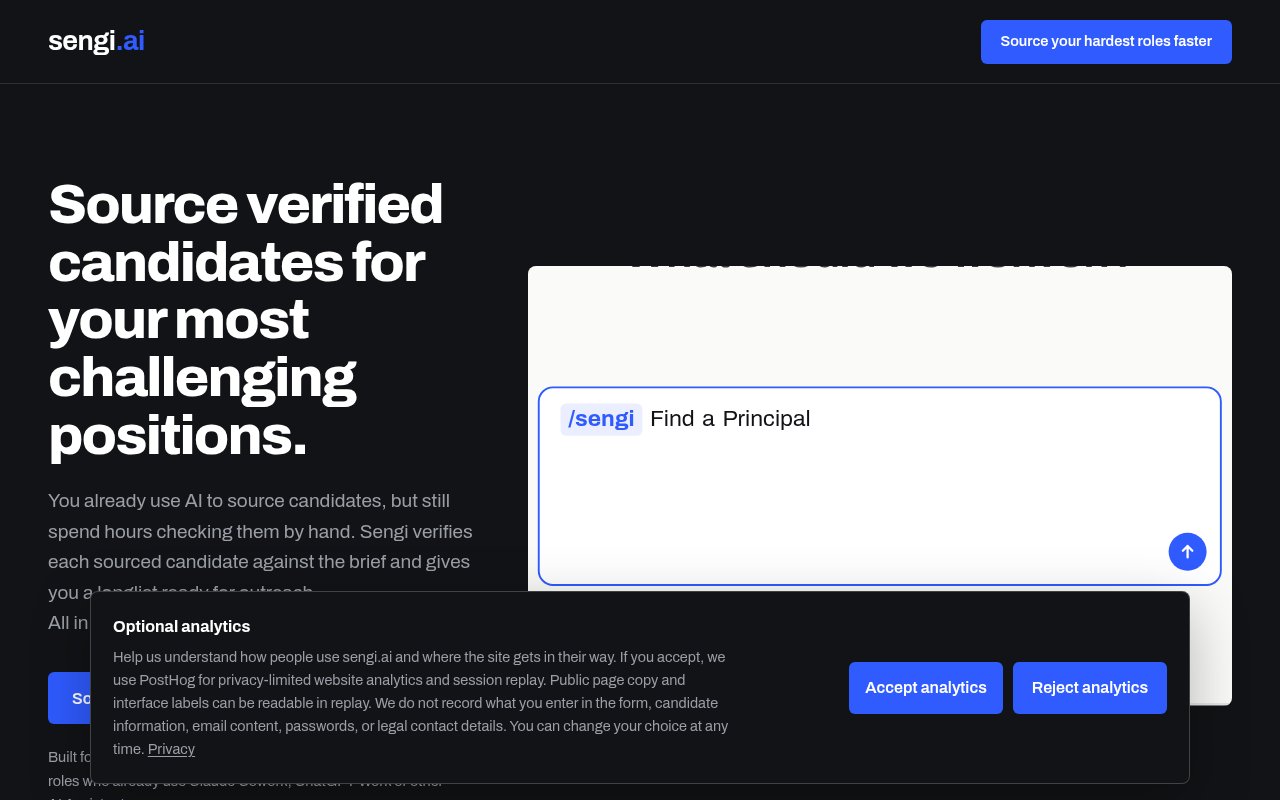
Sengi is a candidate sourcing service for executive search teams handling roles with several firm requirements. It works through a compatible AI assistant such as Claude or ChatGPT, then turns a plain-language brief into a researched and ranked longlist. The central promise is narrower than general recruiting automation. Sengi is built to find people for difficult searches and show evidence for why each person does or doesn't satisfy the role, so a recruiter can spend less time opening profiles and checking claims by hand.
The workflow begins with the role brief in whatever form the recruiter already has. Sengi extracts locations, skills, seniority, industry experience, and other must-haves, and it can calibrate vague requirements before searching. It then looks across public professional sources, including LinkedIn, GitHub, company sites, talks, and the wider web. When an obvious search produces too few credible people, the service explores adjacent roles and fields for additional search angles. That matters for specialist hiring, where relevant experience may be described with different titles or demonstrated somewhere other than a conventional profile.
Verification is the core of the output. Candidates are assessed against each required and optional criterion from the brief, with a fit, might fit, or do not fit verdict. The longlist puts the evidence next to the verdict, so a recruiter can see whether a claimed match comes from a company biography, patent record, technical talk, research paper, public register, or another professional source. A weak or missing signal remains visible instead of being rounded up into an optimistic score. Sengi positions this as decision support, not a hiring decision. The customer still reviews the sources, chooses whom to contact, and owns every recruiting judgment.
The product is aimed at executive search firms, specialist recruiters, and lean sourcing teams that already use an AI assistant but don't trust a quick candidate search on its own. It is particularly relevant when a brief combines technical experience, a specific market, seniority, location, and publicly verifiable work. Straightforward high-volume hiring is not the main use case. Sengi's value appears when the difference between a plausible profile and a qualified prospect depends on careful evidence collection across several sources. Workspaces hold positions, candidate records, longlists, members, and credits, which makes the service suitable for a team rather than only a solo prompt.
Sengi also takes a relatively explicit posture toward candidate data. Its published notice says professional information comes from the recruiting customer and public sources, and isn't reused for advertising, a general talent pool, or training Sengi-owned models. An uncontacted candidate's active record is automatically deleted after 25 days, while a rendered longlist or share link may remain for up to 30 days. The service says it doesn't ask customers for sensitive personal information or private communications, and it doesn't make a solely automated final employment decision. Those rules don't remove the customer's own privacy and employment obligations, but they make the product's intended boundary easier to evaluate.
The team boundary is just as deliberate. Positions, candidate records, ranked longlists, payments, and credits belong to a workspace, and an owner or administrator can manage member access. Before commercial candidate processing, Sengi requires a verified business customer and a separate data processing agreement. Searches are meant to use professional information for a documented recruiting instruction, not to build a reusable general database. That adds process before a team can start paid work, yet it also makes clear that this is a business research system with accountable human review rather than an autonomous outreach bot.
Access is business focused and usage based. Sengi connects to an AI assistant through MCP, and commercial use runs inside a workspace. The published catalog sells one-time credit packs rather than a recurring subscription. Packs start at 10,000 credits for EUR 100, with 50,000 credits for EUR 500 and 100,000 credits for EUR 1,000. Paid credits don't expire, and Sengi shows the credit charge before a paid search or enrichment action. A qualified trial includes 750 promotional credits for 14 days, and the site also invites teams to request a free candidate longlist. That makes it possible to test the approach, though full access is designed for verified business customers rather than casual individual use.
Key Features
- Plain-language role intake
- Multi-source candidate research
- Autonomous search angle expansion
- Criterion-level evidence verification
- Ranked candidate longlists
- AI assistant MCP connection
Pros & Cons
What we like
- Shows source evidence beside each candidate verdict
- Designed for briefs with several hard requirements
- Works inside AI assistants recruiters already use
- Publishes clear candidate retention boundaries
Room for improvement
- Focused on difficult sourced roles rather than broad ATS workflows
- Business verification is required for commercial processing
- Public-source evidence can still be incomplete or outdated
- Credit pricing takes more calculation than a flat subscription
Frequently Asked Questions
What is Sengi?
Does Sengi make hiring decisions?
How much does Sengi cost?
Who is Sengi for?
Best For
Featured in
Alternatives to Sengi
Reviews (0)
Badge builder
Add Sengi to your website
Choose a badge style and size, preview it here, then copy the generated HTML. Badge images are self-contained SVGs and do not require an external script.

<a href="https://toolindex.net/tools/sengi?ref=badge" target="_blank" rel="noopener">
  <img src="https://toolindex.net/badge/sengi/medium.svg" alt="Sengi - Listed on Tool Index" width="180" height="50" />
</a>How to use the badge
- 1. Pick the style, size, and theme that fit your layout.
- 2. Copy the generated HTML from the code block.
- 3. Paste it into your footer, homepage, or press page.
Standard badge available
The standard listing badge is available now. Score and circle badges are limited to tools currently ranked in the top 10 of a category.
Badge clicks return visitors to this profile with a referral tag so the source remains identifiable.
Related Tools
Deel
Global payroll, contractor, and EOR platform

Rippling
Workforce platform unifying HR, IT, and finance

Lattice
People management platform for performance, engagement, and growth

OfferFlow AI
AI email tool that detects recruiter messages and drafts professional replies
Work on Sengi? Request listing access or correction