SkillHacker
Developer skill assessment platform with role-based learning paths and peer benchmarking
Gallery
About SkillHacker
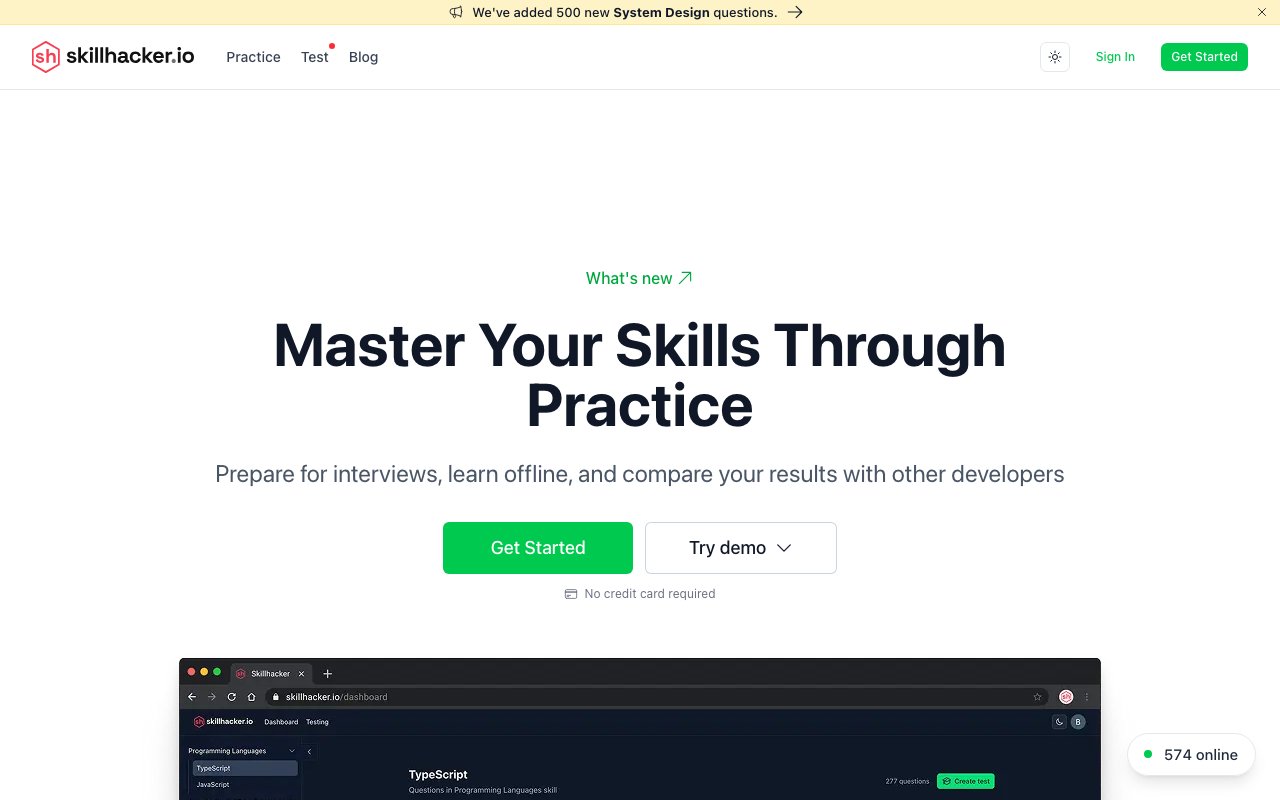
SkillHacker is an interview preparation platform built specifically for developers who want to sharpen their technical skills before job interviews. It combines practice exercises with timed assessments, giving you a way to drill on the concepts that matter for your target role while tracking where you stand compared to other candidates pursuing the same position. The premise is straightforward: if you're preparing for a senior frontend interview, you should be practicing the skills that senior frontend interviews actually test, not a random grab bag of LeetCode puzzles that may never come up.
The core structure splits into two modes. Practice mode lets you work through problems at your own pace with access to hints and contextual documentation, building momentum without time pressure. You can take breaks, look things up, and really absorb the material before moving on. This mode is designed for learning and filling gaps rather than simulating pressure. Test mode flips the dynamic: it puts you on the clock, identifies knowledge gaps, and shows how your score stacks up against other developers preparing for the same role. That comparison piece is the hook. Instead of guessing whether you're ready for a senior frontend interview, you see actual percentile data against the pool of people targeting the same job title. If you're in the 40th percentile on system design questions for backend roles, you know where to focus your next week of prep.
Role-based learning paths are where SkillHacker differentiates itself from generic coding challenge sites. Rather than dumping you into a list of random algorithm problems, it organizes material around eight developer tracks: senior frontend developer, principal backend developer, staff DevOps engineer, senior data engineer, middle game developer, senior mobile developer, middle QA engineer, and senior full-stack developer. Each path tailors the questions and exercises to the skills that actually get tested in those interviews. A staff DevOps track focuses on infrastructure, orchestration, and reliability concerns. A senior mobile track focuses on platform specifics, performance, and native tooling. You're not wasting time on topics that won't come up. The question bank for each track reflects what hiring managers in that discipline actually ask, not what a generalist algorithm course covers.
The platform also supports offline use, so you can practice on a flight or commute without connectivity. This is a practical feature for anyone cramming before an interview during travel. Progress tracking runs across both modes, letting you see improvement over time and pinpoint the topics that still need work. If you bomb the Kubernetes questions in a DevOps assessment, the platform remembers that and can surface related material in your next session. The goal is not just to drill, but to guide you toward the gaps that will hurt you most in a real interview. It's a feedback loop: test, see the gaps, practice those gaps, test again.
Who is this for? Developers actively preparing for technical interviews, especially those targeting specific seniority levels and specializations. If you're applying for a staff DevOps role and want to know whether your Kubernetes knowledge competes with other candidates, SkillHacker gives you that lens. It's also useful if you're considering a level-up move and want to see how your current skills compare to people already at that level. The benchmarking gives you data rather than just hope. You might think you're ready for a senior role, but if your test scores put you below the median of people preparing for those same interviews, that's information you need before walking into the first round. On the flip side, it's less useful if you're just learning to code for the first time or want general programming practice without the interview framing. This is a prep tool, not a teaching tool.
Pricing follows a freemium model. You can sign up and start practicing without a credit card, with paid options unlocking additional features. The site doesn't break down exact tier pricing on the homepage, so you'll see the details after creating an account. The free tier appears functional enough to validate whether the platform fits your learning style before you commit. Overall, if you want interview prep that's organized by role rather than scattered by topic, SkillHacker is a focused option worth trying before your next technical screen. The role-based framing also helps you avoid the trap of over-preparing on algorithms when your target role emphasizes system design or infrastructure work. Prep smarter, not longer.
Key Features
- Practice mode with hints and documentation
- Timed test mode with gap identification
- Eight role-based learning paths
- Peer benchmarking and percentile ranking
- Progress tracking across sessions
- Offline practice support
Pros & Cons
What we like
- Organizes prep around specific developer roles
- Peer comparison shows where you rank
- Free signup without credit card
- Offline mode lets you practice anywhere
Room for improvement
- Focused on interview prep, not general learning
- Paid tier details not shown upfront
- Role tracks may not cover niche specializations
- Value diminishes after you land the job
Frequently Asked Questions
What is SkillHacker?
Is SkillHacker free?
What roles does SkillHacker cover?
Who is SkillHacker for?
Best For
Featured in
Alternatives to SkillHacker
View all
1Lookup
Real-time data verification API for phone, email, IP, and domain validation to fight fraud

Kevin Gabeci
Solo developer building web apps, cozy browser games, and AI creator toolkits.

Codedex
A gamified, story-driven platform that teaches Python, web dev, and more like an RPG quest
Hack2hire
Practice real SDE interview questions from top tech companies with expert worked solutions
Reviews (8)
Pulled its weight from week one
Found SkillHacker on a Show HN thread and I am glad I clicked. The free signup without credit card is more useful than I expected. The core workflow is smooth once you are set up. Mostly using it for preparing for senior frontend interviews. Hard to imagine going back to my old setup.
Solid but not perfect
Have been running SkillHacker for a while, here is where I land. The practice mode with hints and documentation is more useful than I expected. It would be a five if not for paid tier details not shown upfront. Worth it for what I get out of it.
Exactly what I needed
Came to SkillHacker after getting frustrated with what I had before. It has shaved real time off my week. Recommending it to people in a similar spot.
Recommended without reservation
Picked SkillHacker for the price, stayed for the quality. The defaults are sensible, so I was not fighting settings on day one. Setup was painless and I was productive the same day. Mostly using it for benchmarking devops skills against other candidates. Hard to imagine going back to my old setup.
Two months in, no regrets
Started using SkillHacker casually, now it is pinned in my dock. The peer benchmarking and percentile ranking is more useful than I expected.
Solid daily driver
SkillHacker has quietly become part of my daily flow. The interface stays out of my way, which I appreciate. Easy yes for anyone weighing the same trade offs.
Powerful once it clicks
Came to SkillHacker after getting frustrated with what I had before. The output quality holds up better than I expected. It slotted into my routine without much fuss. The catch is paid tier details not shown upfront. No regrets so far.
Worth a look
SkillHacker solves a real problem for me without making a fuss about it. What stands out is how it handles eight role-based learning paths. Would sign up again without thinking twice.
Badge builder
Add SkillHacker to your website
Choose a badge style and size, preview it here, then copy the generated HTML. Badge images are self-contained SVGs and do not require an external script.

<a href="https://toolindex.net/tools/skillhacker?ref=badge" target="_blank" rel="noopener">
  <img src="https://toolindex.net/badge/skillhacker/medium.svg" alt="SkillHacker - Listed on Tool Index" width="180" height="50" />
</a>How to use the badge
- 1. Pick the style, size, and theme that fit your layout.
- 2. Copy the generated HTML from the code block.
- 3. Paste it into your footer, homepage, or press page.
Standard badge available
The standard listing badge is available now. Score and circle badges are limited to tools currently ranked in the top 10 of a category.
Badge clicks return visitors to this profile with a referral tag so the source remains identifiable.
Related Tools
Kevin Gabeci
Solo developer building web apps, cozy browser games, and AI creator toolkits.

Coolify
Self-hostable, open source alternative to Heroku and Netlify

Warp
The modern terminal reimagined with AI and collaboration

Bolt.new
Prompt-to-deployed full-stack app inside the browser
Work on SkillHacker? Request listing access or correction