SlopCop
Scores any website for how much its design looks AI-generated
Gallery
About SlopCop
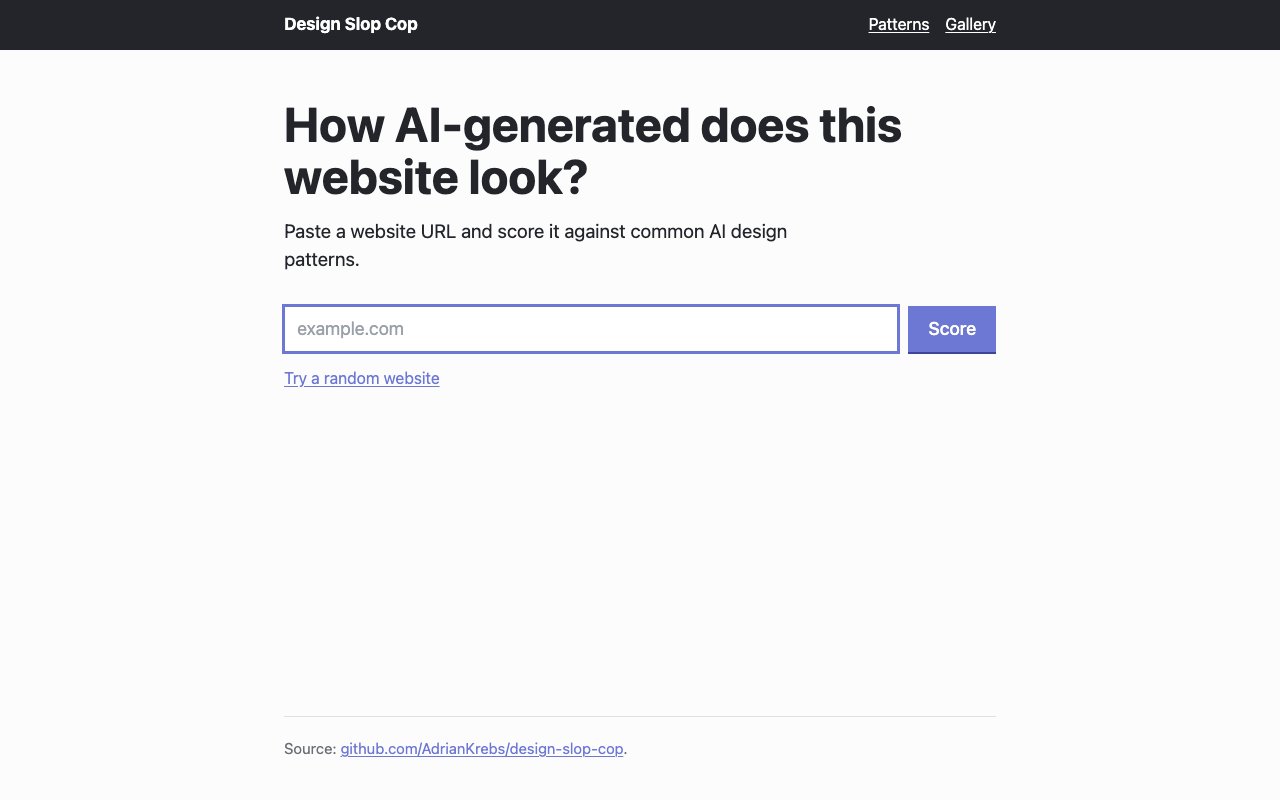
SlopCop is a free web tool that scores any website for how much its design looks like it was made by AI. You paste in a URL, it loads the page, and it tells you whether the look leans into the visual habits that have quietly become the fingerprint of the AI-era, vibe-coded landing page. The result is a single readout of how much slop the design is carrying, framed by the question the site itself leads with, which is how AI-generated does this website look.
The problem it names is one a lot of people have felt without quite being able to describe it. Since design assistants and template-heavy site builders took over, a huge share of new pages have started to look eerily alike, with the same fonts, the same gradients, and the same centered hero holding a little badge above the headline. SlopCop puts an actual number on that sameness instead of leaving it as a vague hunch you can't defend in a design review.
The analysis runs in a real headless browser rather than off a screenshot or a guess. SlopCop loads each page with Playwright, then walks the live DOM and reads the computed styles to check for a set of more than a dozen concrete patterns. Every pattern is a deterministic CSS or DOM query, so the outcome is repeatable and explainable rather than a mood. It pointedly does not use a language model to grade the page, and that's a deliberate choice, because an AI judge would smuggle in the very bias the tool exists to measure.
The patterns it hunts for read like a catalogue of modern landing-page reflexes. Think Inter set everywhere, the Space Grotesk and Instrument Serif pairing, serif italics on accent words, lavender and vibe-purple highlights, dark sections with low-contrast body text, gradient glows, cards with colored left borders, identical feature tiles that each carry an icon, numbered step sequences, stat banners, sidebars dotted with emoji, and all-caps section labels. Trip four or more of them and the page lands in the heavy-slop bucket, while lighter results get marked as clean or mild.
The scoring is meant to be read as a spectrum rather than a pass-or-fail stamp. A page that only nudges one or two checks is treated as broadly clean, a handful lands it in the mild zone, and the heavy bucket is reserved for the sites that pile the tells on top of each other. Because each hit is tied to a named pattern, the score arrives with its own explanation, so you're never left guessing which choices pushed a page up. That makes it useful as a checklist as much as a grade, since you can walk down the triggered items and decide which ones are worth changing and which are fine to keep.
The tool is refreshingly upfront that this is a fuzzy signal, not a verdict. Plenty of careful, hand-designed sites trip the same checks, because the aesthetic has gone close to universal, and the author openly reports something in the range of five to ten percent false positives. That candor is part of the appeal. It grew out of a project where the author scored batches of new launches for these design tells, and it kept that experimental, show-your-work spirit rather than pretending to be an oracle.
What sets it apart from the wider wave of AI detectors is that it studies design, not text. Most detectors try to sniff out AI writing, whereas SlopCop measures the look of a page, the typefaces, the spacing habits, and the hero conventions, using transparent rules you can actually read. It ships with a browsable gallery of scored sites and a patterns reference that explains each signal one by one, so you can see exactly why a given page earned its score and what you'd change to pull it back down.
It's worth being clear about what SlopCop is not. It isn't trying to shame anyone or to claim a site is low quality, and the author is explicit that the look it measures has become the default across the whole web, human-made pages included. The value is diagnostic. If you're a founder who wants a launch to stand out in a sea of near-identical pages, or a designer defending a more distinctive direction to a client, having a concrete, reproducible read on how conventional a page looks is a genuinely useful thing to point at.
It's aimed at designers, founders, and developers who want a quick gut-check on whether a new page reads as distinctive or as one more entry in the template pile. Access could hardly be lighter. It's free with nothing to sign up for, there's a try-a-random-website button if you just want to play with it, and the whole project is open source on GitHub, so you can read the exact checks, run them yourself, or propose new patterns as the AI-design aesthetic keeps drifting. For anyone worried their site has slid into look-alike territory, it works as a fast and honest mirror.
Key Features
- Real-browser DOM and CSS analysis
- More than a dozen slop patterns
- Deterministic rules, no AI judge
- Clean, mild, or heavy scoring
- Browsable gallery of scored sites
- Open-source checks on GitHub
Pros & Cons
What we like
- Free with nothing to sign up for
- Transparent, readable rules you can inspect
- Runs in a real browser for repeatable results
- Open source, so you can self-host or extend it
Room for improvement
- Author reports five to ten percent false positives
- Narrow focus on design, not written content
- Well-designed human sites can still trip it
- Younger project with a small community
Frequently Asked Questions
What is SlopCop?
Is SlopCop free?
How does SlopCop detect AI design?
Who is SlopCop for?
Best For
Featured in
Alternatives to SlopCop

Reviews (11)
Solid but not perfect
Hadn't planned on switching, but SlopCop was hard to ignore. Got real value out of more than a dozen slop patterns. Setup was painless and I was productive the same day. Found it works best for comparing competitor sites for design sameness. My only gripe is younger project with a small community.
Solid daily driver
Tried SlopCop on a side project first, then rolled it out everywhere. Got real value out of deterministic rules, no ai judge. Hard to imagine going back to my old setup.
It just works
Found SlopCop on a Show HN thread and I am glad I clicked. What stands out is how it handles real-browser dom and css analysis. Would sign up again without thinking twice.
Pulled its weight from week one
SlopCop solves a real problem for me without making a fuss about it. What stands out is how it handles open source, so you can self-host or extend it. Recommending it to people in a similar spot.
Genuinely impressed
SlopCop solves a real problem for me without making a fuss about it. The interface stays out of my way, which I appreciate. It does what it says, which is rarer than it should be. Mostly using it for auditing a redesign for ai-era design tells. Easy yes for anyone weighing the same trade offs.
Two months in, no regrets
SlopCop has quietly become part of my daily flow. The output quality holds up better than I expected. It fits well for auditing a redesign for ai-era design tells. Would sign up again without thinking twice.
Solid daily driver
SlopCop has quietly become part of my daily flow. The real-browser dom and css analysis is more useful than I expected. No regrets so far.
It just works
Hadn't planned on switching, but SlopCop was hard to ignore. The output quality holds up better than I expected. Setup was painless and I was productive the same day. Easy yes for anyone weighing the same trade offs.
Finally something that fits
Picked SlopCop for the price, stayed for the quality. The real-browser dom and css analysis is more useful than I expected. It fits well for auditing a redesign for ai-era design tells. Recommending it to people in a similar spot.
Finally something that fits
Three months of SlopCop later, here is what holds up. Where it really wins is more than a dozen slop patterns. Easy yes for anyone weighing the same trade offs.
Pulled its weight from week one
Hadn't planned on switching, but SlopCop was hard to ignore. Got real value out of more than a dozen slop patterns. What stands out is how little babysitting it needs. Easy yes for anyone weighing the same trade offs.
Badge builder
Add SlopCop to your website
Choose a badge style and size, preview it here, then copy the generated HTML. Badge images are self-contained SVGs and do not require an external script.

<a href="https://toolindex.net/tools/slopcop?ref=badge" target="_blank" rel="noopener">
  <img src="https://toolindex.net/badge/slopcop/medium.svg" alt="SlopCop - Listed on Tool Index" width="180" height="50" />
</a>How to use the badge
- 1. Pick the style, size, and theme that fit your layout.
- 2. Copy the generated HTML from the code block.
- 3. Paste it into your footer, homepage, or press page.
Standard badge available
The standard listing badge is available now. Score and circle badges are limited to tools currently ranked in the top 10 of a category.
Badge clicks return visitors to this profile with a referral tag so the source remains identifiable.
Related Tools

Apatero Studio
Creator studio for AI image, video, audio, 3D, and avatars. Every model worth using, in one workspace.

Tailwind CSS
Rapidly build custom designs without leaving your HTML

Figma
Collaborative interface design tool

Marvel
Lightweight prototyping platform for turning images and screens into clickable mobile and web prototypes.
Work on SlopCop? Request listing access or correction