
Spendalyst
Spot recurring charges, price changes, and renewals without maintaining a budget
Gallery
About Spendalyst
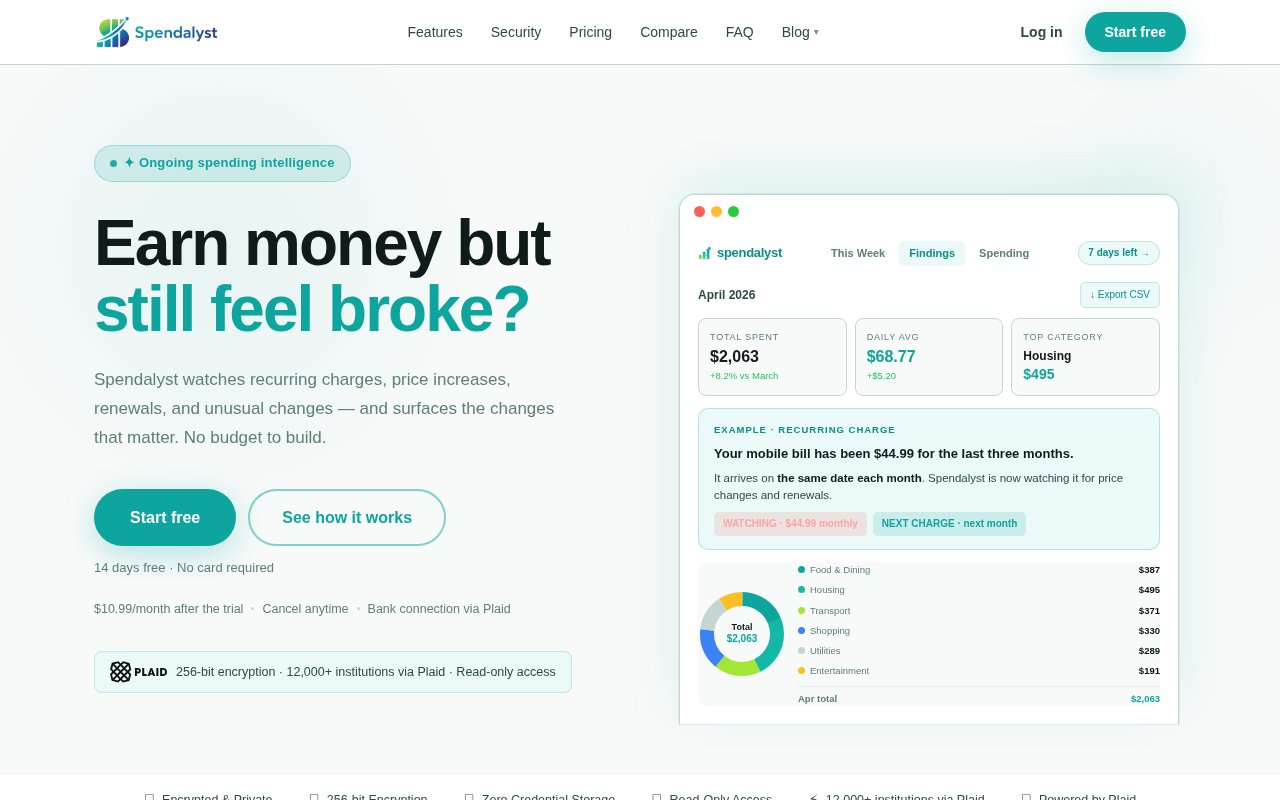
Spendalyst is a personal spending monitor for people who want to know what changed in their finances without building and maintaining a budget. It reads transaction history from connected accounts, identifies charges that repeat, watches those charges for price changes, and flags upcoming renewals. It also looks for unusual movement in day-to-day spending. Instead of expecting someone to study a dashboard every evening, it brings forward the handful of changes that may deserve attention. The central idea is simple. A money app can do the watching, while the person using it checks in only when there is something useful to see.
Setup starts with an account and a read-only bank connection through Plaid. Spendalyst says Plaid covers more than 12,000 financial institutions, and the bank sign-in happens in Plaid's own window rather than on Spendalyst's servers. Once transactions arrive, the service examines the available history, which can extend to 24 months, and works out which merchants charge on a recurring pattern. It keeps syncing as new activity appears. There are no envelopes to fund, category targets to balance, or weekly entries to type. That makes it a better fit for passive awareness than for someone who wants strict forward planning or detailed zero-based budgeting.
The findings are meant to be checked, not accepted on faith. A price-change notice includes the merchant, dates, and amounts that led to the conclusion. A renewal notice can flag an annual charge before it lands, while a newly repeating payment can be added to the watchlist. When an obvious next step exists, Spendalyst may suggest it, but the product doesn't treat every change as a problem. It also maintains automatically categorized spending totals and a longer story of previous findings. CSV and JSON exports give users a way to take their transaction data or results elsewhere instead of leaving everything inside the app.
The weekly experience is built around a Monday card. As monitoring continues, one card summarizes what changed, using plain language and the person's own recent spending as the comparison point. A dining increase, for example, is compared with that person's previous weeks rather than with an arbitrary budget. The product still provides Findings, Watchlist, Story, and Spending views when someone wants more detail, but it doesn't require a daily review habit. It runs as a web app on phones, tablets, and computers, and the site says it can be installed to a mobile home screen without an app-store download.
Spendalyst is aimed at people who earn and spend normally but tend to avoid traditional finance apps because of the upkeep. It can be especially useful for catching a subscription that quietly increased, remembering a yearly renewal, or understanding a sudden shift in a category. Its narrower focus matters. This isn't an investment tracker, bill-payment service, or system for assigning every dollar before it is spent. It watches activity that already happened and reports supported patterns. That can feel calmer and more useful for someone who mainly wants awareness, but committed budgeters may still need another tool for planning.
Financial access is deliberately limited. The Plaid connection is read-only, so Spendalyst says it can view transactions but cannot move or withdraw money. The company also says bank credentials aren't stored on its servers, data is protected with TLS 1.3 in transit and 256-bit AES at rest, and users can disconnect accounts or delete their data. Those are sensible controls, though anyone connecting a financial account should still read the current privacy policy and decide whether transaction analysis by a third-party service fits their comfort level. Findings also need enough history to establish a pattern, so a quiet or newly opened account may not produce useful results immediately.
Access starts with a 14-day trial that doesn't require a payment card. After that, the monthly plan costs $10.99, while the annual plan costs $89.99, which works out to about $7.50 per month. The account pauses if the user doesn't choose a plan, rather than automatically charging after the no-card trial. Both billing choices cover the core monitoring experience, including recurring charges, price changes, renewal notices, the Monday card, and CSV export. The annual option is positioned as a lower total cost for people who already know they want ongoing monitoring. Spendalyst is therefore a paid, focused service rather than a free budgeting suite, with its value tied to whether its alerts catch changes a user would otherwise miss.
Key Features
- Recurring charge detection
- Subscription price-change alerts
- Upcoming renewal notices
- Weekly Monday summary card
- Automatic spending categorization
- CSV and JSON exports
Pros & Cons
What we like
- Requires no budget or category upkeep
- Explains findings with dates and amounts
- Uses read-only bank access through Plaid
- Works across phone and desktop browsers
Room for improvement
- Useful findings require enough transaction history
- Full monitoring depends on a connected account
- No permanent free plan after the trial
- Focused on awareness rather than active budgeting
Frequently Asked Questions
What is Spendalyst?
Does Spendalyst require a bank connection?
How much does Spendalyst cost?
Is Spendalyst a budgeting app?
Best For
Featured in
Alternatives to Spendalyst



Reviews (0)
Badge builder
Add Spendalyst to your website
Choose a badge style and size, preview it here, then copy the generated HTML. Badge images are self-contained SVGs and do not require an external script.

<a href="https://toolindex.net/tools/spendalyst?ref=badge" target="_blank" rel="noopener">
  <img src="https://toolindex.net/badge/spendalyst/medium.svg" alt="Spendalyst - Listed on Tool Index" width="180" height="50" />
</a>How to use the badge
- 1. Pick the style, size, and theme that fit your layout.
- 2. Copy the generated HTML from the code block.
- 3. Paste it into your footer, homepage, or press page.
Standard badge available
The standard listing badge is available now. Score and circle badges are limited to tools currently ranked in the top 10 of a category.
Badge clicks return visitors to this profile with a referral tag so the source remains identifiable.
Related Tools

Simple RMD
Calculate, aggregate, and manage your annual IRA required minimum distributions.
FreshBooks
Cloud accounting designed for service-based small businesses and freelancers
Deel
Global payroll, contractor, and EOR platform
Chargebee
Subscription billing and revenue management for B2B SaaS
Work on Spendalyst? Request listing access or correction