
SubjectiveZero
Open-source agentic node editor for creative coding on macOS
Gallery
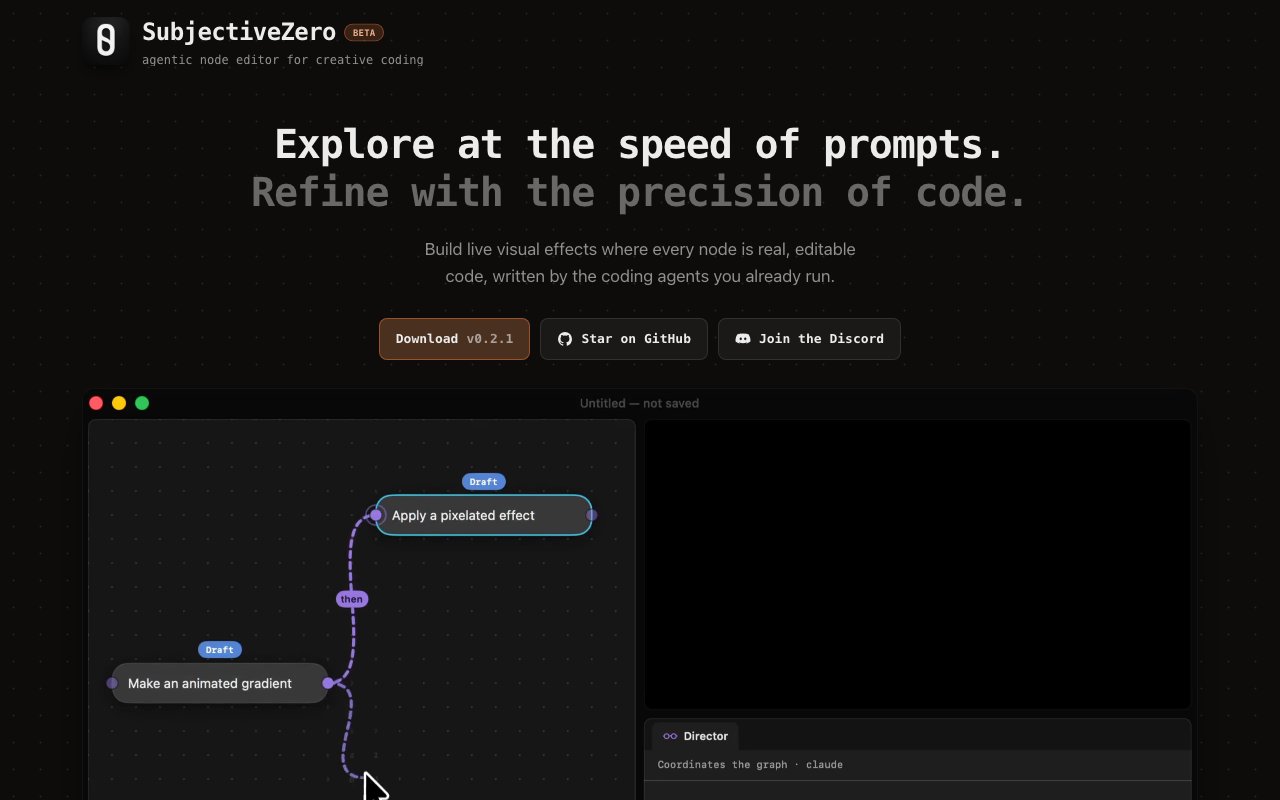
About SubjectiveZero
SubjectiveZero is a native macOS app that sits between two things that usually stay apart, a visual node editor and an AI coding agent. It's built for creative coding, the practice of writing code to make visuals, shaders, and generative art, and it lets you build those pieces by describing them in plain language instead of writing everything from a blank file. The result is a canvas of connected nodes where each node is real, editable code that you either prompted into existence or wrote by hand. That mix is the whole idea, because it treats the prompt and the source as two views of the same thing rather than forcing you to pick one. It runs as a real Mac app rather than a website, so the whole thing feels closer to a creative tool than a browser tab.
The workflow starts with a prompt. A Director agent reads what you type, breaks the idea into typed nodes, and wires them together into a working graph, generating the code for multiple nodes in parallel rather than one at a time. From there you can keep talking to individual nodes through a chat interface, attaching files when you need to, to refine a specific effect without disturbing the rest of the graph. It's designed so you can move freely between high-level prompting and low-level editing, mixing finished hand-written code with prompt-based nodes on the same canvas, and splitting or merging nodes as a composition grows. The Director agent is the piece that turns a sentence into structure, working out which nodes a request needs and how they connect before any code gets written.
Underneath every node is genuine Swift and Metal code, not a black box. You can open any node and edit its source directly, and changes hot-reload fast, with the app polling for file changes roughly every 300 milliseconds so you see results almost immediately. Compile isolation means a node that fails to build won't take the whole graph down with it, which keeps an experimental session from collapsing every time one idea doesn't compile. Because you can always drop to the source, the agent gives you a fast starting point without trapping you at the prompt level the way some AI tools do.
It's built to react to live input, which is where creative coding gets interesting. A live microphone or camera feed can drive node parameters, dragging in an image or video creates a source node automatically, and audio FFT analysis lets you build visuals that respond to frequency and sound. That turns a static graph into something that moves with music, a room, or a performance, which is clearly the kind of work the tool is aiming at, whether that's a live visual set or a reactive art piece. Combining several live sources at once, sound plus camera for instance, is where the node graph really earns its keep.
The engineering choices matter for who it suits. This is a native app for macOS 15.0 and up on Apple Silicon or Intel, built with SwiftUI and a Metal renderer rather than wrapped in Electron, so it behaves like a real Mac application instead of a browser in disguise. The AI side works through your own Claude Code CLI or Codex CLI accounts, meaning it uses your existing agent access and rate limits rather than a separate subscription baked into the app. Output today is Swift and Metal code per node, with video export and standalone app export both listed on the roadmap.
It's aimed at creative coders, shader writers, generative artists, and developers who are comfortable with code but want the speed of describing an effect and getting a working result to build from instantly. Because everything is real Swift and Metal, what you make is inspectable and yours to extend, and it doubles as a way to learn by reading the code the agent produces. The honest caveat is that it's Mac only for now, with Windows and Linux not yet available, and it's an early prototype rather than a mature release, so some workflows are still rough. There's an active Discord community where the studio gathers feedback, which fits an early tool that's still finding its shape.
On access it's refreshing. SubjectiveZero is open source under the AGPL-3.0 license, with the code on GitHub, and it's currently at version 0.2.1 in beta. There's no subscription for the app itself since it runs on your own Claude or Codex accounts, commercial use of what you build is permitted and your own work isn't covered by the AGPL, and there's a Discord community around it. It comes from SXP Studio, a solo, self-funded studio in Paris run by Clem Boissiere that focuses on creative software for Apple platforms and spatial computing.
Key Features
- Prompt-driven node graph generation
- Editable Swift and Metal per node
- Fast hot-reload on code changes
- Live camera, mic, and audio input
- Per-node chat for iterating
- Native macOS SwiftUI and Metal app
Pros & Cons
What we like
- Open source under the AGPL-3.0 license
- Real editable code in every node, not a black box
- Runs on your own Claude or Codex accounts, no extra subscription
- Native Mac app rather than an Electron wrapper
Room for improvement
- macOS only, with no Windows or Linux yet
- Early 0.2.1 beta, still a prototype
- Requires your own Claude Code or Codex CLI access
- Video and app export are still on the roadmap
Frequently Asked Questions
What is SubjectiveZero?
Is SubjectiveZero open source?
What do I need to run it?
Who is SubjectiveZero for?
Best For
Featured in
Alternatives to SubjectiveZero

1Lookup
Real-time data verification API for phone, email, IP, and domain validation to fight fraud

Codedex
A gamified, story-driven platform that teaches Python, web dev, and more like an RPG quest
Hack2hire
Practice real SDE interview questions from top tech companies with expert worked solutions
Cloudflare Pages
Free Jamstack hosting on Cloudflares edge with unlimited bandwidth and tight integration with Workers.
Reviews (9)
Two months in, no regrets
Found SubjectiveZero on a Show HN thread and I am glad I clicked. Their take on native mac app rather than an electron wrapper is genuinely good. It slotted into my routine without much fuss. Worth it for what I get out of it.
Does the job, a few gripes
Three months of SubjectiveZero later, here is what holds up. The runs on your own claude or codex accounts, no extra subscription is more useful than I expected. It just works, day after day, without surprises. Mostly using it for learning metal by reading agent-generated nodes. It would be a five if not for video and app export are still on the roadmap. Glad I made the switch.
Worth a look
Started using SubjectiveZero casually, now it is pinned in my dock. Their take on per-node chat for iterating is genuinely good. The defaults are sensible, so I was not fighting settings on day one. No regrets so far.
Solid daily driver
Tried SubjectiveZero on a side project first, then rolled it out everywhere. It just works, day after day, without surprises. Glad I made the switch.
Quietly excellent
Tried SubjectiveZero on a side project first, then rolled it out everywhere. What stands out is how it handles editable swift and metal per node. It fits well for learning metal by reading agent-generated nodes. Glad I made the switch.
Powerful once it clicks
Found SubjectiveZero on a Show HN thread and I am glad I clicked. The real editable code in every node, not a black box is more useful than I expected. It fits well for building audio-reactive visuals for a performance. My only gripe is early 0.2.1 beta, still a prototype. Easy yes for anyone weighing the same trade offs.
Pulled its weight from week one
SubjectiveZero has quietly become part of my daily flow. What stands out is how it handles open source under the agpl-3.0 license. It has shaved real time off my week. It earns its place in my stack.
Recommended without reservation
Three months of SubjectiveZero later, here is what holds up. The core workflow is smooth once you are set up. It fits well for building audio-reactive visuals for a performance. No regrets so far.
Solid daily driver
SubjectiveZero solves a real problem for me without making a fuss about it. The fast hot-reload on code changes is more useful than I expected. The output quality holds up better than I expected. No regrets so far.
Badge builder
Add SubjectiveZero to your website
Choose a badge style and size, preview it here, then copy the generated HTML. Badge images are self-contained SVGs and do not require an external script.

<a href="https://toolindex.net/tools/subjectivezero?ref=badge" target="_blank" rel="noopener">
  <img src="https://toolindex.net/badge/subjectivezero/medium.svg" alt="SubjectiveZero - Listed on Tool Index" width="180" height="50" />
</a>How to use the badge
- 1. Pick the style, size, and theme that fit your layout.
- 2. Copy the generated HTML from the code block.
- 3. Paste it into your footer, homepage, or press page.
Standard badge available
The standard listing badge is available now. Score and circle badges are limited to tools currently ranked in the top 10 of a category.
Badge clicks return visitors to this profile with a referral tag so the source remains identifiable.
Related Tools

Kevin Gabeci
Solo developer building web apps, cozy browser games, and AI creator toolkits.

Coolify
Self-hostable, open source alternative to Heroku and Netlify

Warp
The modern terminal reimagined with AI and collaboration

Bolt.new
Prompt-to-deployed full-stack app inside the browser
Work on SubjectiveZero? Request listing access or correction