
TickerLayer
Unified REST and WebSocket market data across multiple asset classes
Gallery
About TickerLayer
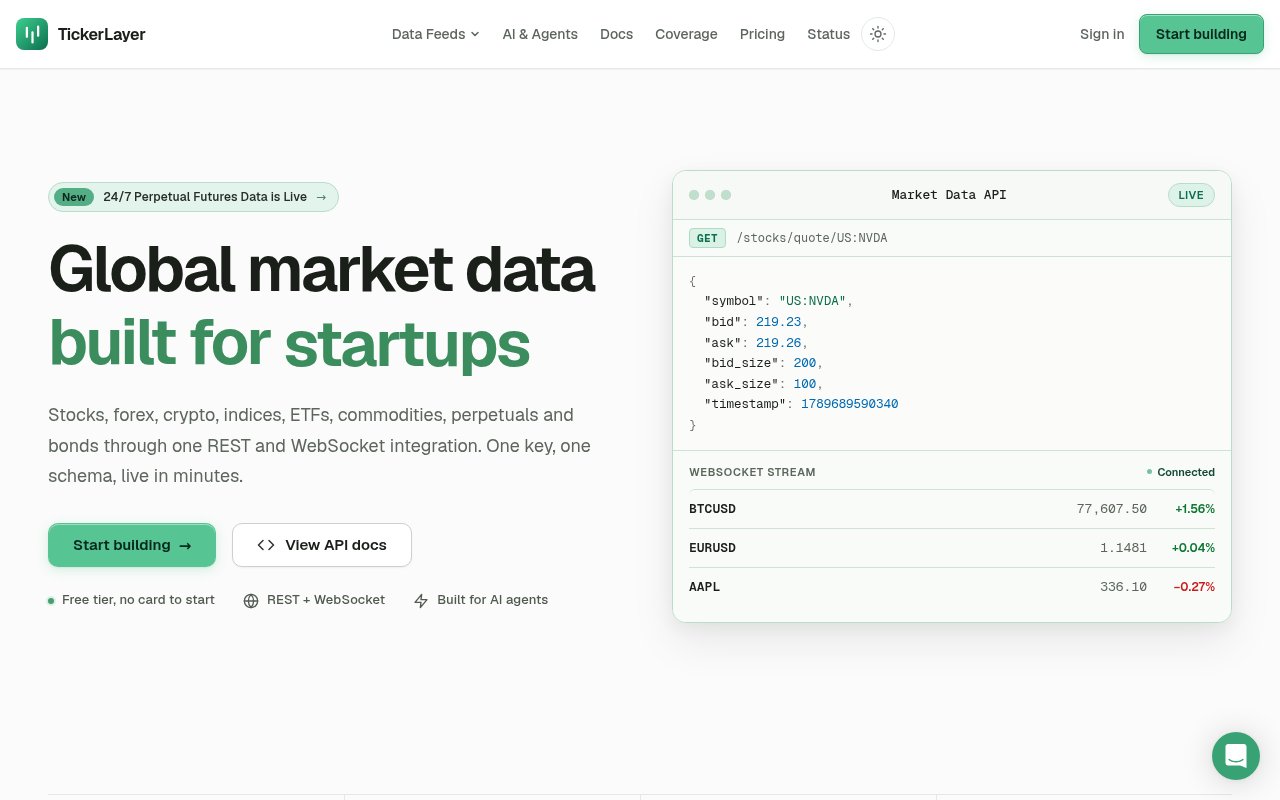
TickerLayer is a market data API for developers building dashboards, financial applications, research systems, alerts, and agent tools. It puts stocks, foreign exchange, cryptocurrency, indices, ETF-style references, commodities, bonds, and perpetual futures behind one account and a consistent integration model. Instead of learning a different symbol convention and response shape for each provider, a team can begin with a REST request and add WebSocket streams for supported feeds using the same API key. The platform is aimed at practical product development rather than order execution. It supplies quotes, trades, snapshots, historical bars, and reference data that an application can display, analyze, or use as an input to its own workflow.
The REST API is organized by asset class and uses read-only GET endpoints for market data. Symbol discovery endpoints show what an account can access, which helps an integration avoid guessing at identifiers. Stocks use market-qualified codes that combine a country and ticker, while compact formats are used for feeds such as crypto and forex. Quote responses use normalized fields for values such as bid, ask, size, and timestamps. Snapshot and aggregate endpoints support initial screen loads and chart history, while WebSocket channels carry live quote and trade updates where available. The same general subscription and field model carries across feeds, so adding another asset class doesn't require an entirely new client design.
Coverage is broad enough for products that would otherwise stitch together several specialist services. The site describes more than 150,000 instruments across its aggregation layer, with global equities, hundreds of currency pairs, thousands of crypto pairs, and curated index, ETF, commodity, bond, and perpetual references. Public instrument pages let a developer inspect delayed charts and key figures before signing up. The perpetuals feed covers contracts tied to crypto as well as stocks, commodities, indices, currencies, and pre-IPO names, with activity around the clock. Documentation includes request examples and exact response structures, so teams can assess an endpoint's shape before building a full client around it.
TickerLayer is particularly suited to watchlists, portfolio dashboards, research interfaces, price widgets, internal analytics, signal systems, and AI agents that need a current reference value through a tool call. REST works for periodic lookups, symbol lists, and backend jobs, while WebSocket access fits screens and alerts that should react to a new tick. The shared conventions make it easier for a small engineering team to expand from one feed into several. Individual plans are expressly for personal projects, research, algorithmic trading, learning, and other non-commercial work. Business plans include commercial use, and enterprise arrangements cover needs such as custom coverage, higher limits, redistribution workflows, service agreements, and guided onboarding.
The most important limitation is also stated clearly by the provider. TickerLayer builds derived and indicative data from non-exchange inputs, including over-the-counter activity, peer-to-peer trades, contributor pricing, and CFD-style references. With the exception of its calculated perpetual composites, this isn't official exchange feed data. Values may be delayed, incomplete, inaccurate, or different from prices on a primary venue. The service doesn't execute trades, provide investment advice, or confer rights in an underlying asset, and redistribution requires written authorization. That makes it sensible for technical and informational experiences, but teams with regulated, official, or execution-sensitive requirements need to evaluate provenance, entitlements, freshness, and display rights carefully.
Access is freemium. Every account starts with 3,000 REST requests per month without a payment card, which is enough to test authentication, inspect symbol coverage, and build a small proof of concept. Individual access starts at $49 per month with 250,000 monthly calls, while business access starts at $449 per month with 25 million monthly calls and commercial use included. Prices vary with the selected feeds, and enterprise packages are custom. The combination of a no-card test tier, public documentation, REST, and streaming gives developers a low-friction evaluation path. Its value is strongest when normalized multi-asset delivery saves more engineering work than a team would gain from sourcing each market independently.
Key Features
- Unified multi-asset market API
- REST quotes and snapshots
- Live WebSocket data streams
- Historical aggregate price bars
- Market-qualified symbol discovery
- Public delayed instrument pages
Pros & Cons
What we like
- One key spans several asset classes
- Consistent response shapes reduce integration work
- Free tier requires no payment card
- Documentation shows exact request and response formats
Room for improvement
- Data isn't an official exchange feed
- Commercial use requires a business plan
- Available markets depend on account entitlements
- Redistribution needs written authorization
Frequently Asked Questions
What is TickerLayer?
Does TickerLayer have a free tier?
Is TickerLayer an official exchange feed?
Who is TickerLayer for?
Best For
Featured in
Alternatives to TickerLayer



Reviews (0)
Badge builder
Add TickerLayer to your website
Choose a badge style and size, preview it here, then copy the generated HTML. Badge images are self-contained SVGs and do not require an external script.

<a href="https://toolindex.net/tools/tickerlayer?ref=badge" target="_blank" rel="noopener">
  <img src="https://toolindex.net/badge/tickerlayer/medium.svg" alt="TickerLayer - Listed on Tool Index" width="180" height="50" />
</a>How to use the badge
- 1. Pick the style, size, and theme that fit your layout.
- 2. Copy the generated HTML from the code block.
- 3. Paste it into your footer, homepage, or press page.
Standard badge available
The standard listing badge is available now. Score and circle badges are limited to tools currently ranked in the top 10 of a category.
Badge clicks return visitors to this profile with a referral tag so the source remains identifiable.
Related Tools

Simple RMD
Calculate, aggregate, and manage your annual IRA required minimum distributions.
FreshBooks
Cloud accounting designed for service-based small businesses and freelancers
Deel
Global payroll, contractor, and EOR platform
Chargebee
Subscription billing and revenue management for B2B SaaS
Work on TickerLayer? Request listing access or correction