
Trylle
Modern Git platform with native stacked PRs, GitHub-compatible CI, and unified workflows
Gallery
About Trylle
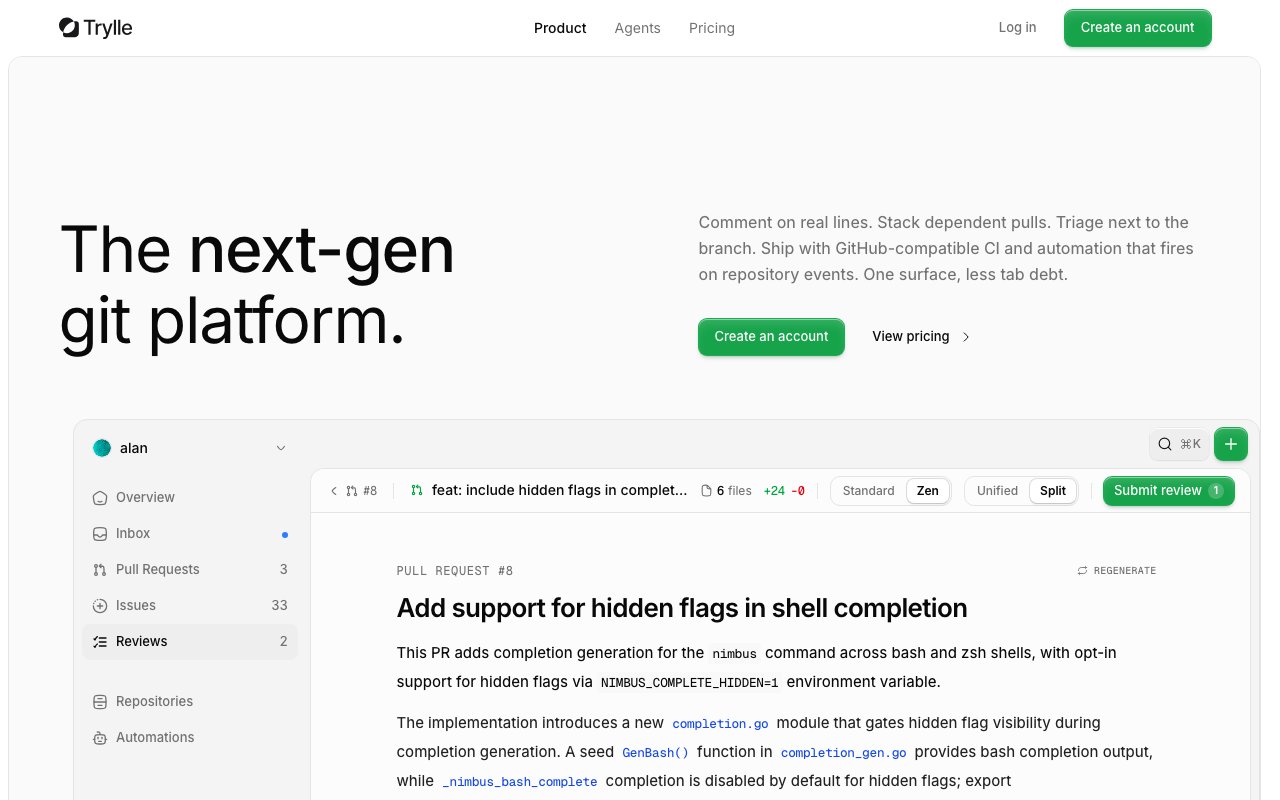
Trylle is a Git hosting platform built as an alternative to GitHub, with a focus on keeping code review, issue tracking, and CI/CD in a single unified interface. The pitch is that you shouldn't need to context-switch between tabs to manage pull requests, automation, and project issues when all of that could live on the same timeline. It's aimed at teams and individuals who find the fragmented tooling around GitHub frustrating and want something more cohesive.
Pull request management is the centerpiece. Trylle supports inline commenting on specific lines, automatically generated review summaries, and a dedicated review queue that organizes incoming and authored requests in one place. The standout feature is native support for stacked pull requests, where dependent branches are grouped together and can be reviewed and merged as a unit. Stacking PRs on GitHub requires third-party tooling and careful rebasing; Trylle builds it into the platform with CLI support for managing the stack.
CI and automation use a GitHub-compatible format, so if you already have .github/workflows YAML files, they should work without rewriting. Runners are available for Linux x86, ARM64, and macOS. The system supports artifact publishing and releases, and automation can fire on standard repository events like pushes, pull requests, and tags. Because CI lives in the same interface as code review, you can see build status, test results, and diffs without jumping to a separate service.
Issue tracking is built in with labels, mentions, and assignment. Security-focused automation can detect secrets in diffs before they get merged, which is a common pain point in fast-moving teams. Bot integrations come with explicit scope controls, so you can grant automation access to specific capabilities without handing over the keys to everything.
Trylle offers a Zen mode for code review that presents diffs in a narrative-focused flow, which is meant to help reviewers understand the intent behind changes rather than just scanning line-by-line. It's a small UX choice that signals the platform is thinking about the review experience rather than just shipping features.
Migration from GitHub preserves history and supports push mirroring so you can keep your original remote synchronized while you evaluate the platform. That lowers the switching cost if you want to try Trylle without burning bridges.
Pricing for personal workspaces has three tiers. Free gives you $15 in monthly CI credits and $10 in AI credits. Pro at $4 per month bumps those to $20 and $15. Max at $20 per month provides $30 CI and $30 AI credits. The AI credits suggest there's some model-assisted functionality, likely the review summaries and possibly secret detection, though the site doesn't break down exactly what consumes them.
Trylle fits developers and small teams who want a GitHub alternative with tighter integration between code review and automation, especially those who rely on stacked PRs and find the GitHub approach clunky.
Key Features
- Native stacked pull request support
- GitHub-compatible CI with YAML workflows
- Integrated issue tracking with labels
- Secret detection in diffs
- Push mirroring to original remotes
- Zen mode for narrative code review
Pros & Cons
What we like
- Stacked PRs are first-class without third-party tools
- Existing GitHub workflows work without rewriting
- Code review, CI, and issues share a single timeline
- Migration from GitHub preserves full history
Room for improvement
- Smaller ecosystem and community than GitHub
- AI and CI credits may run out on the free tier
- Fewer third-party integrations available
- Newer platform with less production mileage
Frequently Asked Questions
What is Trylle?
Is Trylle free?
Can I migrate from GitHub to Trylle?
Does Trylle support my existing GitHub Actions workflows?
Best For
Featured in
Alternatives to Trylle
View all
1Lookup
Real-time data verification API for phone, email, IP, and domain validation to fight fraud

Kevin Gabeci
Solo developer building web apps, cozy browser games, and AI creator toolkits.

Codedex
A gamified, story-driven platform that teaches Python, web dev, and more like an RPG quest
Hack2hire
Practice real SDE interview questions from top tech companies with expert worked solutions
Reviews (0)
Badge builder
Add Trylle to your website
Choose a badge style and size, preview it here, then copy the generated HTML. Badge images are self-contained SVGs and do not require an external script.

<a href="https://toolindex.net/tools/trylle?ref=badge" target="_blank" rel="noopener">
  <img src="https://toolindex.net/badge/trylle/medium.svg" alt="Trylle - Listed on Tool Index" width="180" height="50" />
</a>How to use the badge
- 1. Pick the style, size, and theme that fit your layout.
- 2. Copy the generated HTML from the code block.
- 3. Paste it into your footer, homepage, or press page.
Standard badge available
The standard listing badge is available now. Score and circle badges are limited to tools currently ranked in the top 10 of a category.
Badge clicks return visitors to this profile with a referral tag so the source remains identifiable.
Related Tools
Kevin Gabeci
Solo developer building web apps, cozy browser games, and AI creator toolkits.

Warp
The modern terminal reimagined with AI and collaboration

Bolt.new
Prompt-to-deployed full-stack app inside the browser

Supabase
The open source Firebase alternative
Work on Trylle? Request listing access or correction