
Gallery
About Vaaya
Vaaya is a credit account and purchasing layer for AI agents. It lets a person or company give an agent a defined amount of spending power, restrict what that agent may buy, and keep purchases in one ledger. Agents can use the balance for metered services across hundreds of models and tools covering search, data, scraping, media, compute, storage, memory, and outbound work. Instead of creating a separate account, API key, and billing relationship with every provider, a team connects Vaaya once and pays through a shared account with limits set in advance.
The account can be used in Vaaya's browser chat or connected to an existing agent through MCP or a plain HTTP API. Vaaya also publishes TypeScript and Python SDK paths. For a service call, the agent identifies the action and states the maximum amount it may cost. Vaaya checks the key's policy, runs the call through the relevant provider, and returns the result with the actual amount charged and a transaction identifier. Each transaction records the provider, quoted price, charged amount, outcome, and responsible agent. Failed calls aren't charged, and the account owner can revoke a key at any time.
Spending controls operate at several levels. Each agent key can have a monthly limit, and every request carries a maximum transaction cost. Keys can also be limited to categories such as data, search, scraping, media, compute, LLM routing, and outbound work. These boundaries let a developer give an internal research agent access to search and compute without also allowing unrelated purchases. Vaaya keeps repayment status and transaction history in the same account, which is useful when several agents or services would otherwise leave their usage scattered across separate vendor dashboards.
Behind that single account, Vaaya handles several kinds of provider billing. It can pay request-based services through x402, use Stripe's Machine Payments Protocol for a purchase token, hold metered accounts for services billed by time or unit, and expose some subscription-only products per call from an account it manages. This routing keeps the agent from handling a separate secret for every vendor. The price in the catalog is presented as the final price for the call, and a maximum cost protects the request from running above its ceiling. The approach is most useful when an agent needs small amounts of many different services rather than one large, predictable vendor contract.
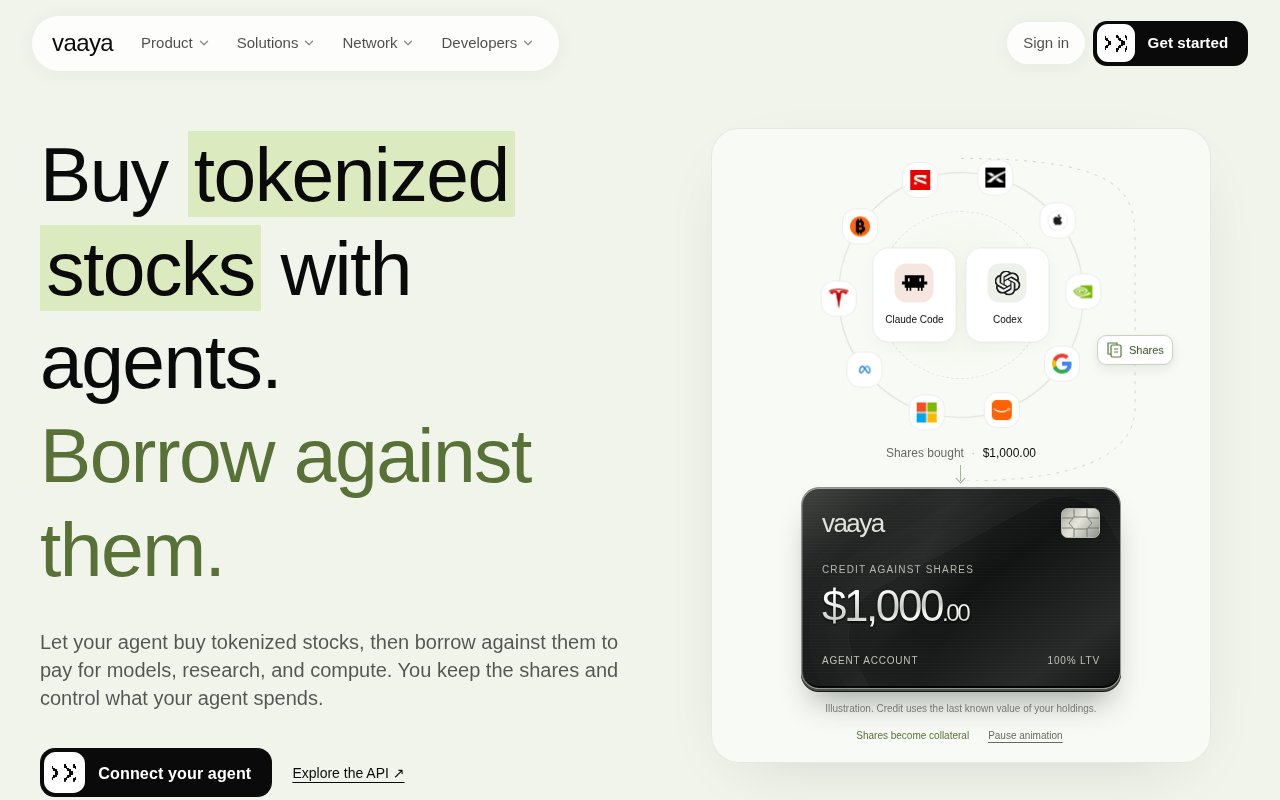
The canonical product page adds an unusual way to expand that spending capacity. An agent can use prepaid funds to buy supported Coinbase-issued tokenized stocks on Base, then use the last known value of confirmed holdings to increase its Vaaya credit limit at a one-to-one ratio. Once holdings are valued, the additional capacity appears automatically. There is no separate borrow call, and the resulting credit can pay for services available through Vaaya. Stock discovery, quotes, purchases, order status, and portfolio reads are exposed through MCP, TypeScript, and Python, allowing an application to preview and submit an order with an idempotency key.
This stock feature is buy-and-hold today. Selling and withdrawals aren't available through Vaaya, purchase availability depends on issuer restrictions and liquidity, and the token units may not match units of the underlying shares. Holdings sit in a managed wallet for the Vaaya account, so this isn't a self-custody brokerage account. Prices can rise or fall, valuations can lag the market, and a lower valuation reduces the share-backed credit limit without erasing outstanding spending. Share credit pays for Vaaya services rather than more stock or a cash withdrawal. Credit drawn still has to be repaid, and investment gains don't automatically settle the account balance.
Vaaya fits developer teams that run agents across many metered services and want one controlled purchasing path. It can also help AI products expose paid tools to their customers' agents without making every customer assemble a collection of vendor accounts. New accounts can receive welcome credit of up to $10 without a card. Users may add prepaid packs of $10, $30, or $100, and those packs don't expire. Connecting a public GitHub history can establish a credit line, with a card required before that line becomes spendable. Drawn card-backed credit is collected weekly or sooner after it passes $50. There is no subscription, seat charge, monthly minimum, or separate platform fee listed. The catalog price is quoted before a call, and users pay only for successful usage, which makes access flexible while keeping the financial obligations visible.
Key Features
- Unified agent credit account
- Per-agent spending policies
- MCP and HTTP API access
- Metered multi-provider service catalog
- Tokenized stock purchasing
- Share-backed agent credit
Pros & Cons
What we like
- Consolidates many provider purchases into one ledger
- Caps spending by agent, category, and transaction
- Charges service calls only when they succeed
- Works in a browser or through developer integrations
Room for improvement
- Share purchases currently can't be sold or withdrawn
- Token availability depends on restrictions and liquidity
- Share-backed spending remains a repayment obligation
- Credit capacity can fall when holdings lose value
Frequently Asked Questions
What is Vaaya?
How can an agent connect to Vaaya?
How does credit against securities work?
Can Vaaya sell or withdraw tokenized stocks?
Best For
Featured in
Alternatives to Vaaya



Reviews (0)
Badge builder
Add Vaaya to your website
Choose a badge style and size, preview it here, then copy the generated HTML. Badge images are self-contained SVGs and do not require an external script.

<a href="https://toolindex.net/tools/vaaya?ref=badge" target="_blank" rel="noopener">
  <img src="https://toolindex.net/badge/vaaya/medium.svg" alt="Vaaya - Listed on Tool Index" width="180" height="50" />
</a>How to use the badge
- 1. Pick the style, size, and theme that fit your layout.
- 2. Copy the generated HTML from the code block.
- 3. Paste it into your footer, homepage, or press page.
Standard badge available
The standard listing badge is available now. Score and circle badges are limited to tools currently ranked in the top 10 of a category.
Badge clicks return visitors to this profile with a referral tag so the source remains identifiable.
Related Tools

Simple RMD
Calculate, aggregate, and manage your annual IRA required minimum distributions.
FreshBooks
Cloud accounting designed for service-based small businesses and freelancers
Deel
Global payroll, contractor, and EOR platform
Chargebee
Subscription billing and revenue management for B2B SaaS
Work on Vaaya? Request listing access or correction