Verbatimeter
Deterministically check how grounded an LLM or RAG answer is in its source text
Gallery
About Verbatimeter
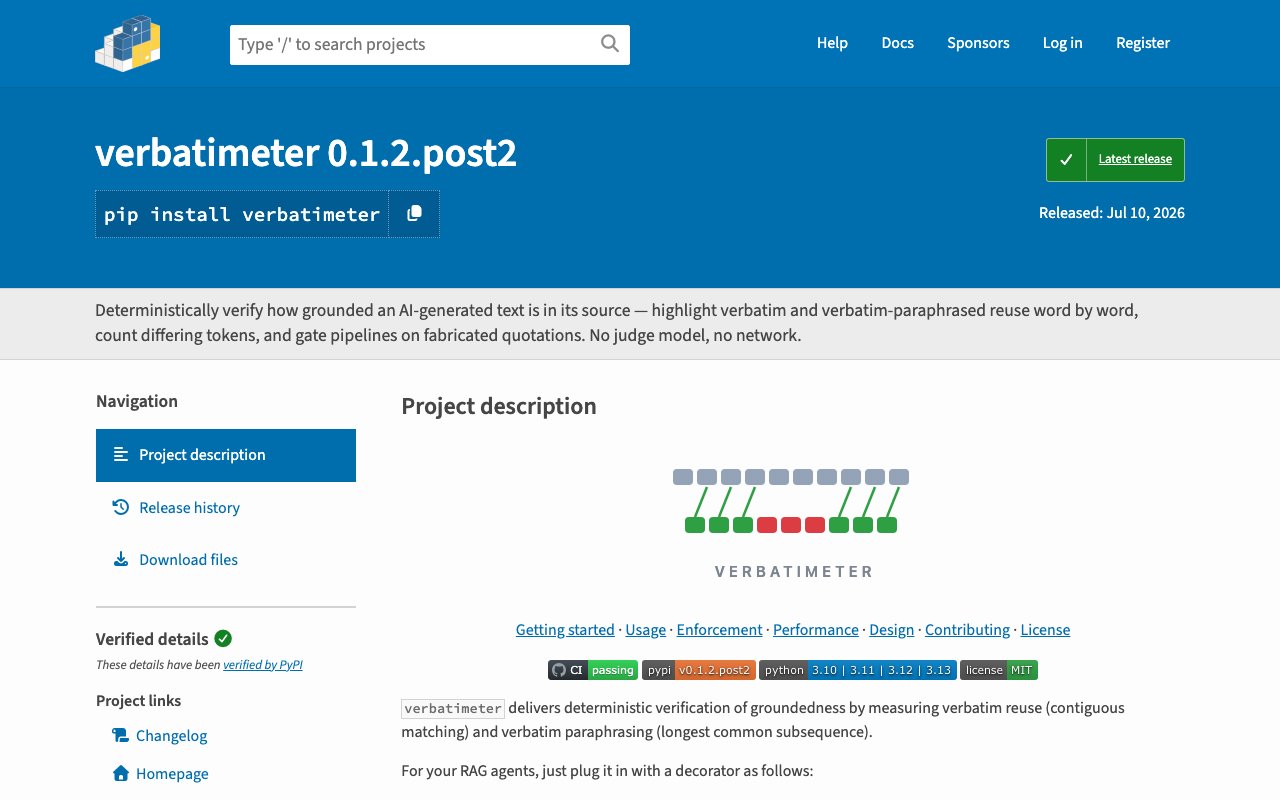
Verbatimeter is an open-source Python tool that checks, deterministically, how grounded an AI-generated answer is in the source text it was supposed to draw from. The problem it targets is familiar to anyone shipping retrieval-augmented generation. A model reads some context, writes an answer, and along the way it can paraphrase loosely, drift away from the passage, or invent a quotation that never appeared. You want to know whether the output actually traces back to the retrieved material, and you want that answer without standing up a separate judge model or making a network call every time you check.
It works by aligning words rather than guessing at meaning. Using word-level dynamic-programming alignment, it detects three things. Verbatim reuse shows up as contiguous matching runs of at least three words. Verbatim paraphrasing is caught with longest-common-subsequence matching, which finds source words that survived even when they were reordered. Quotation verification checks that any span the answer presents as a direct quote genuinely exists in the source. The result is a matched ratio you can threshold on, plus highlighting that shows exactly which parts of an answer are supported and which are floating free. Because the checks are span-level, you're not just told that an answer is 80 percent grounded, you can see which sentences carried real support and which ones the model appears to have made up.
Because everything is a deterministic string operation, the same inputs always produce the same score, and there's no model to prompt or API to pay for. The README is blunt about one of its selling points, that it uses no network access, ever. That makes it cheap to run, easy to reason about, and safe to drop into environments where you can't send text to a third-party service. It also means results are reproducible in a way a judge model can't promise, which matters when you're trying to gate a release or debug a regression.
Getting started is a single pip install verbatimeter. From the command line you can run something like verbatimeter with a source file, an answer file, a quotes flag to check quotations, and a fail flag that exits non-zero when grounding falls short, which is what lets you wire it into continuous integration. As a library it's just as direct. A check function compares candidate text against source text and hands back a result with a matched ratio, and a verify decorator wraps your own generation function so grounding is checked automatically on the way out, scoped either to quotations or to the whole answer. That decorator is the piece that makes it easy to bolt onto a RAG agent, since you pass it the argument that carries your retrieved context and it verifies each response against that context without you rewriting the call site. Token counting is configurable and defaults to tiktoken, so word and token accounting line up with the model you're already using.
A few touches show it's meant for real pipelines rather than a demo. It has a streaming integration that verifies text as it arrives, so you can flag ungrounded output while a response is still being produced instead of only after the fact. The highlighting is configurable and ships with colorblind-accessible palettes. And it carries multilingual support across eleven languages, spanning cases from English and French through to Hindi, Urdu, and Arabic, so grounding checks aren't limited to English-only content.
The people it's for are developers and researchers building RAG systems, LLM applications, and content-verification workflows who want a fast, offline, reproducible grounding check they can actually put in tests. If you've tried to measure hallucination by asking another model to grade the first one, you know how slow, costly, and non-deterministic that loop gets. Verbatimeter is a different bet, that a large share of grounding questions are really questions about textual overlap, and those can be answered exactly with alignment rather than approximately with a second model.
On access, it's MIT-licensed and free, published on PyPI with source on GitHub, and it needs Python 3.10 or newer. It's an early-stage project sitting in the 0.1 range, so the surface area is still small and the community young, but the README is substantive, with usage examples, benchmarks, architecture decision records, and integration notes for RAG agents. For a team that wants a lightweight, auditable guardrail on how faithful its generated text is to its sources, it's a focused tool that does one job and does it without a model in the loop.
Key Features
- Word-level dynamic-programming alignment
- Verbatim reuse detection on 3-word runs
- Paraphrase detection via longest common subsequence
- Quotation existence verification
- Fully local with no network access
- Streaming verification as text arrives
Pros & Cons
What we like
- Deterministic and reproducible, no judge model needed
- Runs entirely offline, so nothing leaves your machine
- Drops into CI with a fail flag that gates on grounding
- MIT-licensed and free with a substantive README
Room for improvement
- Measures textual overlap, not deeper semantic faithfulness
- Early-stage 0.1 project with a small community
- Command-line and library only, no graphical interface
- Requires Python 3.10 or newer to install
Frequently Asked Questions
What is Verbatimeter?
How do I use it?
Is Verbatimeter free?
How is it different from an LLM judge?
Best For
Featured in
Alternatives to Verbatimeter

1Lookup
Real-time data verification API for phone, email, IP, and domain validation to fight fraud

Codedex
A gamified, story-driven platform that teaches Python, web dev, and more like an RPG quest
Hack2hire
Practice real SDE interview questions from top tech companies with expert worked solutions
Cloudflare Pages
Free Jamstack hosting on Cloudflares edge with unlimited bandwidth and tight integration with Workers.
Reviews (8)
Pulled its weight from week one
Found Verbatimeter on a Show HN thread and I am glad I clicked. The drops into ci with a fail flag that gates on grounding is more useful than I expected. The core workflow is smooth once you are set up. Mostly using it for gating a rag release when answers drift from sources. Hard to imagine going back to my old setup.
Solid but not perfect
Have been running Verbatimeter for a while, here is where I land. The word-level dynamic-programming alignment is more useful than I expected. It would be a five if not for early-stage 0.1 project with a small community. Worth it for what I get out of it.
Exactly what I needed
Came to Verbatimeter after getting frustrated with what I had before. It has shaved real time off my week. Recommending it to people in a similar spot.
Recommended without reservation
Picked Verbatimeter for the price, stayed for the quality. The defaults are sensible, so I was not fighting settings on day one. Setup was painless and I was productive the same day. Mostly using it for verifying that quoted spans actually exist in the source. Hard to imagine going back to my old setup.
Two months in, no regrets
Started using Verbatimeter casually, now it is pinned in my dock. The quotation existence verification is more useful than I expected.
Solid daily driver
Verbatimeter has quietly become part of my daily flow. The interface stays out of my way, which I appreciate. Easy yes for anyone weighing the same trade offs.
Powerful once it clicks
Came to Verbatimeter after getting frustrated with what I had before. The output quality holds up better than I expected. It slotted into my routine without much fuss. The catch is early-stage 0.1 project with a small community. No regrets so far.
Worth a look
Verbatimeter solves a real problem for me without making a fuss about it. What stands out is how it handles paraphrase detection via longest common subsequence. Would sign up again without thinking twice.
Badge builder
Add Verbatimeter to your website
Choose a badge style and size, preview it here, then copy the generated HTML. Badge images are self-contained SVGs and do not require an external script.

<a href="https://toolindex.net/tools/verbatimeter?ref=badge" target="_blank" rel="noopener">
  <img src="https://toolindex.net/badge/verbatimeter/medium.svg" alt="Verbatimeter - Listed on Tool Index" width="180" height="50" />
</a>How to use the badge
- 1. Pick the style, size, and theme that fit your layout.
- 2. Copy the generated HTML from the code block.
- 3. Paste it into your footer, homepage, or press page.
Standard badge available
The standard listing badge is available now. Score and circle badges are limited to tools currently ranked in the top 10 of a category.
Badge clicks return visitors to this profile with a referral tag so the source remains identifiable.
Related Tools

Kevin Gabeci
Solo developer building web apps, cozy browser games, and AI creator toolkits.
Coolify
Self-hostable, open source alternative to Heroku and Netlify

Warp
The modern terminal reimagined with AI and collaboration

Bolt.new
Prompt-to-deployed full-stack app inside the browser
Work on Verbatimeter? Request listing access or correction