
ViewKit
Browser-based dataset viewer for ML researchers with full client-side processing
Gallery
About ViewKit
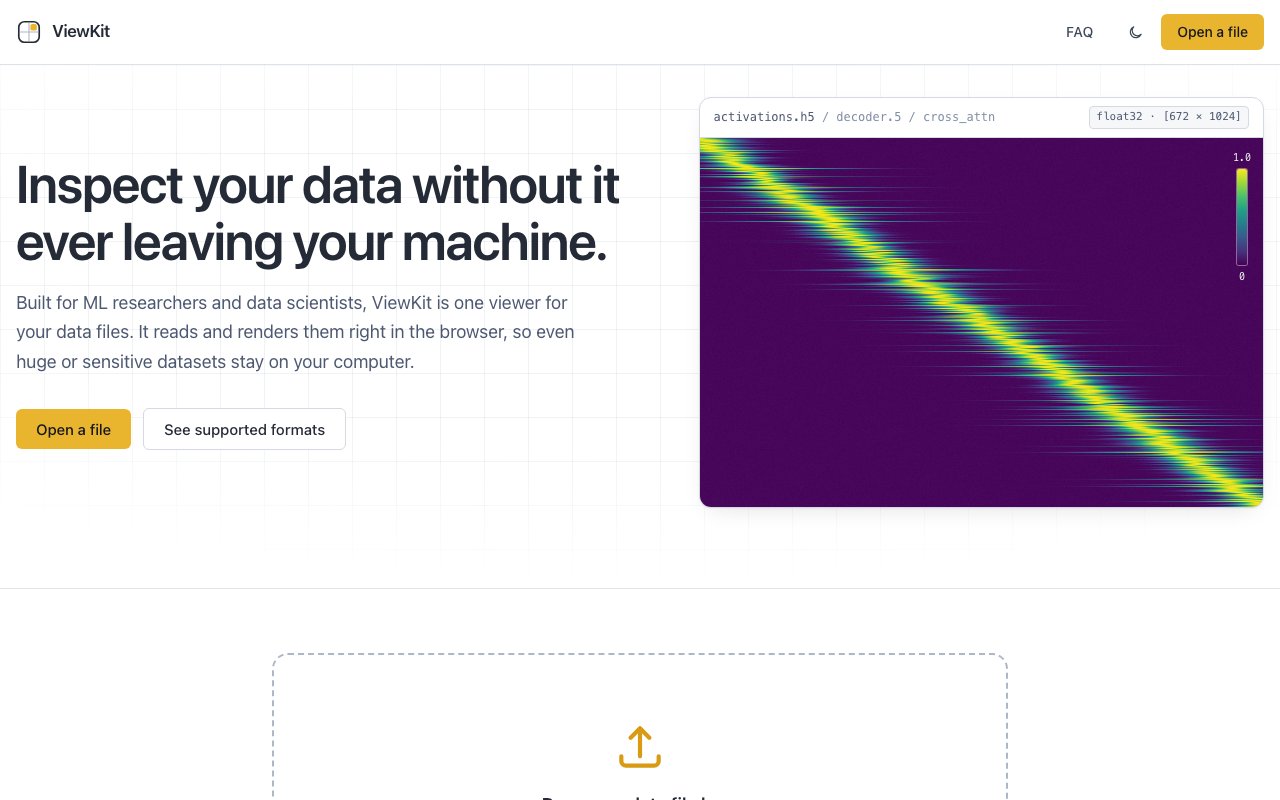
ViewKit is a browser-based data file viewer built for machine learning researchers and data scientists who need to inspect datasets without uploading them anywhere. The entire application runs client-side, which means your data never leaves your machine. You open a file, it processes in your browser, and that's it. No server, no upload, no third party ever sees your work.
The problem it solves is one that anyone working with research data knows well. You have an HDF5 file or a Parquet dataset sitting on your machine, and you just want to look at it. The traditional path is to fire up a Jupyter notebook, import the right libraries, and write a few lines of code to peek at the structure. ViewKit skips all of that. You drag the file into the browser, and you're looking at the data in seconds.
Format support is broad and clearly aimed at the ML ecosystem. It handles HDF5, Parquet, Zarr in both v2 and v3, CSV, TSV, Excel, JSON Lines, Apache Arrow, Feather, NumPy arrays in npy and npz form, safetensors, TFRecord, WebDataset tar archives, and a range of audio files including WAV, MP3, FLAC, OGG, and M4A. That coverage means you can open most of the common artifacts from a training pipeline without switching tools or installing anything locally.
The audience is anyone who touches datasets in a research or production ML context. If you're debugging a data pipeline, checking the shape of tensors before a training run, or just exploring a dataset you received from a collaborator, ViewKit lets you do that in the browser. There's no account to create, no installation to manage, and no data leaving your control.
What sets it apart is the combination of breadth and simplicity. Plenty of tools can open a CSV, but fewer handle the more specialized formats like safetensors or TFRecord without requiring local setup. And because everything runs in the browser with client-side processing, you can use it on a locked-down work machine where you can't install arbitrary software. The privacy story is strong because there's nothing to trust beyond your own browser.
ViewKit is free with no paid tier mentioned. You visit the site, open your file, and inspect your data. There's light and dark mode support that persists between sessions, but the core value is the instant, zero-friction inspection of datasets in a format-aware viewer that never phones home.
Key Features
- Full client-side data processing
- Support for HDF5, Parquet, Zarr, safetensors, and more
- NumPy array inspection for npy and npz files
- Audio file preview for WAV, MP3, FLAC, OGG, M4A
- No installation or account required
- Light and dark mode with persistence
Pros & Cons
What we like
- Data never leaves your machine because everything runs in the browser
- Supports over a dozen ML and data science file formats
- No setup or installation needed on any operating system
- Completely free with no paywalls or usage limits
Room for improvement
- Performance depends on browser and local hardware for large files
- No editing or transformation capabilities, read-only inspection only
- Newer tool with a smaller community and fewer resources
- Limited documentation for advanced use cases
Frequently Asked Questions
What is ViewKit?
Does ViewKit upload my data anywhere?
Is ViewKit free?
What file formats does ViewKit support?
Best For
Featured in
Alternatives to ViewKit
View all
1Lookup
Real-time data verification API for phone, email, IP, and domain validation to fight fraud

Kevin Gabeci
Solo developer building web apps, cozy browser games, and AI creator toolkits.

Codedex
A gamified, story-driven platform that teaches Python, web dev, and more like an RPG quest
Hack2hire
Practice real SDE interview questions from top tech companies with expert worked solutions
Reviews (0)
Badge builder
Add ViewKit to your website
Choose a badge style and size, preview it here, then copy the generated HTML. Badge images are self-contained SVGs and do not require an external script.

<a href="https://toolindex.net/tools/viewkit?ref=badge" target="_blank" rel="noopener">
  <img src="https://toolindex.net/badge/viewkit/medium.svg" alt="ViewKit - Listed on Tool Index" width="180" height="50" />
</a>How to use the badge
- 1. Pick the style, size, and theme that fit your layout.
- 2. Copy the generated HTML from the code block.
- 3. Paste it into your footer, homepage, or press page.
Standard badge available
The standard listing badge is available now. Score and circle badges are limited to tools currently ranked in the top 10 of a category.
Badge clicks return visitors to this profile with a referral tag so the source remains identifiable.
Related Tools
Kevin Gabeci
Solo developer building web apps, cozy browser games, and AI creator toolkits.

Warp
The modern terminal reimagined with AI and collaboration

Bolt.new
Prompt-to-deployed full-stack app inside the browser

Supabase
The open source Firebase alternative
Work on ViewKit? Request listing access or correction