ZenVeil
Security scanner tuned to the vulnerabilities AI coding tools leave behind
Gallery
About ZenVeil
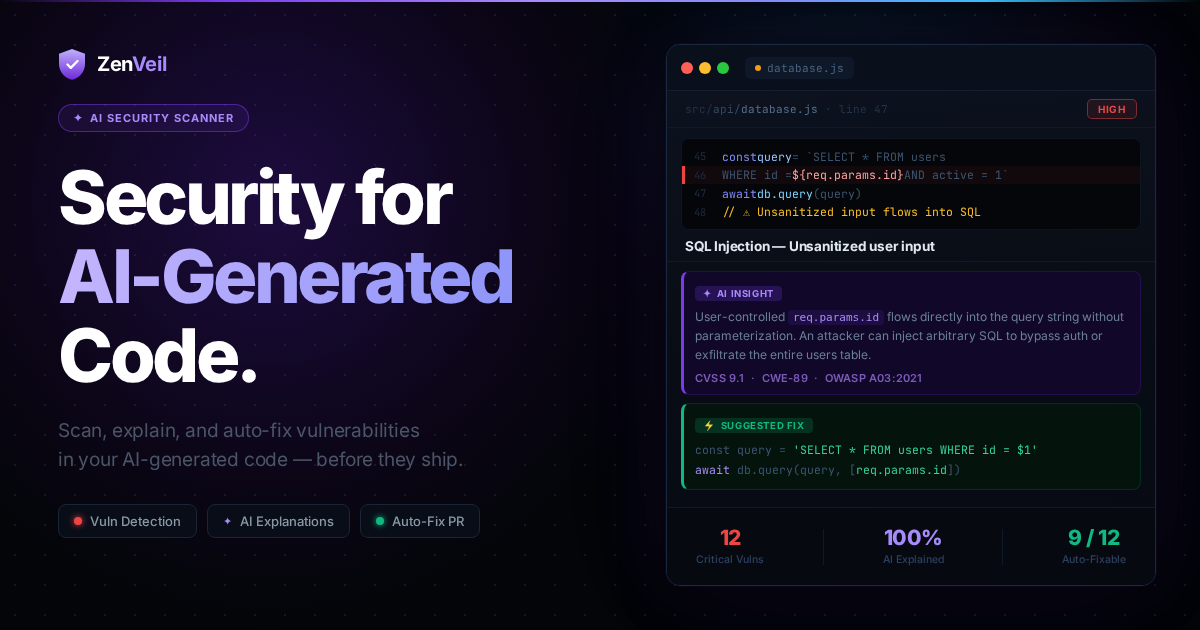
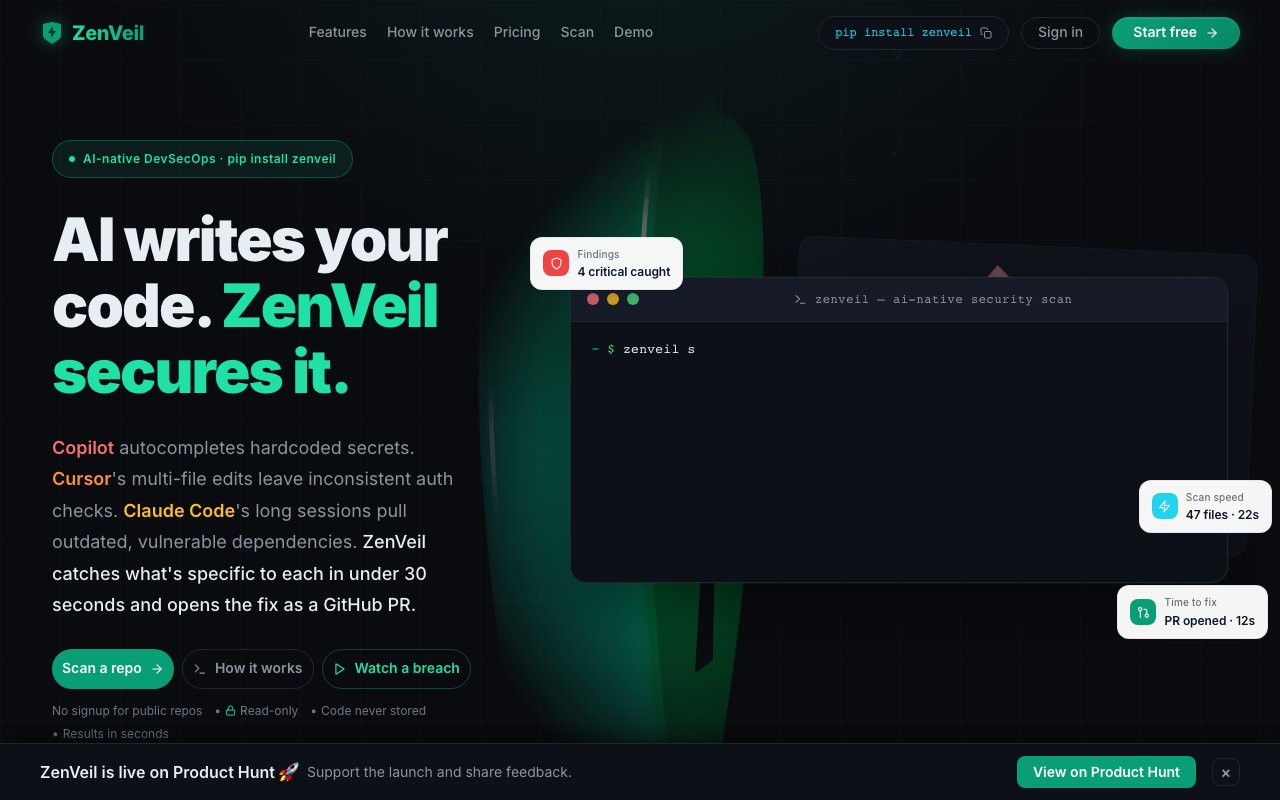
ZenVeil is a security scanner built for one specific situation, which is code an AI wrote. The headline on the site is "AI writes your code. ZenVeil secures it." and the argument underneath it is that traditional scanners were designed for the mistakes humans make, while assistants like GitHub Copilot, Cursor, and Claude Code fail in their own recognisable patterns. It runs as a CLI, a GitHub Action, or through a dashboard, and when it finds something it can open the fix as a pull request rather than handing you a report to work through. The framing is worth taking seriously, because the volume of code a small team ships has gone up sharply while the number of people reading it carefully has not.
The failure patterns it names are concrete, and that specificity is most of the pitch. Copilot autocompletes hardcoded secrets, because it learned from repositories full of them. Cursor's multi-file edits leave auth checks inconsistent, since a change applied across several files doesn't always land everywhere it should. Claude Code's long sessions pull in outdated dependencies with known vulnerabilities, because a model working from memory reaches for the version it knows. None of these are exotic. They're the predictable seams of letting a model write at speed, and they slip through review precisely because the code looks fine. Generated code tends to be well formatted and plausibly structured, which is exactly what disarms a reviewer skimming a large diff on a Friday.
What it actually scans for covers the usual high-severity ground with an AI-shaped emphasis. It detects hardcoded secrets against more than 200 patterns including AWS keys, JWT tokens, and API credentials. It flags routes missing authorization middleware, which is the inconsistent-auth problem showing up as a real hole. It catches tokens parked in browser localStorage, where any cross-site scripting bug turns into account takeover. It checks the dependency tree against CVE data for supply chain issues, and looks for exposed source maps and dependency confusion risk. Findings map to the OWASP Top 10, so the output lands in a vocabulary security teams and auditors already use.
Speed is treated as a feature rather than a footnote, and the reasoning holds up. The site cites roughly 47 files scanned in 22 seconds and a target of catching what's specific to each assistant in under 30 seconds. A scanner that takes ten minutes gets skipped, then disabled, then forgotten. One that finishes before you've switched tabs can sit in the loop where AI-generated code is actually produced, which is the only place it does any good. Installation is a single pip command, and there's a GitHub Actions workflow so the same check runs on every pull request without anyone remembering to trigger it.
The remediation side is what separates it from a linter that shouts. Rather than printing a list of file paths and line numbers, it can generate a pull request with the fix already written, which puts the finding into a workflow developers already respond to. Paid tiers add AI-generated explanations alongside the fixes, so a junior developer learns why localStorage was the wrong place for that token instead of just merging a diff they don't understand. That matters more as teams lean harder on generated code, because the knowledge gap widens exactly when the volume of code goes up.
It's aimed at developers and small teams shipping with AI assistants daily, and at security engineers who've noticed their existing tooling wasn't tuned for this. If your team went from writing every line to reviewing generated pull requests, the review bottleneck moved and your scanner probably didn't move with it. Reviewers who once read every line now skim diffs they didn't write, in volumes nobody was reading before, and what slips through is exactly the quiet structural problem this looks for. The narrow focus cuts both ways. ZenVeil isn't trying to be a full application security platform, and if you need deep static analysis across a large legacy codebase you'll still want a heavier tool beside it. What it does is cover the specific gap that opened when assistants started writing production code, which is a gap most teams didn't have two years ago and can't really ignore now.
Access is freemium and the free tier is genuinely usable for evaluation, with 3 public repository scans an hour, no credit card, and basic findings included. Pro is $19 a month for unlimited scans, private repositories, and AI-powered explanations and fixes. Team is $59 a month for up to 5 members with compliance reports. Enterprise is custom priced and adds SSO, audit logs, and on-premise deployment. The product launched on Product Hunt, the dashboard is live, and the published contact is security@zenveil.dev.
Key Features
- Detection tuned to AI assistant failure patterns
- Secret scanning across 200+ credential patterns
- Missing authorization middleware detection
- CVE-based supply chain and dependency checks
- Automatic fix pull requests on GitHub
- CLI plus GitHub Actions integration
Pros & Cons
What we like
- Targets the specific mistakes Copilot, Cursor, and Claude Code actually make
- Opens fixes as pull requests instead of just listing findings
- Fast enough to sit in the loop without anyone disabling it
- Free tier needs no credit card, and findings map to the OWASP Top 10
Room for improvement
- Free tier is limited to public repositories and 3 scans an hour
- Narrow focus, so it doesn't replace a full application security platform
- GitHub-centric, which is awkward if you host code elsewhere
- Younger product with a short public track record
Frequently Asked Questions
What is ZenVeil?
How is ZenVeil different from a normal security scanner?
Is ZenVeil free?
Who is ZenVeil for?
Best For
Featured in
Alternatives to ZenVeil

1Password
Password and secrets manager for individuals, families, and developer teams with strong CLI and SSH agent support.
Clerk
Drop-in authentication and user management for modern apps

Tailscale
WireGuard-based mesh VPN that connects your devices, servers, and cloud resources into one private network in minutes.

BackPedal
UK bike theft protection that sends recovery agents after your stolen bike
Reviews (9)
Pulled its weight from week one
Found ZenVeil on a Show HN thread and I am glad I clicked. Got real value out of opens fixes as pull requests instead of just listing findings. Setup was painless and I was productive the same day. Worth it for what I get out of it.
Quietly excellent
ZenVeil has quietly become part of my daily flow. Their take on automatic fix pull requests on github is genuinely good.
Solid daily driver
Picked ZenVeil for the price, stayed for the quality. The core workflow is smooth once you are set up. It fits well for catching hardcoded secrets before ai-generated code gets merged. It earns its place in my stack.
Quietly excellent
Picked ZenVeil for the price, stayed for the quality. Performance has been steady even when I lean on it hard. It fits well for gating pull requests from ai assistants in ci.
Recommended without reservation
Three months of ZenVeil later, here is what holds up. Setup was painless and I was productive the same day. It handles the boring parts so I can focus on the work that matters. Easy yes for anyone weighing the same trade offs.
Two months in, no regrets
Started using ZenVeil casually, now it is pinned in my dock. Got real value out of opens fixes as pull requests instead of just listing findings. No regrets so far.
Solid daily driver
Three months of ZenVeil later, here is what holds up. What stands out is how it handles free tier needs no credit card, and findings map to the owasp top 10. It fits well for finding auth checks that multi-file ai edits left inconsistent. Glad I made the switch.
Genuinely impressed
Came to ZenVeil after getting frustrated with what I had before. Their take on secret scanning across 200+ credential patterns is genuinely good. It fits well for catching hardcoded secrets before ai-generated code gets merged. Would sign up again without thinking twice.
Genuinely impressed
ZenVeil has quietly become part of my daily flow. Their take on targets the specific mistakes copilot, cursor, and claude code actually make is genuinely good. The thing I keep coming back to is how reliable it is. It earns its place in my stack.
Badge builder
Add ZenVeil to your website
Choose a badge style and size, preview it here, then copy the generated HTML. Badge images are self-contained SVGs and do not require an external script.

<a href="https://toolindex.net/tools/zenveil?ref=badge" target="_blank" rel="noopener">
  <img src="https://toolindex.net/badge/zenveil/medium.svg" alt="ZenVeil - Listed on Tool Index" width="180" height="50" />
</a>How to use the badge
- 1. Pick the style, size, and theme that fit your layout.
- 2. Copy the generated HTML from the code block.
- 3. Paste it into your footer, homepage, or press page.
Standard badge available
The standard listing badge is available now. Score and circle badges are limited to tools currently ranked in the top 10 of a category.
Badge clicks return visitors to this profile with a referral tag so the source remains identifiable.
Related Tools
Clerk
Drop-in authentication and user management for modern apps

DomeSOC
Autonomous SOC that grades every AI claim against evidence before it reaches an analyst
Reel
Forensic evidence capture for regulated Kubernetes, plus a free open-source VEX hub

HeimWall
Menu bar app that catches secrets and PII before you paste them into AI coding tools
Work on ZenVeil? Request listing access or correction