
AgentsProof
Trace, grade and share proof that your AI agent actually works
Gallery
About AgentsProof
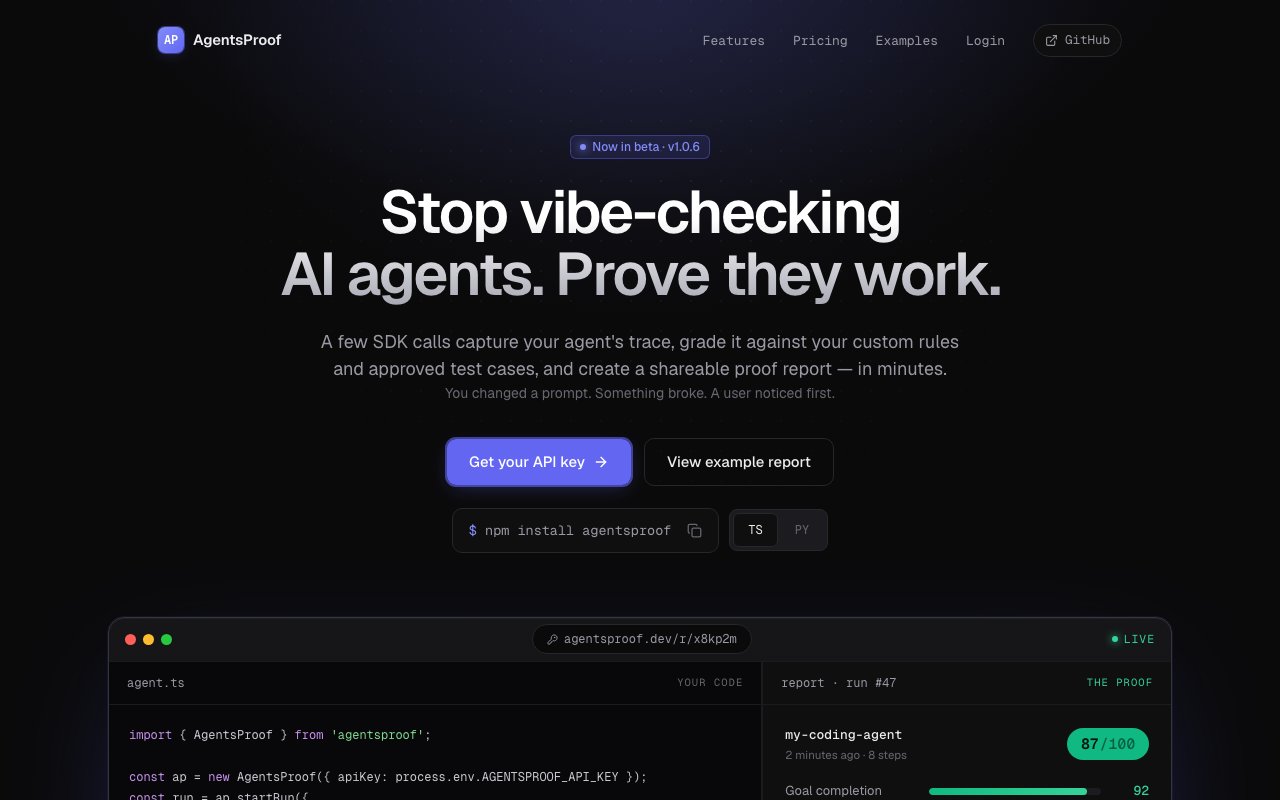
AgentsProof is an evaluation platform for AI agents. You wrap your existing LLM and tool calls in a few SDK calls, and it captures the run as a trace, grades it against rules you wrote, and produces a report you can hand to someone else. The pitch on the site is aimed at a specific failure, you changed a prompt, something broke, and a user noticed before you did.
Integration is deliberately small. You install the package from npm, create a client with an API key, and call startRun with a project slug, the input, and a plain-English goal that anchors how the run gets graded. Each LLM or tool call gets wrapped in run.trace with a label and the function itself. When you call complete, you get back a public URL for the report. There are TypeScript and Python paths, and the site lists OpenAI, Anthropic, LangChain, CrewAI, the Vercel AI SDK and LlamaIndex as things it drops into, since it instruments your calls rather than replacing your framework.
Grading works on several layers, which is the more interesting part. Custom graders let you write what good means in plain English, something like the agent must never reveal user PII, and every run gets checked against those rules automatically. Goldens turn a run that passed into an executable test spec with success criteria, expected behavior and assertions attached, and you can pass a goldenId straight into startRun to test against it on demand. Trace assertions are the deterministic layer, structured checks that run without an LLM at all, so a rule like must_not_call:send_email or max_steps:10 fails the case outright and catches regressions an LLM judge might wave through. Synthetic variants use AI to generate edge cases from your existing Goldens so the suite grows without you hand-writing every test.
The onboarding is laid out as five steps and they map cleanly onto how you'd actually adopt it. Install the package, which the site describes as one package with zero config that works in any Node or edge runtime. Wrap your calls with run.trace, which it calls the whole integration. Add custom graders from the dashboard so the LLM checks every run against your rules. Save a passing run as a Golden from the trace view to set your success bar. Then run the proof suite. You can walk the output before writing any code, because example reports are live and public on the site. A report shows the project, how long ago the run happened and how many steps it took, an overall score out of 100, and the individual axis scores underneath it.
Proof suites tie it together. One SDK call runs every approved Golden through your agent and produces a report showing per-criterion pass and fail for each case alongside a five-axis score covering goal completion, tool accuracy, step efficiency, output quality and safety. The point the product keeps making is that a single number isn't enough, so results stay explainable down to the individual criterion rather than collapsing into one grade.
The reports being public and shareable is the angle that separates it from the obvious comparisons. AgentsProof puts itself next to LangSmith and Braintrust on its own comparison table and claims the differences are shareable public proof reports, a roughly five-minute SDK setup, saving real runs as test cases, and being designed for indie builders. That last one is the honest framing. This is built for a solo developer or small team who needs to show a client or a user that an agent behaves, not for an enterprise platform rollout.
Pricing is freemium and the free tier is usable rather than decorative. Free gives you one project, 200 eval runs a month, the default LLM grader, 10 golden test cases, one proof suite, public reports and basic email support, with no card required. Pro runs $29 a month or $290 a year and lifts that to unlimited projects, 10,000 eval runs a month, unlimited custom graders, Goldens and suites, private reports alongside public ones, and priority support. An eval run is counted each time startRun fires in the SDK, and hitting the free ceiling returns a 402 from the SDK while your previous runs stay available. Pro cancels anytime from the dashboard. The product is marked as being in beta, which is worth knowing before you build a release gate on top of it. Example reports are live and browsable on the site without an account, and there are public GitHub repositories for the project and its examples, so you can see the integration shape before committing any code. If you're shipping agents and your current quality process is running them a few times and eyeballing the output, this is aimed squarely at that gap.
Key Features
- Plain-English custom graders
- Goldens as executable test specs
- Deterministic trace assertions
- AI-generated synthetic test variants
- Public shareable proof reports
- Batch proof suites with per-criterion results
Pros & Cons
What we like
- Integration is a few SDK calls around your existing LLM and tool calls
- Framework-agnostic across OpenAI, Anthropic, LangChain, CrewAI and more
- Shareable public reports turn agent reliability into something you can show
- Free tier covers 200 eval runs a month with no card required
Room for improvement
- Still in beta, so limits and behavior may shift
- Free tier keeps every report public
- Each graded run counts against a monthly eval quota
- Requires code changes to instrument your agent
Frequently Asked Questions
What is AgentsProof?
Is AgentsProof free?
Which frameworks does AgentsProof work with?
How is AgentsProof different from LangSmith or Braintrust?
Best For
Featured in
Alternatives to AgentsProof
View all
Playwright
Microsofts open-source end-to-end browser testing framework for Chromium, Firefox, and WebKit with one API.
Buildkite
Hybrid CI/CD where the control plane is hosted but the build agents run on your own infrastructure.

Storybook
Open-source workshop for building UI components in isolation. Preview, document, and test them outside the app.

Postman
API client and collaboration platform that started as a Chrome extension and now covers design, testing, and mocking.
Reviews (13)
Genuinely impressed
Picked AgentsProof for the price, stayed for the quality. Where it really wins is integration is a few sdk calls around your existing llm and tool calls. The core workflow is smooth once you are set up. Worth it for what I get out of it.
Genuinely impressed
Have been running AgentsProof for a while, here is where I land. The free tier covers 200 eval runs a month with no card required is more useful than I expected. The defaults are sensible, so I was not fighting settings on day one. Found it works best for catching agent regressions after changing a prompt. It earns its place in my stack.
It just works
Tried AgentsProof on a side project first, then rolled it out everywhere. Got real value out of integration is a few sdk calls around your existing llm and tool calls. Mostly using it for showing a client an agent meets its success bar.
Powerful once it clicks
Came to AgentsProof after getting frustrated with what I had before. The shareable public reports turn agent reliability into something you can show is more useful than I expected. Found it works best for turning a passing run into a repeatable test case. It would be a five if not for requires code changes to instrument your agent.
Quietly excellent
Picked AgentsProof for the price, stayed for the quality. Their take on batch proof suites with per-criterion results is genuinely good. It does what it says, which is rarer than it should be. It fits well for showing a client an agent meets its success bar.
Decent with some rough edges
Hadn't planned on switching, but AgentsProof was hard to ignore. Their take on public shareable proof reports is genuinely good. It fits well for turning a passing run into a repeatable test case. It would be a five if not for still in beta, so limits and behavior may shift. Worth it for what I get out of it.
Quietly excellent
AgentsProof has quietly become part of my daily flow. Where it really wins is integration is a few sdk calls around your existing llm and tool calls. Recommending it to people in a similar spot.
Solid daily driver
Three months of AgentsProof later, here is what holds up. It does what it says, which is rarer than it should be. Mostly using it for turning a passing run into a repeatable test case. Recommending it to people in a similar spot.
Exactly what I needed
Three months of AgentsProof later, here is what holds up. The plain-english custom graders is more useful than I expected. Support actually answered when I had a question, which surprised me. Mostly using it for growing an agent test suite without hand-writing tests. Would sign up again without thinking twice.
Recommended without reservation
Found AgentsProof on a Show HN thread and I am glad I clicked. What stands out is how it handles framework-agnostic across openai, anthropic, langchain, crewai and more. Would sign up again without thinking twice.
Decent with some rough edges
Tried AgentsProof on a side project first, then rolled it out everywhere. The interface stays out of my way, which I appreciate. My only gripe is free tier keeps every report public. Hard to imagine going back to my old setup.
Powerful once it clicks
Tried AgentsProof on a side project first, then rolled it out everywhere. Got real value out of shareable public reports turn agent reliability into something you can show. It handles the boring parts so I can focus on the work that matters. It fits well for growing an agent test suite without hand-writing tests. The catch is free tier keeps every report public. Worth it for what I get out of it.
Pulled its weight from week one
Three months of AgentsProof later, here is what holds up. Where it really wins is free tier covers 200 eval runs a month with no card required. The defaults are sensible, so I was not fighting settings on day one.
Badge builder
Add AgentsProof to your website
Choose a badge style and size, preview it here, then copy the generated HTML. Badge images are self-contained SVGs and do not require an external script.

<a href="https://toolindex.net/tools/agentsproof?ref=badge" target="_blank" rel="noopener">
  <img src="https://toolindex.net/badge/agentsproof/medium.svg" alt="AgentsProof - Listed on Tool Index" width="180" height="50" />
</a>How to use the badge
- 1. Pick the style, size, and theme that fit your layout.
- 2. Copy the generated HTML from the code block.
- 3. Paste it into your footer, homepage, or press page.
Standard badge available
The standard listing badge is available now. Score and circle badges are limited to tools currently ranked in the top 10 of a category.
Badge clicks return visitors to this profile with a referral tag so the source remains identifiable.
Related Tools

DeviceKit
Free Screen & Device Tests Online | Private Browser Diagnostics

Chromatic
Visual regression testing and review platform built by the Storybook team, with cloud-rendered snapshots and PR integration.
Playwright
Microsofts open-source end-to-end browser testing framework for Chromium, Firefox, and WebKit with one API.

Tests.ws
WebSocket testing tools, protocol guides, and a Chrome extension for developers
Work on AgentsProof? Request listing access or correction