
AletheionAGI
Grounding layer that validates AI outputs against your evidence before delivery
Gallery
About AletheionAGI
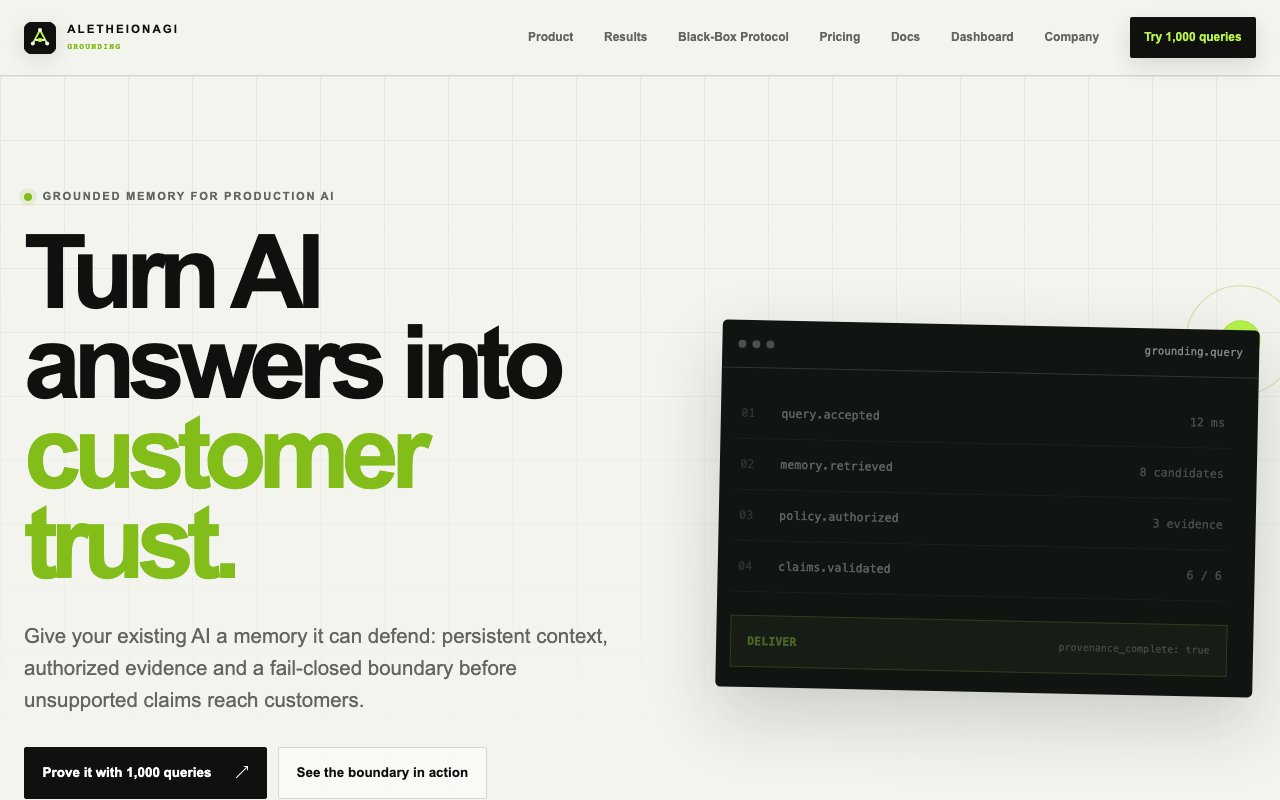
AletheionAGI is infrastructure that sits between your AI system and your users to make sure outputs are backed by evidence before they ship. It provides a grounding layer, a fact check checkpoint that validates claims against your authorized data sources and blocks anything unsupported from reaching customers. The design philosophy is fail closed rather than fail open, meaning if evidence cannot be found to support a statement, the system explicitly abstains rather than guessing. If you are building a product where accuracy matters more than sounding confident, this is the plumbing that enforces it.
The problem it tackles is familiar to anyone who has deployed a language model in production. The model generates fluent, plausible sounding answers, but some of them are wrong. In domains like customer support, commerce agents, or internal copilots, a wrong answer is not just embarrassing. It can cost money, damage trust, or create liability. AletheionAGI addresses this by treating retrieval and validation as first class operations rather than afterthoughts. The platform positions itself as persistent memory with authorized evidence and fail closed grounding for AI, meaning the memory persists across sessions, evidence is scoped by authorization rules, and nothing ships unless it passes the grounding check.
Under the hood the system operates in four stages. First, canonical events remain under your authority, so you control what counts as ground truth. Second, retrieval combines multiple methods including the company's own ASM-CM approach alongside BM25 and vector search, pulling candidates that might support a claim. Third, authorization applies namespace and label constraints to those candidates, ensuring that cross account data never leaks into a response. Fourth, grounding validates that the retrieved evidence actually supports the output, and if it does not, delivery is blocked. The architecture separates the grounding bridge from the reader model entirely, so you can swap language models without renegotiating how evidence is handled.
The benchmark numbers the company publishes show how the multi method retrieval compares to single method approaches. On 979 MultiWOZ support questions using Qwen3 14B, the ASM-CM plus Bridge configuration hit 93.6 percent recall at five retrievals and a 66.5 percent diagnostic answer score while using only 1.09K input tokens. For comparison, standard vector RAG hit 70 percent recall and 49.7 percent score at 2.04K tokens, and BM25 landed at 75.9 percent recall and 56.8 percent score at 2.20K tokens. The takeaway is that retrieval quality goes up while token usage goes down, which matters both for accuracy and for inference cost.
The architecture includes a persistent memory layer where corrections accumulate in a feedback ledger without contaminating your source data. If a user reports an error, that feedback informs future retrievals without requiring you to edit the original documents. The system handles incorrect, malicious, and contradictory feedback explicitly, treating feedback integrity as a named threat class. Namespace isolation means different tenants or product lines stay separated, which matters if you are running multi tenant infrastructure or have strict data boundaries. The company lists 22 failure classes across feedback, retrieval, authorization, delivery, and lifecycle, all of which it claims to mitigate through deterministic controls. Internal testing shows 18 out of 18 deterministic controls passed and 45 out of 45 unsafe deliveries contained.
Pricing starts with a test plan at ninety nine Brazilian reais for one thousand grounding queries over thirty days. That plan includes one namespace, concurrency of one, dashboard access, and documentation. There is no auto renewal or overage charge, so the trial just stops when you hit the limit. Production deployments require a custom quote and legal review. You bring your own key for the reader model, so you control which language model backs the generation side and how you get billed for inference. Checkout is immediate via Stripe.
AletheionAGI is for teams shipping AI features where hallucination is a serious problem, not a minor annoyance. Customer support bots that need to remember account history safely, commerce agents that preserve personalization while respecting tenant boundaries, and internal copilots that require auditable organizational context all fit the profile. It will not make a model smarter, but it will make it harder for unsupported claims to slip through. If you have already built retrieval augmented generation and found that retrieval alone does not stop hallucinations, this adds the enforcement layer you were probably going to build yourself anyway. The mean warm query latency sits around 311ms, so the check is fast enough to run inline without noticeable delay on most applications.
Key Features
- Fail-closed delivery blocking unsupported outputs
- Multi-method retrieval with ASM-CM, BM25, vector
- Feedback ledger for corrections without source edits
- Namespace isolation for multi-tenant deployments
- Bring your own reader model
- Persistent memory layer
Pros & Cons
What we like
- Blocks hallucinations before they reach users
- Corrections accumulate without editing source data
- Supports multiple retrieval methods in one layer
- Namespace isolation keeps tenant data separate
Room for improvement
- Pricing in Brazilian reais may complicate budgeting
- Production plans require custom quoting
- Adds latency to the generation pipeline
- Newer product with limited public case studies
Frequently Asked Questions
What is AletheionAGI?
How does AletheionAGI prevent hallucinations?
Is there a free tier?
Who is AletheionAGI for?
Best For
Featured in
Alternatives to AletheionAGI

Stack AI
No-code platform for building and deploying enterprise AI agents and workflows on a visual canvas
Rememori
Embedded memory engine for AI agents in TypeScript with zero dependencies

Almanac
A hosted, source-cited wiki that turns your files into context your AI agents can use

Demi AI
Demi helps busy professionals eliminate repetitive admin work across their favorite tools.
Reviews (0)
Badge builder
Add AletheionAGI to your website
Choose a badge style and size, preview it here, then copy the generated HTML. Badge images are self-contained SVGs and do not require an external script.

<a href="https://toolindex.net/tools/aletheionagi?ref=badge" target="_blank" rel="noopener">
  <img src="https://toolindex.net/badge/aletheionagi/medium.svg" alt="AletheionAGI - Listed on Tool Index" width="180" height="50" />
</a>How to use the badge
- 1. Pick the style, size, and theme that fit your layout.
- 2. Copy the generated HTML from the code block.
- 3. Paste it into your footer, homepage, or press page.
Standard badge available
The standard listing badge is available now. Score and circle badges are limited to tools currently ranked in the top 10 of a category.
Badge clicks return visitors to this profile with a referral tag so the source remains identifiable.
Related Tools

OpenBenchmarks
Public, externally validated benchmarks that help agents pick SaaS APIs
Almanac
A hosted, source-cited wiki that turns your files into context your AI agents can use

Wizard
Self-extending Rust terminal AI agent that works with any model

Chariot
Elastic cloud infrastructure for deploying and scaling AI agent fleets with persistent storage
Work on AletheionAGI? Request listing access or correction