
Animaxxing
Agent skills that teach Claude Code, Cursor and Codex to add GSAP animation to your website
Gallery
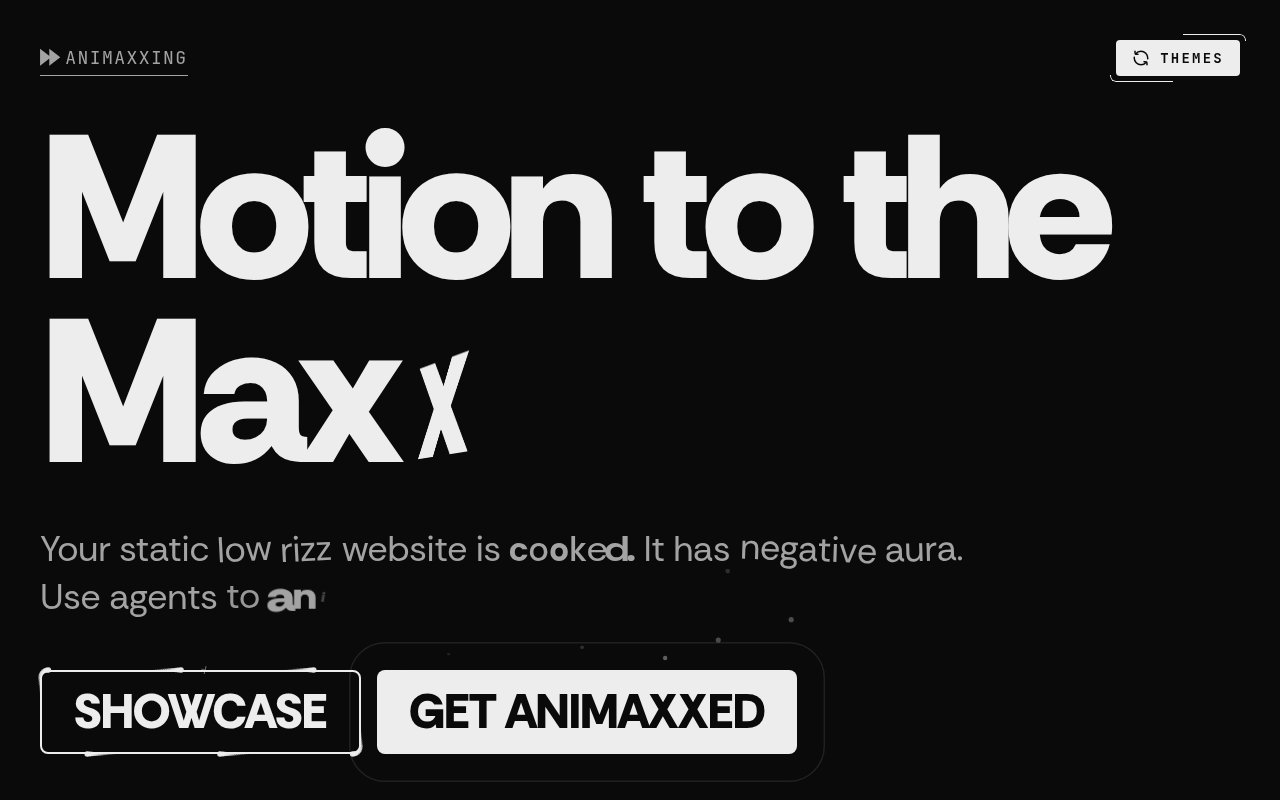
About Animaxxing
Animaxxing is a set of agent skills that teach AI coding assistants how to animate a website properly with GSAP. Install them into Claude Code, Cursor, Codex, Copilot or any of the dozens of agents that read the Agent Skills format, and the agent picks up a working knowledge of page transitions, scroll reveals, split-text headings and the framework-specific cleanup that stops those animations from breaking on navigation. The site at animaxxing.com is the demo, a Next.js page built with the same skills, so you can see the result before you install anything.
The problem it targets is that agents build static pages by default, and when you ask for motion the hard part isn't the tween. It's the lifecycle, when to start an animation, how to tear it down when the route changes, and how to make it behave with a given framework's rendering model. Generic GSAP knowledge doesn't cover that, and the framework skills are written specifically to fill the gap. Installation is one line. Running npx skills add against the gsap-skills repository and then the animaxxing-skills repository puts both layers in place, and Claude Code users can add it through the plugin marketplace instead. Cursor takes it as a remote rule pointed at the GitHub repository, and other agents get a manual directory install. The two layers matter. The official GSAP skills cover the GSAP API itself, and Animaxxing builds on top of them, so both should be installed for the agent to have the full picture.
The package contains seven framework skills and one aesthetic skill. The framework skills are gsap-vanilla, gsap-astro, gsap-sveltekit, gsap-nuxt, gsap-react-router, gsap-tanstack-router and gsap-nextjs, and each encodes the routing, rendering and cleanup patterns for its framework. The aesthetic skill, aesthetic-animaxxing, is the opinionated part. It carries design tokens, typography, a layout grammar and motion recipes such as split-text entrances, particle effects and blast-off outros. The demo site shows those recipes in use, with letter-by-letter scatter and rise effects on page transitions and reveals as you scroll. Each framework gets its own named skill rather than one generic document, which is what lets the patterns be specific about routing and cleanup instead of hedging across frameworks.
Once the skills are installed, the workflow is the ordinary one. You ask the agent for what you want, a split-text entrance on the hero heading, a reveal as each section scrolls into view, a transition between routes, and the agent consults the skill for the right pattern in your framework before writing the code. The demo site's own source is public, so if you'd rather see a finished example than read the recipes, you can clone it, run pnpm install and pnpm dev, and inspect how the animations were wired up.
Compared with prompting an agent cold, the gain is consistency and fewer lifecycle bugs, since the framework skill already knows how that framework mounts, navigates and unmounts. Compared with writing GSAP by hand, it's faster and more uniform, at the cost of a house style you didn't choose. The framework skills and the aesthetic skill are separate, so a team with its own design language can lean on the former and ignore the latter. It's for front-end developers who already work with an agent and want it to produce motion they'd be happy to ship, for designers directing an agent without writing GSAP themselves, and for teams that want a consistent motion vocabulary across projects instead of whatever the model improvises each time it's asked. It's also a reasonable way to learn GSAP patterns yourself, since the code the agent writes is ordinary GSAP you can read and adjust.
What makes it different is the framework awareness and the fact that it's a skill rather than a library. There's nothing new to import at runtime, GSAP does the animating. What changes is what the agent knows when it writes the code. The trade-offs are that it's GSAP only, the aesthetic is strongly opinionated and you may want to swap it for your own, the output still depends on the agent doing the work, and it's a young project whose documentation is the README and an AGENTS.md file rather than a docs site.
Access is open source under the MIT license, and it's free. It's made by John Polacek, the site's source is on GitHub alongside the skills, and there's no published contact email, with contributions directed through the AGENTS.md documentation. GSAP itself is a separate project with its own terms, so check those for your use. For a project that's already on GSAP, there's nothing to buy and nothing to migrate, only a skill to install and a prompt to write.
Key Features
- Skills for Claude Code, Cursor, Codex and Copilot
- Seven framework-specific GSAP skills
- Aesthetic skill with motion recipes and tokens
- Split-text entrances and scroll reveals
- Page transition patterns with proper cleanup
- One-line install through npx skills add
Pros & Cons
What we like
- Free and MIT licensed
- Framework-aware, not just generic GSAP snippets
- Works across dozens of agents via the Agent Skills format
- Live demo site shows the results
Room for improvement
- GSAP only, no Framer Motion or CSS-first option
- Output quality still depends on the agent
- Strongly opinionated aesthetic
- Young project with a README for documentation
Frequently Asked Questions
What is Animaxxing?
Is Animaxxing free?
Which agents does it work with?
Do I still need GSAP?
Best For
Featured in
Alternatives to Animaxxing

Kevin Gabeci
Solo developer building web apps, cozy browser games, and AI creator toolkits.
SoloDevStack
A solo developer blog built on head-to-head tool comparisons, 580+ posts deep.

Codedex
A gamified, story-driven platform that teaches Python, web dev, and more like an RPG quest

Vibe Built
Building real apps with agentic AI. What worked, what broke, what shipped.
Reviews (0)
Badge builder
Add Animaxxing to your website
Choose a badge style and size, preview it here, then copy the generated HTML. Badge images are self-contained SVGs and do not require an external script.

<a href="https://toolindex.net/tools/animaxxing?ref=badge" target="_blank" rel="noopener">
  <img src="https://toolindex.net/badge/animaxxing/medium.svg" alt="Animaxxing - Listed on Tool Index" width="180" height="50" />
</a>How to use the badge
- 1. Pick the style, size, and theme that fit your layout.
- 2. Copy the generated HTML from the code block.
- 3. Paste it into your footer, homepage, or press page.
Standard badge available
The standard listing badge is available now. Score and circle badges are limited to tools currently ranked in the top 10 of a category.
Badge clicks return visitors to this profile with a referral tag so the source remains identifiable.
Related Tools
Kevin Gabeci
Solo developer building web apps, cozy browser games, and AI creator toolkits.
Coolify
Self-hostable, open source alternative to Heroku and Netlify

Warp
The modern terminal reimagined with AI and collaboration

Bolt.new
Prompt-to-deployed full-stack app inside the browser
Work on Animaxxing? Request listing access or correction